Learn how to solve Bubble Word Jam material categories by sorting metals, gems, fabrics, minerals, recyclables, construction substances, and crystals fast.

Guide By Liam Stone
Updated on August 1, 2026
Liam Stone has been playing Bubble Word Jam since the mobile app first launched on the Apple App Store. He knew this game would pop, so he enjoys playing every level, collecting the answers, and running this site for other players. He loves mobile puzzle games and sometimes publishes his walkthroughs on his YouTube channel Puzzle Game Answer. Follow his channel if you are a puzzle game lover too.
Material puzzles in Bubble Word Jam have a sneaky little trick: they look simple, but they rarely stay in one lane. Wood can belong to construction. Glass can belong to recycling. Cotton can sit inside fashion. Quartz can show up as a mineral, a gemstone clue, or part of a crystalline structure. That overlap is exactly what makes these levels crunchy.
The winning move is not just asking, “What is this thing?” Ask, “What physical property is the puzzle testing?” Is the word a metal? A fabric? A gemstone? A recyclable substance? A construction material? A fuel? A crystal? Once you shift into that mindset, material categories stop feeling floaty and start clicking into place.
A great early example appears in Level 8, where the material group uses wood, glass, plastic, and paper. This is the cleanest version of the idea. These words are broad everyday substances, not objects made from them. That matters.
Paper is not being treated as stationery here. Glass is not a window. Plastic is not a bottle. Wood is not furniture. They are all raw or common materials. When Bubble Word Jam throws this kind of group at you, avoid chasing finished products too early. Look for the substance underneath the object.
This is one of my favorite low-pressure teaching moments in the game because it sets up a rule that comes back later: material categories often hide in plain sight. They use words we see every day, but the category asks us to strip away context and focus on composition.
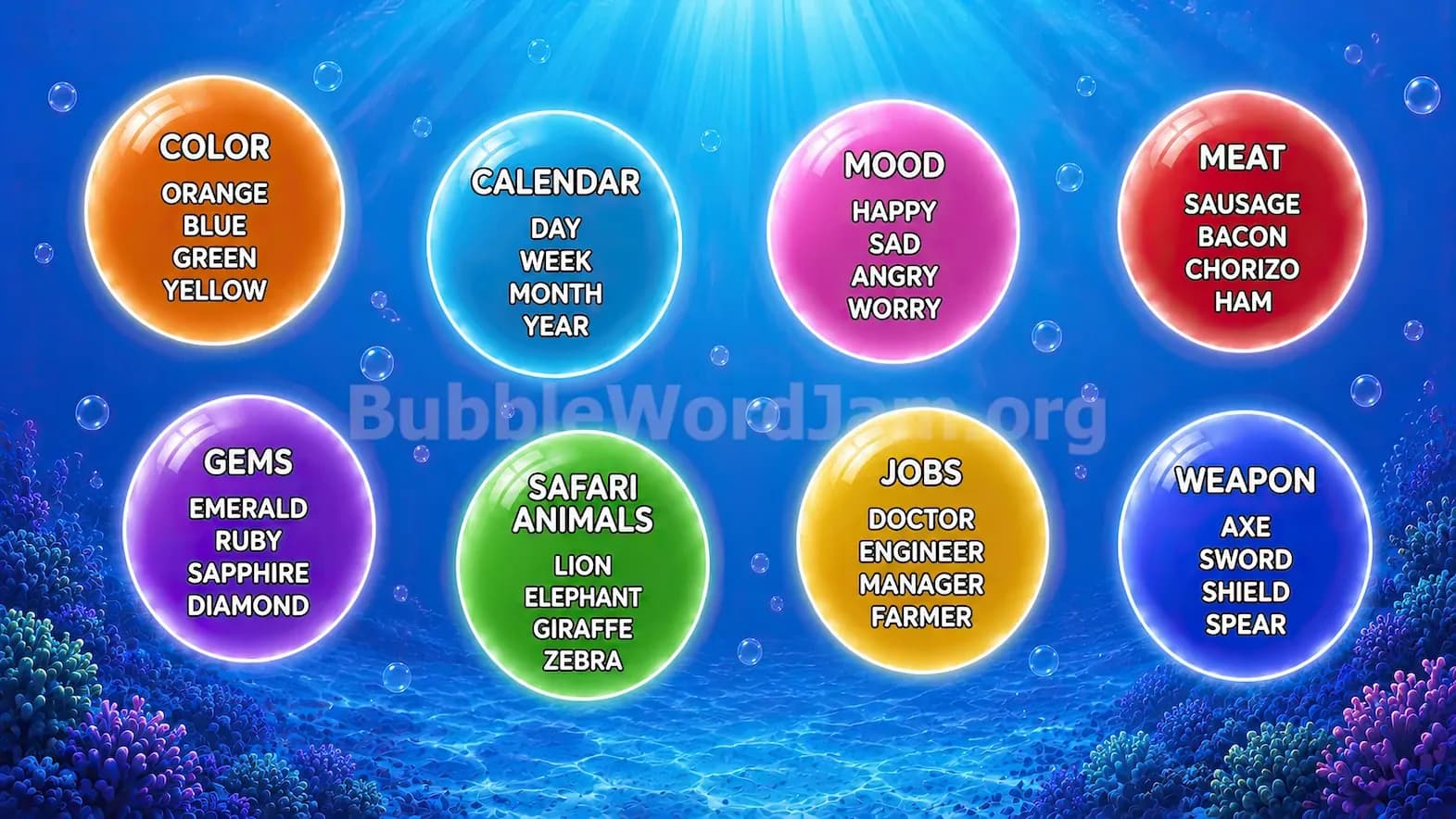
Level 10 gives players a clean gemstone set: emerald, ruby, sapphire, and diamond. This is one of those banger categories that most players spot quickly, but it still teaches an important sorting habit.
Gem clues often share three signals: they are naturally occurring, decorative or valuable, and commonly associated with jewelry. If you see diamond next to words like ruby or sapphire, don’t overthink it. That’s a gemstone cluster.
The trap comes when gems appear near colors. Ruby can suggest red. Emerald can suggest green. Sapphire can suggest blue. Diamond can suggest shape or luxury. Bubble Word Jam loves this kind of semantic bait. The safe play is to check whether the words form a stronger “valuable mineral” group than a color group. If three or four words could sit inside a jewelry store, you’ve probably found your match.
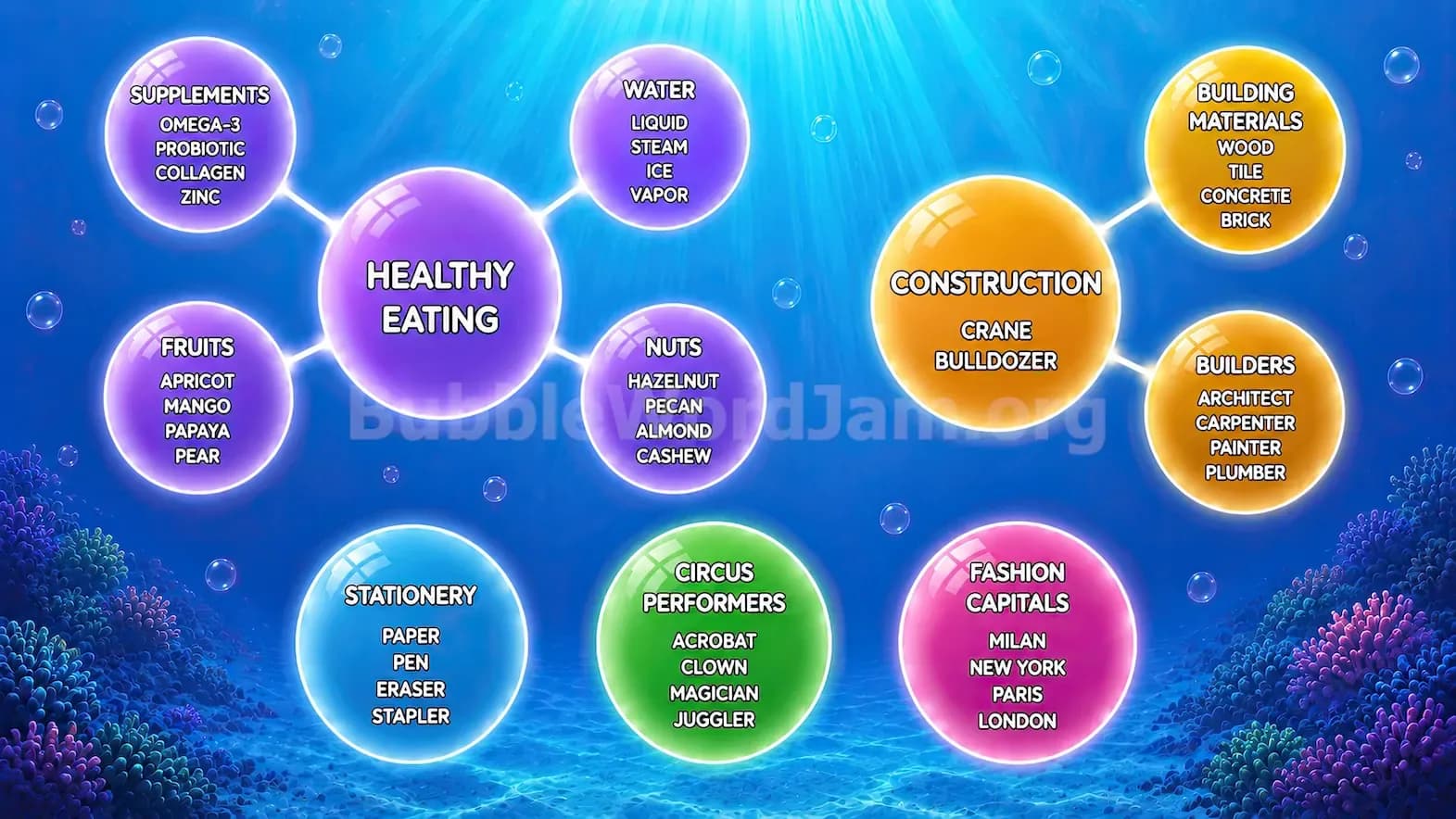
Level 17 uses building materials with wood, tile, concrete, and brick. This group overlaps heavily with construction, builders, and workplace categories, which can make the board feel crowded. The key is to separate workers, tools, and substances.
Architect, carpenter, painter, and plumber belong to builders. Crane and bulldozer point toward construction equipment. Wood, tile, concrete, and brick are not workers and not machines. They are the stuff a structure is made from.
That distinction sounds obvious, but under move pressure it’s easy to tank a run by merging context-adjacent words too soon. I like to treat construction puzzles as three buckets: who does the job, what tool or machine helps, and what material gets used. Once you sort those buckets, the level’s logic becomes much less messy.
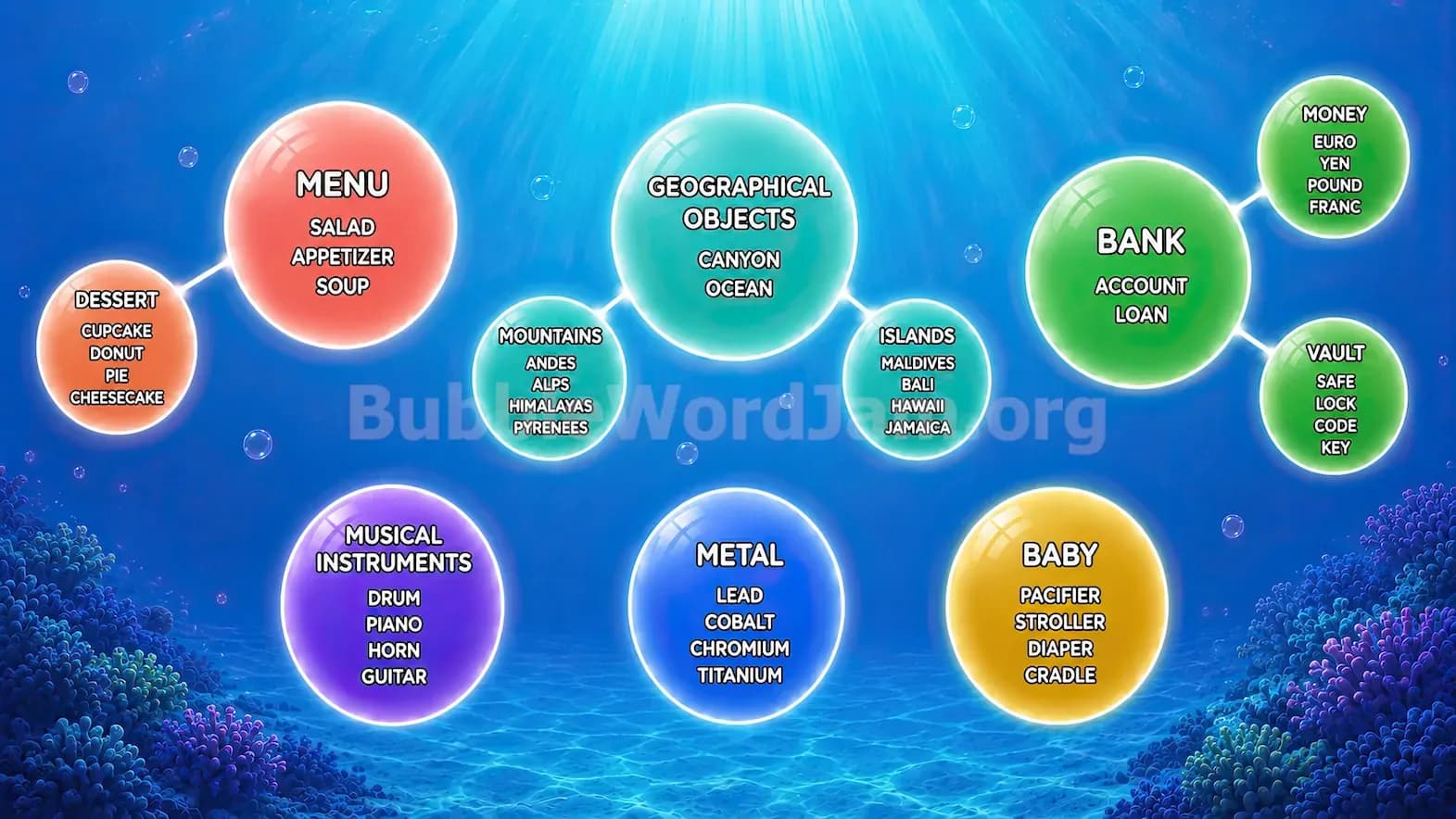
Level 18 introduces metal with lead, cobalt, chromium, and titanium. Later, Level 253 returns with iron, copper, silver, and gold. Level 474 uses copper, iron, silver, and zinc. The repeated metal pattern is worth learning because it becomes one of the game’s most reliable material families.
Metals usually share a few clues: they are elements, conduct heat or electricity, appear in tools or coins, and often have a hard, shiny, industrial vibe. But Bubble Word Jam can make this tricky by mixing metals with valuables. Silver and gold can feel like money. Copper and zinc can feel like science. Lead can feel like a verb if you’re reading too fast.
My rule: if the set includes multiple element names, check for metals before checking for money, color, or chemistry. The metal category has a rock-solid internal logic, and it often solves faster than more abstract groups around it.
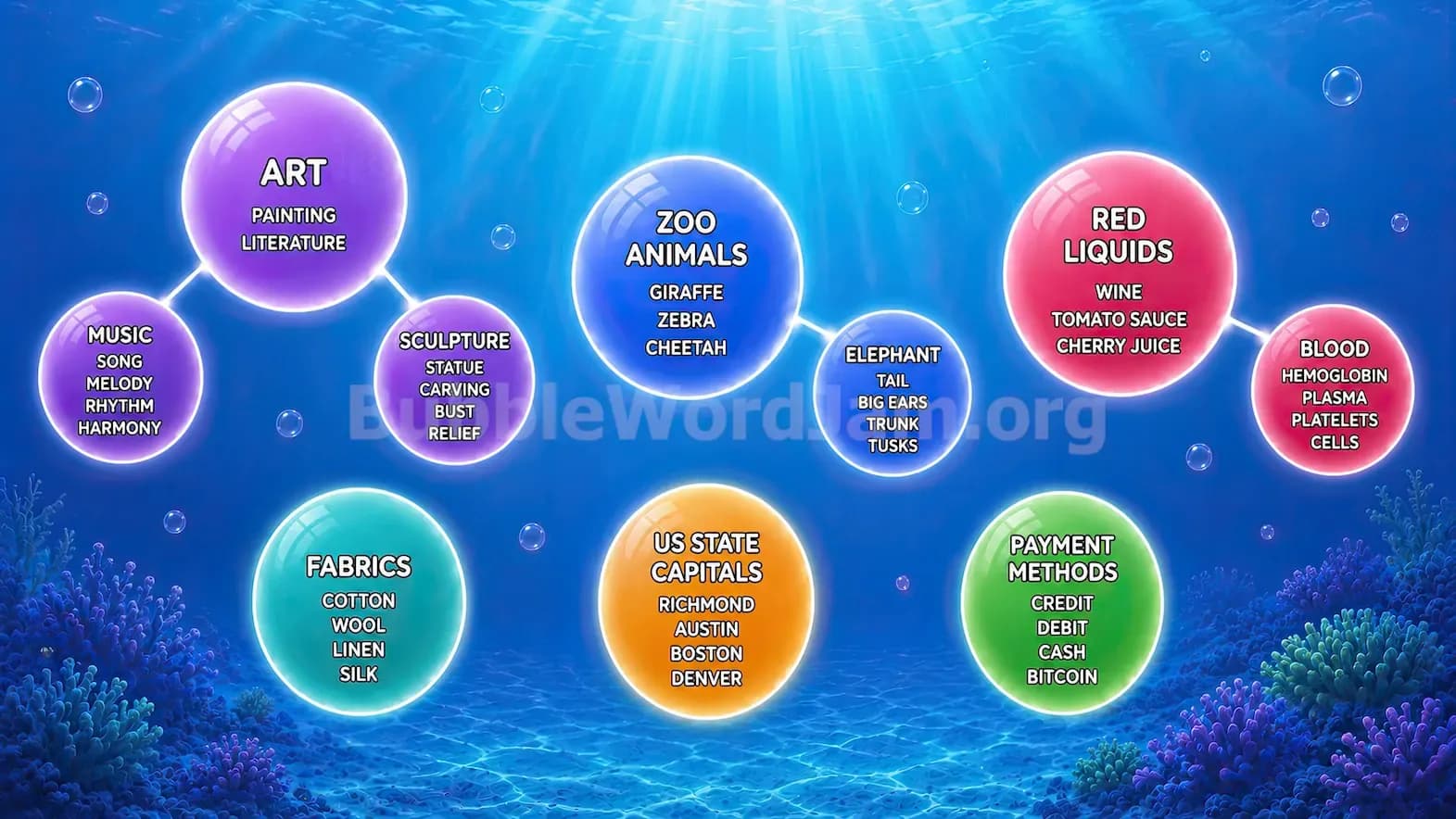
Level 28 gives the classic fabric set: cotton, wool, linen, and silk. This one has a soft, fashion-adjacent vibe, but again, the category is not “clothes.” It is material.
Cotton can become a shirt. Wool can become a sweater. Linen can become bedding. Silk can become a scarf. But the puzzle wants the fabric itself, not the finished item. That’s the same root-category lesson from the material group in Level 8, just with a fashion skin.
Level 474 pushes the idea further with burlap, denim, flannel, and tweed. These are more specific fabric materials, and they may not all feel equally common. Denim is easy. Flannel is familiar. Tweed has that jacket-and-professor energy. Burlap is the rough one, the word that might make players pause. But texture solves it: all four describe woven materials with strong tactile identities.
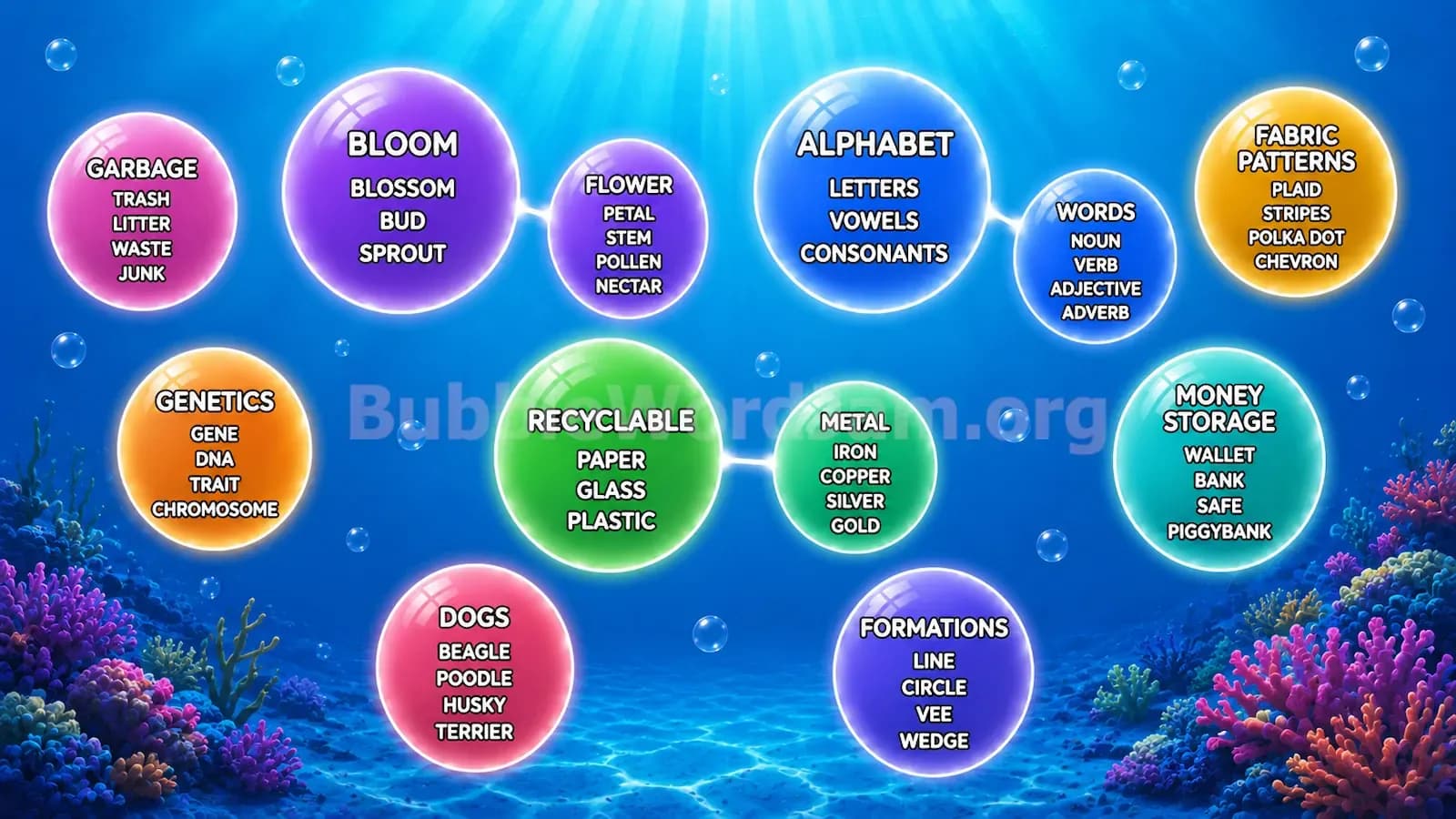
Level 253 adds a smart twist with fabric patterns: plaid, stripes, polka dot, and chevron. This is where Bubble Word Jam gets properly clever. These are not fabrics. They are designs printed, woven, or displayed on fabrics.
That means cotton does not belong here. Denim does not belong here. Plaid and chevron describe appearance, not substance. The distinction is small but huge for solving.
When I see clothing-related words, I ask one question immediately: is this what the thing is made of, or what it looks like? Cotton, wool, silk, and linen answer “made of.” Plaid, stripes, polka dot, and chevron answer “looks like.” That one question can save several moves.
Level 253 also uses recyclable with paper, glass, plastic, and metal. This category is especially interesting because several of those words can appear in other material groups too. Paper, glass, and plastic showed up as everyday materials earlier, while metal can branch into element-based sets.
Here, the category angle is not composition alone. It is disposal and reuse. The words fit because they are common recycling-bin materials.
This is a great example of why physical-property sorting needs one extra layer: function. Paper, glass, plastic, and metal are substances, yes, but in this context they share a real-world action. You recycle them. When a group contains broad materials that do not feel like a pure science set or construction set, check whether they share an environmental role.
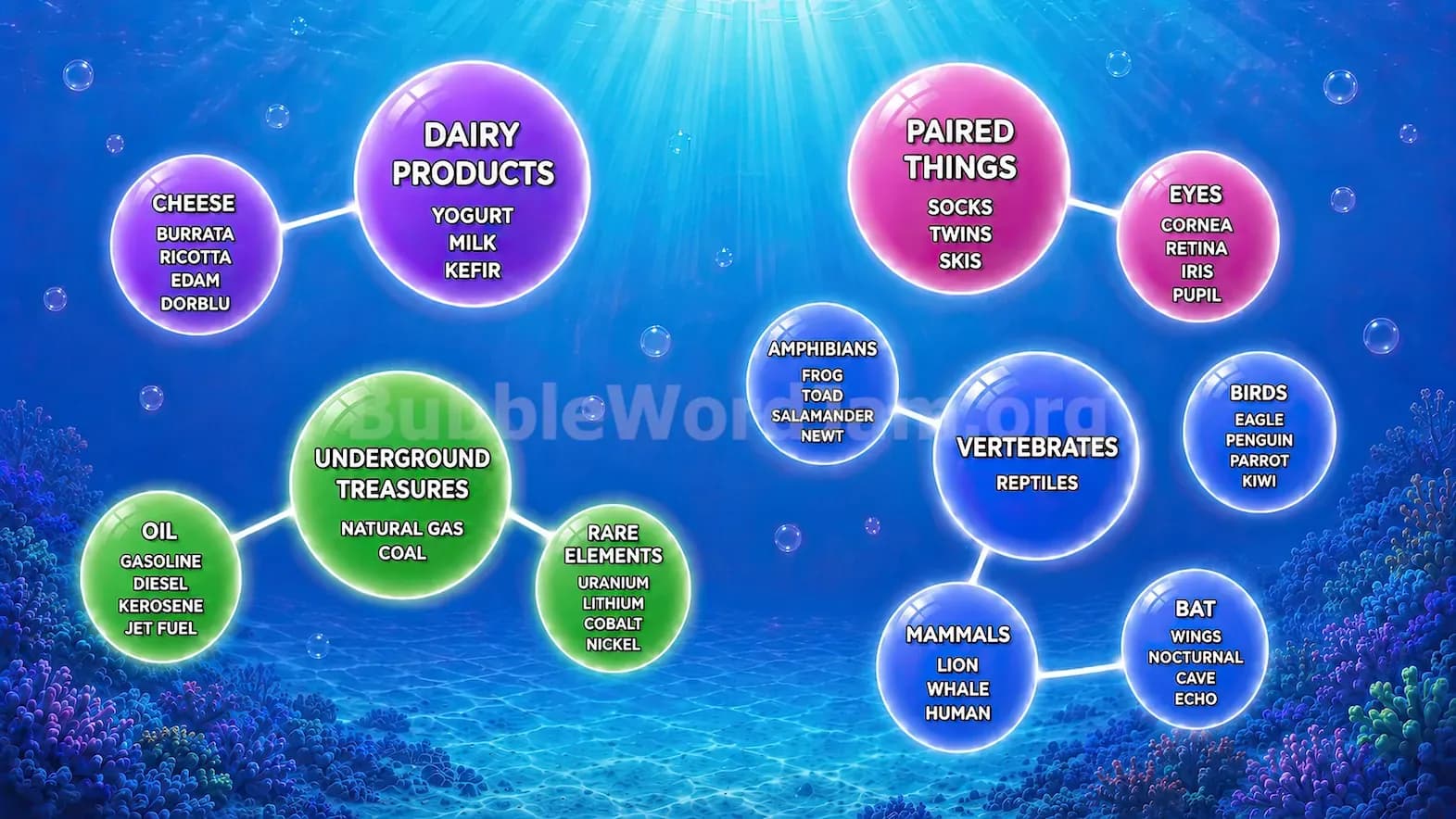
Level 51 brings in underground treasures with natural gas, oil, coal, and rare elements. It also includes oil as gasoline, diesel, kerosene, and jet fuel, plus rare elements with uranium, lithium, cobalt, and nickel.
This is a tougher, more layered material zone. Natural gas, oil, and coal are resources. Gasoline and diesel are fuels derived from petroleum. Uranium, lithium, cobalt, and nickel lean toward elements and minerals with industrial value.
Here’s the technique: sort by source and transformation. Oil is the parent material. Gasoline, diesel, kerosene, and jet fuel are processed products. Rare elements are not fuels; they are valuable substances used in energy, batteries, alloys, and tech. Cobalt is especially tricky because it can also appear as a metal clue, so don’t merge it until you know whether the level wants “metal” or “rare element.”
Level 720 is a fantastic late-game example because it goes beyond everyday materials. Quartz includes amethyst, smoky, rose, and citrine. Crystalline structures include quartz, calcite, pyrite, and fluorite. Then fabric types appear nearby with velvet, denim, tweed, and flannel.
This level asks for sharper taxonomy. Amethyst, smoky quartz, rose quartz, and citrine are varieties of quartz. Quartz, calcite, pyrite, and fluorite are minerals or crystalline structures. Velvet, denim, tweed, and flannel are fabric types.
The puzzle is testing hierarchy: quartz can be a category, but it can also be an item inside a broader crystal group. That’s a classic Bubble Word Jam move. When a word can act as both parent and child, build the narrower group first. If amethyst, smoky, rose, and citrine are all present, quartz probably owns them. Then quartz itself may connect upward into a crystalline structure group.
When a material category gets messy, run this loop:
Are they metals, fabrics, minerals, fuels, gems, or broad substances? This catches groups like lead, cobalt, chromium, titanium or cotton, wool, linen, silk.
Wood is a material. Chair is an object. Denim is a fabric. Jeans are clothing. This stops bad merges before they burn moves.
Quartz can contain amethyst, smoky, rose, and citrine. But quartz can also sit beside calcite, pyrite, and fluorite as part of a crystal group.
Paper, glass, plastic, and metal may be recyclable. Wood, tile, concrete, and brick may be building materials. The same word can change teams depending on nearby bubbles.
Materials, metals, gems, and fabrics are some of the most satisfying Bubble Word Jam categories because they reward real-world common sense. You don’t need obscure trivia most of the time. You need clean sorting logic.
Think physical property first: metal, fabric, mineral, recyclable, gemstone, fuel, or construction material. Then check whether the puzzle is asking for a root substance, a finished object, a pattern, a resource, or a child variety. Once you build that habit, these levels stop feeling like a rehash of random nouns and start feeling like a neat little taxonomy game.
And honestly? That’s the loop at its best: a few bubbles, one hidden connection, and that tiny “aha” hit when the whole material family snaps into place.