Master Bubble Word Jam weather, climate, volcano, storm, and disaster categories with smart merge timing, clue patterns, and level examples for tough puzzles.


Guide By Liam Stone
Updated on June 10, 2026
Liam Stone has been playing Bubble Word Jam since the mobile app first launched on the Apple App Store. He knew this game would pop, so he enjoys playing every level, collecting the answers, and running this site for other players. He loves mobile puzzle games and sometimes publishes his walkthroughs on his YouTube channel Puzzle Game Answer. Follow his channel if you are a puzzle game lover too.
Weather looks like one of the friendliest common-knowledge categories in Bubble Word Jam. Sun, rain, snow, wind—easy, right? Then the game starts mixing in tornadoes, volcanoes, earthquakes, seasons, forecasts, and natural disasters, and suddenly that “obvious” weather group becomes a trap.
That’s the crunchy part of Bubble Word Jam’s weather puzzles: the game rarely asks only, “Which words are weather?” More often, it asks, “Which weather-looking words belong to a tighter category?” If you rush the first stormy match you see, you can tank your move count and leave yourself with a board full of leftovers that almost fit together but don’t quite click.
The best rule I use for weather, climate, and disaster words is simple: merge the obvious weather category last if a disaster, season, forecast, or geology group may form a cleaner set first.
In Bubble Word Jam, weather words often overlap with four nearby ideas: disaster events, seasonal clues, forecast language, and earth science. That means “wind” might be weather, but it might also be part of “forecast.” “Blizzard” might feel like a storm, but it can also point to winter. “Lava” screams volcano, but it could belong to “parts of a volcano” or “volcanic eruption.”
This is where the game’s loop gets clever. You’re not just matching words by vibe. You’re sorting by category strength.
A strong category usually has four words that share the same role. For example, “vortex,” “funnel,” “debris,” and “twister” are all tornado-related terms. That group is tighter than a broad weather bucket with hurricane, hailstorm, tornado, and thunder. Both sets make sense, but one is more specific. In most tricky boards, specific beats broad.
The best technique for weather and disaster puzzles is to rank possible groups from narrowest to broadest.
Start with exact disaster terms. If you see words like crater, magma, lava, and vent, that’s probably a volcano group. If you see tremor, fault, seismic, and shake, that’s an earthquake group. If you see wave, ocean, surge, and flood, you’re likely staring at tsunami.
After that, look for event categories. These are groups like disasters, weather phenomena, or natural phenomena. They collect bigger nouns: earthquake, tsunami, volcano, tornado, hurricane, lightning, thunder.
Then check seasonal or climate-adjacent words. Winter, spring, cold, bloom, warmth, and blizzard may not behave like pure weather. The category may be about a season, not the weather itself.
Finally, merge the broad weather set. Words like wind, rain, snow, and hail are so obvious that the game often uses them as bait. I know that sounds backward, but in Bubble Word Jam, the easiest-looking group is sometimes the one you should hold until the board has fewer traps.
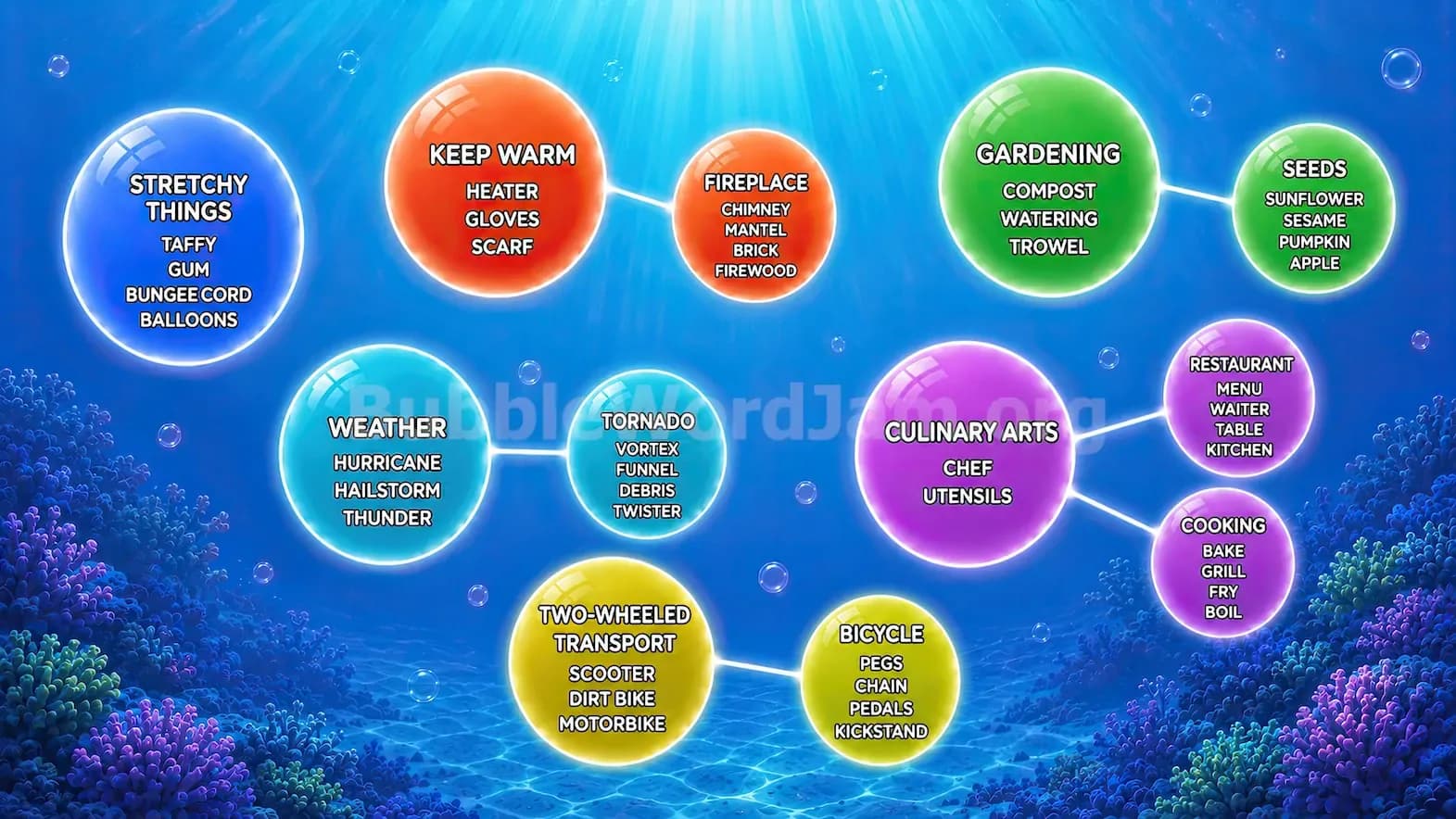
Level 27 is a perfect early example of why weather categories can be sneaky. You get a broad weather group with hurricane, hailstorm, tornado, and thunder. That feels like an instant merge. I’d be tempted too.
But there’s also a dedicated tornado category: vortex, funnel, debris, and twister. That group has a tighter identity. It doesn’t just name weather events; it describes one specific disaster.
The smart play is to solve tornado first. Once vortex and funnel are gone, the board becomes cleaner, and the broader weather group has less competition. This is the core weather strategy in Bubble Word Jam: when one word could be a headline category and another group explains its parts or traits, solve the smaller system first.
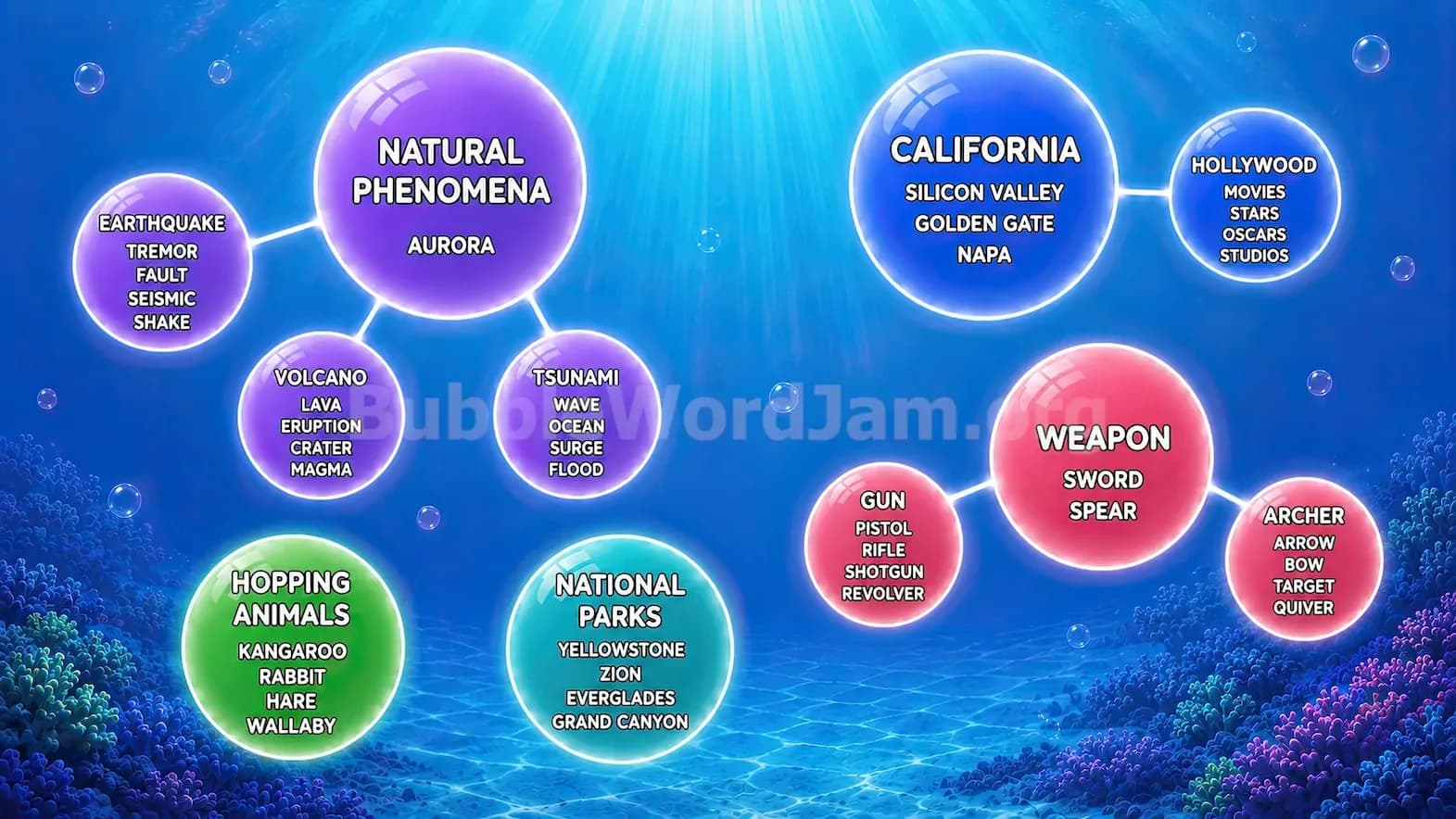
Level 33 turns the difficulty up with a banger disaster spread. You have natural phenomena like earthquake, volcano, aurora, and tsunami. But the same board also breaks out earthquake, tsunami, and volcano into their own specific groups.
Earthquake uses tremor, fault, seismic, and shake. Tsunami uses wave, ocean, surge, and flood. Volcano uses lava, eruption, crater, and magma.
This is the classic “parent category vs. child category” problem. Natural phenomena is the parent. Earthquake, tsunami, and volcano are child categories. If you merge the parent too soon, you may strand the child clues and make the board feel floaty and awkward.
My move order would be earthquake first, tsunami second, volcano third, then natural phenomena. That order preserves logic and avoids burning moves on a rehash of the same theme.
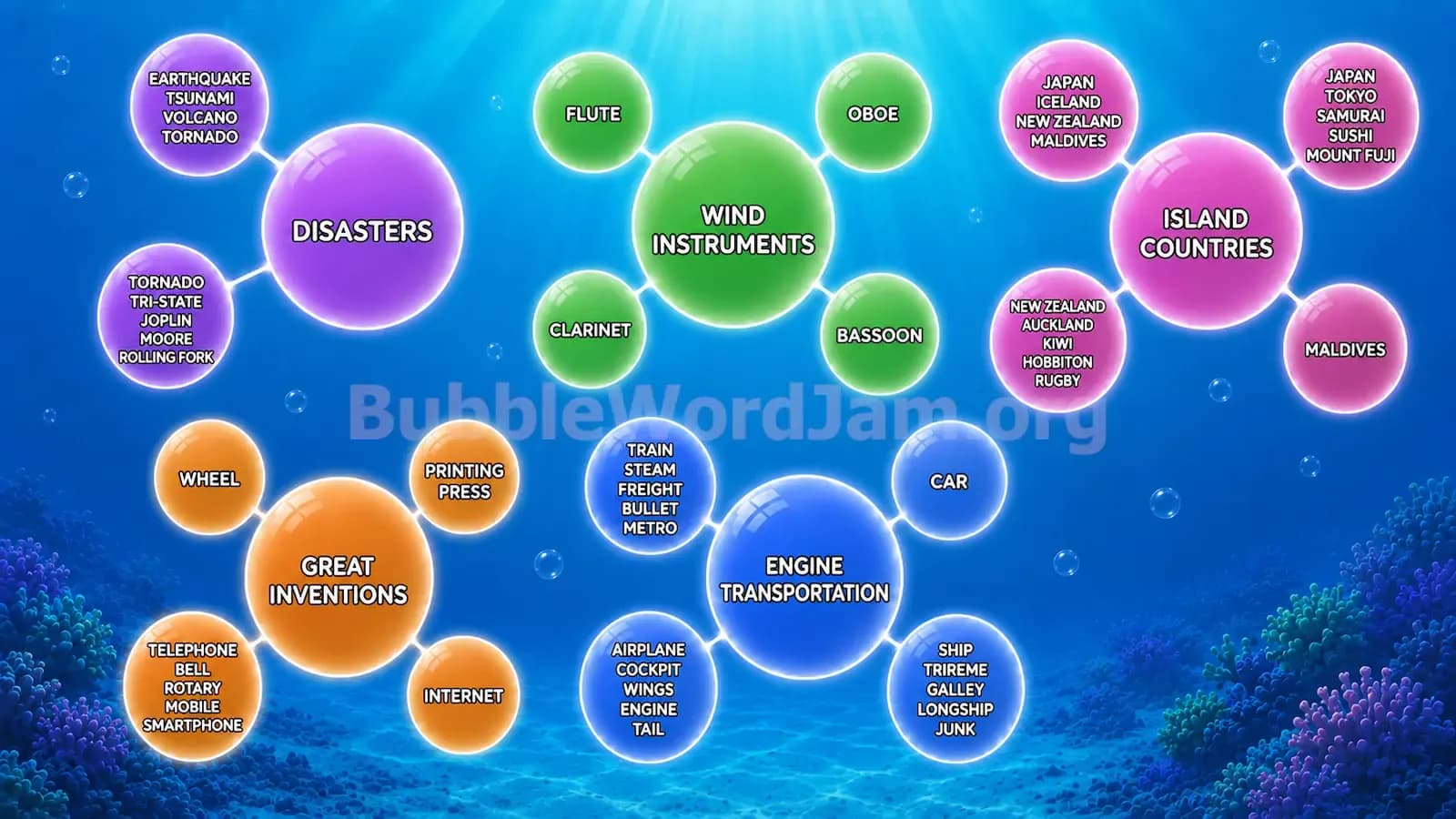
Level 120 is especially nasty because it includes disasters—earthquake, tsunami, volcano, tornado—while also using wind in a completely different way. The board has wind instruments: flute, oboe, clarinet, and bassoon.
That “wind” word is a trap if your brain is locked into weather mode. In a weather-focused puzzle, you may see wind and immediately think breeze, gale, gust, storm. But here, wind belongs to music.
This is why Bubble Word Jam rewards a quick context scan before any merge. Ask yourself: is this word being used literally, scientifically, culturally, or as part of a phrase? “Wind instruments” has nothing to do with storms, but it looks dangerous when you’re hunting disaster clues.
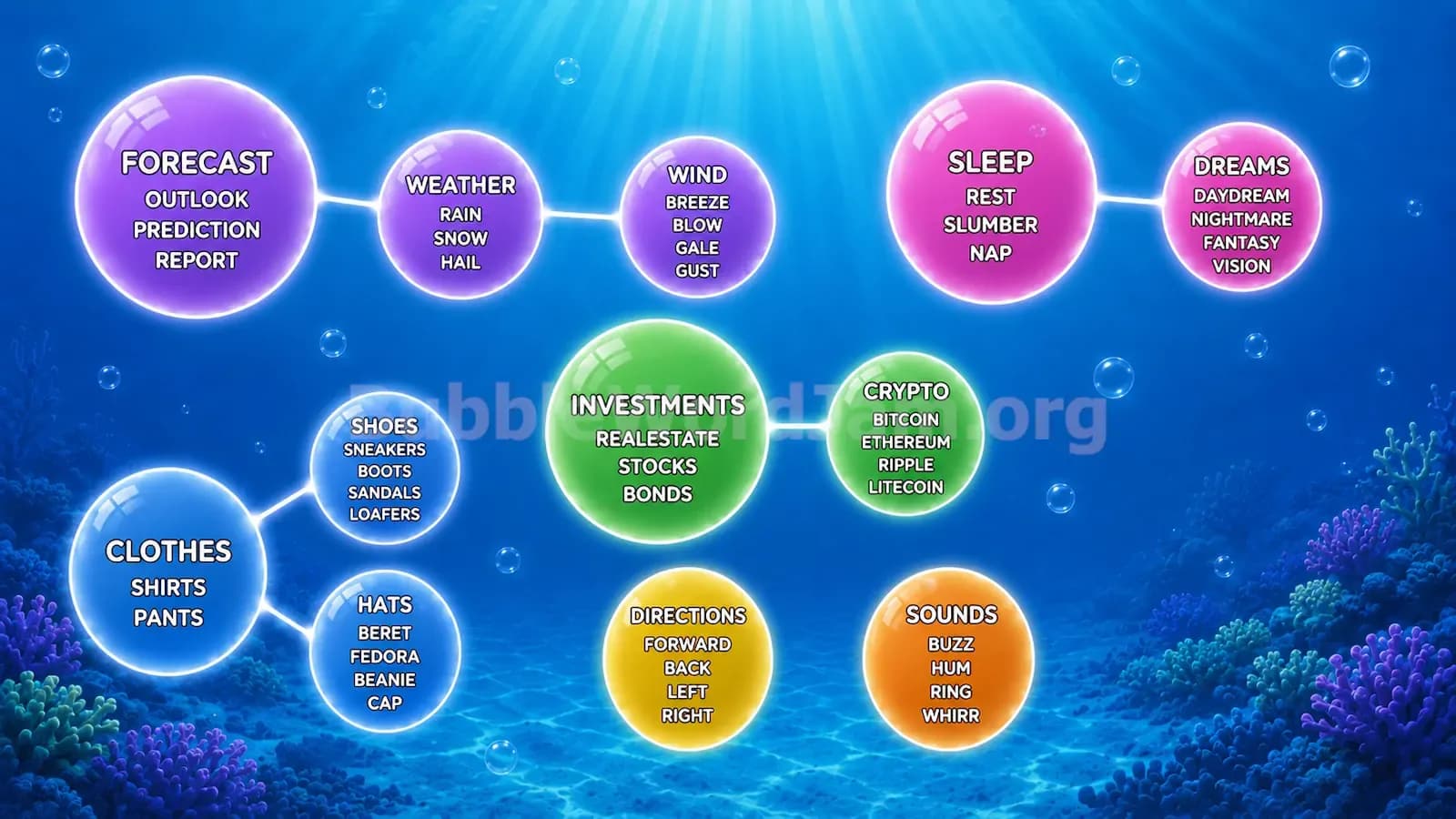
Level 214 teaches the cleanest version of the weather hierarchy. It includes forecast, weather, and wind as separate groups.
Forecast uses weather, outlook, prediction, and report. Weather uses wind, rain, snow, and hail. Wind uses breeze, blow, gale, and gust.
This is a masterpiece of layered clue design. “Weather” appears inside forecast. “Wind” appears inside weather. Then wind gets its own supporting terms. The trick is not to panic when the same idea appears at multiple levels of meaning.
Solve the most descriptive set first: breeze, blow, gale, gust. Then solve weather: wind, rain, snow, hail. Then forecast: weather, outlook, prediction, report. It feels almost like peeling an onion, except the onion is yelling at you with limited moves.
Volcano categories show up often because they sit between natural disasters and earth science. In Level 474, parts of a volcano uses crater, lava, magma, and vent. In Level 499, a similar category uses caldera, conduit, crater, and magma. In Level 503, volcano appears with lava, crater, eruption, and magma. Level 546 goes even more specific with volcanic eruption: ash, lava, crater, and tremor.
Here’s the key: don’t treat volcano words as generic disaster words unless the board clearly asks for disasters. If the words are physical components—crater, vent, caldera, conduit—they belong to structure. If the words describe an event—ash, lava, tremor, eruption—they point to an eruption. If the category contains earthquake, tsunami, volcano, and tornado, then volcano is just one member of a disaster group.
That distinction is huge. It’s the difference between a rock-solid solve and a mediocre merge that wrecks your board flow.
Level 499 uses winter with blizzard, christmas, cold, and fireplace. Level 546 uses season with spring, winter, summer, and fall, while spring itself connects to warmth, bloom, flower, and easter.
This is where Bubble Word Jam shifts from weather knowledge to seasonal association. Blizzard and cold look meteorological, but the category may be winter. Warmth and bloom feel like climate clues, but they may point to spring.
When you see seasonal words, pause before merging storm terms. Ask: are these words describing the sky, or are they describing a time of year? If the answer is time of year, you’re in a season puzzle, not a weather puzzle.
Before you merge, run this checklist:
Do I see a specific disaster group, like tornado, earthquake, tsunami, hurricane, or volcano?
Do I see parts of something, like crater, magma, vent, caldera, or conduit?
Do I see forecast language, like outlook, prediction, report, or weather?
Do I see season words, like winter, spring, summer, fall, cold, bloom, or warmth?
Do I see a word with a non-weather meaning, like wind instruments?
If yes, hold the broad weather merge. Let the tighter category reveal itself first.
If you want to sharpen this skill, replay or review Level 27 for weather and tornado, Level 33 for earthquake, tsunami, and volcano, Level 120 for disasters and the wind fake-out, Level 214 for forecast, weather, and wind, Level 447 for hurricane and weather phenomena, Level 474 for parts of a volcano, Level 499 for volcano and winter, Level 503 for forecast, thunder, and volcano, and Level 546 for season and volcanic eruption.
Together, these levels teach the real weather meta in Bubble Word Jam: storms are rarely just storms. Sometimes they’re disasters. Sometimes they’re seasons. Sometimes they’re geology. And sometimes “wind” is a bassoon waiting to embarrass you.
Play patiently, merge specific groups first, and save the obvious weather bucket for last. That one habit will make these stormy puzzles feel much less chaotic.