Learn how to solve Bubble Word Jam time, calendar, season, and holiday categories with chronological sorting tips, key level examples, and cleaner merges.

Guide By Liam Stone
Updated on July 27, 2026
Liam Stone has been playing Bubble Word Jam since the mobile app first launched on the Apple App Store. He knew this game would pop, so he enjoys playing every level, collecting the answers, and running this site for other players. He loves mobile puzzle games and sometimes publishes his walkthroughs on his YouTube channel Puzzle Game Answer. Follow his channel if you are a puzzle game lover too.
Time sounds easy until Bubble Word Jam starts squeezing it from every angle. Days of the week? Simple. Hours and minutes? Still fine. Then the game starts mixing calendar units, daylight phases, holidays, birthdays, anniversaries, seasons, life stages, and time zones into the same broader logic family. That’s where the loop gets crunchy.
I actually like these puzzles because they reward calm sorting more than raw vocabulary. You’re not just asking, “Do I know this word?” You’re asking, “Where does this word sit on the timeline?” That’s a different skill, and it’s one of the cleanest ways to improve at Bubble Word Jam without burning moves.
The core technique is chronological sorting: unit → phase → season → holiday. Once you learn that order, time-based categories stop feeling floaty and start snapping into place.
The safest way to attack time puzzles is to begin with the smallest obvious unit. In Bubble Word Jam, that usually means words like second, minute, hour, day, or week. These are pure time units. They don’t depend on culture, weather, emotion, or event context.
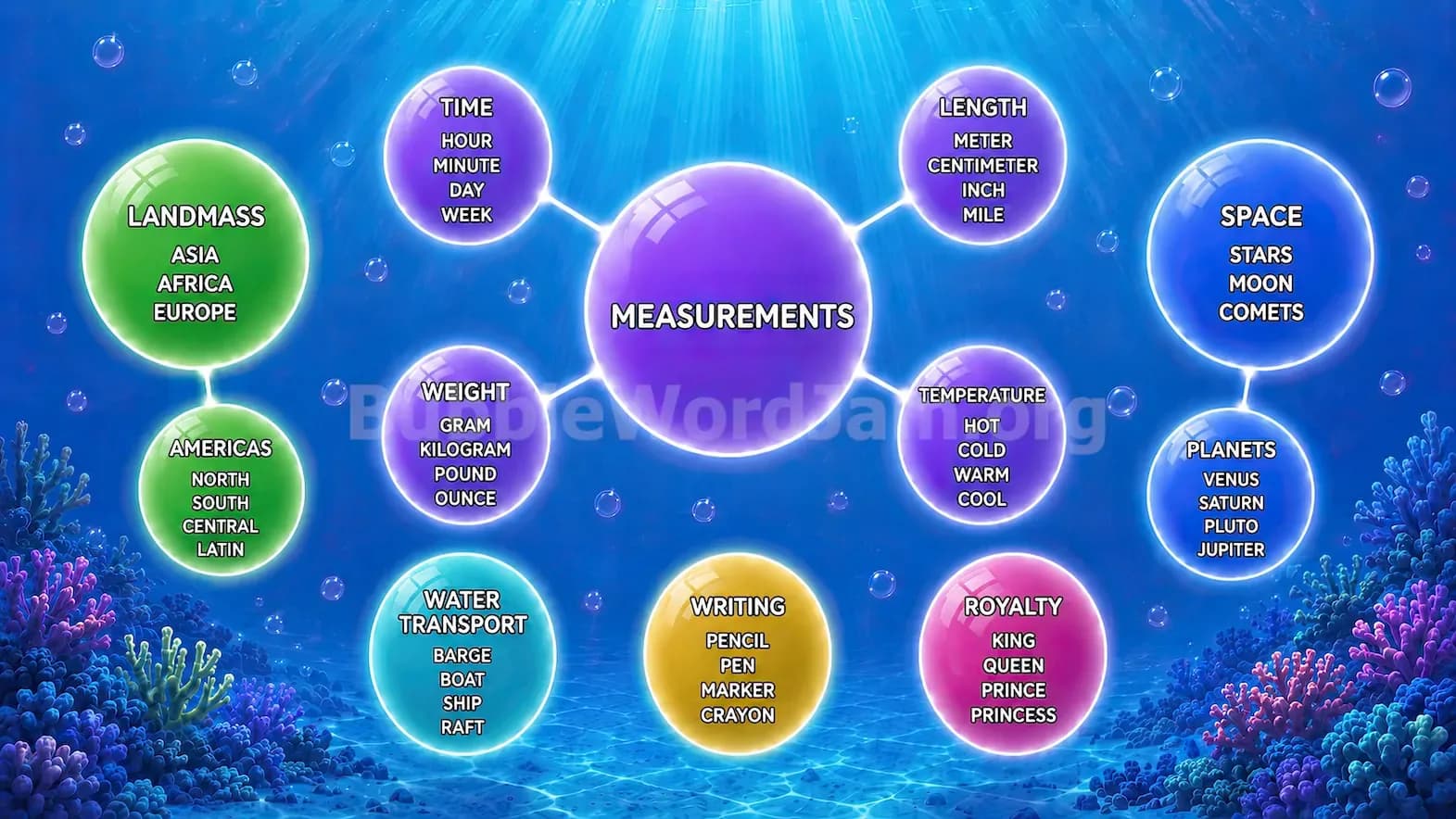
Level 7 gives a great early example with hour, minute, day, and week under a time category. What makes this level a banger teaching moment is that time also appears as part of a bigger measurements group beside length, weight, and temperature. That means “time” can be both a category and a member of a larger category.
That’s the trick: Bubble Word Jam loves hierarchy. A word can be an answer in one group and a clue toward another group. So when you see time words, don’t merge too fast. Ask whether you’re looking at direct units, or whether the word “time” itself belongs inside a broader “measurement” idea.
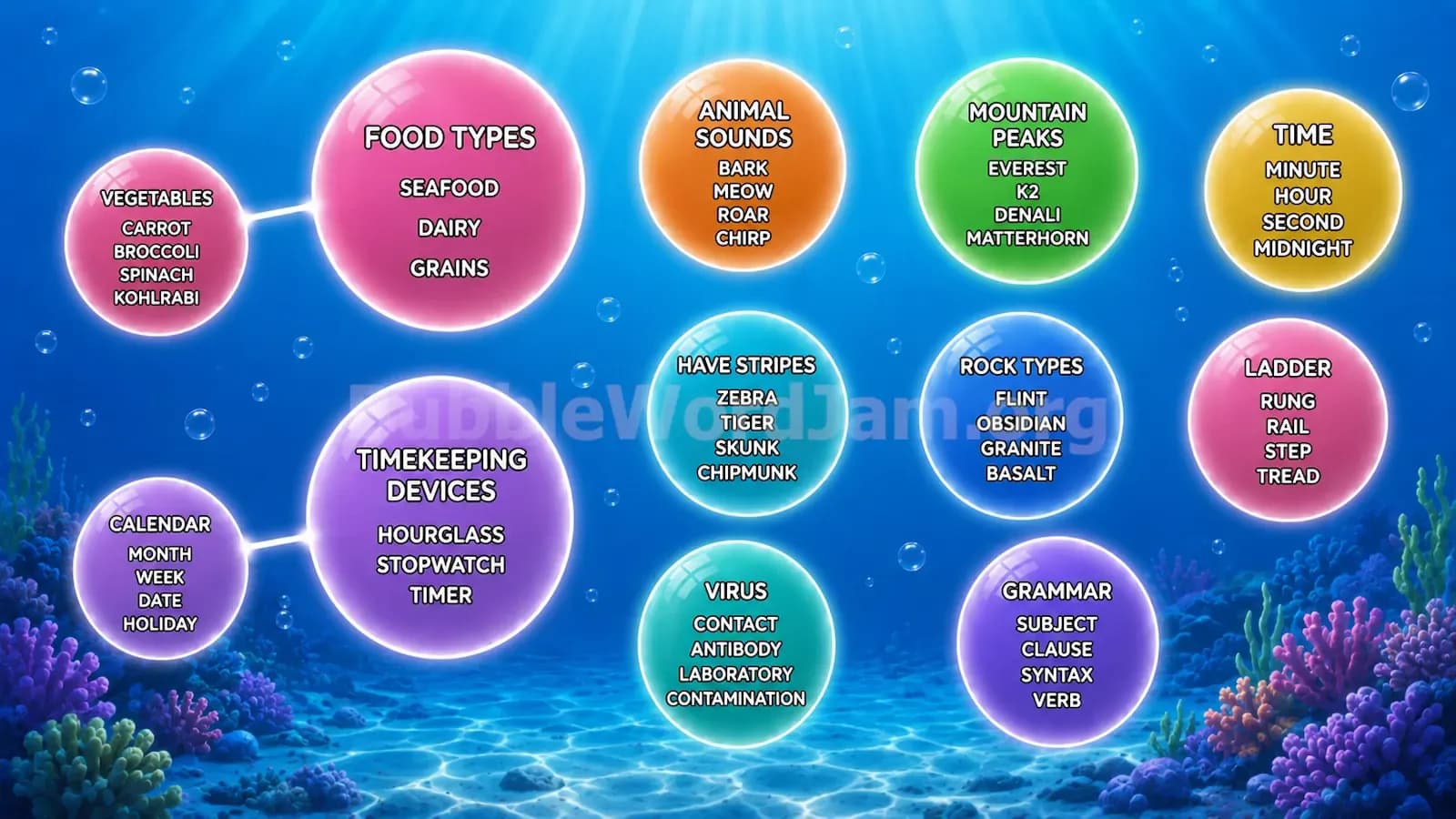
Level 127 pushes the same idea harder with minute, hour, second, and midnight. Three of those are units, while midnight is a point in the day. That mix can bait a sloppy merge. The right read is: they all answer the question “when?” not “how long?” That’s a subtle distinction, but it’s the kind of distinction that saves moves.
Calendar categories are the next step up. They don’t describe the passage of time in tiny pieces; they describe how people organize time.
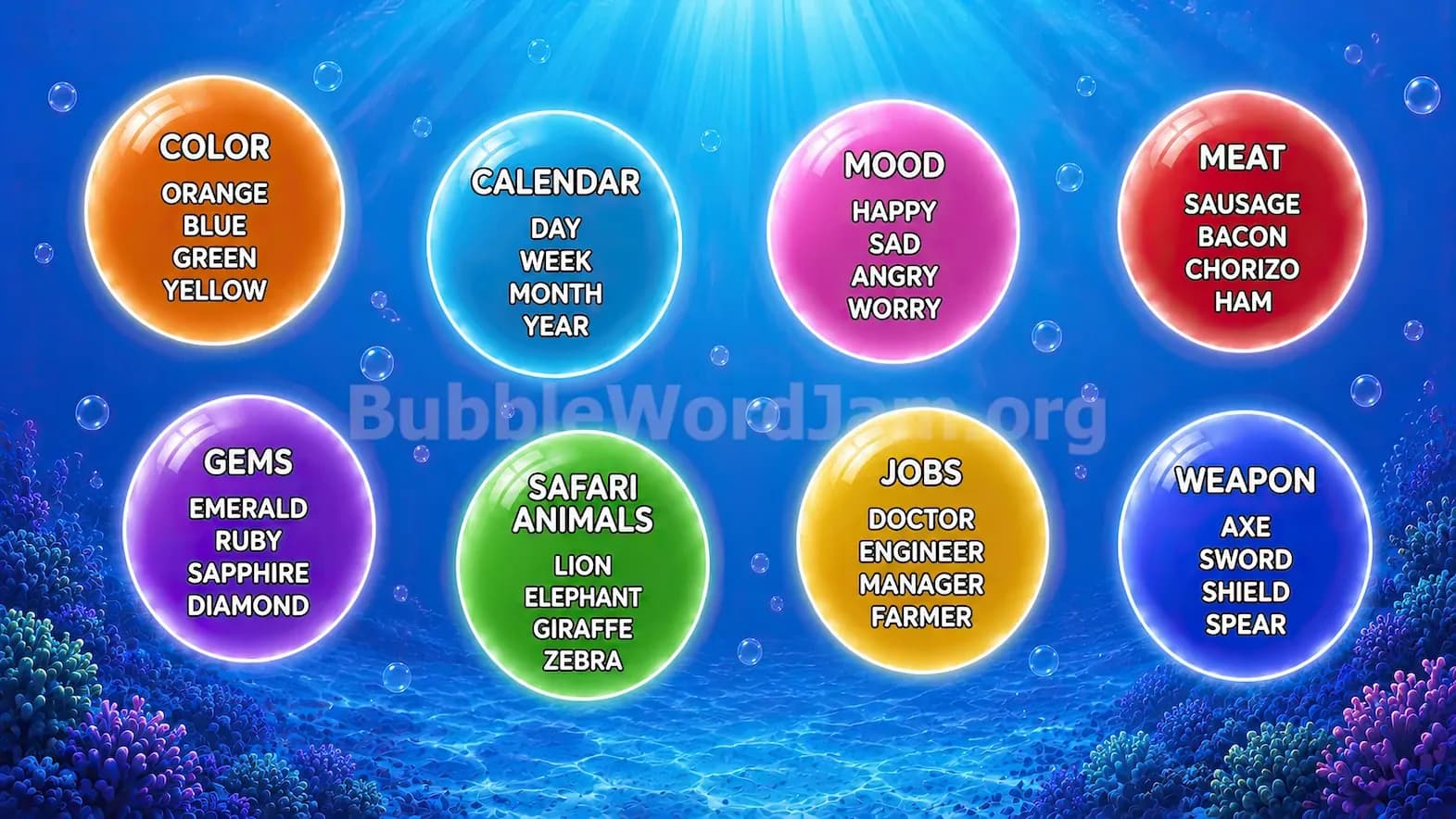
Level 10 is the clean version: day, week, month, year. This is one of the most useful calendar patterns in Bubble Word Jam because the words scale upward in order. You can almost hear the ladder: day becomes week, week becomes month, month becomes year.
When I’m stuck, I literally sort calendar words by size in my head. Is it smaller than a week? Bigger than a month? Does it repeat yearly? That mental order turns a messy board into a neat stack.
Level 127 complicates the calendar idea with month, week, date, and holiday. Here, “holiday” is not the same kind of word as month or week. Month and week are calendar containers. Date is a specific calendar marker. Holiday is a special marked occasion. But they all belong to calendar language, so the merge still works.
That’s where Bubble Word Jam gets clever. It doesn’t always give you four identical objects. Sometimes it gives you four words that live in the same system. Calendar puzzles often work exactly like that.
Level 1 includes monday, sunday, tuesday, and friday as days of the week. This is a rock-solid opening pattern because the category is instantly recognizable, even with the days out of order.
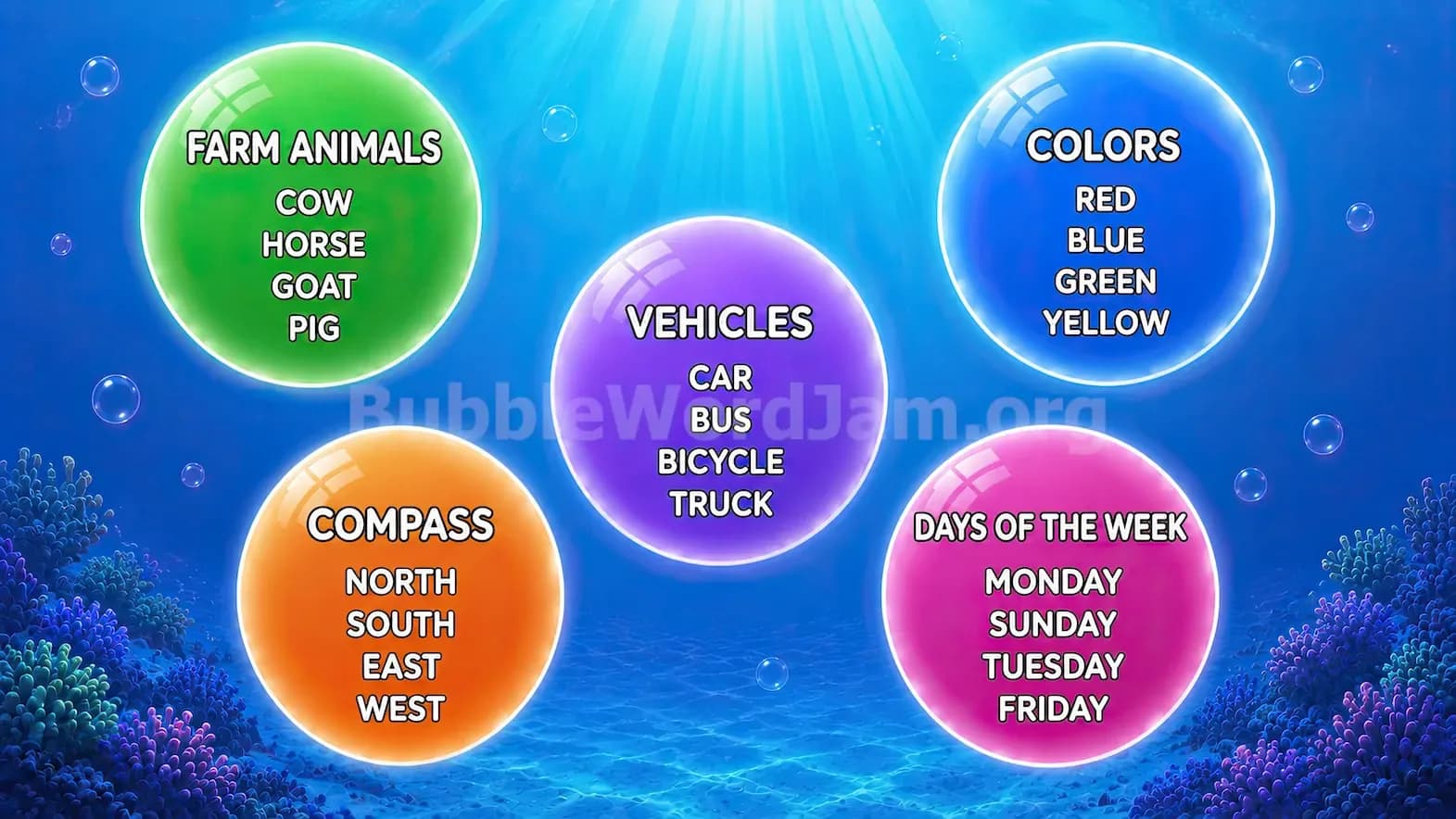
The move here is not to force chronological order on the board itself. You don’t need Monday, Tuesday, Friday, Sunday in perfect sequence before merging. You only need to recognize that they share the same calendar bucket.
Still, chronological thinking helps. If you spot two day names, scan the board for more day names before touching anything else. Days of the week are usually safer than vague words like spring, party, or time, which can belong to multiple categories.
This is also why time categories make good anchor groups. In Bubble Word Jam, an anchor group is a category you solve early because it removes uncertainty. Once the obvious day names disappear, the remaining celebration or season words become easier to read.
Seasons are sneaky because they often bridge time and nature. Spring can be a season, but it can also appear beside flowers, gardens, bloom, or Easter. Winter can point toward snow, fireplace, ice, and Christmas. The game uses that overlap constantly.
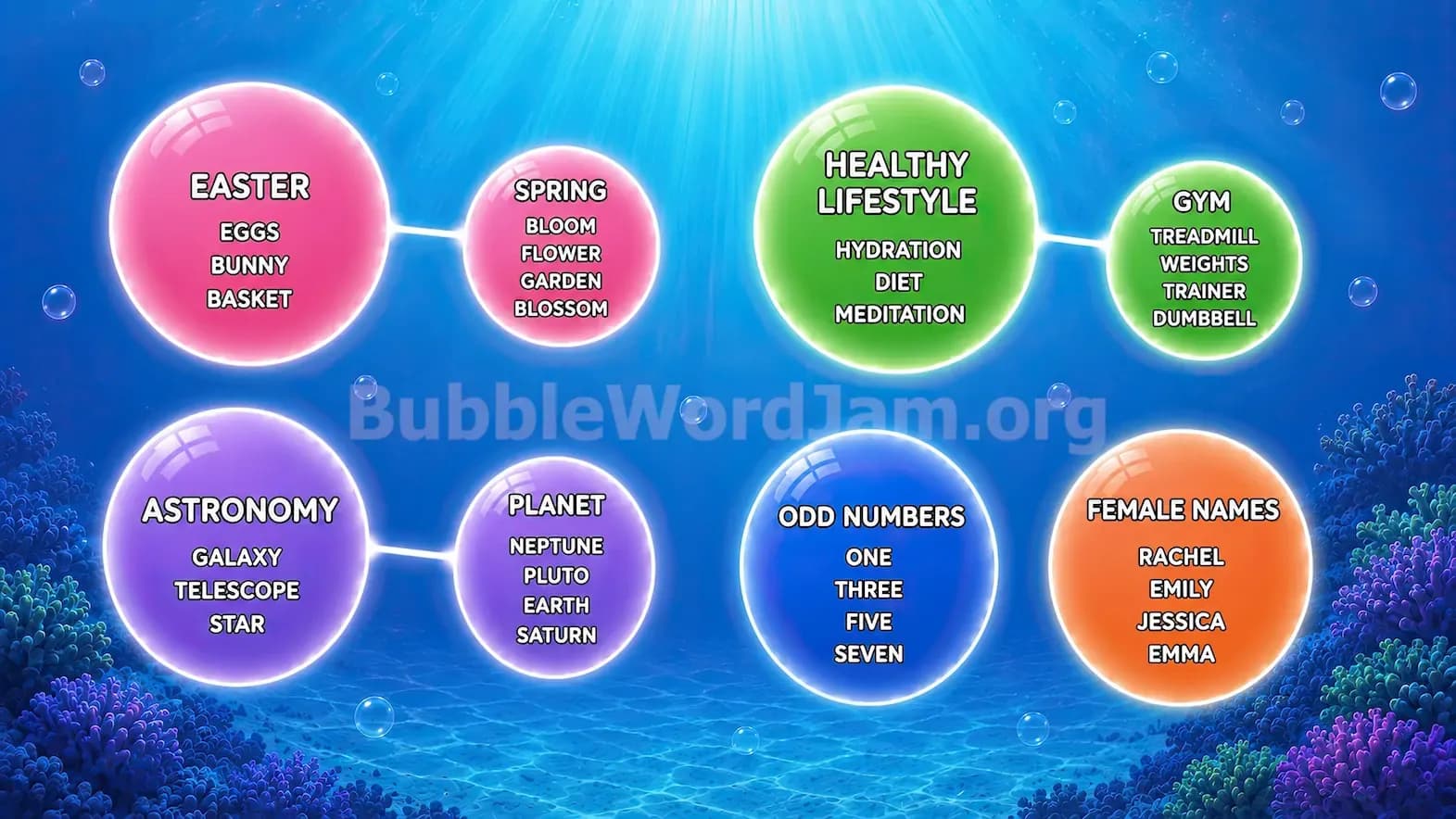
Level 20 is the cleanest spring example. Easter contains eggs, bunny, basket, and spring, while spring itself connects to bloom, flower, garden, and blossom. That’s a fantastic two-layer puzzle. Spring is both a seasonal clue in one group and the name of a nature-themed category in another.
This is where players often tank their run. They see spring and immediately drag it toward bloom or flower, but the puzzle may need spring to finish an Easter group first. The lesson: when a season word appears, check whether it is acting as a time marker or a nature marker.
Level 73 does something similar with winter and Christmas. Winter includes christmas, snow, fireplace, and ice, while Christmas expands into santa claus, tree, ornament, and carol. Again, Bubble Word Jam builds a chain: season → holiday → holiday objects.
Once you recognize that chain, the board starts to feel fair. Not easy, but fair.
Holiday categories usually include symbols, traditions, objects, and characters. That makes them different from pure calendar categories.
In Level 20, Easter is solved through eggs, bunny, basket, and spring. Only one of those words is truly time-based. The others are holiday symbols. So if you’re only looking for calendar words, you’ll miss the category.
In Level 73, Christmas works through santa claus, tree, ornament, and carol. Santa Claus can then branch into deer, sleigh, elves, and chimney. That’s a very Bubble Word Jam kind of structure: one celebration contains a character, and that character becomes its own category.
This is why I don’t treat holidays as dates when playing. I treat them as event worlds. Easter has props. Christmas has music, decorations, weather vibes, and characters. Birthdays have cake and candles. Anniversaries have rings and toast.
That shift matters. You’re no longer asking, “What day is this?” You’re asking, “What scene does this word belong in?”
Level 73 also includes birthday, anniversary, festival, and graduation under celebrations. That category is broader than holidays. It gathers social events rather than fixed calendar events.
Then the level breaks two of those events into smaller sets. Birthday includes cake, candle, gift, and party. Anniversary includes rings, dinner, flowers, and toast. These are not time units. They are rituals.
This is a great example of why Bubble Word Jam time puzzles aren’t just about clocks and calendars. They’re about human time. We measure life through events, milestones, and repeated traditions.
The best solving technique is to separate official time from social time. Official time gives you day, week, month, year, hour, and minute. Social time gives you birthday, anniversary, graduation, festival, Christmas, and Easter.
When those two worlds mix on the board, don’t panic. Sort the official units first, then build the social events around their props.
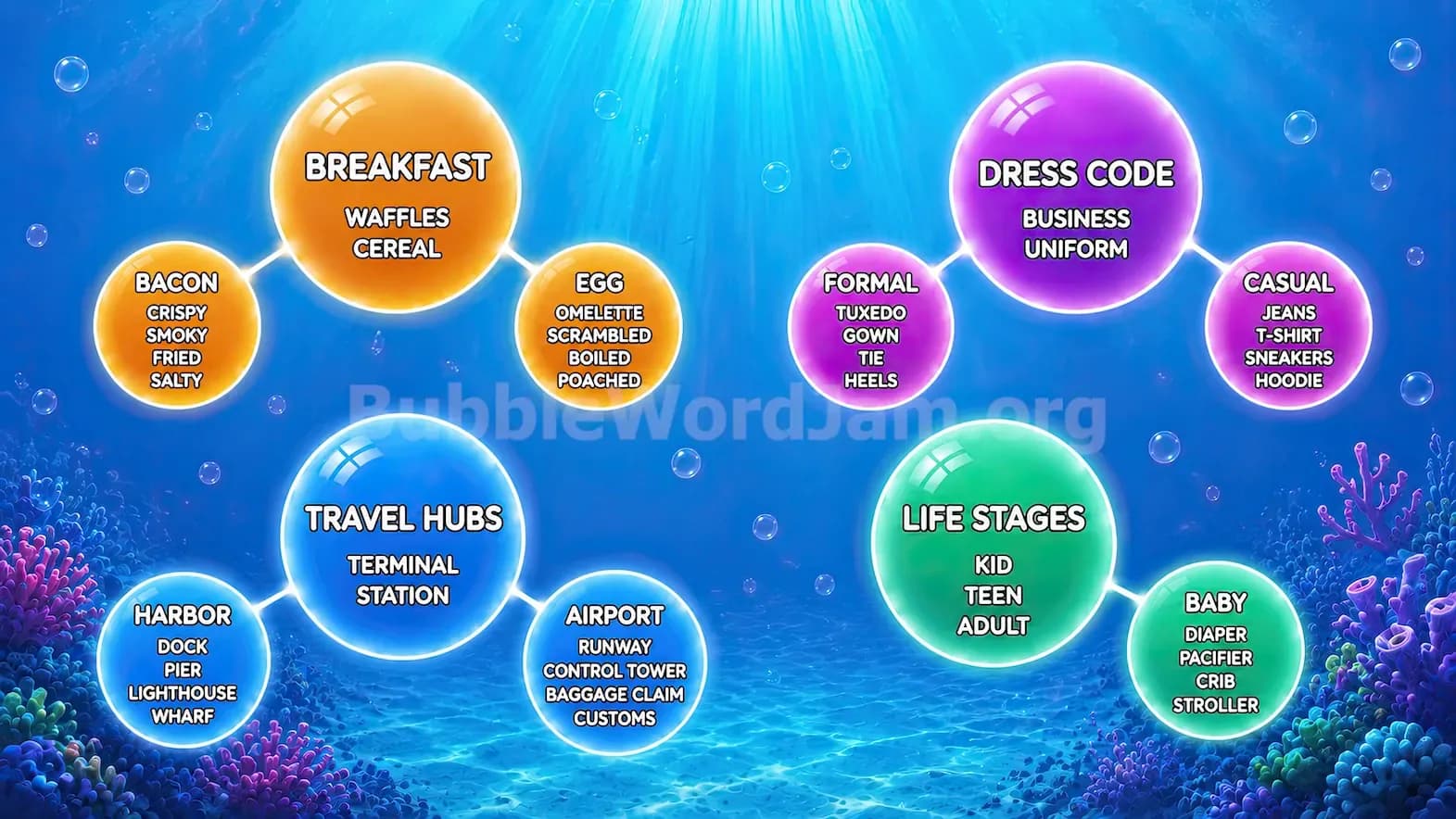
Level 39 includes baby, kid, teen, and adult as life stages. This category doesn’t look like a clock or calendar puzzle at first, but it absolutely belongs to the time family.
Life stages are chronological, but they describe human development instead of dates. The order is obvious once you see it: baby → kid → teen → adult. That makes life stages one of the easiest time-adjacent patterns to solve if you think in sequence.
The danger is that words like baby can also point to objects: diaper, pacifier, crib, stroller. In the same level, baby works as its own category too. So again, Bubble Word Jam is using a parent-child structure. “Baby” can be part of life stages, and baby-related objects can form another group.
My rule: if the board has several age words, solve life stages first. If it has only one age word and several baby objects, solve the object category instead.
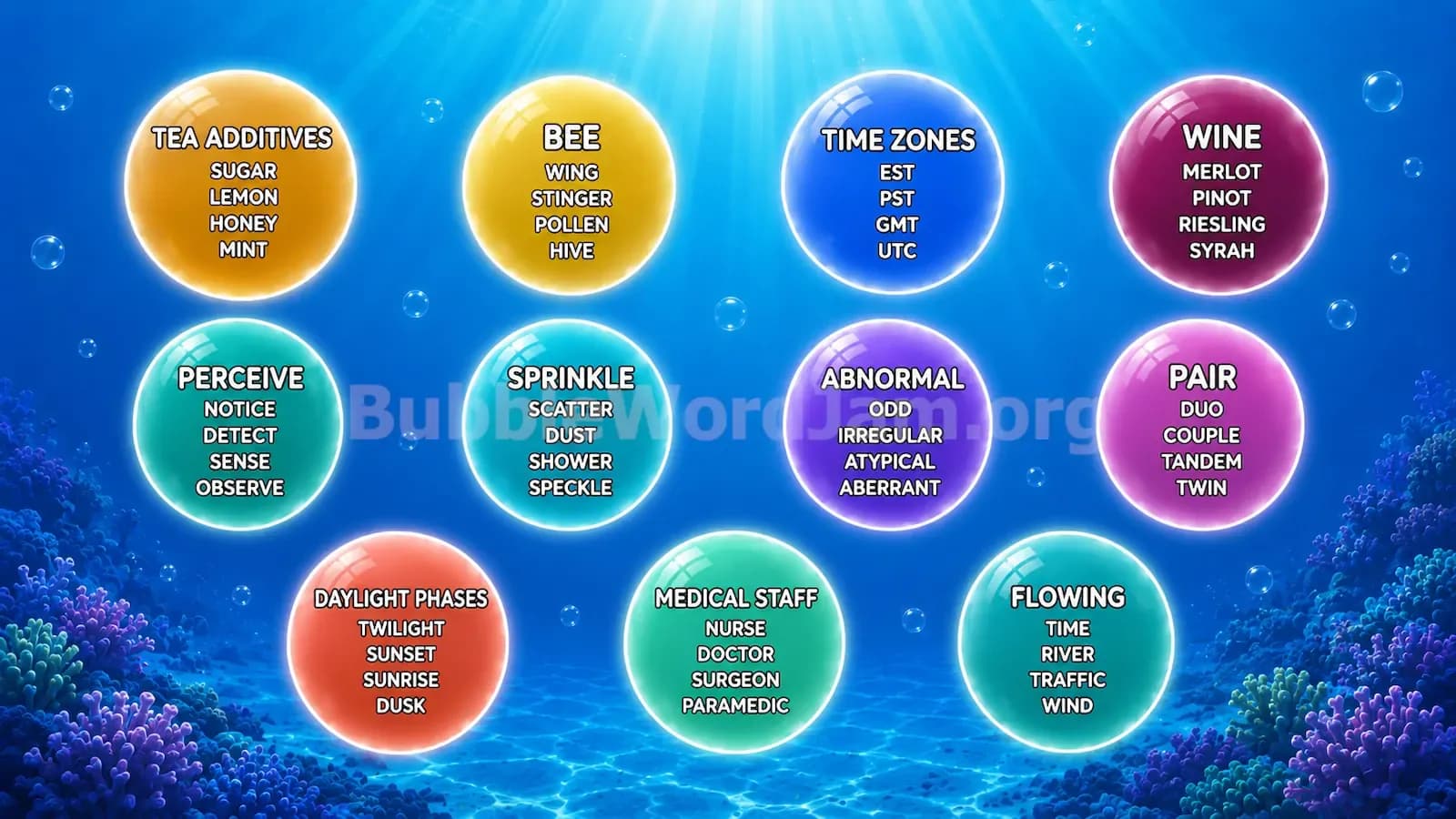
Level 252 brings in two more advanced time patterns: daylight phases and time zones.
Daylight phases include twilight, sunset, sunrise, and dusk. These words don’t measure time like hour or minute. They describe visual transitions in the day. They also carry a vibe, which can make them harder to spot if the board has nature or weather words nearby.
The clean solve is to ask: “Does this word describe light changing?” If yes, it probably belongs with daylight phases.
Time zones are even more specialized: est, pst, gmt, and utc. These are abbreviations, so they stand out visually. In Bubble Word Jam, abbreviations often signal a tight category. If you see two or three short all-caps-style time markers, hunt for the fourth before spending moves elsewhere.
Time zones are part of the calendar-and-clock family, but they behave like technical labels. Treat them less like words and more like codes.
Here’s the simple loop I use for time and celebration puzzles in Bubble Word Jam:
First, identify pure units: second, minute, hour, day, week, month, year. These usually form the cleanest group.
Next, check for phases: morning, night, midnight, sunrise, sunset, twilight, dusk. These describe positions inside a day.
Then scan for seasons: spring, winter, summer, autumn or fall. Ask whether the season belongs with weather, plants, or a holiday.
After that, look for holidays and celebrations: Easter, Christmas, birthday, anniversary, festival, graduation. These usually need props, symbols, or rituals.
Finally, check for life-stage sequences: baby, kid, teen, adult. These are chronological even when they don’t look like calendar words.
This method won’t solve every board for you, but it gives you a strong first pass. More importantly, it stops you from making those painful early merges that ruin the flow.
Time categories train exactly the skill Bubble Word Jam wants from players: flexible sorting. You learn to see when a word is a unit, a phase, a season, an event, or a symbol inside an event.
That’s why levels like 1, 7, 10, 20, 39, 52, 73, 127, and 252 are so useful. They don’t just test whether you know calendar words. They teach you how the game thinks.
And honestly? That’s the good stuff. The best Bubble Word Jam puzzles aren’t solved by random dragging. They’re solved by finding the hidden structure. Time categories make that structure visible: small units become bigger calendar blocks, calendar blocks become seasons, seasons become holidays, and holidays become little worlds full of objects and rituals.
Once that loop clicks, these puzzles stop feeling like a jumble and start feeling like a clean, satisfying merge chain.