Learn how to solve Bubble Word Jam sports categories by separating sport names from gear, moves, positions, events, and Olympic groupings with confidence.
Guide By Liam Stone
Updated on June 26, 2026
Liam Stone has been playing Bubble Word Jam since the mobile app first launched on the Apple App Store. He knew this game would pop, so he enjoys playing every level, collecting the answers, and running this site for other players. He loves mobile puzzle games and sometimes publishes his walkthroughs on his YouTube channel Puzzle Game Answer. Follow his channel if you are a puzzle game lover too.
Sports puzzles in Bubble Word Jam look easy at first. You see baseball, basketball, tennis, swimming, golf, archery, volleyball, and your brain instantly says, “Cool, sports.” Then the game throws hoop, dunk, pitcher, catcher, backstroke, serve, spike, bow, quiver, lob, volley, and suddenly the board gets crunchy.
That’s the real loop. Bubble Word Jam sports categories don’t only ask whether you know sports. They test whether you can separate a sport name from the vocabulary that belongs inside that sport. I’ve seen plenty of players make the same mistake: they grab every athletic-looking word and merge too early. It feels right for two seconds, then the puzzle tanks because “basketball” needed to sit with other ball games, while “hoop” and “dribble” belonged in the basketball-specific group.
The best way to solve these stages is simple: don’t start with the biggest sports label. Start by asking what role each word plays. Is it the sport itself? Is it equipment? Is it a move? Is it a position? Is it an Olympic event? Once you make that split, sports puzzles become much more manageable.
Here’s the technique I use whenever a Bubble Word Jam sports board shows up: divide the bubbles into two mental piles.
First pile: sport names. These are words like baseball, basketball, tennis, swimming, golf, archery, volleyball, squash, badminton, climbing, surfing, bowling, diving, rowing, and paddleboarding. They can usually form a broad category, such as sports, individual sports, indoor sports, extreme sports, games with a ball, or water sports.
Second pile: sport terms. These are words that live inside one sport. Hoop, dunk, rebound, and free throw point to basketball. Pitcher, batter, catcher, and home run point to baseball. Club, ball, tee, and hole point to golf. Net, serve, spike, and block point to volleyball. Ace, lob, serve, and volley point to tennis shots.
That difference matters because Bubble Word Jam loves nesting categories. A word can be part of a bigger family, but the puzzle may want the smaller, cleaner family first. “Swimming” can be a sport name, an Olympic sport, a water sport, or part of a movement category. “Serve” can belong to tennis or volleyball. “Bow” can suggest archery, music, or even a gesture. The board is asking for precision, not vibes.
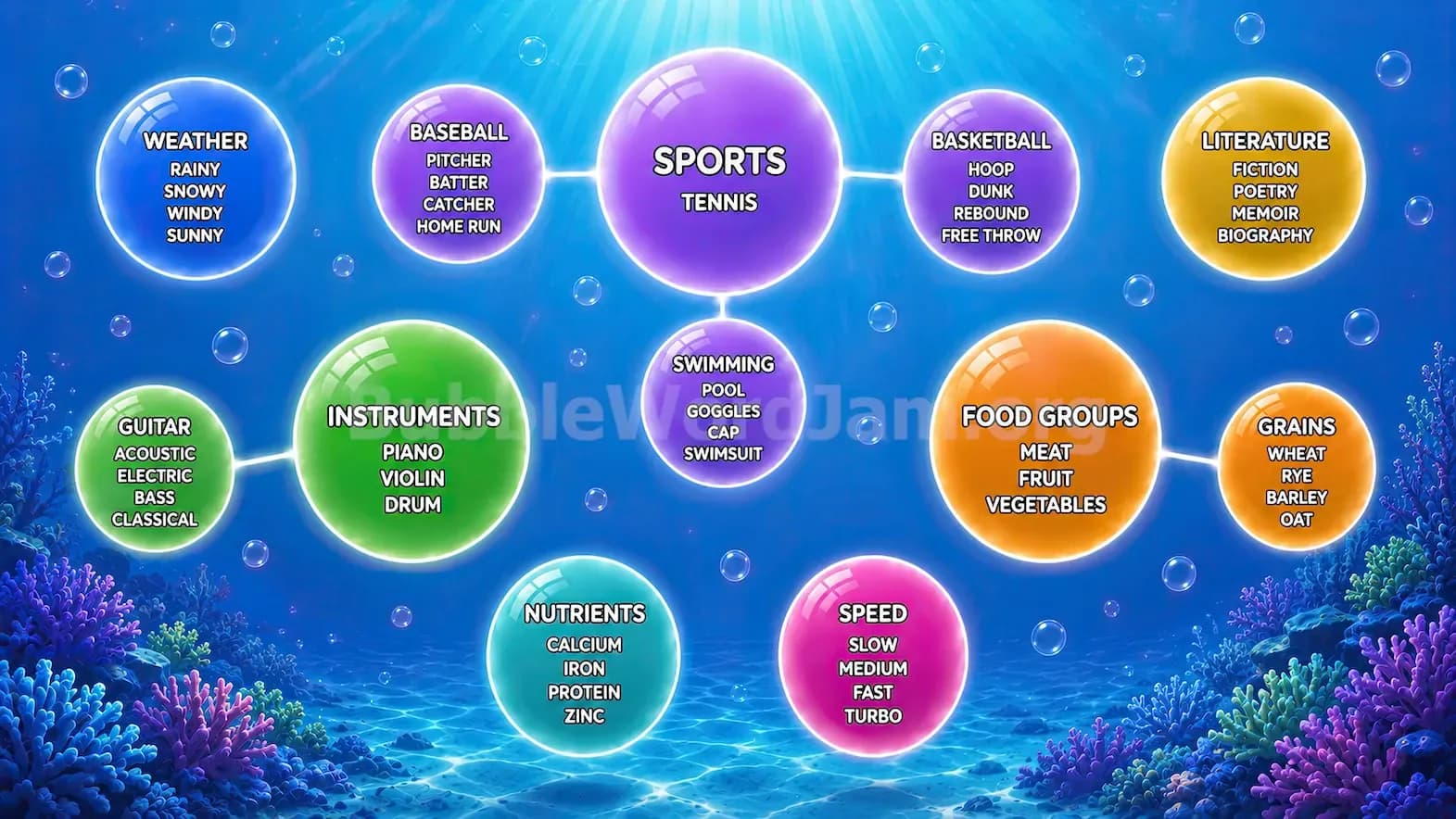
Level 11 is one of the best early sports examples because it shows the whole design philosophy without getting too mean. You get a broad sports group with baseball, basketball, tennis, and swimming. That’s the easy win. But the same puzzle also breaks basketball into hoop, dunk, rebound, and free throw; baseball into pitcher, batter, catcher, and home run; and swimming into pool, goggles, cap, and swimsuit.
This is where the game teaches a rock-solid habit: solve the specific terms first when they are obvious. If you see pitcher, batter, catcher, and home run, don’t waste time wondering whether pitcher is a job or whether home run is a general achievement phrase. In this context, baseball is screaming at you.
Basketball works the same way. Hoop and dunk are the anchors. Rebound and free throw complete the set. Once those terms are safely merged, the remaining sport names are easier to read. That’s a nice little aha moment, and it keeps your moves from bleeding away.
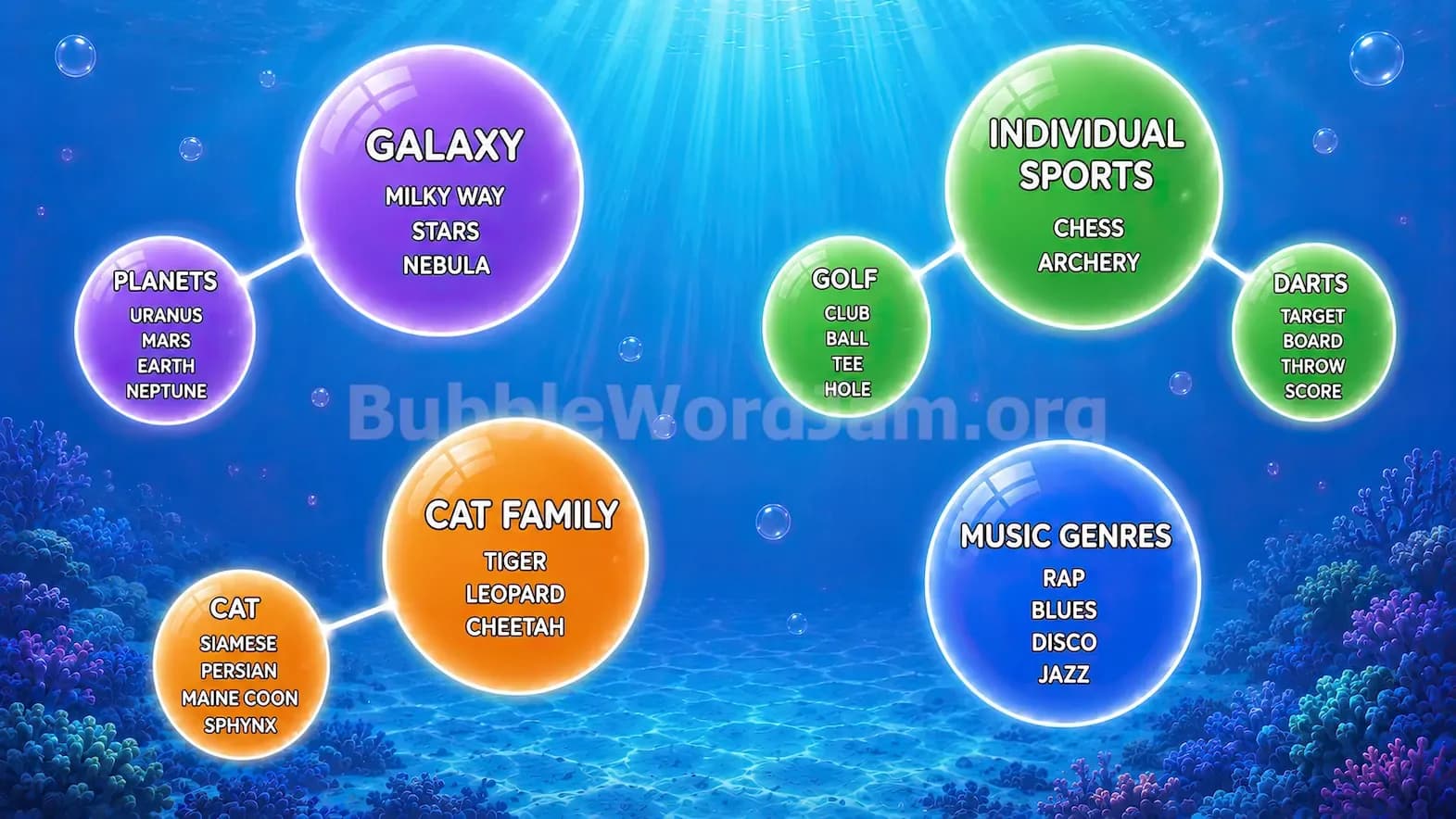
Not every sports category is “team with a ball.” Level 13 uses individual sports: golf, chess, archery, and darts. That category can feel odd if you only think of sports as running, sweating, and scoreboards. Chess and darts are the curveballs. They don’t look athletic in the same way, but they fit the solo-competition structure.
The trick is to look for how the sports are played, not how intense they feel. Golf, chess, archery, and darts are all activities where one player’s performance can stand alone. In the same level, golf gets its own gear-and-course set: club, ball, tee, and hole. Darts also has target, board, throw, and score. Again, the sport names and the sport terms split apart.
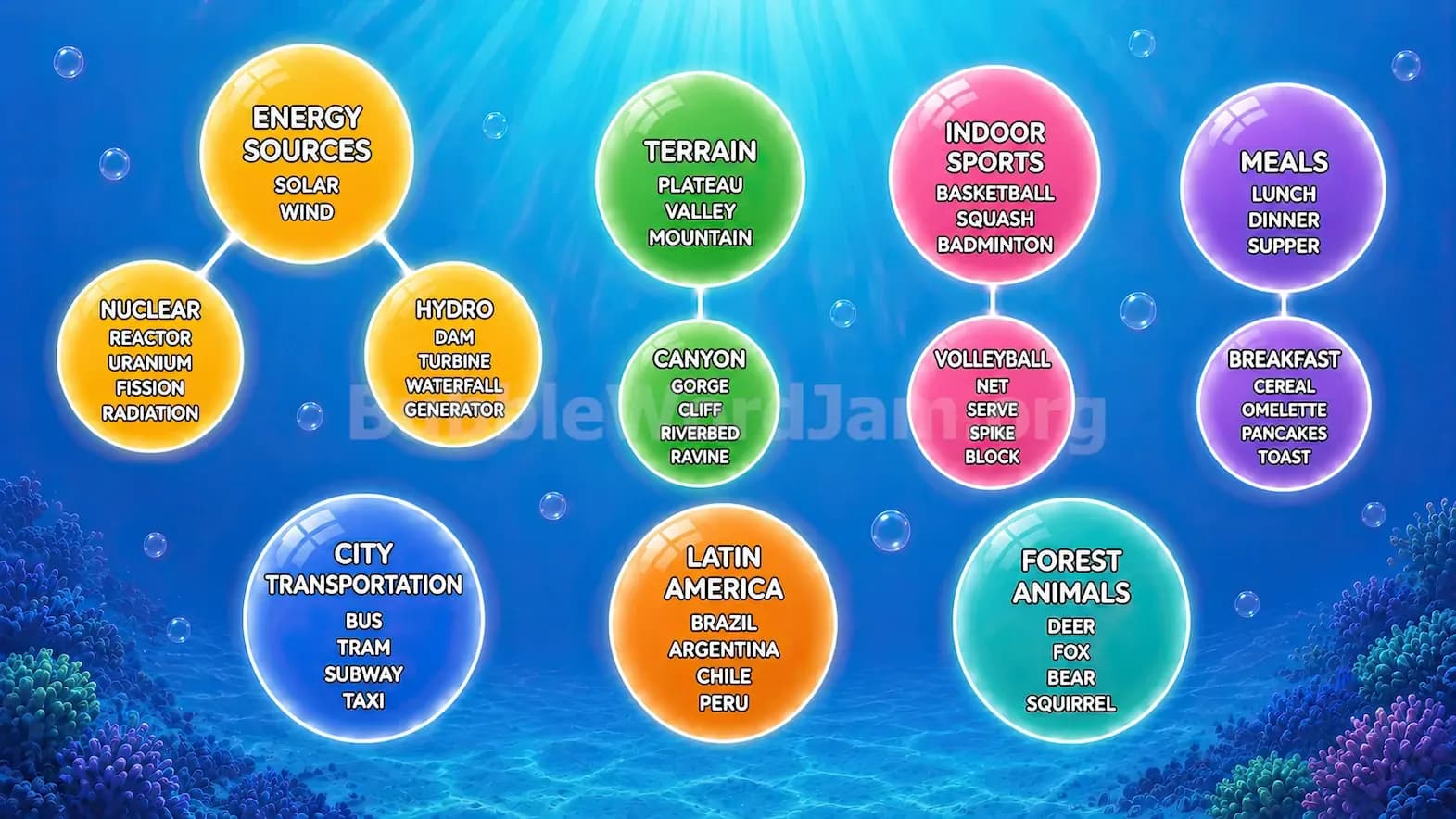
Level 59 moves into indoor sports with basketball, volleyball, squash, and badminton. The vibe is different: courts, nets, gyms, and enclosed spaces. Volleyball then gets its own term group with net, serve, spike, and block. If you see “serve” beside “spike,” volleyball becomes the better read than tennis.
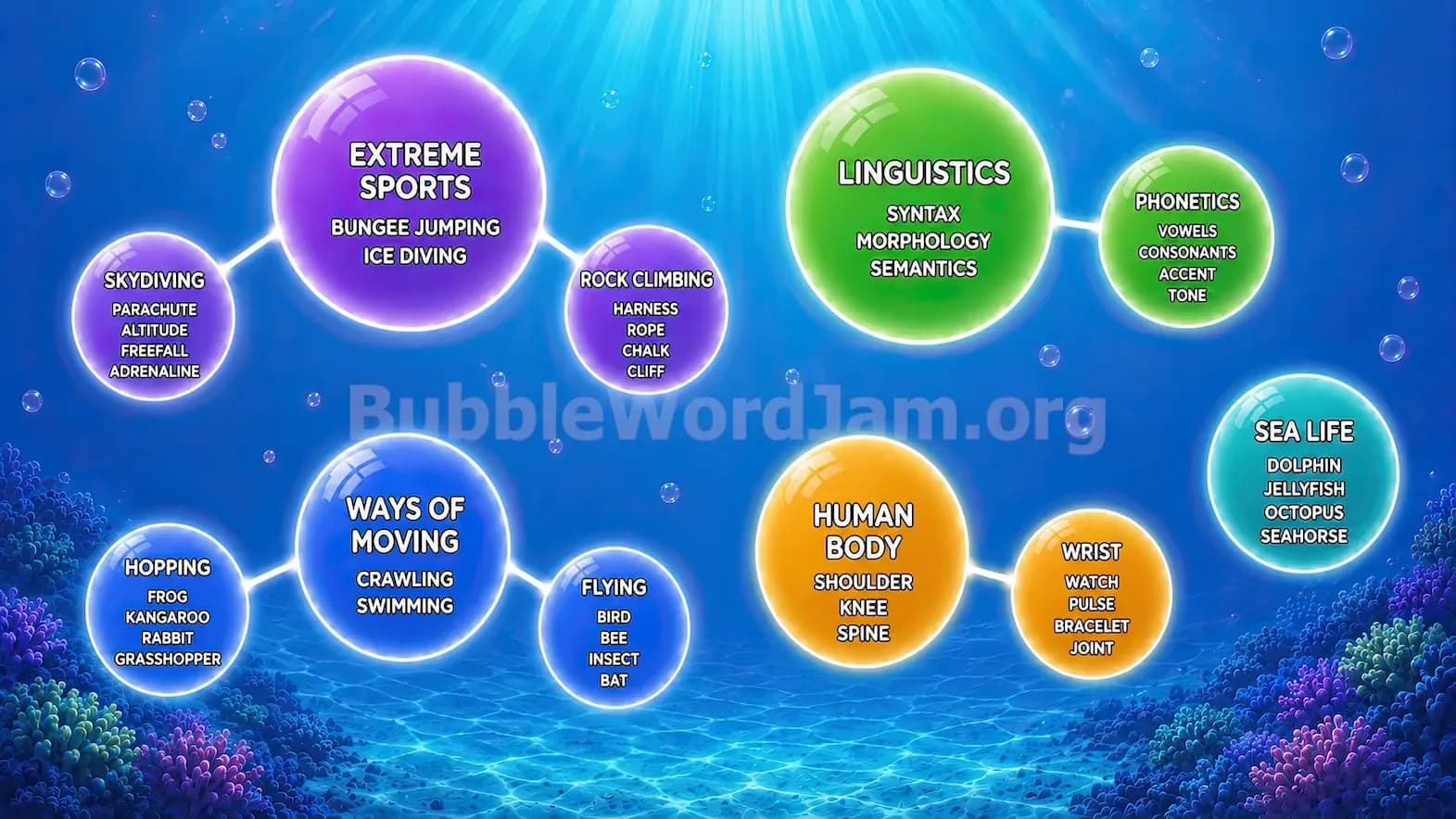
Level 68 turns up the adrenaline with extreme sports: skydiving, bungee jumping, rock climbing, and ice diving. Rock climbing also appears as its own term cluster with harness, rope, chalk, and cliff. This is a perfect example of why you shouldn’t merge “rock climbing” too quickly. It might be one piece of the extreme sports group, while its gear terms form a separate mini-puzzle.
Olympic sports and Olympic events can be sneaky because they overlap with everyday sport knowledge. Level 42 uses Olympic sports such as gymnastics, figure skating, skiing, and swimming. Then it zooms into swimming strokes: backstroke, freestyle, butterfly, and sidestroke.
The smart play is to separate “event family” from “technique.” Gymnastics, figure skating, skiing, and swimming are broad Olympic disciplines. Backstroke and butterfly are not separate sports in the same way; they are swimming styles. If you merge them with Olympic sports, you’ll get that ugly stuck-board feeling.
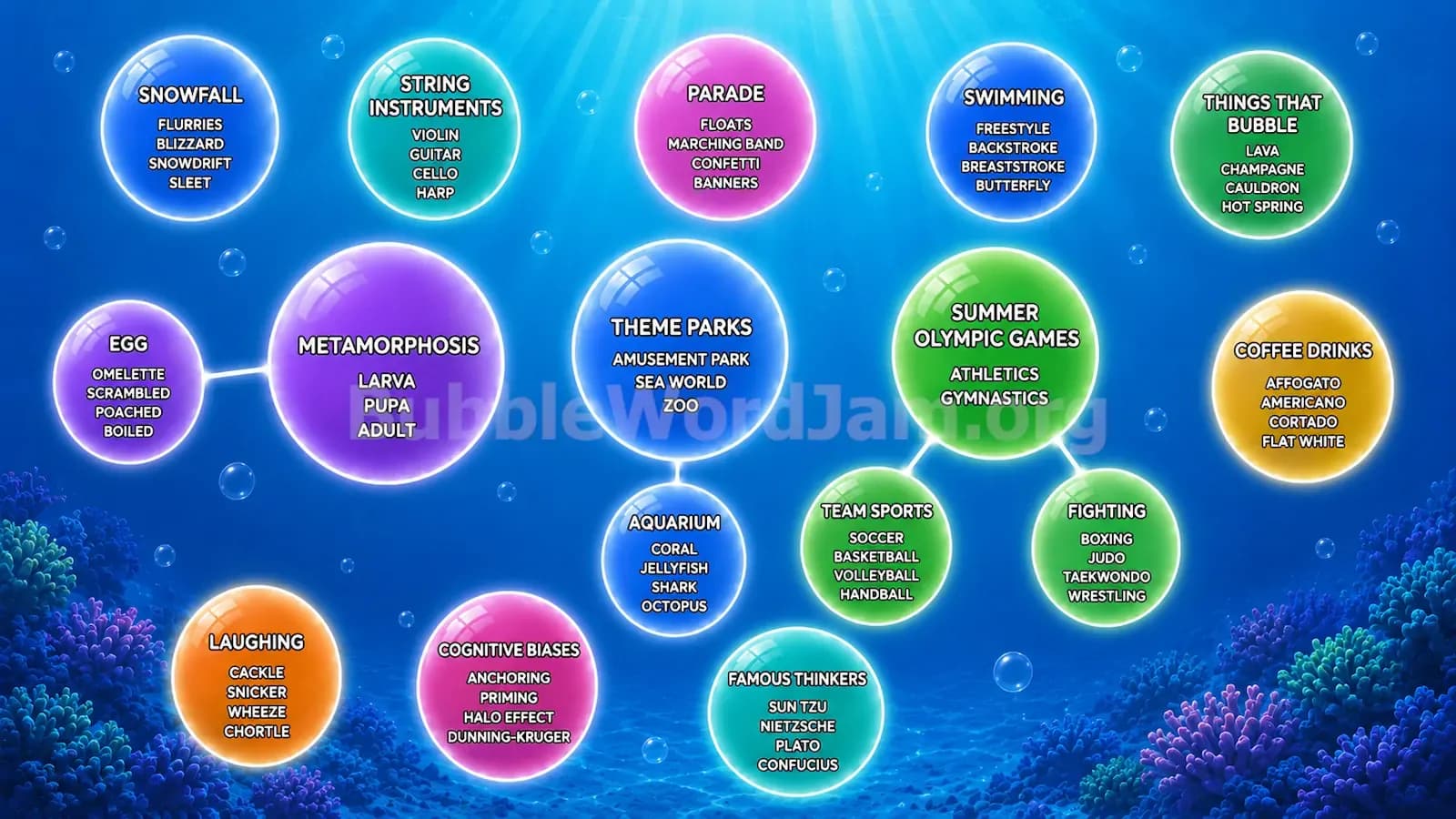
Level 164 makes the Olympic angle even more layered. Summer Olympic Games includes athletics, gymnastics, fighting, and team sports. Then fighting opens into boxing, judo, taekwondo, and wrestling. Team sports opens into soccer, basketball, volleyball, and handball. Swimming also appears through freestyle, backstroke, breaststroke, and butterfly.
That’s a lot of athletic vocabulary on one board. My rule here is to find the “container” words. Fighting and team sports are not just normal answers; they are category labels hiding in plain sight. When a word can contain other sports, treat it like a hub bubble. Then sort the smaller terms under it.
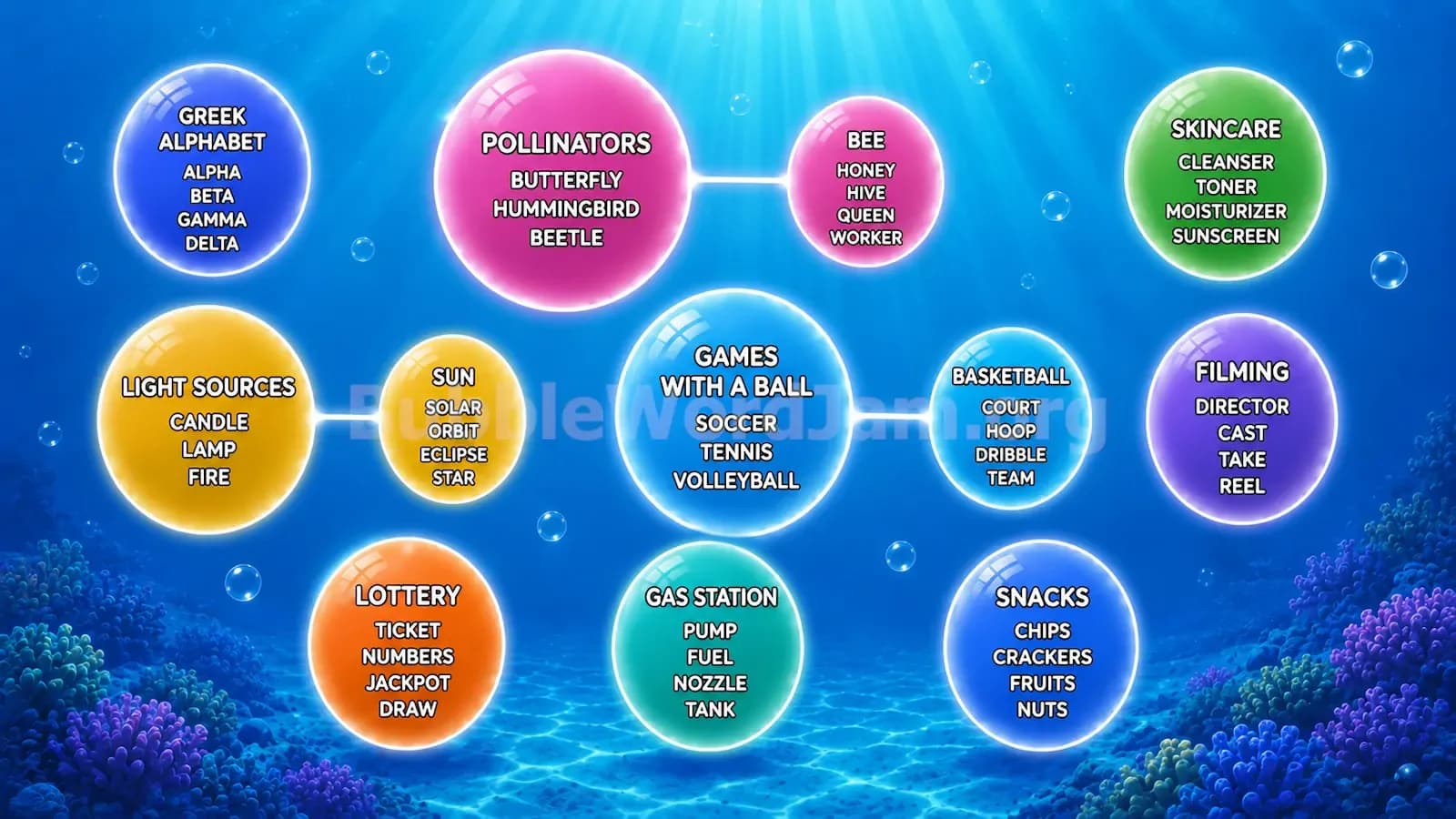
Level 122 is a clean lesson in ball-game grouping. Soccer, basketball, tennis, and volleyball all fit games with a ball. But basketball also has court, hoop, dribble, and team. The danger word is basketball because it belongs to both conversations. Is it a member of ball games, or is it the label for basketball terms? Usually, the surrounding words decide.
When you see soccer, tennis, and volleyball nearby, basketball likely joins the broad group. When you see court, hoop, dribble, and team, basketball becomes the theme. This is the kind of distinction that makes Bubble Word Jam satisfying when it clicks and frustrating when you rush.
Level 493 shifts to water sports with diving, kitesurfing, paddleboarding, and rowing. It also includes tennis shots: ace, lob, serve, and volley. This is a great late-game sports example because “serve” can bait you. Serve belongs in tennis shots here, but in another puzzle it could help volleyball. Don’t solve a word by itself. Solve the squad around it.
When a sports board starts to feel floaty, slow down and run this checklist.
Look for pure sport names first: baseball, golf, swimming, archery, tennis, volleyball, diving, rowing. These often form the broad group.
Then look for equipment: club, tee, bow, arrow, quiver, goggles, cap, harness, rope, chalk, net. Equipment usually points to one sport.
Next, scan for actions or techniques: dunk, rebound, serve, spike, block, backstroke, freestyle, butterfly, lob, volley. These are rarely broad categories. They usually belong to a specific sport.
Finally, watch for umbrella terms: individual sports, indoor sports, extreme sports, Olympic sports, team sports, fighting, water sports, games with a ball. These words tell you how the puzzle wants the sports sorted.
Sports categories in Bubble Word Jam are a banger when you stop treating every athletic word the same. The game isn’t just asking, “Do you know sports?” It’s asking, “Can you tell the difference between the sport, the gear, the move, the position, and the event family?”
That’s the winning mindset. Sort sport names away from sport-specific terms, use obvious clusters like pitcher-batter-catcher or hoop-dunk-rebound, and be careful with flexible words like serve, swimming, fighting, and team sports. Do that, and sports boards go from messy rehash to clean, satisfying logic puzzle.