Learn how to solve Bubble Word Jam space and astronomy categories by splitting planets, tools, sky objects, and events before you merge bubbles.

Guide By Liam Stone
Updated on June 8, 2026
Liam Stone has been playing Bubble Word Jam since the mobile app first launched on the Apple App Store. He knew this game would pop, so he enjoys playing every level, collecting the answers, and running this site for other players. He loves mobile puzzle games and sometimes publishes his walkthroughs on his YouTube channel Puzzle Game Answer. Follow his channel if you are a puzzle game lover too.
Space categories in Bubble Word Jam have a sneaky vibe. At first, they look obvious. You see “moon,” “stars,” “planet,” and “galaxy,” and your brain immediately goes, “Easy. Space.” Then the puzzle drops “telescope,” “eclipse,” “aurora,” “Apollo,” “orbit,” or “perigee” into the mix, and suddenly the board gets crunchy.
That’s the real trick: astronomy puzzles rarely use just one clean bucket. They split space words into several nearby ideas. One group might be planets. Another might be sky objects. Another might be tools used to observe space. Another might be events or phenomena that happen in the sky. If you merge too quickly, you can burn moves on a serviceable-looking match that blocks the real solution.
The best mindset is simple: don’t ask, “Is this related to space?” Ask, “What kind of space word is this?”
The most reliable technique for Bubble Word Jam space puzzles is the object/tool/event split. It sounds basic, but it’s a banger habit once you start using it.
A space object is something that exists in space or appears in the night sky: planet, star, comet, moon, galaxy, satellite. A tool is something people use to study or observe space: telescope, lens, eyepiece, mount, finder. An event or phenomenon is something that happens: eclipse, meteor, aurora, supernova, orbit, gravity-related motion.
That split keeps you from jamming “telescope” into a category with “Mars” and “Saturn.” They share an astronomy theme, but they don’t share the same category logic. Bubble Word Jam loves that kind of near-miss. It’s not trying to trick you unfairly; it’s testing whether you can see the category’s exact shape.
When planets show up, I usually solve them first. They’re one of the cleanest astronomy groups because the answers tend to be proper planet names: Mars, Earth, Neptune, Uranus, Jupiter, Saturn, Mercury, Pluto, Venus.
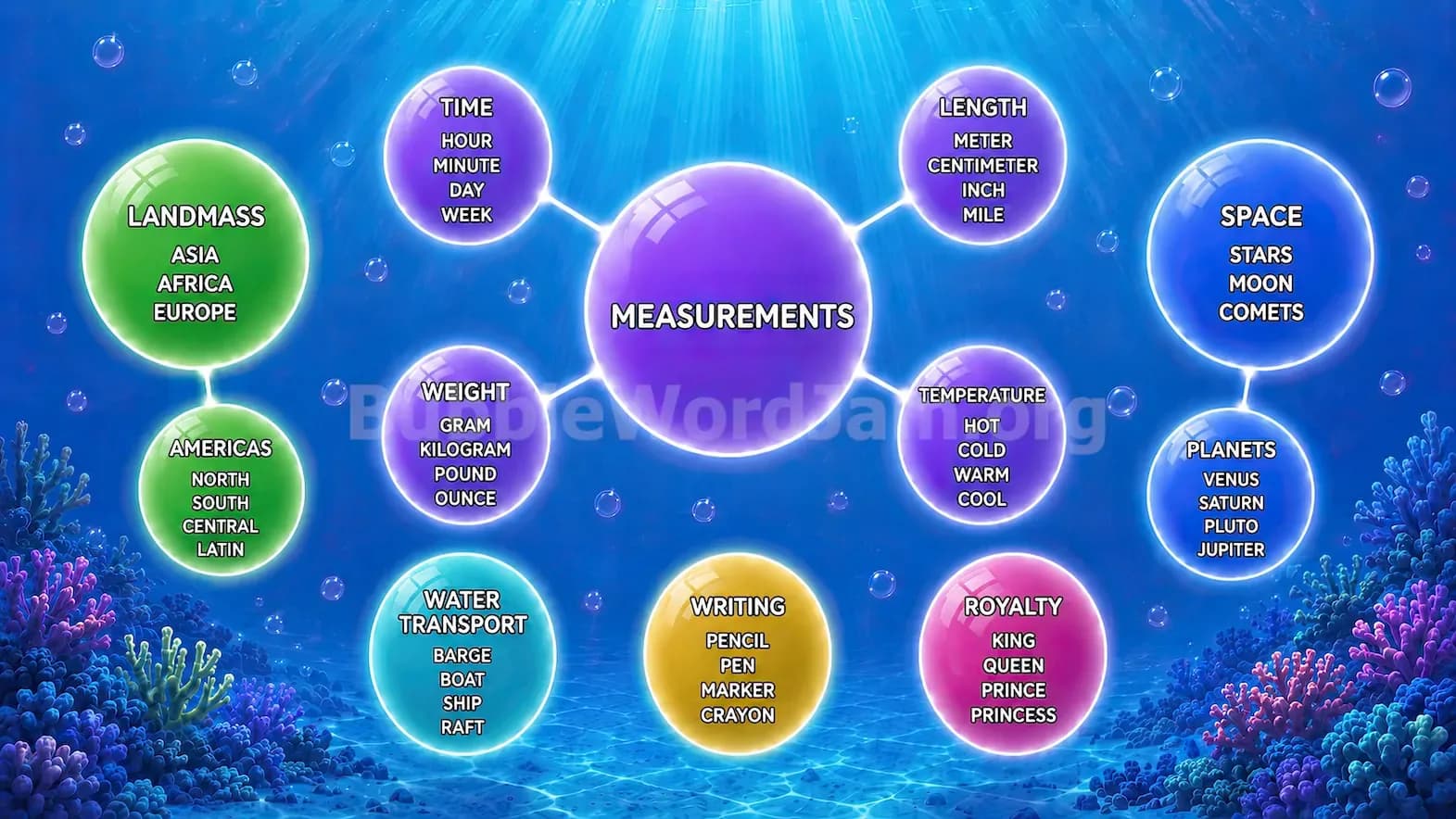
Levels like 7, 13, 20, and 70 all use planet-related groups in ways that teach the same lesson: planet names should stay together unless the puzzle clearly asks for a wider space category. “Saturn,” “Jupiter,” “Mars,” and “Mercury” are a rock-solid group. But “planet,” “star,” “orbit,” and “moon” point toward astronomy as a subject, not planets as a list.
That difference matters. “Planet” can be a category label, a clue word, or a member of a broader astronomy set. Don’t treat it the same as “Mars.” One is a type. One is an example.
Bubble Word Jam often blends concrete sky objects with general astronomy vocabulary. In Level 7, the space group includes stars, planets, moon, and comets. That’s a classic “things in space” group. But in Level 20, astronomy includes galaxy, planet, telescope, and star, which is broader because it mixes objects with a study tool.
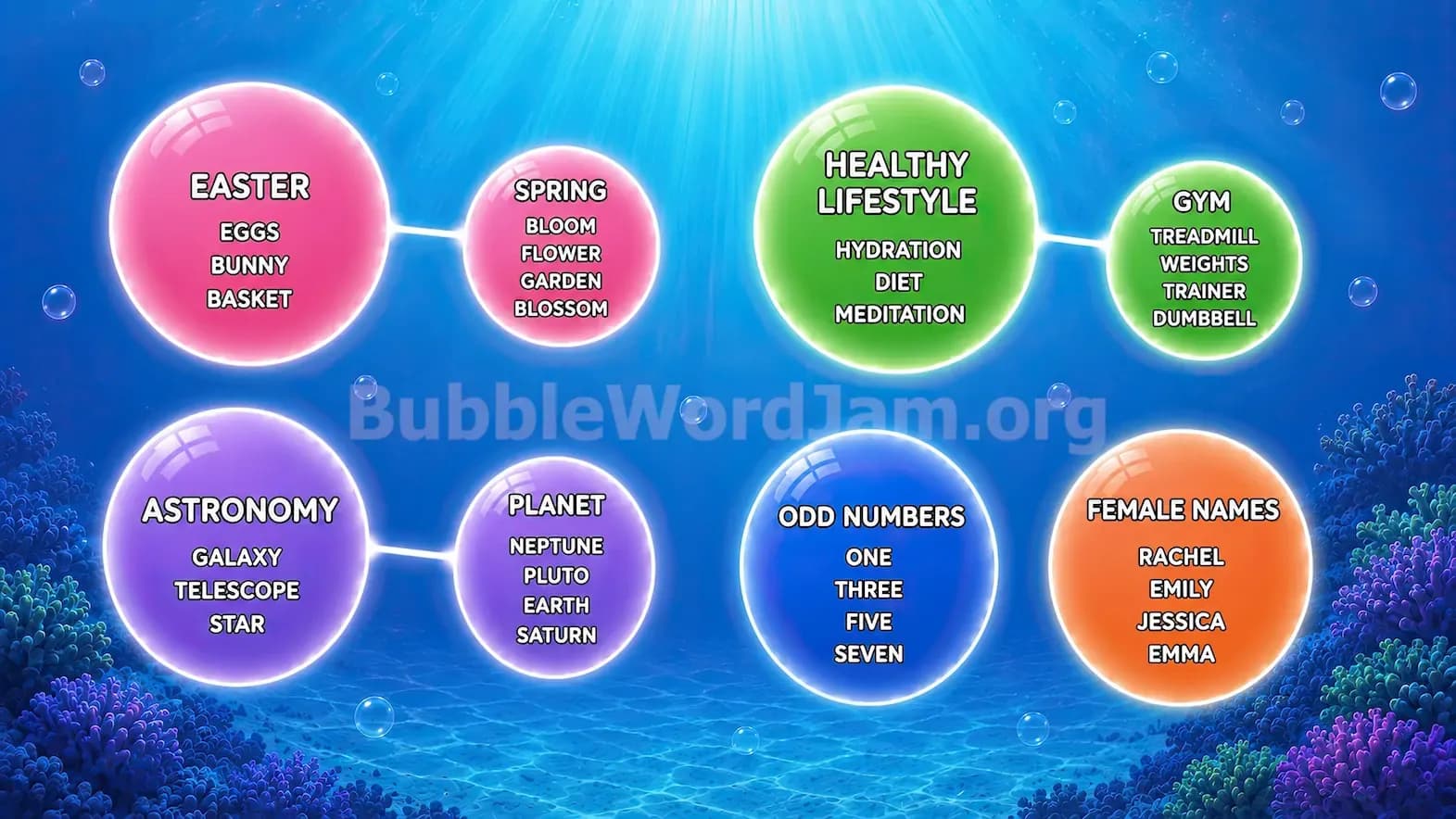
That’s where players get caught. “Galaxy” and “star” feel like sky objects. “Telescope” clearly isn’t one. So why does it belong? Because the category is “astronomy,” not “celestial bodies.” The puzzle is asking for the subject area, not the object type.
When I’m stuck, I scan for the category’s strictness. If every word is a physical thing in the sky, I keep the group narrow. If one word is a tool or field term, I widen the category.
Celestial phenomena are some of the most satisfying Bubble Word Jam categories because they feel dramatic. They also punish lazy sorting. Level 40 is a great example, with celestial phenomena built around supernova, aurora, meteor, and eclipse. Those words are not planets. They’re not tools. They’re events or visible effects.
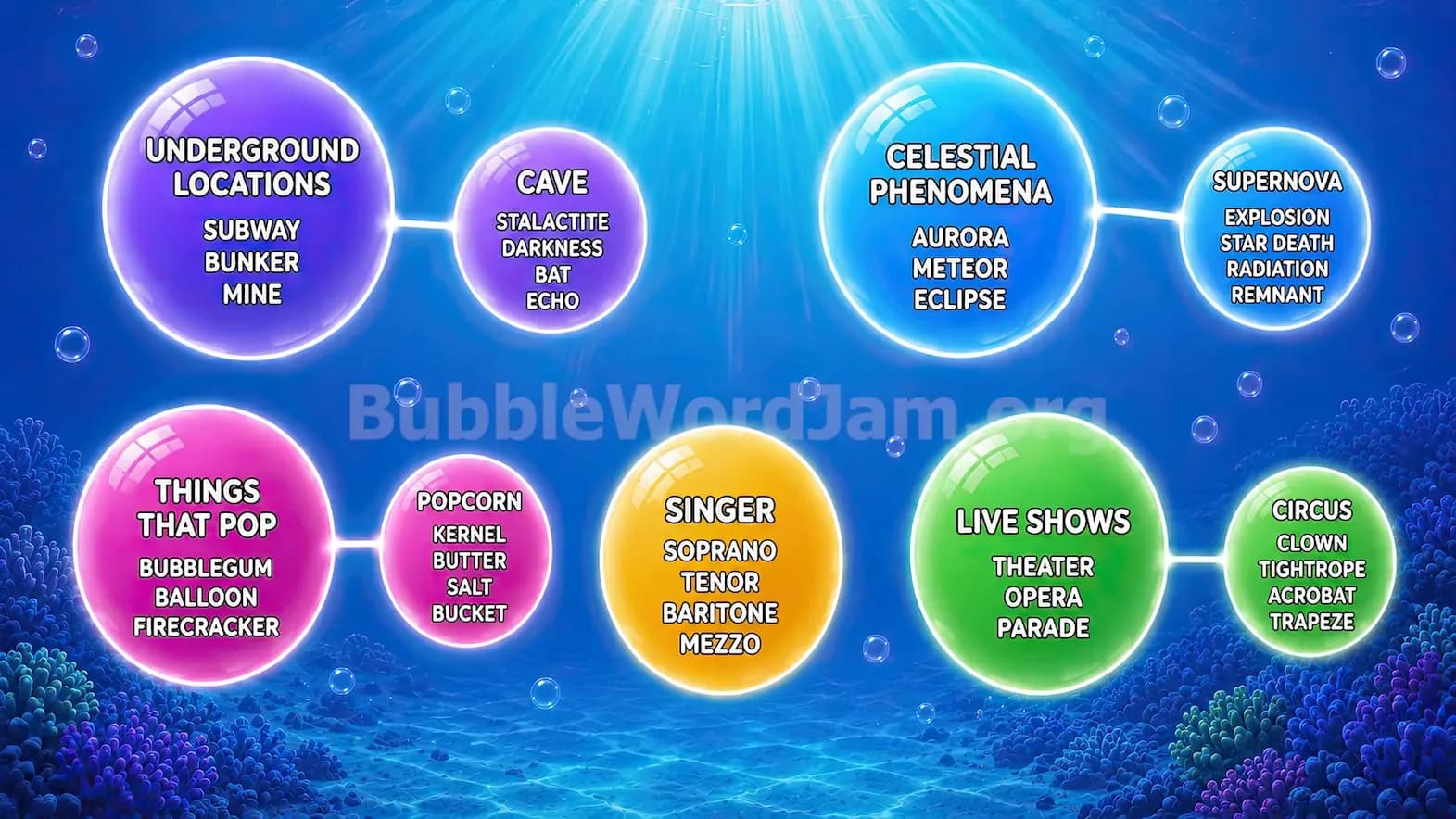
This is where the object/tool/event split shines. “Meteor” might feel like an object, but in many word puzzles it functions as a sky event. “Aurora” is not an object you can hold or a place you can visit; it’s a visible atmospheric light display. “Eclipse” is an alignment event. “Supernova” is a stellar explosion.
If the words feel active, temporary, explosive, glowing, or seasonal in the sky, check for a phenomena category before merging them with general space nouns.
Telescope categories are a whole little puzzle loop by themselves. Bubble Word Jam uses “telescope” in multiple ways: sometimes as part of astronomy, sometimes as an optical device, and sometimes as its own object with parts like eyepiece, focuser, mount, and finder.
This is a classic hierarchy test. “Telescope” can sit under “astronomy,” but “eyepiece” sits under “telescope.” That’s the same logic we see in other common-knowledge puzzles: object → part, subject → example, tool → component.
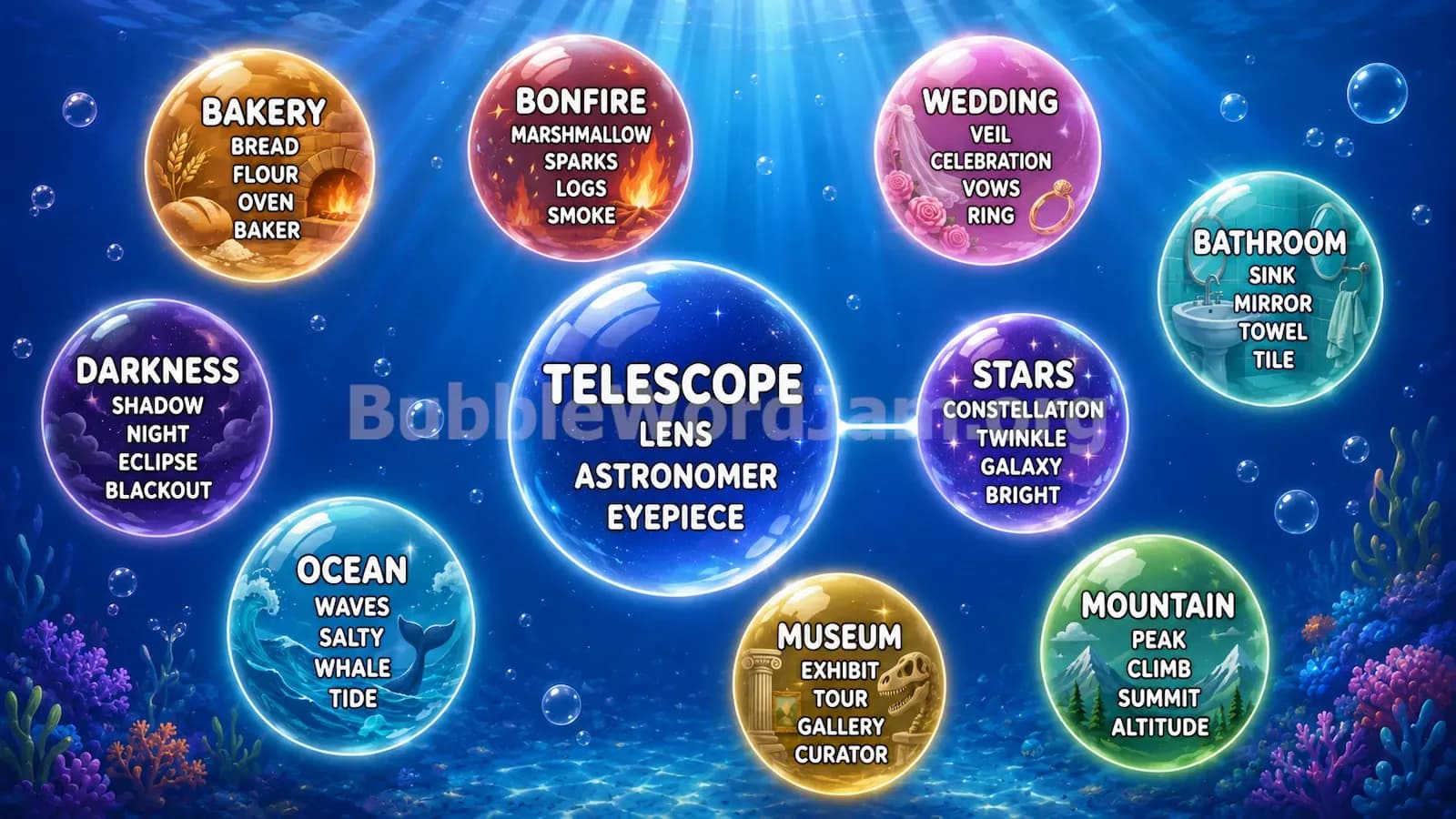
Level 401 puts telescope near stars, lens, astronomer, and eyepiece. Level 525 goes deeper with optical devices and telescope parts. When you see tool words, slow down. Ask whether the puzzle wants the tool itself, tools of a subject, or the parts of one tool.
Constellations are another category players often merge too fast. Level 70 is useful because it includes astronomy, constellations, and planets close together. That’s a crowded board. “Orion,” “Ursa Major,” “Cassiopeia,” and “Scorpius” belong together because they are named constellations. “Mercury,” “Jupiter,” “Mars,” and “Saturn” belong together because they are planets.
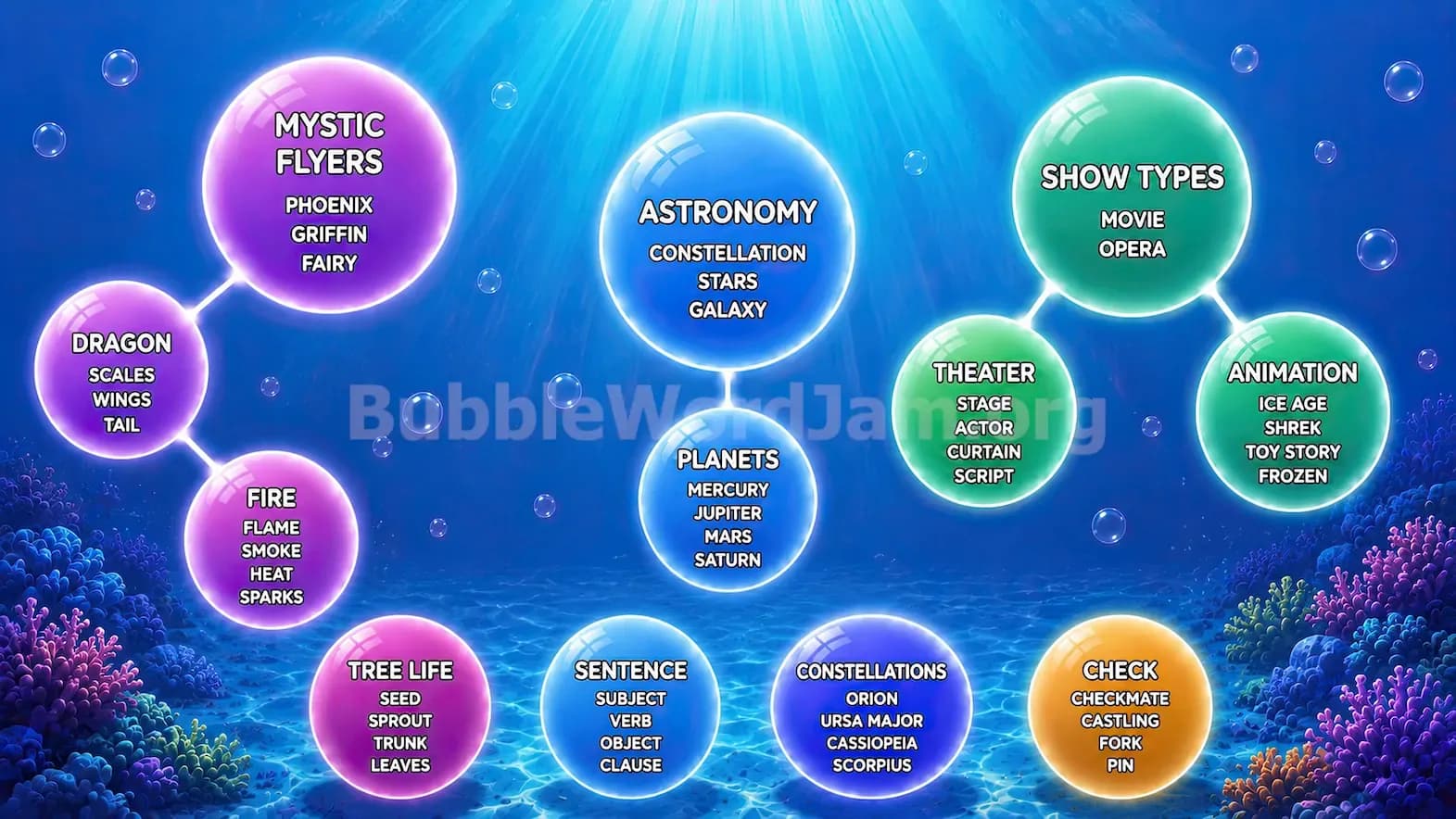
The word “stars” can make this messy. Constellations are star patterns, but named constellations are not the same category as stars in general. I treat constellation names like proper nouns. If the word sounds mythic, classical, or like a sky map label, I test it as a constellation before using it in a generic space group.
Not every astronomy word lives in a pure space category. Level 49 uses astronomy alongside school subjects and elements of nature. That means “astronomy” can behave like a subject word, not just a collection of space items.
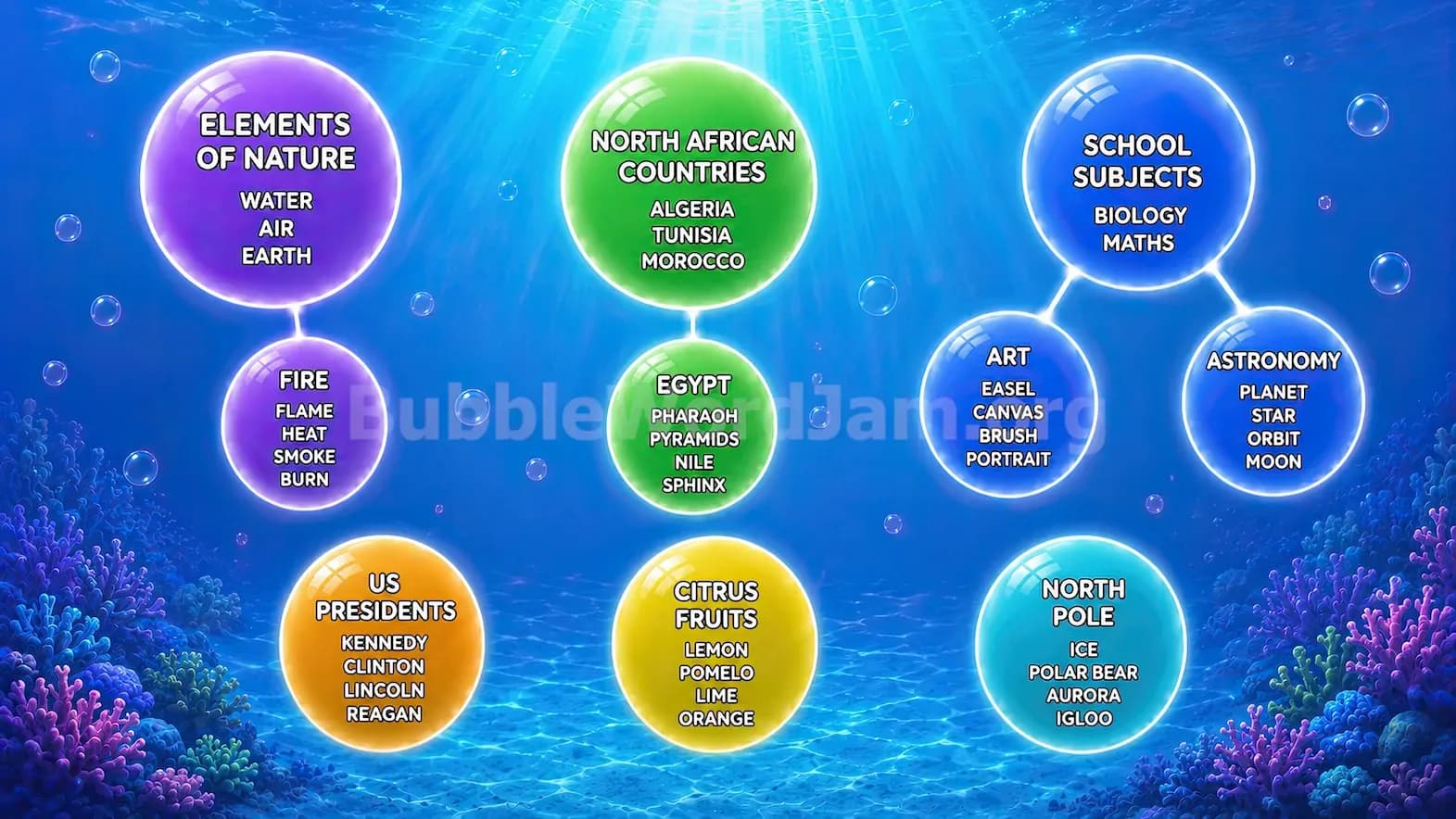
This is why Bubble Word Jam has a nice brain-training loop. It asks you to move between common knowledge and classification. “Biology,” “maths,” “art,” and “astronomy” form a school-subject style group. But “planet,” “star,” “orbit,” and “moon” form the astronomy content itself.
When a word looks like a field of study, compare it against other subjects before you place it with examples from that field.
By the later levels, Bubble Word Jam gets more willing to use sharper vocabulary. Level 773 includes space words like satellite, gravity, Milky Way, and perigee. That’s not beginner-level “moon and stars” stuff anymore. “Perigee” is especially crunchy because it describes the point in an orbit where an object is closest to Earth.
These words push you to think beyond simple nouns. “Gravity” is a force. “Satellite” is an object. “Milky Way” is a galaxy. “Perigee” is an orbital position. They don’t all share the exact same type, but they can share a broader space category when the puzzle wants astronomy vocabulary rather than a narrow object list.
The move is to look for the best available fit, not the most perfect science textbook taxonomy.
Use these levels as a practice path if you want to sharpen your astronomy sorting instincts:
This is a clean early example. It separates space objects from planet names, which teaches the basic split between a broad category and a specific list.
This level reinforces the difference between galaxy-themed words and planet-name groups. It’s a good test of whether you’re sorting by “space vibe” or exact category.
This one introduces telescope as part of astronomy, so it’s perfect for learning that tools can belong in a broader subject category.
A great phenomena lesson. Supernova, aurora, meteor, and eclipse should make you think “events in the sky,” not planets or tools.
This level is useful because astronomy can appear near school subjects and nature concepts. It teaches context reading.
This is one of the best space-category training levels because it forces three nearby astronomy ideas to coexist without collapsing into one messy group.
A good reminder that “eclipse,” “stars,” and “telescope” can point in different directions depending on the category label.
This level goes more specific, separating ringed planets from optical devices and telescope parts. It’s a crunchy but fair sorting challenge.
This later example uses broader astronomy vocabulary like satellite, gravity, Milky Way, and perigee. It’s a strong test of flexible space knowledge.
The fastest way to improve at Bubble Word Jam astronomy puzzles is to stop merging words just because they share a theme. Space is too broad. Sort by role instead.
Is the word a planet? Is it a sky object? Is it a scientific tool? Is it a telescope part? Is it a celestial event? Is it a school subject? Is it a force or orbital term?
Once you ask those questions, the board stops feeling floaty. You’ll see the hidden structure faster, save moves, and avoid those mediocre almost-matches that look right until they wreck the solve. Space categories can look intimidating, but with the object/tool/event split, they become one of the most satisfying puzzle loops in Bubble Word Jam.