Solve Bubble Word Jam science puzzles faster with a discipline, object, and process method for chemistry, physics, lab gear, particles, and reactions.

Guide By Liam Stone
Updated on July 6, 2026
Liam Stone has been playing Bubble Word Jam since the mobile app first launched on the Apple App Store. He knew this game would pop, so he enjoys playing every level, collecting the answers, and running this site for other players. He loves mobile puzzle games and sometimes publishes his walkthroughs on his YouTube channel Puzzle Game Answer. Follow his channel if you are a puzzle game lover too.
Science puzzles in Bubble Word Jam have a very specific vibe. They look simple at first—just a few familiar school words floating around in bubbles—but then the board starts playing tricks. Is “atom” the answer, or is it part of “chemistry”? Is “enzyme” a biology clue, a chemistry clue, or the name of its own tiny category? That’s where the science loop gets crunchy.
The best way to handle these puzzles is to stop treating every science word as “science” and start asking what role the word plays. In Bubble Word Jam, science categories usually fall into three buckets: discipline, object, or process. A discipline is a field like chemistry, physics, biology, biochemistry, or particle physics. An object is a thing you can name or point to, like atom, beaker, proton, enzyme, or bacteria. A process is something that happens, like combustion, oxidation, digestion, fission, or glycolysis.
Once you see that split, science levels feel much less floaty. The game stops being a guessing game and starts feeling like a clean sorting puzzle.
Here’s the mental shortcut I use: before merging bubbles, label each word in your head.
A discipline answers “What subject does this belong to?” Chemistry, physics, biochemistry, astronomy, and particle physics are disciplines. They are umbrellas.
An object answers “What is this thing?” Atom, molecule, acid, element, proton, neutron, electron, nucleus, beaker, funnel, burner, pipette, bacteria, fungi, protozoa, and virus are objects or entities.
A process answers “What is happening?” Rusting, combustion, oxidation, digestion, fission, and glycolysis are processes.
This matters because Bubble Word Jam loves nested logic. A category can contain another category word. “Chemistry” can contain “atom,” but “atom” can also open into proton, neutron, electron, and nucleus. That’s the banger trick: one word can be both an answer in one group and a doorway into another.
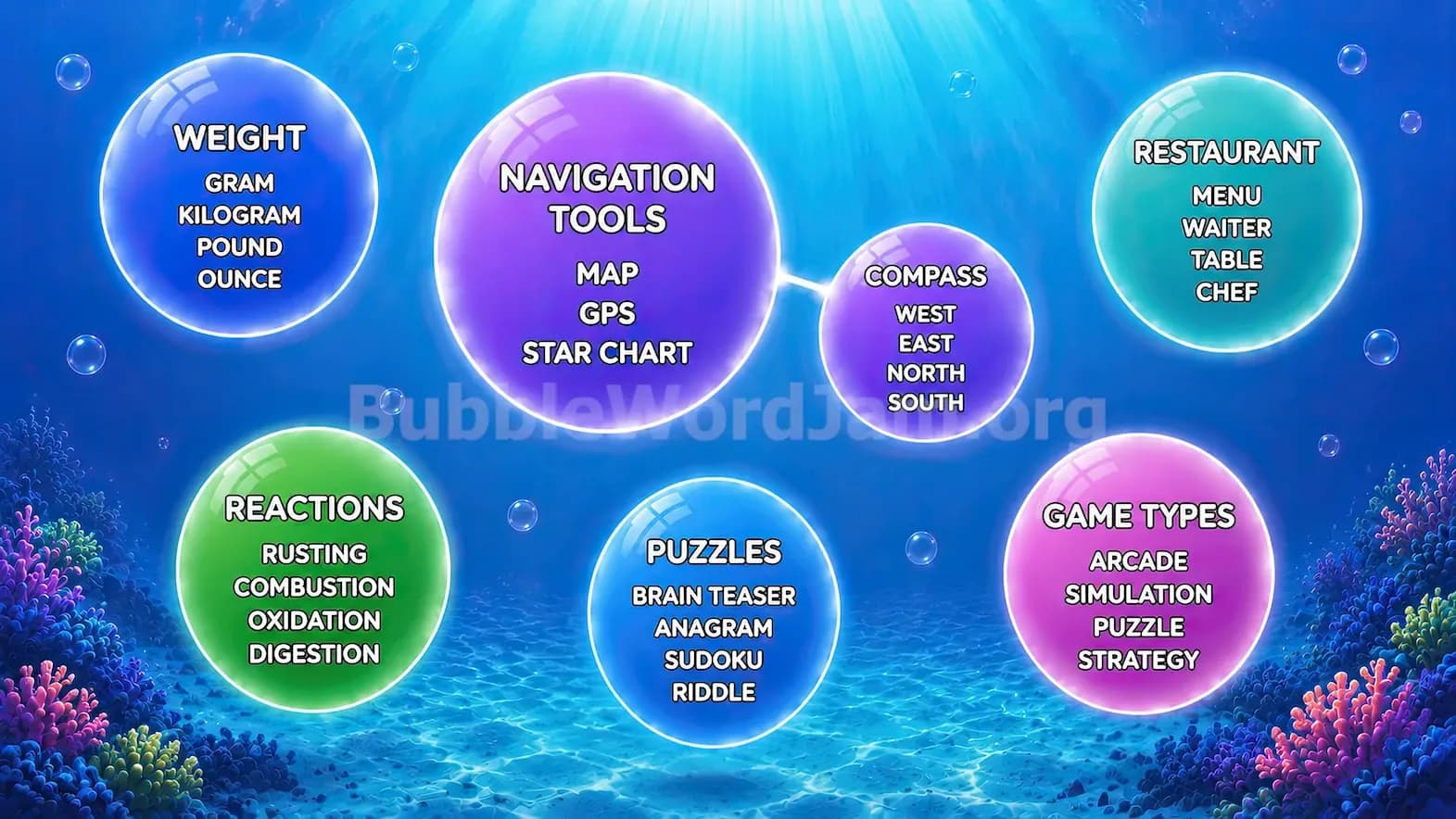
Level 24 is a great early science check because the category “reactions” includes rusting, combustion, oxidation, and digestion. None of these are tools. None are fields of study. They’re all things that happen.
That sounds obvious until the board throws in nearby words like weight, gram, kilogram, pound, and ounce. A player rushing through the puzzle may see “oxidation” and “gram” and think chemistry, but that’s too broad. The smarter move is to ask: are these measuring terms, or are they transformations?
Rusting and combustion both involve chemical change. Oxidation is a reaction type. Digestion is a biological process, but it still fits because it describes breakdown and transformation. That’s the key: the group is built around action. When a science set uses verbs or process nouns, don’t force it into a school-subject bucket.
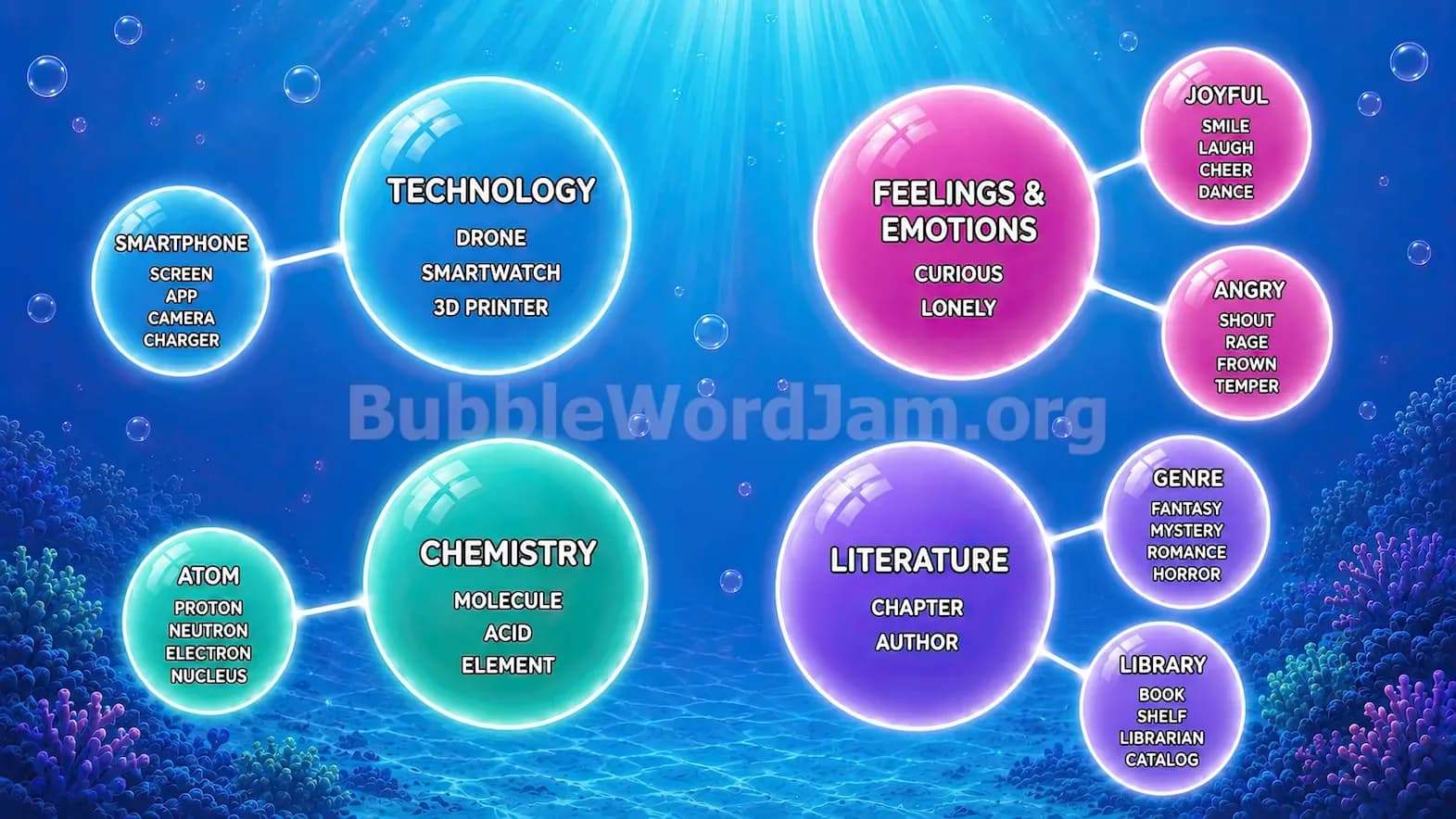
Level 35 is where the science logic gets sharper. “Chemistry” gathers atom, molecule, acid, and element. Then “atom” gathers proton, neutron, electron, and nucleus.
I love this kind of Bubble Word Jam layout because it rewards players who can separate a broad category from a smaller structure inside it. Chemistry is the discipline. Atom is an object inside chemistry. Proton, neutron, electron, and nucleus are components of that object.
The mistake is merging “proton” straight into chemistry just because it feels science-y. It is science, sure, but the cleaner match is atom. In these cases, always look for the tightest possible category. If a word can fit a broad group and a narrow group, Bubble Word Jam usually wants the narrow group first.
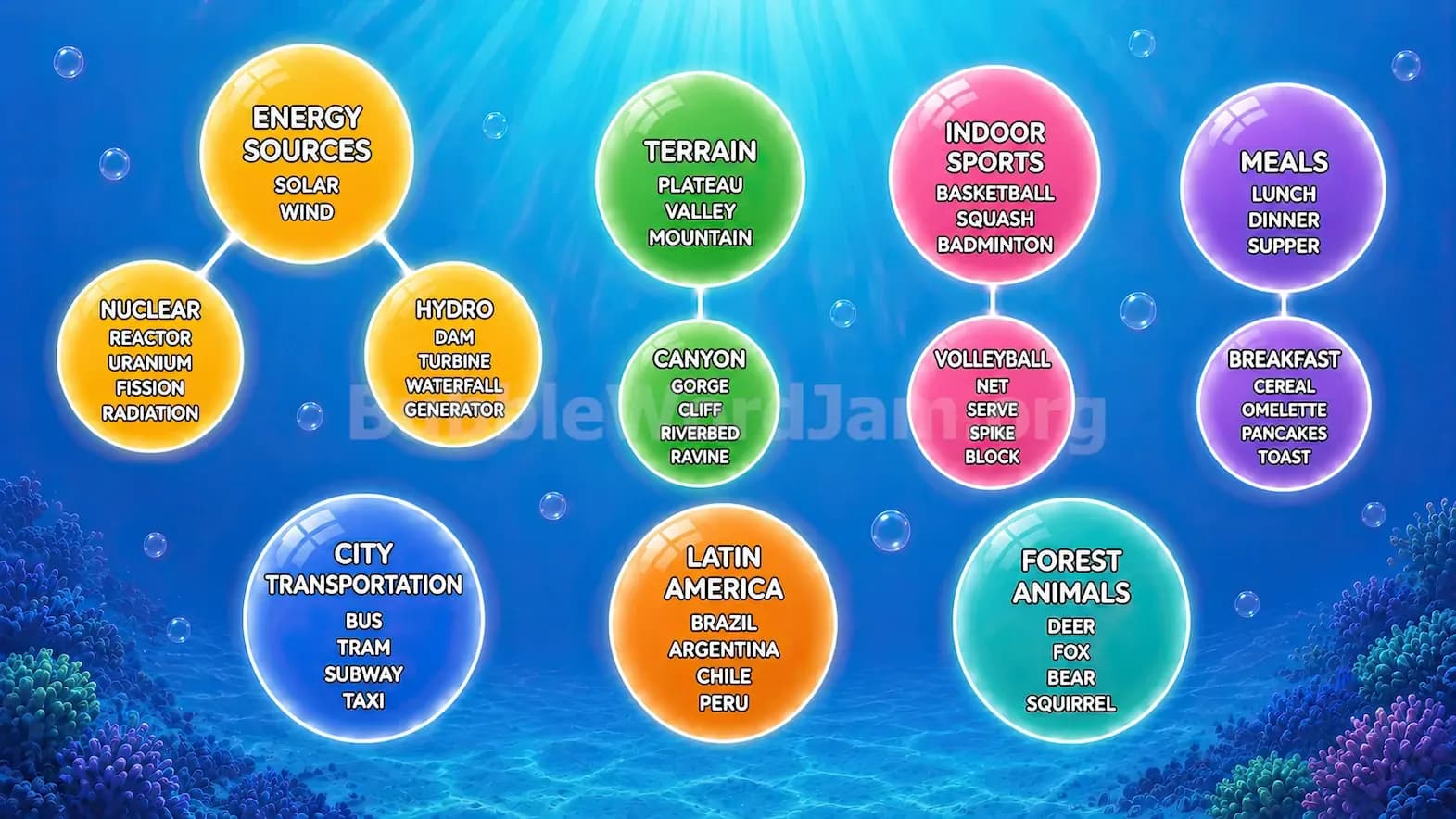
Level 59 gives us one of the cleanest science ladders: nuclear, reactor, uranium, fission, radiation, plus energy sources like nuclear, solar, wind, and hydro. This is a classic hierarchy trap.
“Nuclear” belongs with solar, wind, and hydro when the topic is energy sources. But nuclear also becomes its own category when paired with reactor, uranium, fission, and radiation. The board is asking players to understand two layers at once.
Here’s the solving technique: when one word appears to belong with several others, ask whether it is acting as a label or an item. In “energy sources,” nuclear is an item. In the nuclear group, it is the label. That little shift is the whole puzzle.
Hydro works the same way, with dam, turbine, waterfall, and generator. Bubble Word Jam likes this structure because it feels fair once you see it, but it can absolutely tank your move count if you merge too fast.
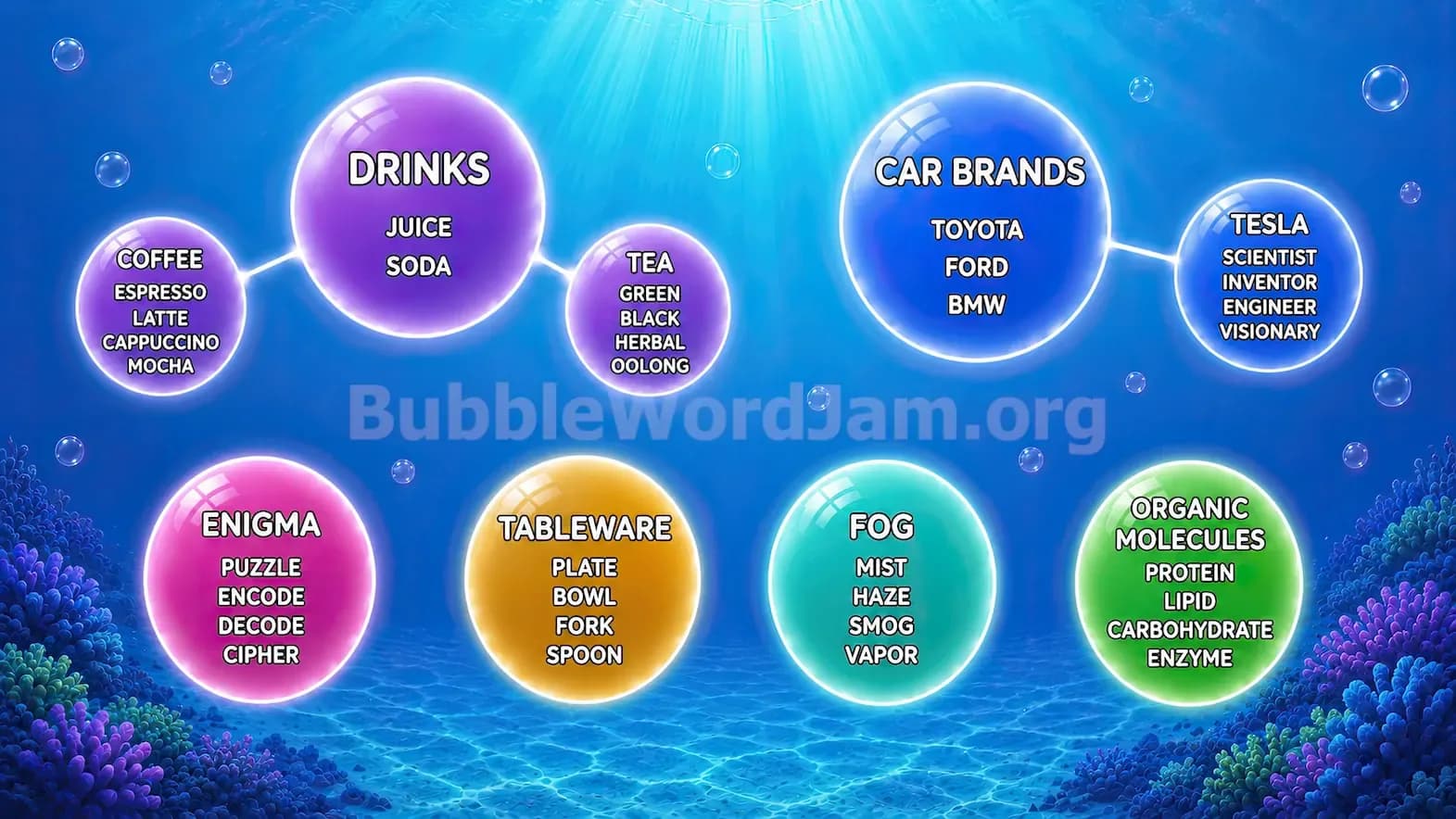
Level 61 uses “organic molecules” with protein, lipid, carbohydrate, and enzyme. This is where science puzzles start crossing subject borders. These words can feel like biology, nutrition, chemistry, or medicine depending on the player’s background.
The clean read is this: organic molecules are objects or molecule classes. Protein, lipid, and carbohydrate are major biological molecules. Enzyme is trickier because players may think of it as a helper in digestion, but in this puzzle it belongs as a molecule-related term.
When a category has a technical label like “organic molecules,” don’t sort by where you heard the word in school. Sort by what the word is. Protein is not a process. Lipid is not a lab tool. Carbohydrate is not a discipline. They’re all molecular categories, and that locks the group.
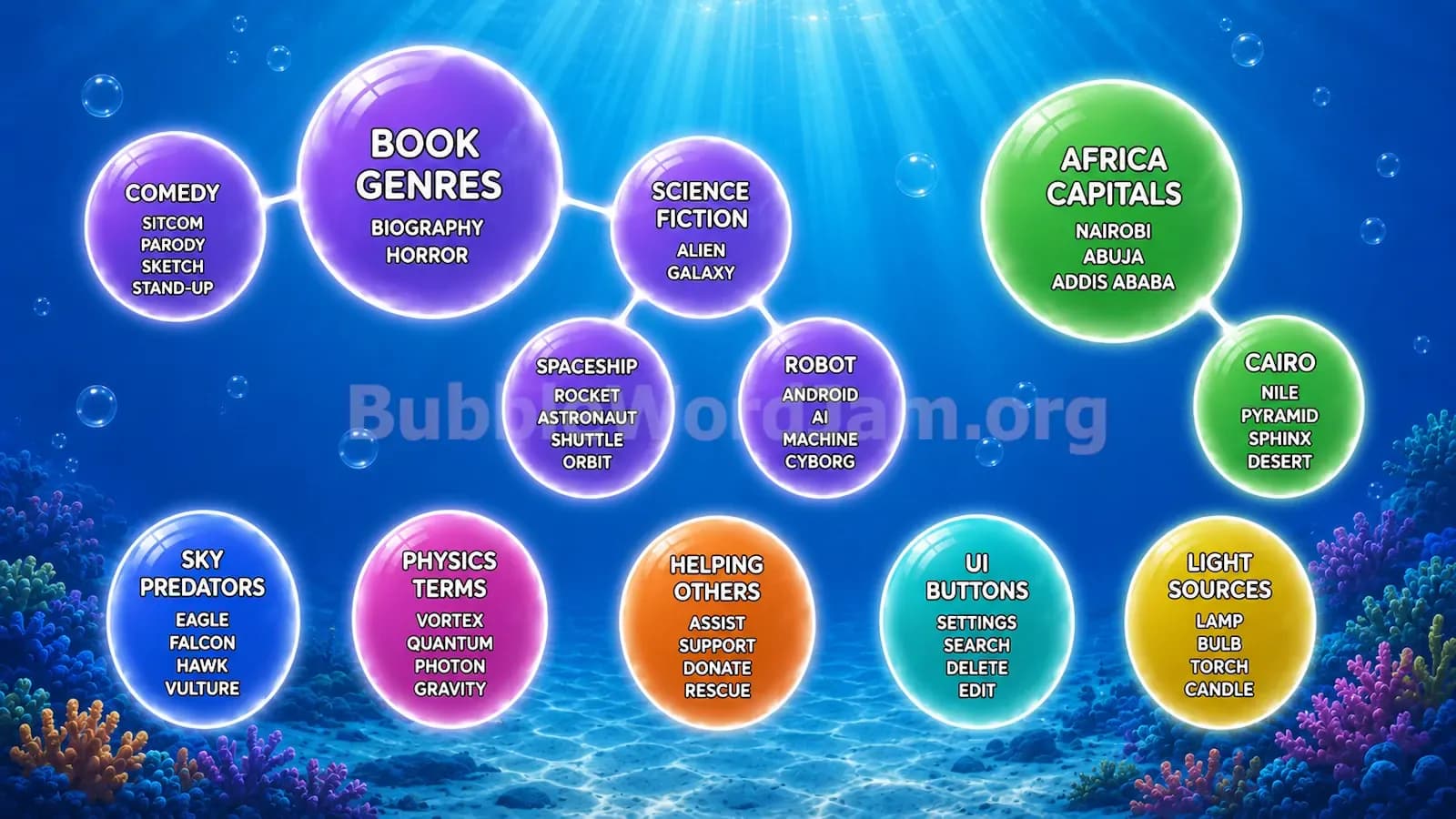
Level 81 is sneaky because it mixes real science with sci-fi vocabulary. Physics terms include vortex, quantum, photon, and gravity. Nearby, science fiction includes alien, spaceship, robot, and galaxy.
This is a beautiful trap because “galaxy,” “spaceship,” “photon,” and “gravity” all live in the same mental neighborhood. The board is testing whether you can split real physical concepts from genre furniture.
I’d solve this by asking: could this word appear in a physics textbook as a technical concept? Photon and gravity, yes. Quantum, absolutely. Vortex, yes. Alien and spaceship are not physics terms here; they’re sci-fi signals. Robot also belongs more to fiction in this setup, even though robotics is a real field. Context wins.
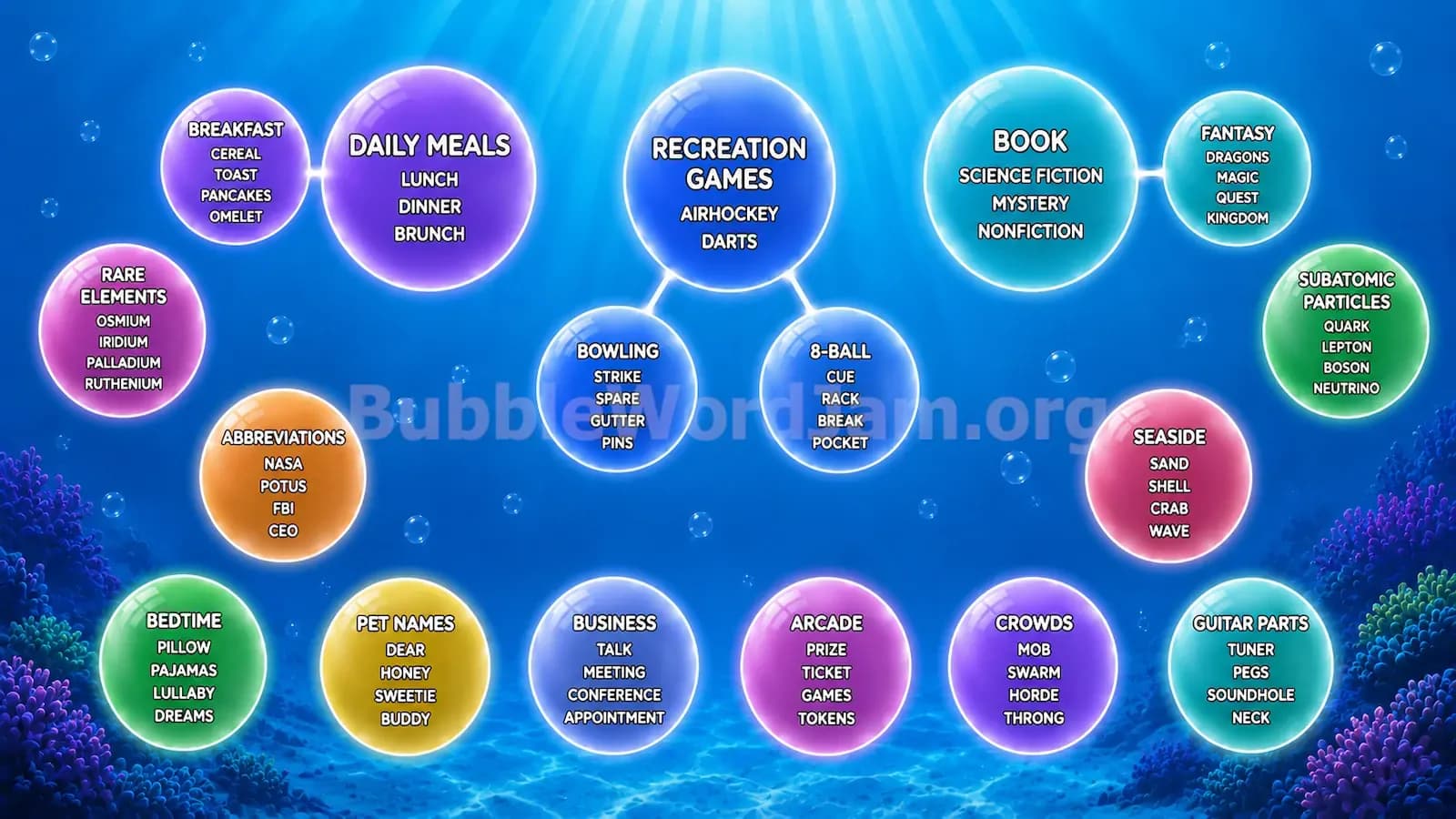
Level 159 brings in “subatomic particles”: quark, lepton, boson, and neutrino. This is one of those categories that looks intimidating if you don’t know the words, but the structure is actually rock-solid.
All four terms describe particles or particle families. The trick is not to overthink “rare elements” on the same board. Osmium, iridium, palladium, and ruthenium are elements. Quark, lepton, boson, and neutrino are smaller-than-atom physics terms.
So the fast rule is: if the word sounds like it belongs on the periodic table, check the element group. If it sounds like it belongs inside particle physics, check the subatomic group. That split keeps the board clean.
Level 469 uses science in two very different ways: female scientists and microorganisms. Female scientists includes Lovelace, Curie, Franklin, and Johnson. Microorganisms includes bacteria, fungi, protozoa, and virus.
This is a great reminder that science categories are not always about terms from a textbook. Sometimes the category is people. Sometimes it is living things. The same puzzle can ask for history of science and biology at the same time.
For names, ask whether the set shares a human achievement or profession. For organisms, ask whether the terms describe life forms or microscopic agents. Don’t mix Curie with bacteria just because both feel “science.” Bubble Word Jam wants the relationship type, not just the general theme.
Level 633 is almost a perfect training room for the discipline-object method. Laboratory equipment includes beaker, funnel, burner, and pipette. Physics terms include atomic, kinetic, thermal, and magnetic. Atomic components include electron, neutron, proton, and nucleus.
That’s three science groups, and each one has a different job. Lab equipment is physical gear. Physics terms are descriptive concepts. Atomic components are parts of an atom.
This is where I slow down before merging anything. If I see “burner,” my brain might shout chemistry lab, but the specific category is equipment. If I see “thermal,” it’s not a tool or a particle; it’s a physics adjective. If I see “proton,” it belongs to the atom structure group.
Level 700 is a crunchy late-game science example because it stacks biochemistry, enzyme, neutrino, and particle physics. Biochemistry includes glycolysis, enzyme, substrate, and cofactor. Enzyme includes catalase, amylase, pepsin, and trypsin. Particle physics includes quark, boson, neutrino, and hadron. Neutrino includes electron, muon, tau, and lepton.
That’s not random difficulty; it’s nested difficulty. Enzyme is both an item in biochemistry and a category with its own examples. Neutrino is both an item in particle physics and a category connected to particle types.
The safest play is to build from the most specific group upward. Catalase, amylase, pepsin, and trypsin clearly point to enzyme. Electron, muon, tau, and lepton point to neutrino. Once those smaller boxes are solved, the broader biochemistry and particle physics groups become easier to see.
When a Bubble Word Jam science puzzle starts to feel messy, use this checklist:
Is the word a field of study? Put it near discipline words like chemistry, physics, biology, or biochemistry.
Is the word a physical thing, organism, particle, or tool? Look for object categories like atom, laboratory equipment, microorganisms, or atomic components.
Is the word something that happens? Look for process categories like reactions, fission, digestion, combustion, or glycolysis.
Is the word both a category and an item? Treat it carefully. These nested words are often the key to solving the board without wasting moves.
Science puzzles in Bubble Word Jam are not about memorizing every technical term. They’re about reading the relationship. Once you separate discipline, object, and process, the whole board snaps into place—and that “aha” moment is exactly why this game’s category loop works so well.