Solve Bubble Word Jam mind puzzles faster by sorting feelings, memories, sleep clues, perception terms, and psychology branches before making costly merges.

Guide By Liam Stone
Updated on July 4, 2026
Liam Stone has been playing Bubble Word Jam since the mobile app first launched on the Apple App Store. He knew this game would pop, so he enjoys playing every level, collecting the answers, and running this site for other players. He loves mobile puzzle games and sometimes publishes his walkthroughs on his YouTube channel Puzzle Game Answer. Follow his channel if you are a puzzle game lover too.
Emotions, memory, and psychology puzzles in Bubble Word Jam are some of the sneakiest boards in the game. Animal sets? Easy enough. Kitchen tools? Usually clean. But mind categories are floaty. A word like “dream” can look like sleep, memory, imagination, or human experience depending on what else is on the board. That’s where a casual merge can tank your run.
I like these puzzles because they reward patience, not just vocabulary. The loop is less “find four obvious words” and more “figure out what layer the game is asking for.” Are you sorting feelings? Mental states? Brain functions? Academic psychology branches? The difference matters. Since every merge costs a move, mind puzzles punish vibe-based guessing harder than most themes.
When I see a psychology-heavy Bubble Word Jam board, I immediately divide the words into three buckets.
First, there are feelings and emotions: joy, fear, anger, hope, sadness, surprise, anxiety, loneliness, pride, guilt, relief. These answer the question, “What am I feeling right now?”
Second, there are mental states and traits. These include mood, personality, instincts, curiosity, shyness, honesty, and bravery. They describe a longer condition, a tendency, or a character quality. Level 6 is a clean early example because sleep and personality sit near each other, but bed and dream do not belong with honest and brave. Same mind-adjacent vibe, totally different lane.
Third, there are cognitive or psychology terms: cognition, attention, perception, logic, memory, behavioral, clinical, social, cognitive. They point to how the mind works, not just what it feels. This is the crunchy part of the category tree.
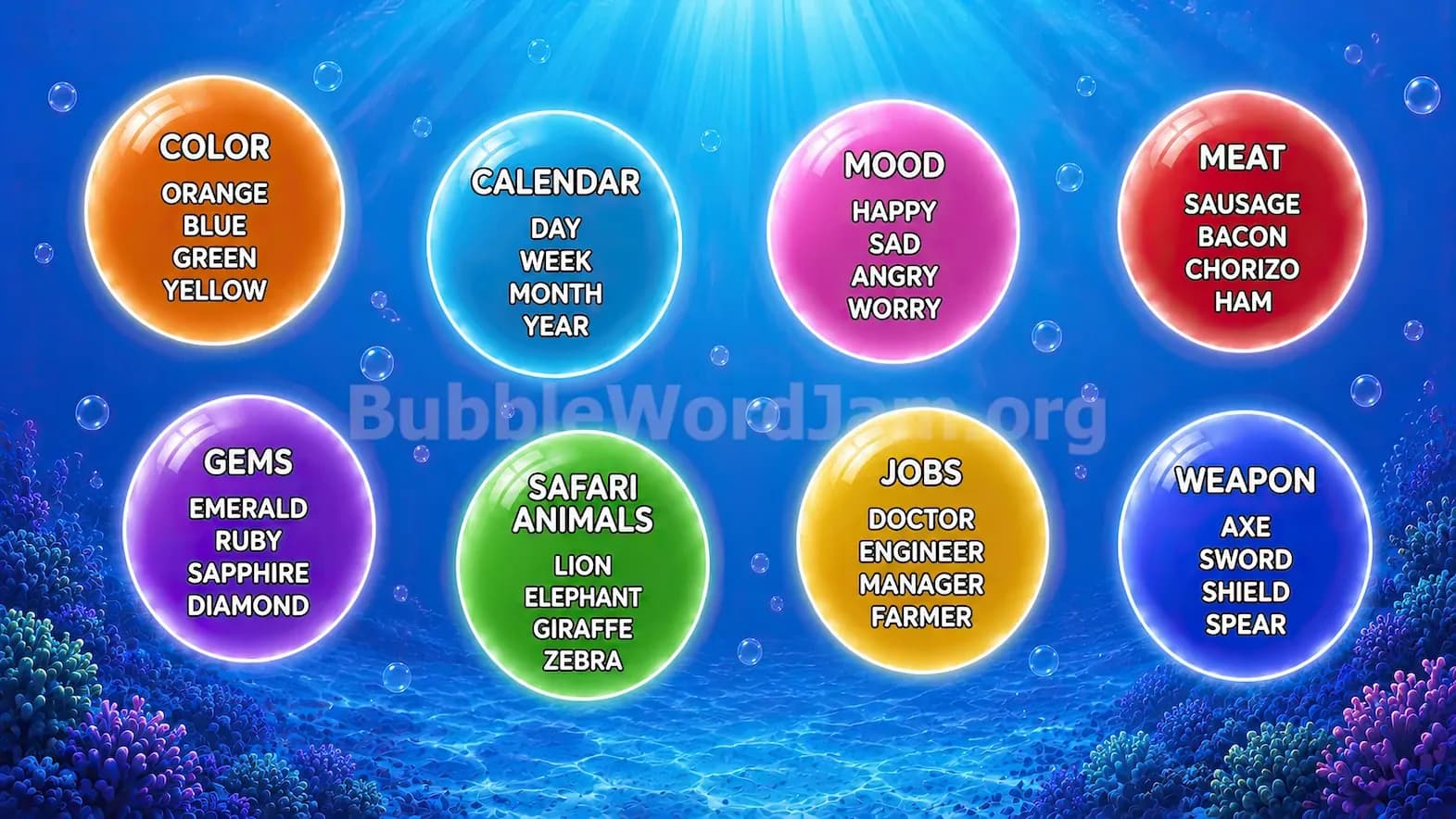
Emotion sets look friendly, and that’s why they bait mistakes. Level 10 uses a simple mood group with happy, sad, angry, and worry. That looks obvious, but it teaches a habit you’ll need later: mood categories often mix adjectives with nouns. Worry is not shaped like happy, but it still belongs emotionally.
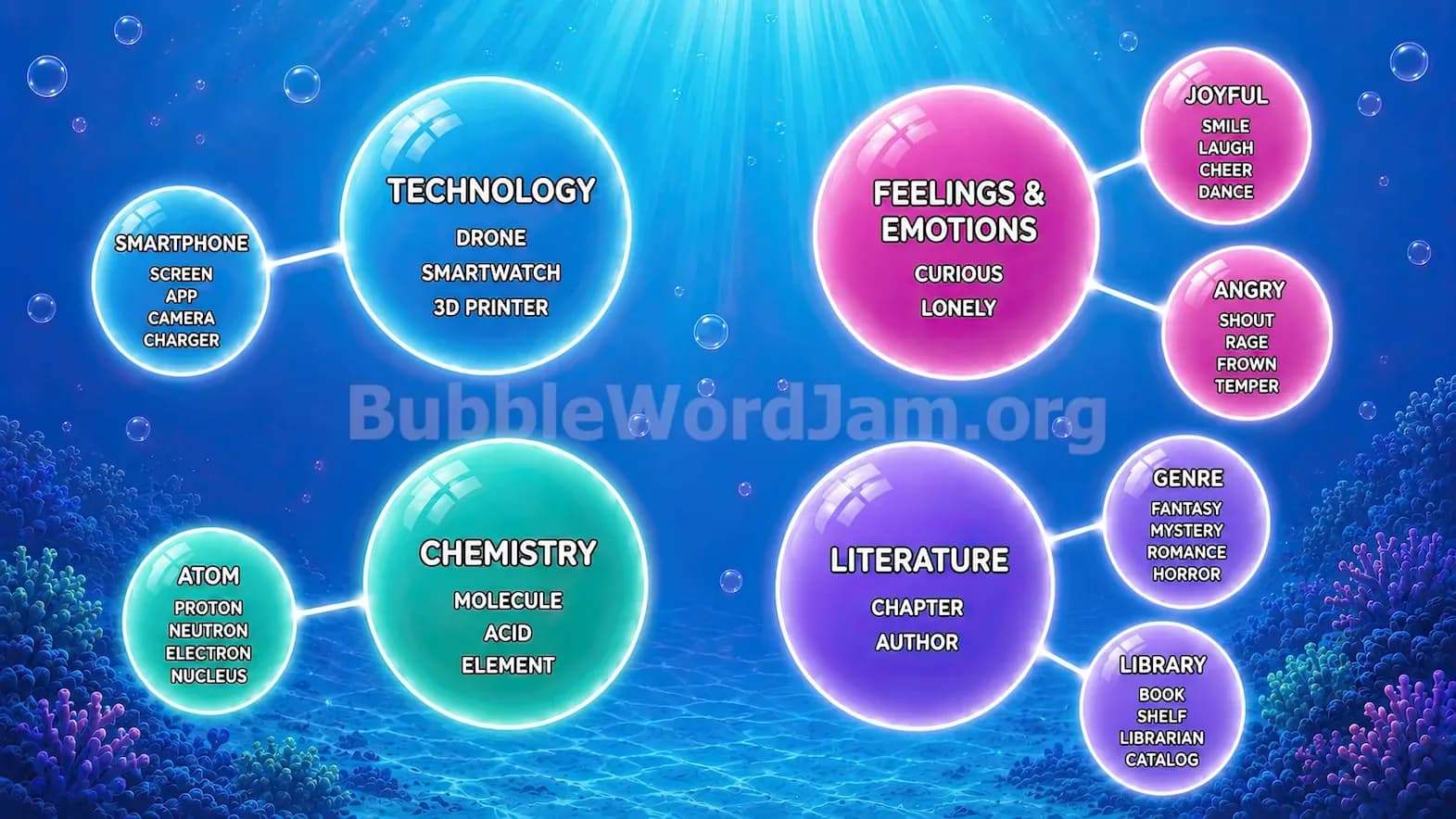
Level 35 gets nastier. It includes feelings and emotions, but also child categories like joyful and angry. Joyful can sit inside a larger feelings set, while smile, laugh, cheer, and dance orbit around joyful. Angry works the same way with shout, rage, frown, and temper. If you merge joyful with smile too early, you may block the parent category. If you merge joyful with angry, you might be solving the wider feelings group.
My rule: when an emotion word can also be a category label, pause. Ask whether the board wants the emotion itself or the behaviors that express it.
Memory categories feel softer than emotion categories, but they follow a clearer logic. Level 60 gives a banger example with memories: childhood, photograph, flashback, nostalgia. Those words share a past-looking angle. On the same level, human experience collects emotions, memories, dreams, and thoughts. That’s a parent category, not a normal word pile.
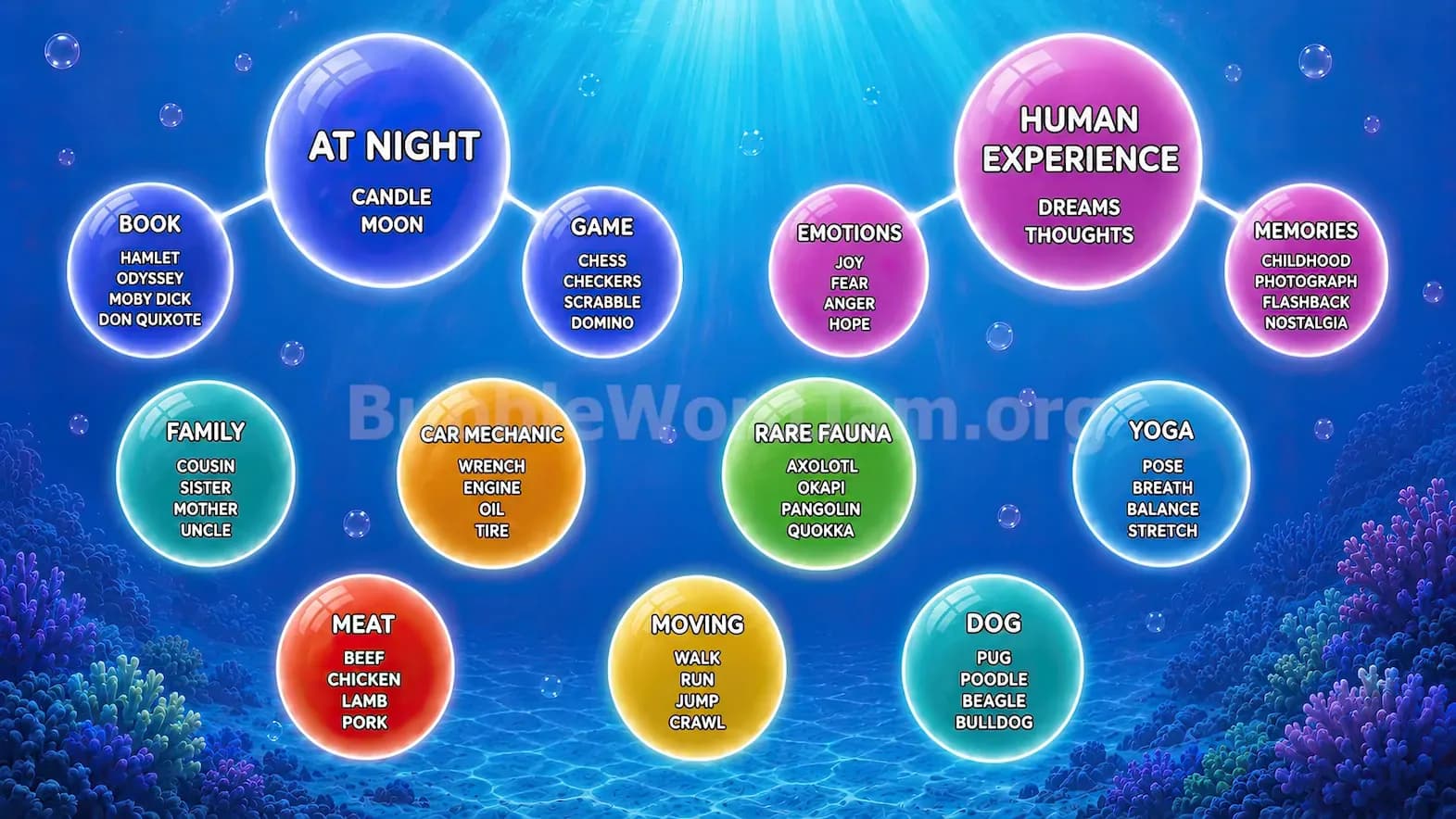
This parent-child structure matters. Memories can be an answer inside a broader category, while childhood and nostalgia belong under memories. Bubble Word Jam loves this nesting trick. Mind puzzles do it with abstract nouns, so don’t panic when the same idea appears at two layers.
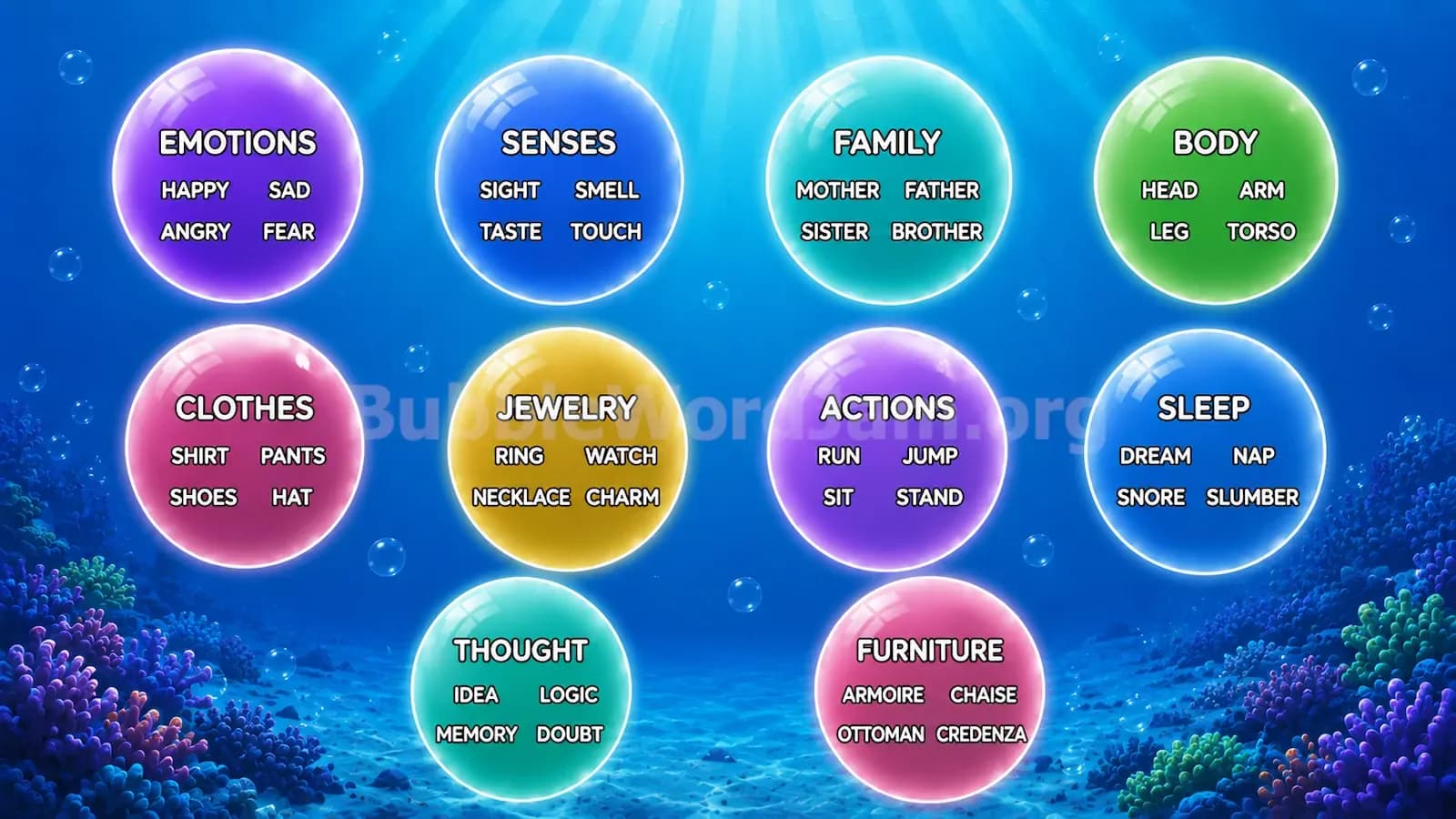
Level 234 sharpens the idea with thought: idea, logic, memory, and doubt. That set is not about feelings, even though doubt can feel emotional. The category is about mental content and reasoning. When you see logic on the board, it usually drags the group away from raw emotion and toward thinking.
Sleep words are another common wrong merge. Dream is the biggest culprit. In Level 6, sleep uses bed, dream, pillow, and blanket. That’s physical bedtime plus one mental word. In Level 234, sleep uses dream, nap, snore, and slumber. Here the theme leans into sleep actions and states.
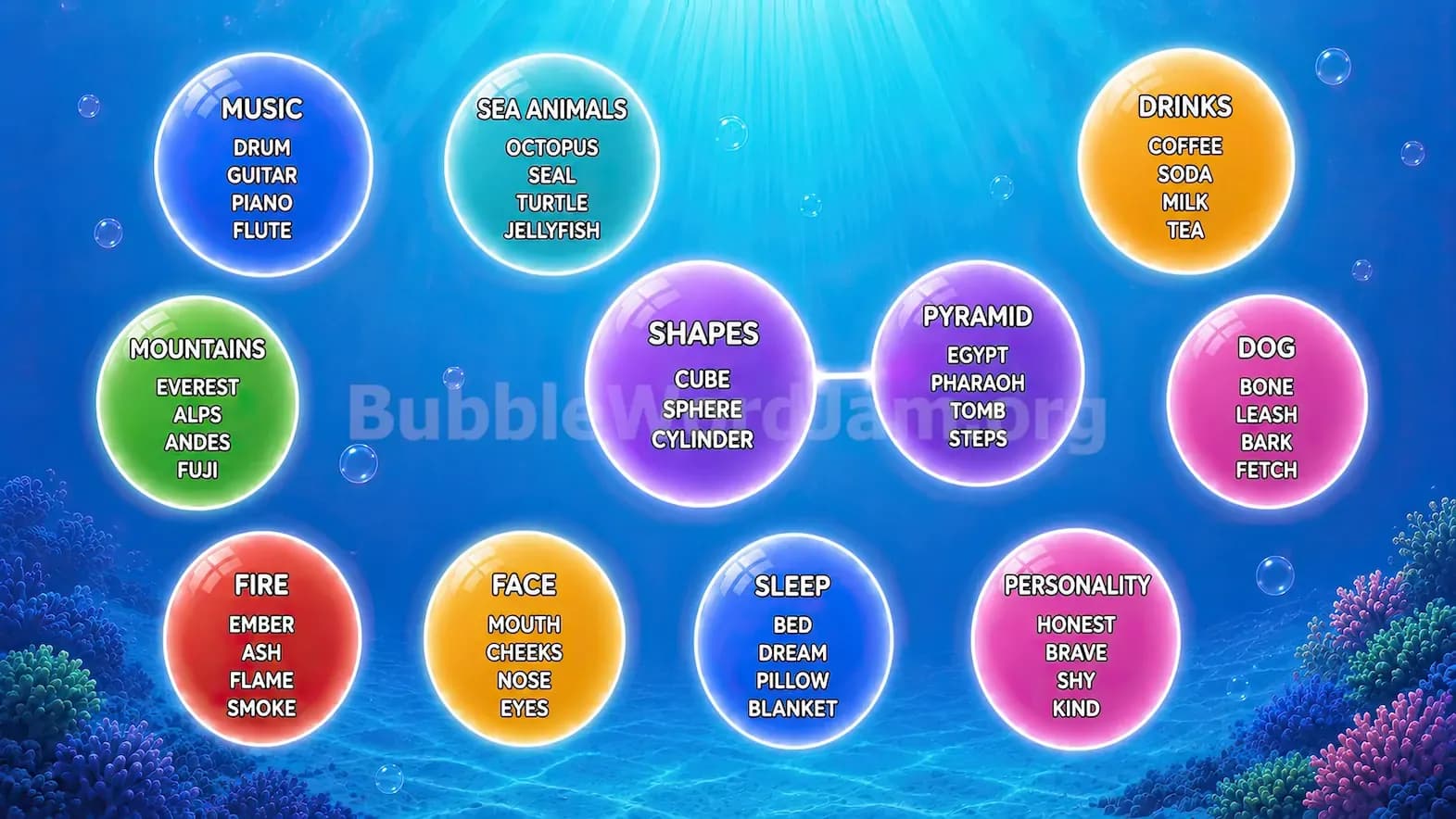
The trap is that dream can also look like memory, imagination, ambition, or human experience. Don’t let one poetic word hijack the category. Check its neighbors. If you see pillow, blanket, nap, snore, slumber, pajamas, or yawn, you’re probably in sleep territory. If you see childhood, photograph, flashback, and nostalgia, dream is not the anchor.
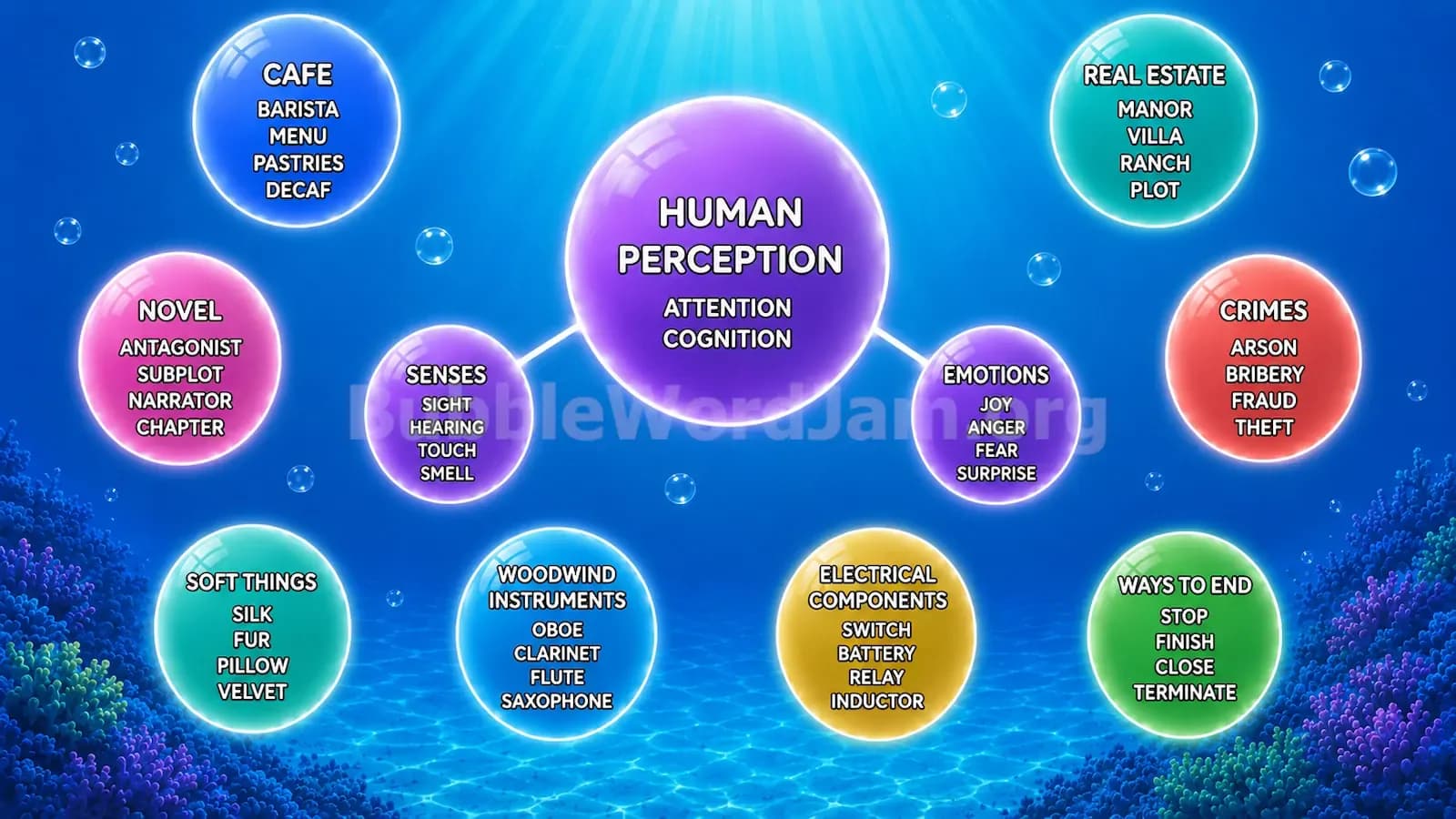
Level 276 is one of the clearest teaching moments for this theme. Human perception gathers senses, emotions, attention, and cognition. That set is broad, almost like a mind dashboard. But the same level also has separate senses and emotions groups. You can’t just throw sight, anger, attention, and cognition into one pile unless the board signals the parent category.
I treat perception words as “input and processing.” Sight, hearing, touch, and smell belong to senses. Attention and cognition describe how the brain handles information. Emotions describe reactions. They all live in the same neighborhood, but they don’t share the same apartment.
By Level 432, the game stops being cute about it. Psychology branches include cognitive, behavioral, clinical, and social. Those words are not moods. They’re fields or approaches inside psychology. The same board also includes university departments, where psychology sits beside chemistry, linguistics, and anthropology.
That overlap can mess with you. Psychology might be a school subject in one merge, while cognitive and behavioral build the branch category elsewhere. When academic words show up, scan for other department-style terms first. Chemistry, linguistics, anthropology, biology, sociology, and philosophy usually signal a university or discipline set. Clinical, social, behavioral, and cognitive signal psychology branches.
Here’s the solve order I trust when the board starts feeling mushy.
Start with concrete supports: sleep items, body senses, visible expressions, or obvious behaviors. These are less ambiguous than big abstract labels. Then separate raw emotions from moods or traits. Happy, sad, angry, fear, joy, hope, and surprise usually form emotional sets. Honest, brave, shy, and kind lean personality. Feelings, moods, emotions, and instincts may form a higher-level psychological states set, as in Level 285.
Next, hold broad labels until the end. Words like human experience, perception, psychology, memories, thoughts, and emotions can be parent nodes. Don’t spend them too early unless the board clearly gives you their children.
Finally, watch for category words hiding as playable words. Bubble Word Jam loves putting emotions inside human experience, then asking you to solve an emotions group separately. That’s the nasty but satisfying part of the loop.
For quick practice, use Level 6 for personality and sleep separation, Level 10 for basic mood recognition, Level 35 for parent and child emotion categories, Level 60 for memories and human experience, Level 234 for emotions, sleep, and thought, Level 276 for perception hierarchy, Level 285 for psychological states versus feelings, and Level 432 for academic psychology branches.
Together, these levels teach the full mind-category toolkit. You’ll learn to spot raw feelings, longer moods, personality traits, memory clues, sleep clues, perception terms, and formal psychology words without blending them into one messy bucket.
Mind puzzles in Bubble Word Jam are abstract, but they’re not random. They only feel like a shambling corpse when you merge by vibes. Slow down, sort the words by function, and ask what each group is doing: feeling, remembering, sleeping, perceiving, thinking, or studying the mind.
Once that clicks, these categories go from floaty to rock-solid. And honestly? That’s when Bubble Word Jam is at its best. It turns a tiny bubble board into a clever little psychology exam, then gives you that sweet “aha” hit when the last category snaps into place.