Learn how to solve Bubble Word Jam plant puzzles by spotting flowers, trees, seeds, gardening tools, plant parts, and ecosystem clues across levels fast.

Guide By Liam Stone
Updated on June 1, 2026
Liam Stone has been playing Bubble Word Jam since the mobile app first launched on the Apple App Store. He knew this game would pop, so he enjoys playing every level, collecting the answers, and running this site for other players. He loves mobile puzzle games and sometimes publishes his walkthroughs on his YouTube channel Puzzle Game Answer. Follow his channel if you are a puzzle game lover too.
Plant categories in Bubble Word Jam look harmless at first. A rose goes with flowers. Oak goes with trees. Seeds go with gardening. Easy, right? Then the game drops soil, watering, seedlings, flower, petal, stamen, compost, botany, alpine plants, and pollinators onto the same board, and suddenly the whole thing gets crunchy.
That’s why I like this theme. It’s one of the best common-knowledge lanes in Bubble Word Jam because it teaches a clean sorting habit: don’t just ask, “Is this plant-related?” Ask, “What layer of plant knowledge is this?” Soil is not a flower. Petal is not gardening. Bee is not a tree. The trick is to sort by hierarchy.
Think of plant puzzles as a ladder: plant → plant part → garden tool → growing material → ecosystem. Once you see that ladder, the vibe changes. You stop panic-dragging bubbles and start building the board like a tidy little greenhouse.
The biggest trap in Bubble Word Jam plant levels is mixing a root category with a part category. A root category names the whole thing: flowers, trees, plants, gardening, seeds, botany, garden. A part category names pieces, tools, or support systems: petal, stem, stamen, bud, root, trunk, bark, branch, soil, rake, hose, compost.
When I hit a plant-heavy level, I run a fast three-pass check. First, I look for complete living things: rose, tulip, oak, pine, fern, moss. Second, I look for components: petal, stem, root, trunk, bark. Third, I look for gardener words: rake, hose, watering can, shovel, compost, seeds.
It sounds simple, but it saves moves. Bubble Word Jam punishes sloppy merges because every merge costs a move, so treating “plant-related” as one big bucket can tank a run. The correct loop is narrower: identify the level of meaning before you merge.
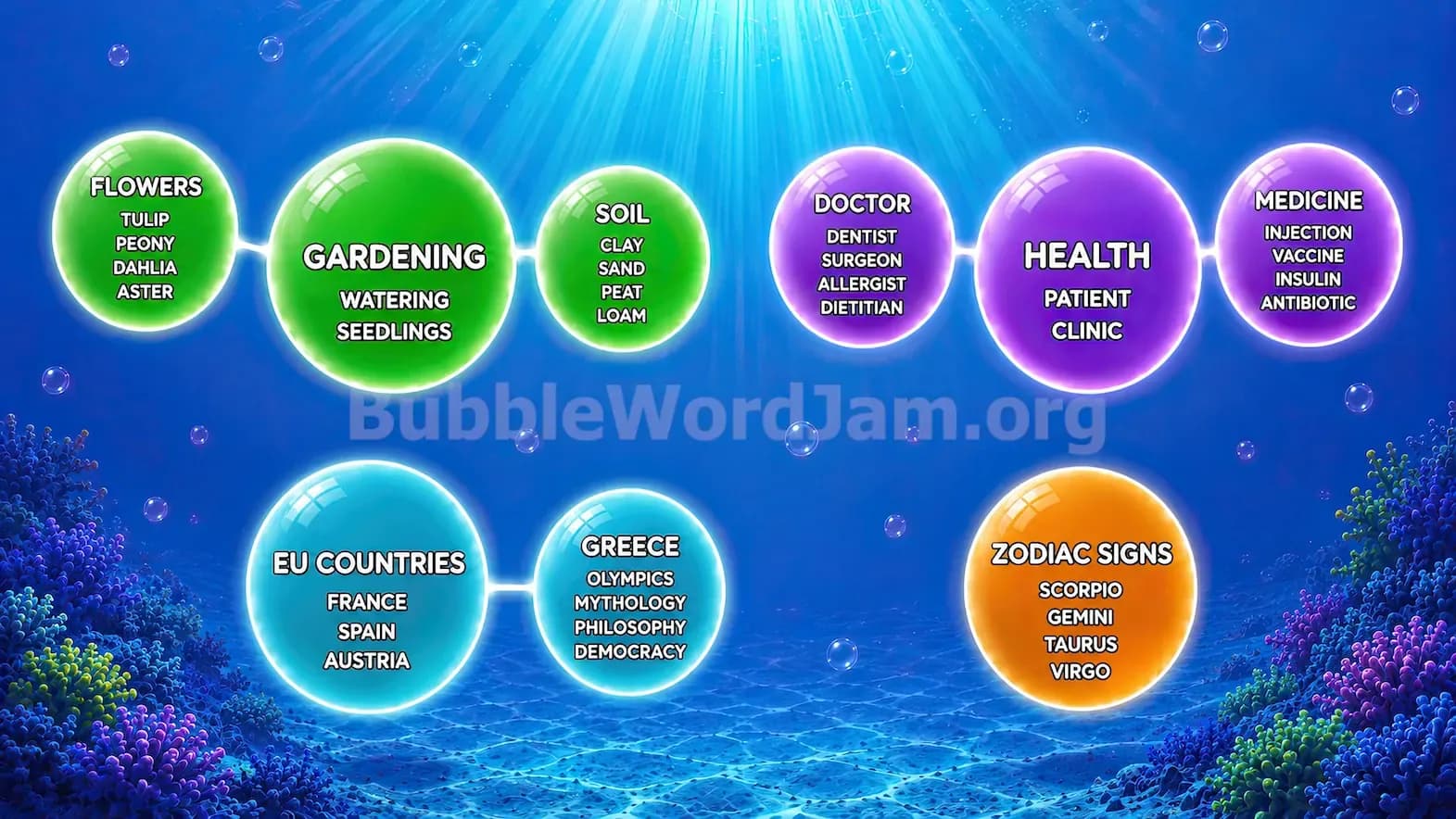
Level 16 is the clean tutorial version of this idea. It separates flowers from soil from gardening. Tulip, peony, dahlia, and aster form the flowers set. Clay, sand, peat, and loam form soil. Watering, seedlings, flowers, and soil form gardening.
That last category is the important one. “Flowers” and “soil” can become individual answers, but they can also act as items inside the broader gardening category. This is classic Bubble Word Jam hierarchy design: a category name at one level can become a playable word at another level.
My move here is to solve the narrow sets first. Lock flowers as individual flower types. Lock soil as soil types. Only then use the broader words flowers and soil for gardening. If you do it backward, the board gets floaty fast.
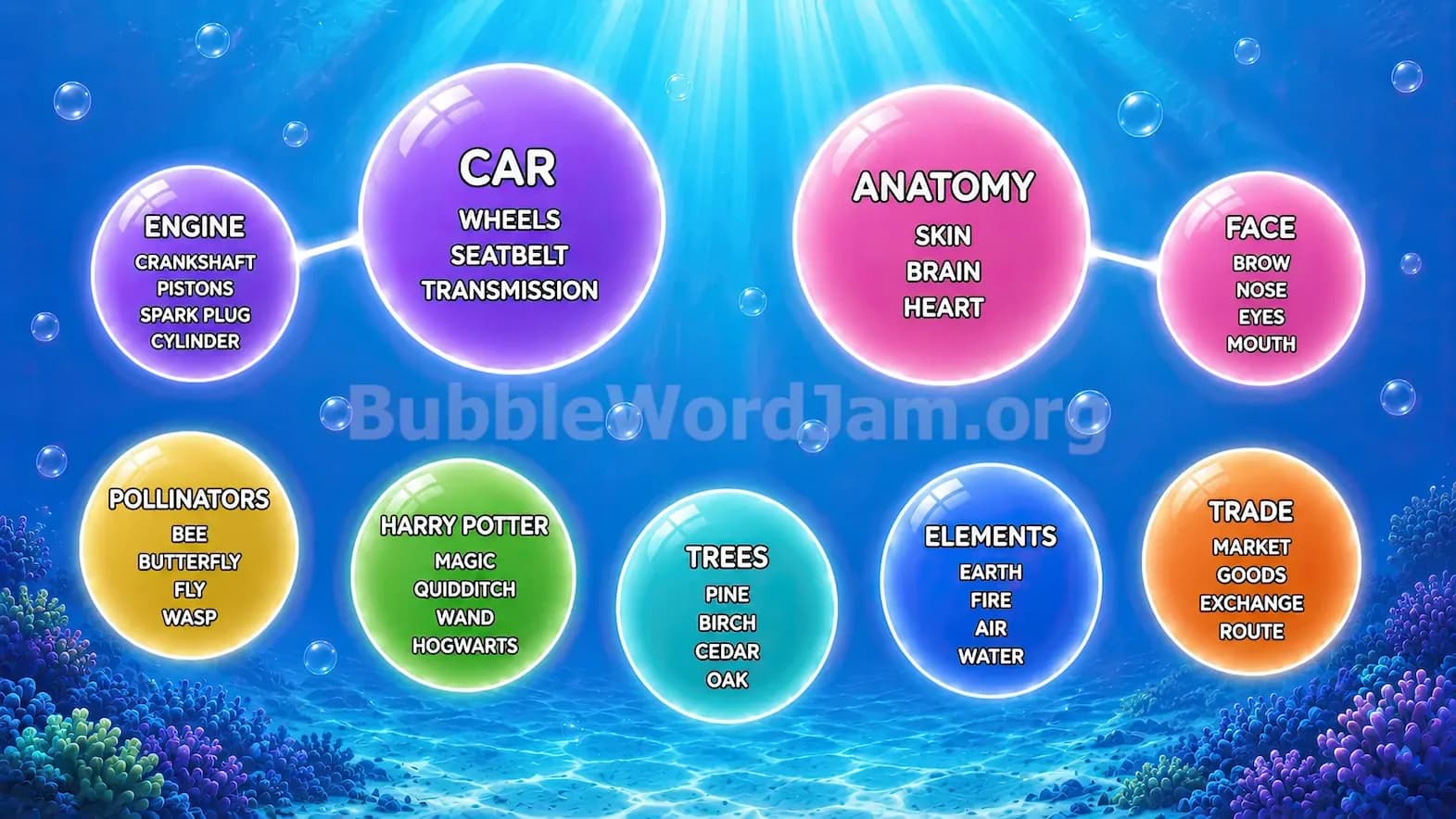
Level 25 adds a neat wrinkle with pollinators and trees. Bee, butterfly, fly, and wasp are not plants, but they orbit the plant ecosystem. Pine, birch, cedar, and oak are trees. The danger is not that players don’t know these words; the danger is that plant-world association gets too broad.
This is where I use an “actor vs. object” split. A tree is the object. A pollinator is an actor in the ecosystem. If the category is trees, you want plant names. If the category is pollinators, you want creatures that help reproduction. That difference sounds academic, but in-game it’s a banger shortcut.
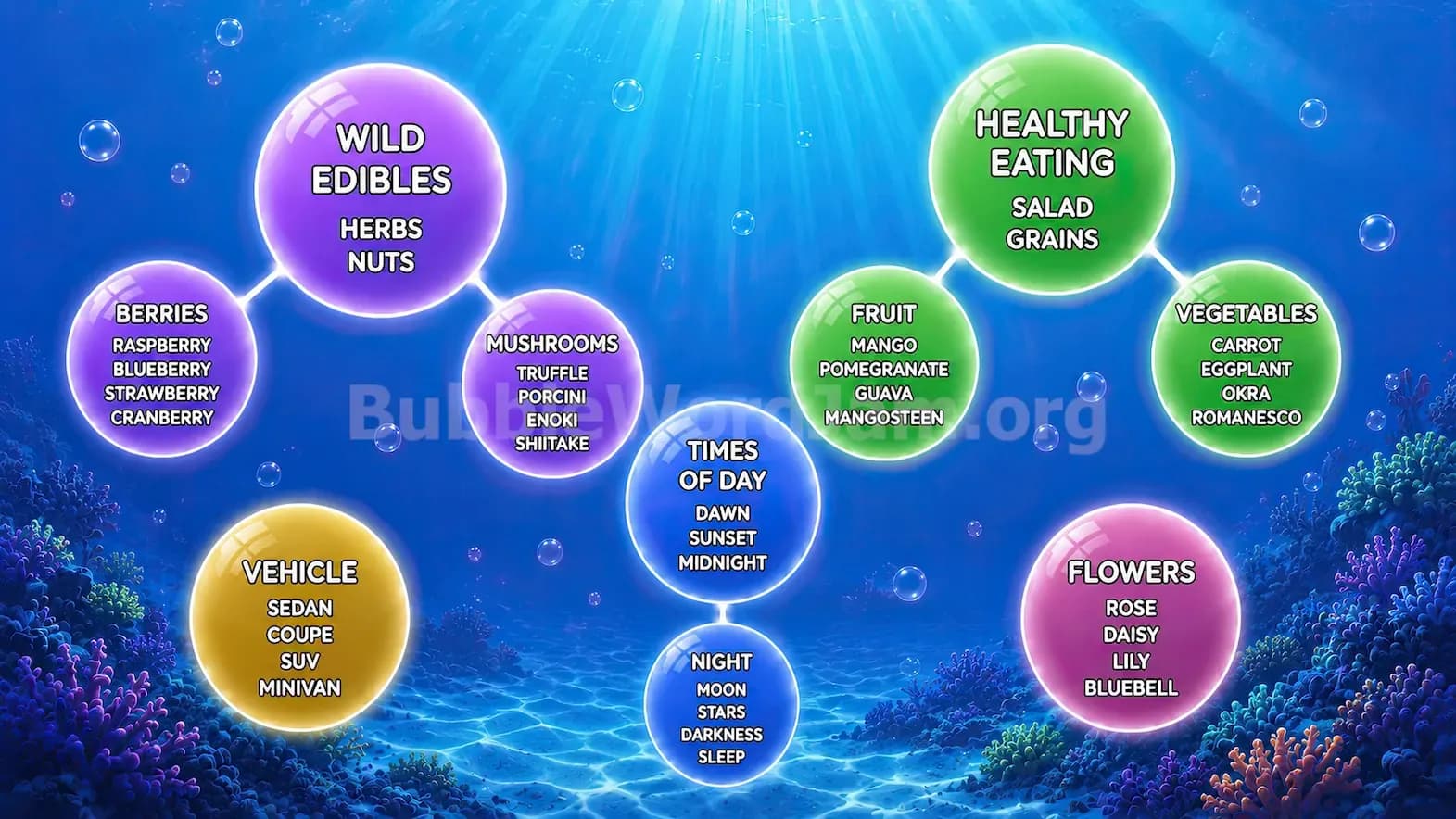
Level 37 is more chaotic and more fun. It includes mushrooms, wild edibles, healthy eating, berries, fruit, flowers, and vegetables. This is where the plant theme crosses into food knowledge. The puzzle is no longer just botany; it’s grocery-store logic, forest-foraging logic, and garden logic stacked together.
The clean solve path is to split by use case. Rose, daisy, lily, and bluebell are flowers. Carrot, eggplant, okra, and romanesco are vegetables. Raspberry, blueberry, strawberry, and cranberry are berries. Truffle, porcini, enoki, and shiitake are mushrooms. Then the broad category wild edibles can absorb berries, mushrooms, herbs, and nuts.
Again, Bubble Word Jam loves making completed concepts become ingredients in bigger concepts. “Mushrooms” can be a category, but mushrooms can also be one item in wild edibles. It’s a rehash of the Level 16 logic, only with more chances to overthink.
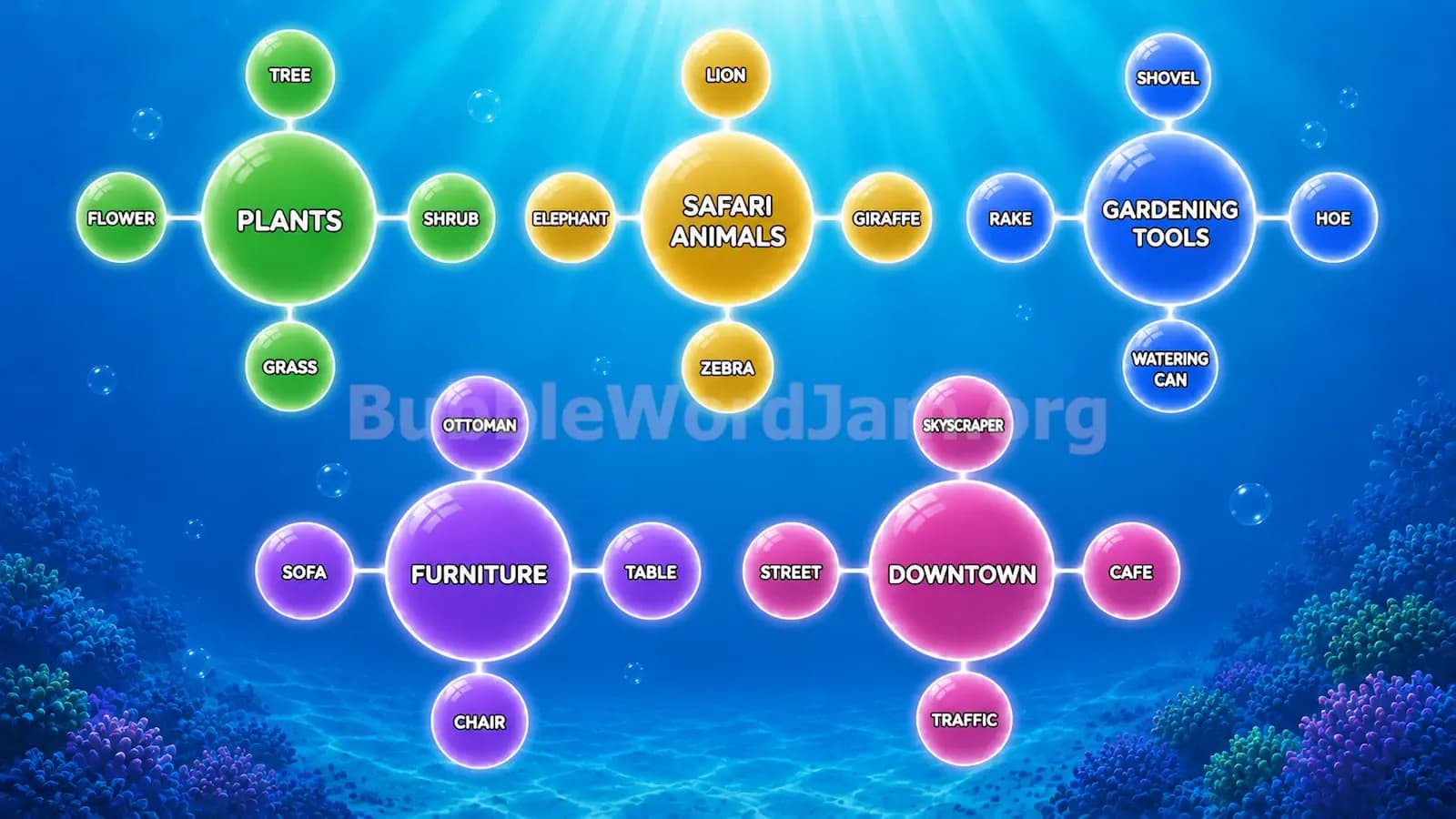
Level 116 keeps the plant side straightforward: tree, flower, shrub, and grass form plants, while shovel, rake, hoe, and watering can form gardening tools. This is the pure tool-recognition lesson. These are not living things; they are objects used to shape the garden.
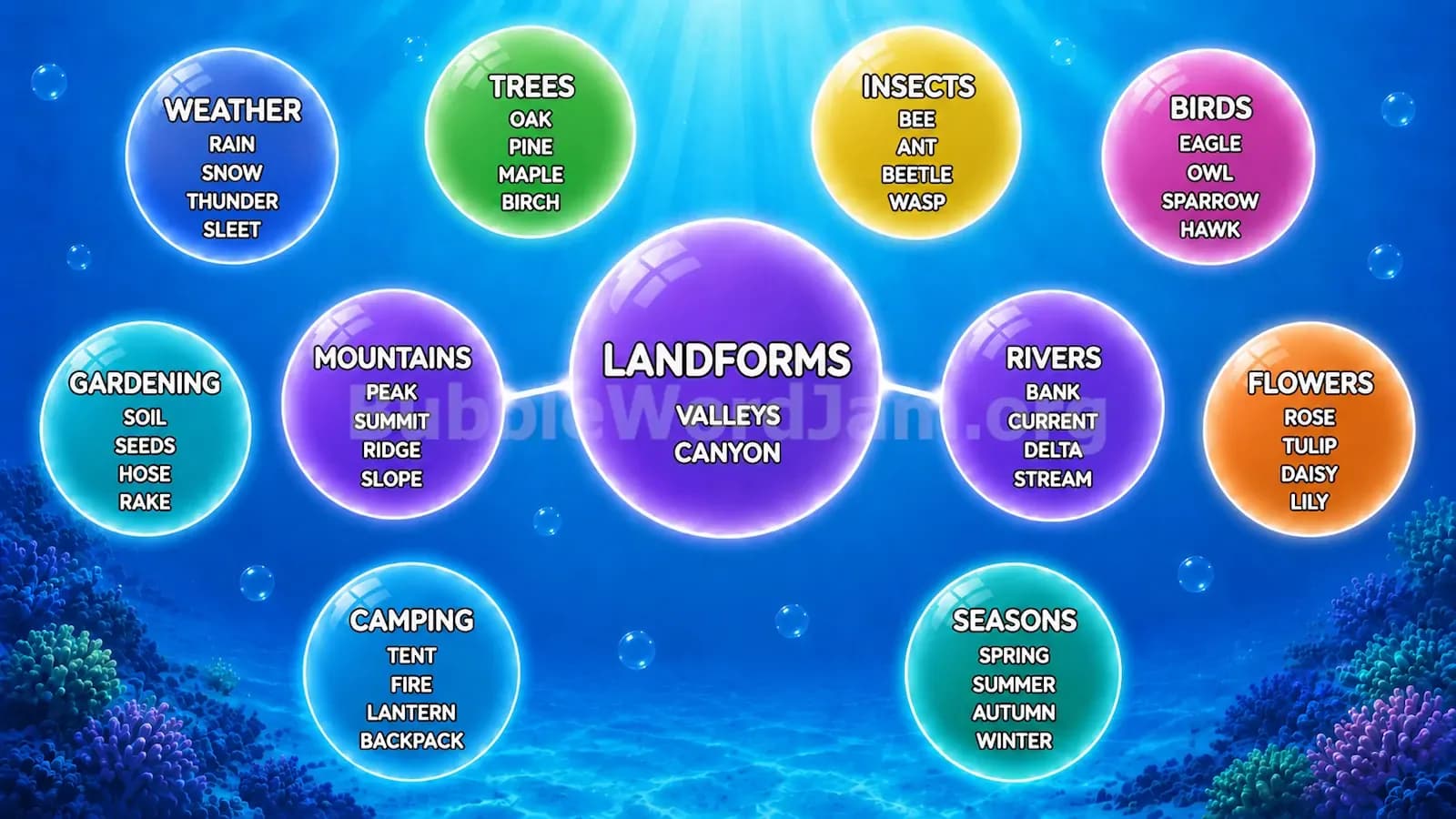
Level 232 makes the same idea broader. Trees are oak, pine, maple, and birch. Flowers are rose, tulip, daisy, and lily. Gardening is soil, seeds, hose, and rake. That category mix is sneaky because seeds and soil are materials, while hose and rake are tools. They still belong together because the root idea is “gardening activity.”
When you see that kind of mixed set, don’t demand that all four words be the same type of object. Bubble Word Jam often builds categories around a scene or activity. A garden scene can include materials, tools, and results.
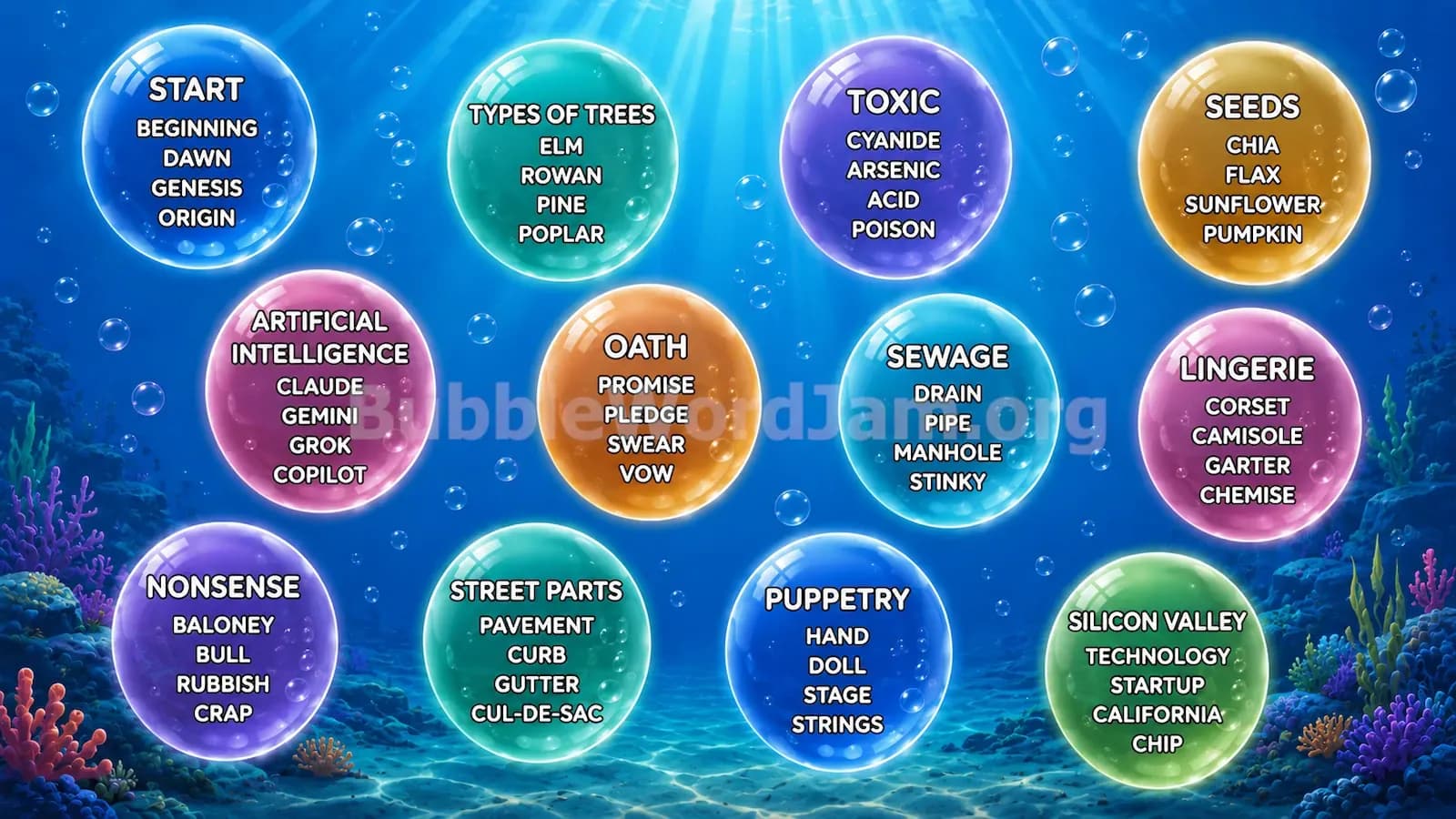
By Level 398, the game starts flexing. Types of trees includes elm, rowan, pine, and poplar. Seeds includes chia, flax, sunflower, and pumpkin. These are still common-knowledge categories, but they ask for cleaner vocabulary. You can’t just recognize “green things”; you need to know which words are tree species and which are edible or growable seeds.
Level 675 goes even harder with botany, natural sciences, and alpine plants. Botany uses phloem, stomata, chloroplast, and cambium. Alpine plants uses anemone, edelweiss, gentian, and saxifrage. I’ll be honest: this is where the game stops being a cozy garden stroll and becomes a crunchy science quiz.
The technique changes here. For botany-heavy boards, look for technical texture. Words like chloroplast and stomata have a biology-class vibe. Words like edelweiss and gentian sound like named plants. Natural sciences, meanwhile, can hold botany, chemistry, physics, and geology, so “botany” itself may be an item, not the final category.
Level 821 is a beautiful capstone because it puts garden, flower, and trees together. Garden contains soil, watering, compost, and flower. Flower contains petal, stem, stamen, and bud. Trees contains oak, willow, elm, and redwood.
This is exactly the hierarchy players should learn. Garden is the space or activity. Flower is a living plant type. Petal, stem, stamen, and bud are parts of that plant. Trees are a separate living plant group. If you merge “flower” too early with petal or stem, you might miss that flower itself belongs in garden.
My preferred solve order is anatomy first, species second, scene last. Build flower from the parts. Build trees from the tree names. Then place flower into garden alongside soil, watering, and compost. It feels clean because each merge moves from smaller meaning to bigger meaning.
Before merging plant words in Bubble Word Jam, pause for five seconds and classify each bubble into one of five roles: plant type, plant part, garden tool, growing material, or ecosystem actor.
Plant types include rose, tulip, oak, pine, shrub, grass, edelweiss, and gentian. Plant parts include petal, stem, stamen, bud, root, trunk, bark, and branch. Garden tools include rake, shovel, hoe, hose, watering can, and trowel. Growing materials include soil, clay, loam, peat, compost, and seeds. Ecosystem actors include bee, butterfly, fly, and wasp.
That checklist won’t solve every board by itself, but it gives you the right mental map. And in Bubble Word Jam, the mental map is half the battle.
Flowers, trees, seeds, and gardening levels work because they’re familiar, but they’re not brainless. The game keeps asking the same sharp question: are you looking at the whole plant, a part of the plant, the tool used on it, the material it grows in, or the ecosystem around it?
Once you learn that distinction, plant puzzles become much less messy. Level 16 teaches the basics. Level 37 tests food and wild-edible overlap. Level 232 sharpens garden-scene recognition. Level 675 brings the crunchy botany vocabulary. Level 821 ties it all together.
That’s the real triumph of this category. It takes common knowledge and turns it into a sorting loop that feels fair, readable, and satisfying when you finally see the root.