Learn how to solve Bubble Word Jam music puzzles by sorting instruments, genres, performers, and performance terms by sound source and role.

Guide By Liam Stone
Updated on June 19, 2026
Liam Stone has been playing Bubble Word Jam since the mobile app first launched on the Apple App Store. He knew this game would pop, so he enjoys playing every level, collecting the answers, and running this site for other players. He loves mobile puzzle games and sometimes publishes his walkthroughs on his YouTube channel Puzzle Game Answer. Follow his channel if you are a puzzle game lover too.
Music puzzles in Bubble Word Jam have a sneaky little rhythm to them. At first, they look simple: drum, guitar, piano, flute. Easy, right? That’s just “music.” But as the game starts layering in genre names, instrument families, instrument parts, performers, and performance terms, the loop gets a lot crunchier.
The trick is not to ask, “Is this related to music?” Almost everything in these puzzles is. The better question is: “What kind of musical relationship is this?”
That shift matters. A word like “violin” might belong with orchestra instruments. But in another puzzle, “fingerboard” and “tailpiece” point to violin parts. “Aria” can sit inside opera terms, while “soprano” may point toward singers or opera itself. “Jazz” could be a genre, a clue for upright bass, or part of a band/concert category. That’s where Bubble Word Jam gets its teeth.
The best way to beat music categories is to sort by sound source: strings, brass, percussion, voice, and genre. Once you hear the hidden category, the board stops feeling floaty and starts feeling like a banger little logic puzzle.
Early music puzzles often introduce the cleanest version of the category. Level 6 gives players a straightforward music group: drum, guitar, piano, and flute. This is the beginner-friendly version of the theme because all four words are recognizable instruments, and none of them need extra context.
When you see a set like this, don’t overthink it. Ask whether the words are objects that create sound. If they are, group them before chasing more abstract categories. Drum, guitar, piano, and flute may come from different families, but they share the same root category: musical instruments.
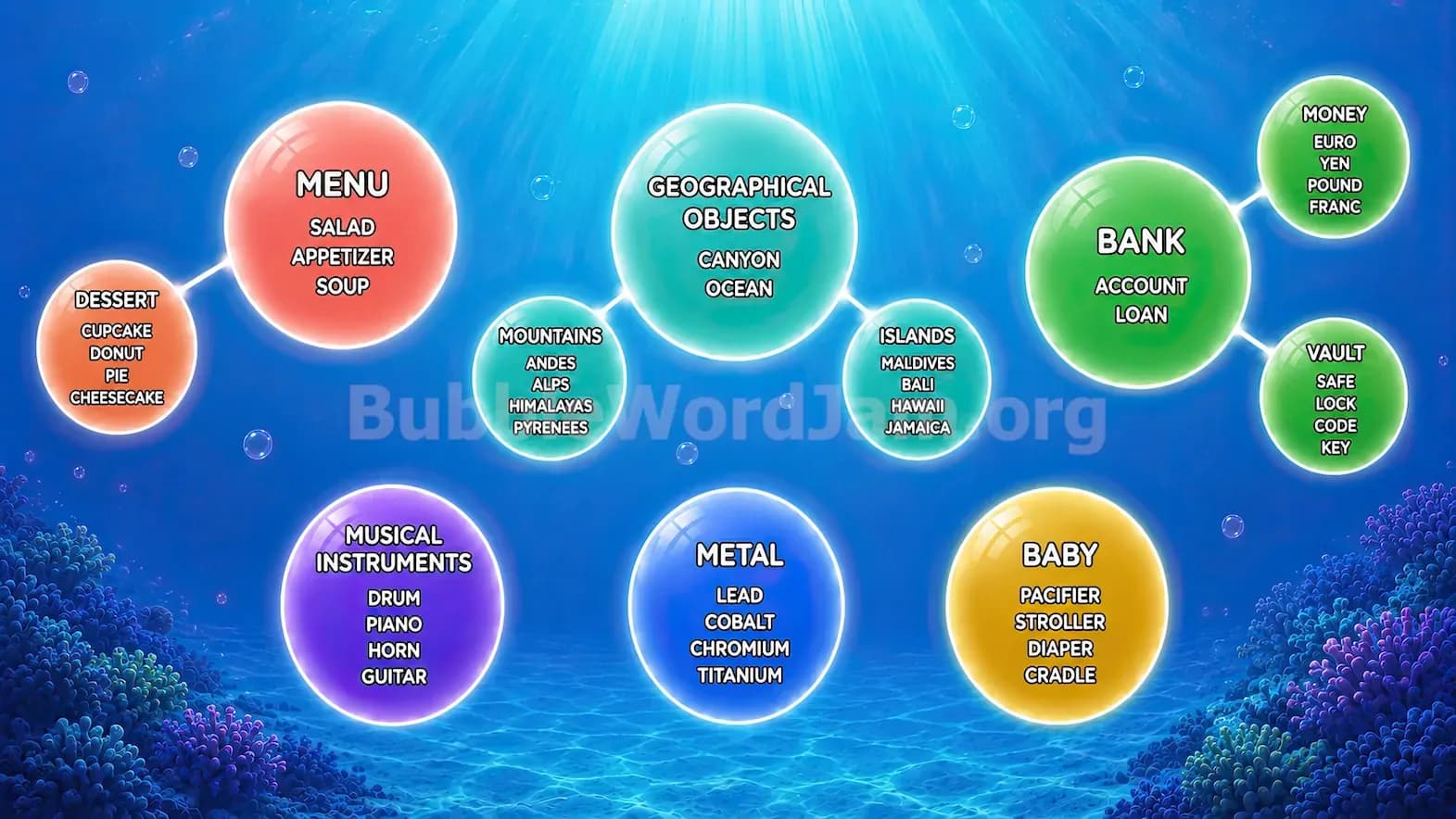
Level 18 uses a similar structure with drum, piano, horn, and guitar under musical instruments. The addition of “horn” is a small but important step up. It pushes the category beyond the usual school-music trio and starts nudging players toward instrument families. Drum is percussion. Guitar and piano involve strings in different ways. Horn belongs to brass. That mix is deliberate. Bubble Word Jam often uses broad categories by pulling one item from several subfamilies.
My rule: if the words are all playable sound-making objects, merge the broad instrument group first. Save the family sorting for later.
One of the most common traps in music puzzles is mixing genres with instruments. Level 138 makes this distinction clear. It includes a music category with jazz, rock, pop, and classical. Those are not instruments. They are styles or genres.
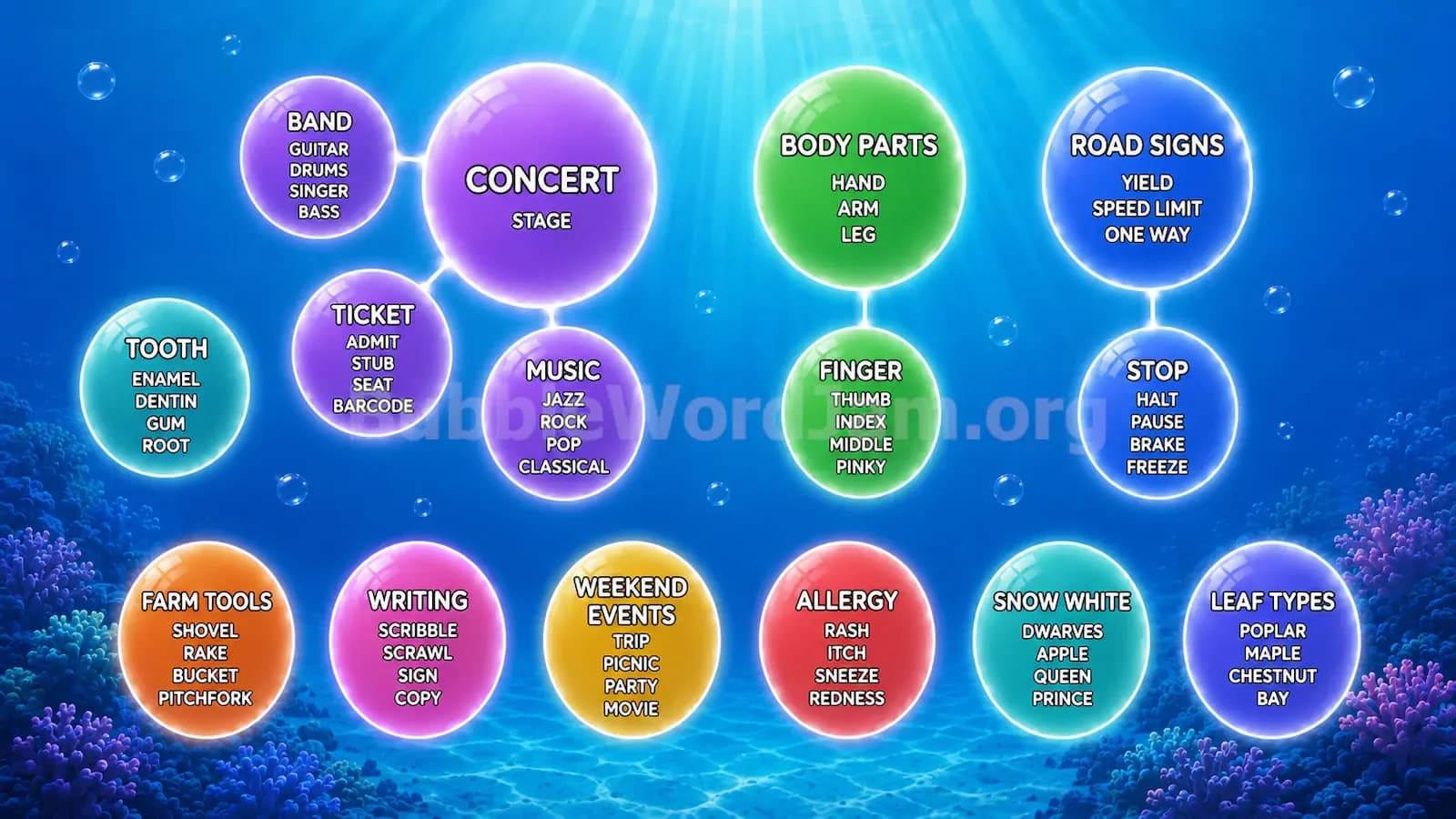
That same level also includes band: guitar, drums, singer, and bass. This is a totally different category. It describes the roles or components of a performing group.
This is where a lot of players waste moves. “Jazz” and “bass” feel related because jazz bass is a real thing. “Rock” and “guitar” feel glued together because rock guitar is iconic. But Bubble Word Jam usually wants the cleanest shared label, not the coolest association.
So when you see genre words, keep them together:
Jazz, rock, pop, classical = music genres.
Guitar, drums, singer, bass = band roles.
That difference is huge. Genres describe the vibe. Instruments and performers create the sound. If you separate vibe from source, the puzzle opens up fast.
When music puzzles get harder, I like to divide every clue into five buckets:
Strings: guitar, violin, cello, viola, bass, mandolin, banjo, sitar, koto.
Wind or brass: flute, oboe, horn.
Percussion: drum, drums.
Voice: singer, soprano, tenor.
Form or genre: jazz, opera, symphony, rock, pop, classical.
This isn’t just trivia. It’s a practical Bubble Word Jam move-saving tool. If you can quickly identify what kind of sound source a word points to, you avoid false merges.
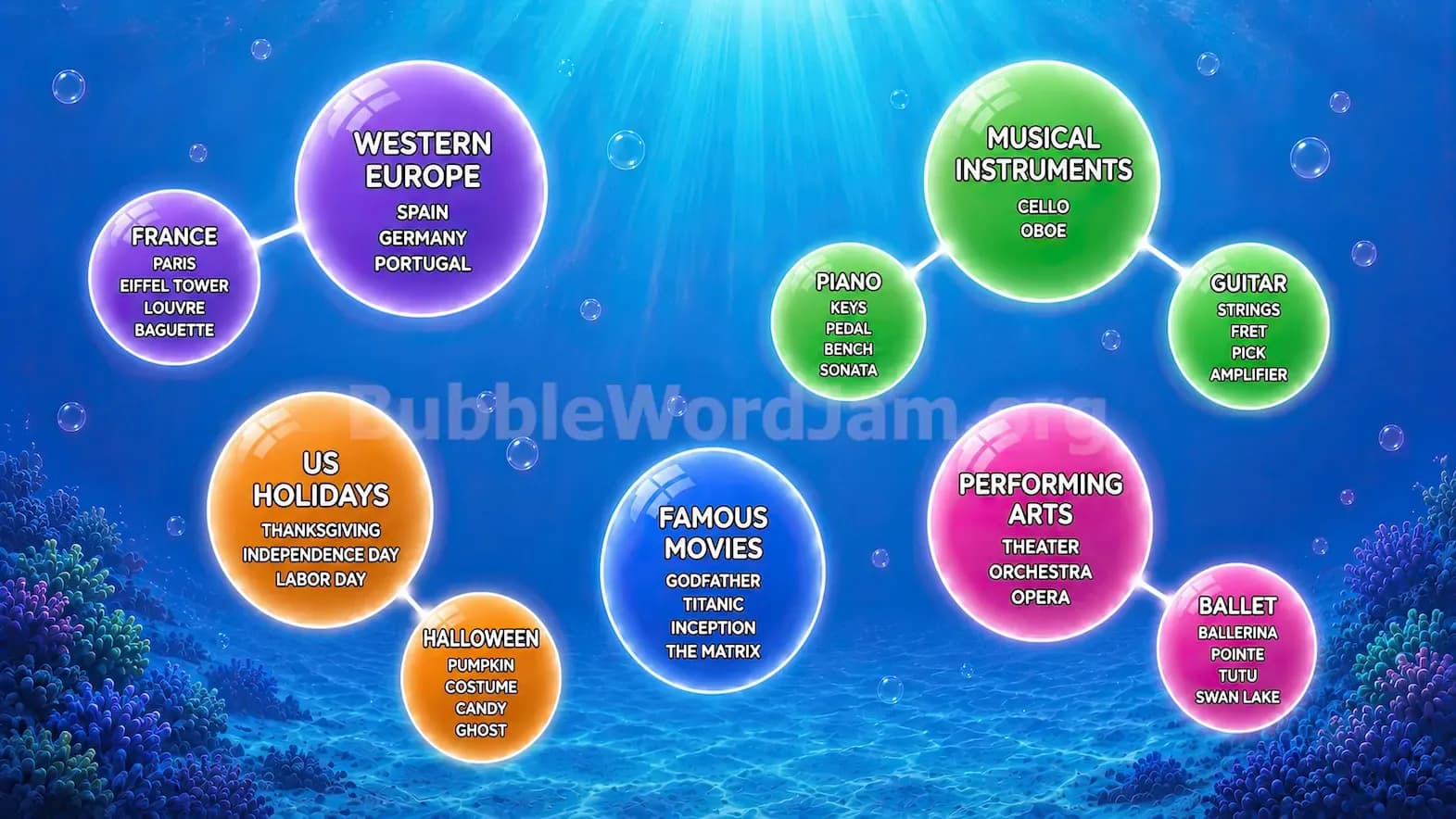
Level 72 is a great example. It includes musical instruments: piano, guitar, cello, and oboe. But the same puzzle also has piano as its own category with keys, pedal, bench, and sonata, plus guitar with strings, fret, pick, and amplifier. The game is testing whether you can spot root category versus part category.
Piano and guitar can be instruments in one group. But keys and pedal are piano-related parts. Strings and fret are guitar-related parts. That means you should not merge every music-adjacent word together. First decide whether the word is the instrument itself, a part of an instrument, a performance object, or a broader art form.
Instrument-part categories are some of the most satisfying music puzzles in Bubble Word Jam because they feel precise. They also punish sloppy sorting.
Level 72 gives guitar parts and accessories: strings, fret, pick, amplifier. It also gives piano clues: keys, pedal, bench, sonata. That last one, “sonata,” is a little spicy. It is not a physical piano part, but it belongs in the piano world as a musical form often associated with piano performance. That’s the kind of clue that can make players hesitate.
Level 674 goes even deeper with violin parts: scroll, fingerboard, soundpost, tailpiece. This is a much more specialized set. If you don’t know violin anatomy, the category can feel like a wall. But there’s still a logic path. “Fingerboard” strongly signals string instruments. “Tailpiece” and “soundpost” are too specific to belong with broad orchestra instruments. Once you see one highly specific part, look for the other anatomy words.
The key technique is to separate “the instrument” from “things attached to the instrument.” Violin, viola, cello, and flute may form an orchestra group. Scroll, fingerboard, soundpost, and tailpiece form the instrument-parts group. Same music world, different category layer.
Level 674 is one of the best music examples because it introduces a more advanced split: plucked instruments and bowed instruments.
Plucked instruments include mandolin, banjo, sitar, and koto. These instruments are strongly connected by how the sound is made: the strings are plucked, picked, or struck by the fingers or a plectrum.
Bowed instruments include violin, viola, erhu, and sarangi. These produce sound mainly through a bow drawn across strings.
This is the sort of Bubble Word Jam category that feels unfair until you learn the pattern. Then it becomes a triumph. The words are not grouped by geography, popularity, or orchestra status. They are grouped by playing technique.
That means “violin” and “mandolin” should not automatically merge just because they are both string instruments. One is bowed, one is plucked. “Sitar” and “koto” may come from different musical traditions, but the shared action is the clue. When in doubt, ask: how does the player make the sound?
By the time you reach examples like Level 591 and Level 747, Bubble Word Jam starts moving beyond instruments into performance vocabulary.
Level 591 includes opera: aria, soprano, stage, tenor. It also includes jazz: saxophone, bop, improvise, standards. Then it adds symphony: orchestra, maestro, movement, violin. These are not simple object groups. They are musical worlds.
Opera is built around voice, stage performance, and formal sung pieces. Aria is a solo vocal piece. Soprano and tenor are voice types. Stage anchors the performance setting.
Jazz leans on style and method. Saxophone is an iconic instrument, but the stronger clues are bop, improvise, and standards. Those words scream jazz vocabulary.
Symphony points toward orchestral structure. Orchestra, maestro, movement, and violin all sit naturally inside that formal concert tradition.
Level 747 sharpens this with opera terms: aria, libretto, overture, recitative. If you see multiple Italian-sounding or classical-performance words, don’t force them into “music” broadly. They may belong to opera specifically.
Orchestra categories usually gather instruments used in a formal ensemble. Level 747 includes orchestra instruments: violin, cello, flute, and viola. That set mixes strings and wind, which is why “sound source” alone is not always enough. Here, the better label is ensemble role.
This is a nice reminder: Bubble Word Jam does not always sort by one rule. Sometimes it sorts by family. Sometimes by setting. Sometimes by performance tradition.
So if you see violin, cello, viola, and flute together, ask whether the shared home is the orchestra. If you also see opera terms nearby, don’t panic. Opera and orchestra often overlap in real life, but the puzzle probably wants two clean sets: the terms of opera in one group, and the instruments of the orchestra in another.
When a music board gets crowded, I run this checklist:
First, pull out obvious instruments. Words like piano, guitar, drum, flute, violin, cello, horn, and oboe are usually safe anchors.
Second, split genres from objects. Jazz, rock, pop, and classical describe styles, not tools.
Third, identify performers and voices. Singer, soprano, tenor, maestro, and ballerina are roles, not instruments.
Fourth, look for parts. Keys, pedal, fret, strings, scroll, fingerboard, soundpost, and tailpiece point to specific instrument categories.
Fifth, check the performance world. Aria, libretto, overture, recitative, improvise, bop, standards, movement, and orchestra are terms that usually belong to opera, jazz, or symphony.
This method keeps your moves clean. And since every bubble merge costs a move, clean thinking is not just elegant; it’s survival.
Level 6 is the warm-up: music as a broad instrument category.
Level 11 adds instruments and guitar types, making it useful for learning the difference between a general instrument group and a more specific subcategory.
Level 18 reinforces musical instruments with a mixed family set: drum, piano, horn, and guitar.
Level 72 is one of the strongest training boards because it includes musical instruments, piano clues, guitar clues, ballet, and performing arts.
Level 138 teaches the split between concert, band, and music genres.
Level 591 is excellent for advanced sorting across opera, jazz, and symphony.
Level 674 is a banger for serious music categorization, with bowed instruments, plucked instruments, violin parts, mandolin clues, ballet movements, and Renaissance composers.
Level 747 ties everything together with orchestra instruments, opera terms, and upright bass vocabulary.
Music puzzles in Bubble Word Jam work because they turn common knowledge into category pressure. You’re not just recognizing words. You’re deciding whether they belong to a genre, an instrument family, a performer role, a concert setting, or a specific instrument’s anatomy.
That’s why the best solve technique is sound-source sorting. Strings, brass, percussion, voice, and genre give you a reliable first pass. After that, refine by role: instrument, part, performer, performance term, or style.
Once you start hearing the category behind the bubbles, the music puzzles stop feeling like a messy rehash of random terms. They become a tight, satisfying loop: spot the sound, sort the role, merge with confidence. And when a tough opera or violin-parts group finally clicks? That’s the exact kind of “aha” moment that makes Bubble Word Jam such a rock-solid word puzzle.