Learn how to solve Bubble Word Jam movie, theater, and pop culture categories by separating medium, venue, franchise, and performance clues before merging.

Guide By Liam Stone
Updated on June 24, 2026
Liam Stone has been playing Bubble Word Jam since the mobile app first launched on the Apple App Store. He knew this game would pop, so he enjoys playing every level, collecting the answers, and running this site for other players. He loves mobile puzzle games and sometimes publishes his walkthroughs on his YouTube channel Puzzle Game Answer. Follow his channel if you are a puzzle game lover too.
Entertainment categories in Bubble Word Jam can feel like a banger when everything clicks. You spot “popcorn,” “screen,” and “ticket,” and boom, the movie theater group practically solves itself. But these puzzles can also turn nasty fast because pop culture words love to overlap. “Opera” might be a venue clue, a performance type, or part of a broader performing arts group. “Animation” might describe a medium, while “Shrek” and “Toy Story” point toward animated movies. “Marvel” is not just entertainment; it’s a whole character universe.
That’s the real trick. Movie, theater, and pop culture puzzles don’t just ask, “Do you know this reference?” They ask, “What kind of reference is this?” If you rush straight into franchise thinking, you’ll burn moves on a floaty guess and tank the board. The cleaner play is to rule out medium categories first, then venue categories, then performance types, and only then lock in franchises or famous titles.
The biggest mistake I see in Bubble Word Jam entertainment puzzles is treating every familiar name like a franchise clue. I get the impulse. When “Iron Man,” “Hulk,” “Thor,” and “Captain America” appear together, the Marvel group is screaming at you. That one is safe. But when you see “movie,” “theater,” “animation,” and “opera,” you’re not looking at a franchise. You’re looking at show types.
That difference matters. A medium category describes how entertainment is delivered: cinema, animation, drama, comedy, thriller, movie, theater, opera. A franchise category describes a connected universe or brand: Marvel, Ice Age, Toy Story, Shrek, Finding Nemo. A venue category describes where entertainment happens: cinema, theater, opera house, circus, comedy club. A performance category describes what people do on stage or in front of an audience: ballet, orchestra, opera, circus, acting.
Before you merge, ask one blunt question: “Are these words formats, places, performances, or named works?” That question saves moves.
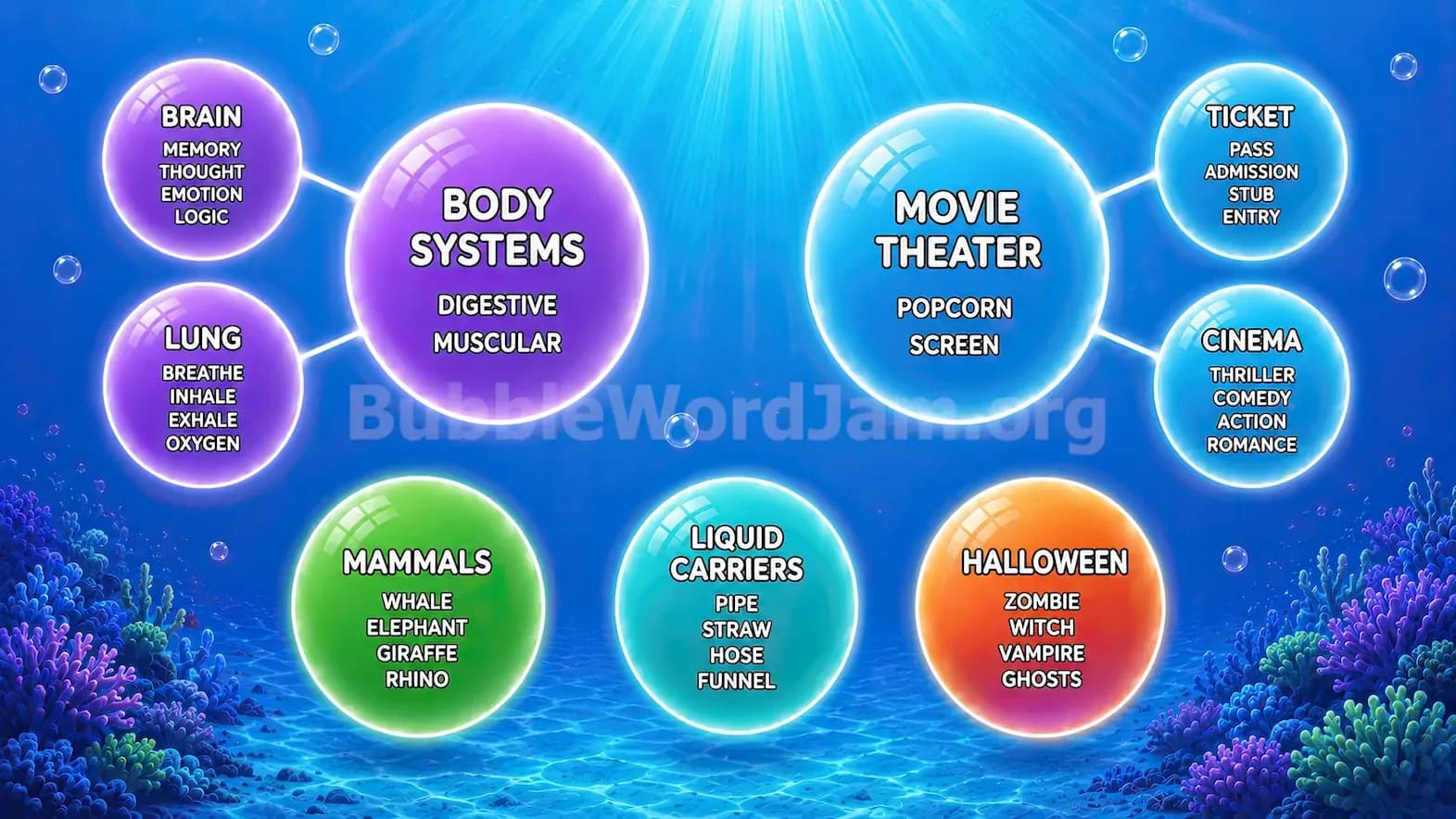
Level 19 is a clean warm-up for this whole entertainment loop. The puzzle separates “movie theater” from “cinema,” and that split is crunchy in the best way.
“Popcorn,” “screen,” “ticket,” and “cinema” belong to the movie theater group because they describe the venue experience. They’re the stuff around watching a film. But “thriller,” “comedy,” “action,” and “romance” belong to cinema because they describe movie genres.
The trap is “cinema.” It can feel like it belongs with movie types, but here it acts as part of the theater-going environment. That’s a classic Bubble Word Jam move: one word points upward into a parent category while other words point sideways into subcategories. Don’t panic. Look at the other three words. Popcorn, screen, and ticket all drag “cinema” toward the venue group.
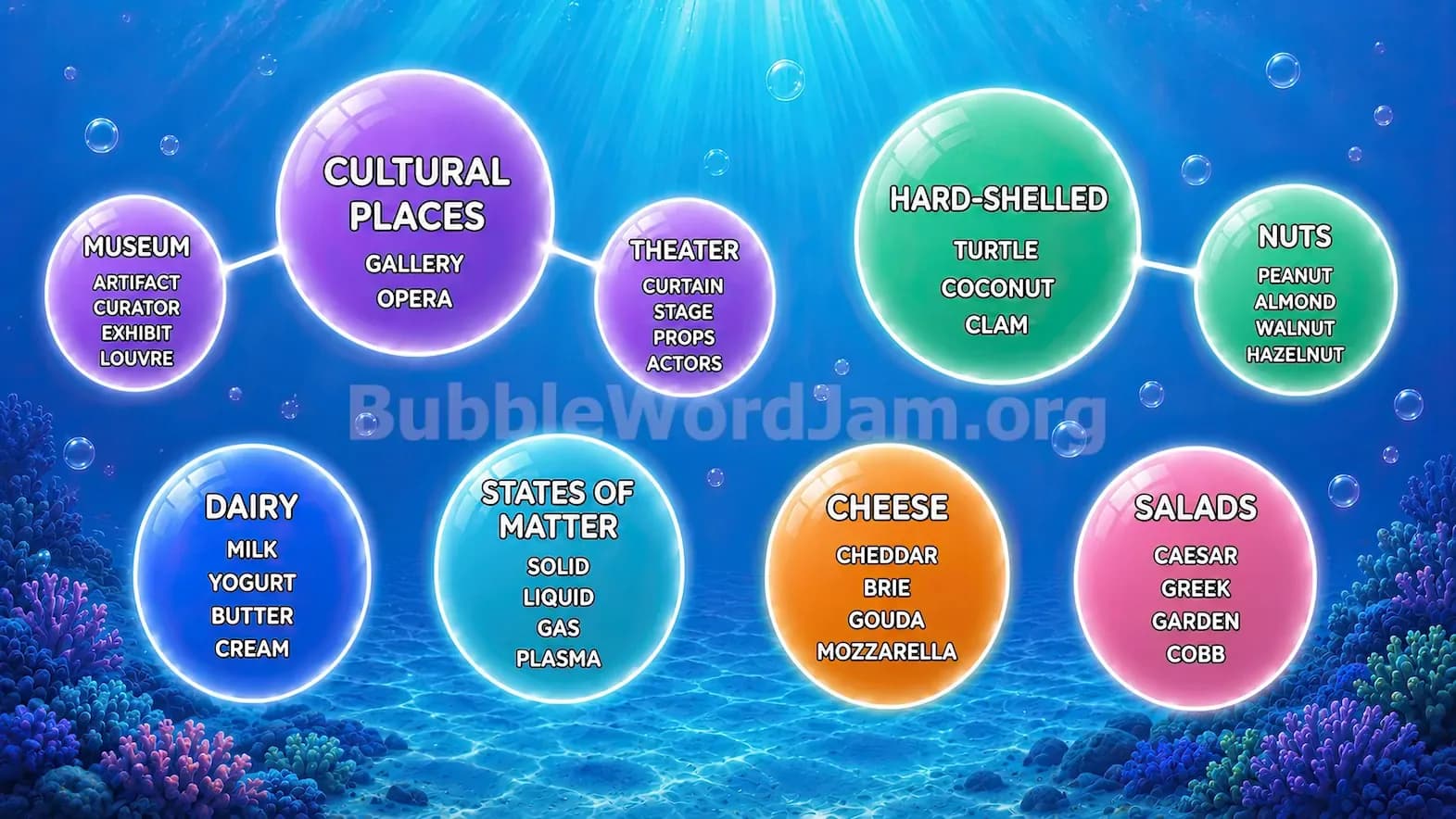
Level 23 adds another layer with “cultural places” and “theater.” This is where players who merge too quickly can get punished.
“Gallery,” “museum,” “theater,” and “opera” work as cultural places. They’re destinations. Meanwhile, “curtain,” “stage,” “props,” and “actors” form theater as a stage-production category. Same word family, different angle.
That’s the entertainment version of a root-category puzzle. “Theater” can be a building, an art form, or a production environment. In Bubble Word Jam, the winning move is to check the surrounding clues before deciding which version is active. If the clues are physical or professional objects like stage, props, and actors, you’re probably dealing with theater production. If the clues are places people visit, you’re dealing with cultural venues.
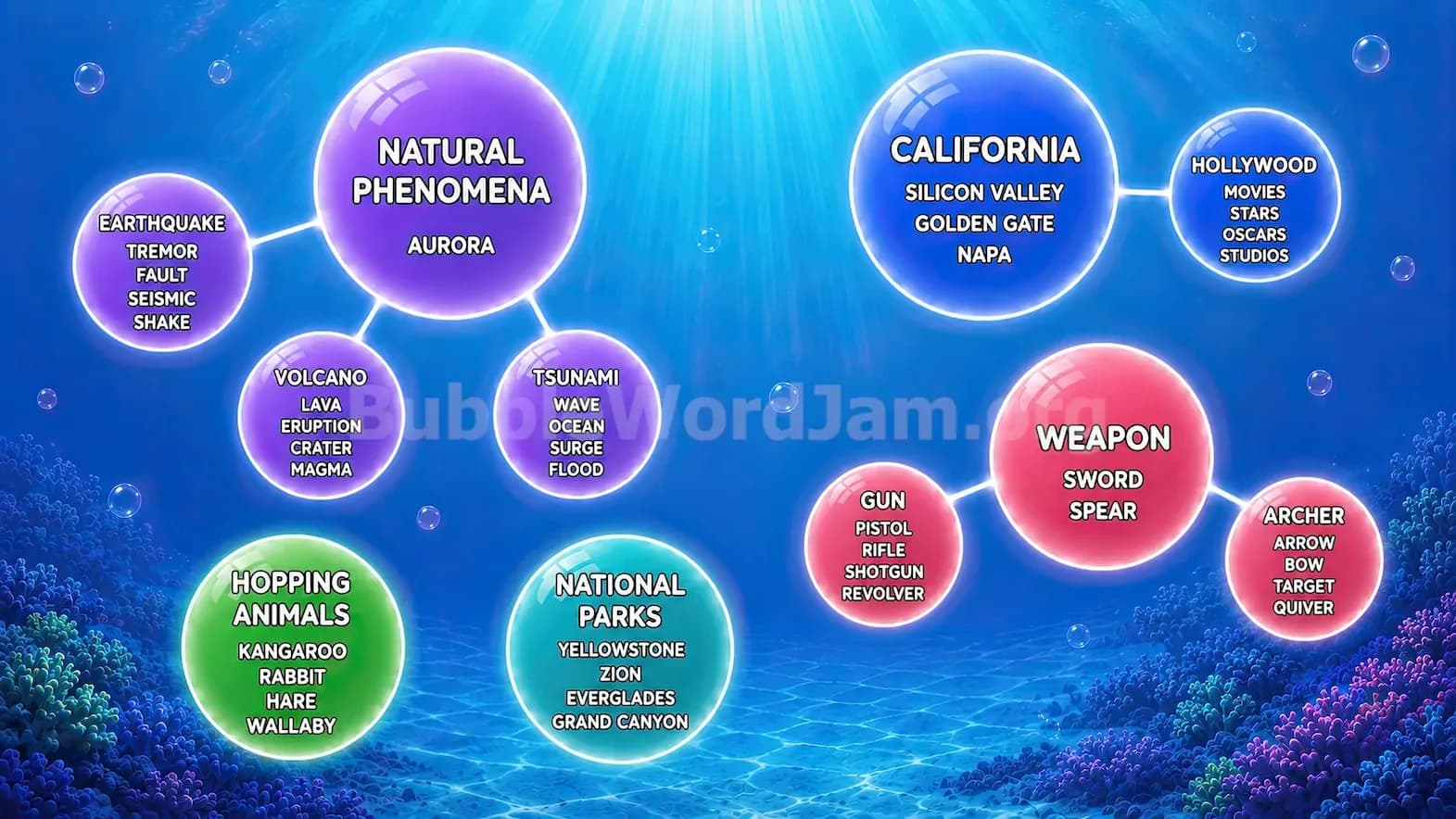
Level 33 uses Hollywood in a way that feels obvious at first, but it’s still worth slowing down. “Movies,” “stars,” “Oscars,” and “studios” build a Hollywood group. This is not a specific franchise. It’s an industry hub.
That distinction is important because Hollywood can tempt players into thinking about famous films, actors, or awards separately. But the actual category is broader. “Movies” is the output, “stars” are the celebrity layer, “Oscars” are the award layer, and “studios” are the production layer. Together, they create the Hollywood ecosystem.
When you see a pop culture location like Hollywood, Broadway, or Bollywood in Bubble Word Jam, treat it as a possible industry hub before you treat it as a named place. The game loves these umbrella categories because they test common knowledge without needing deep trivia.
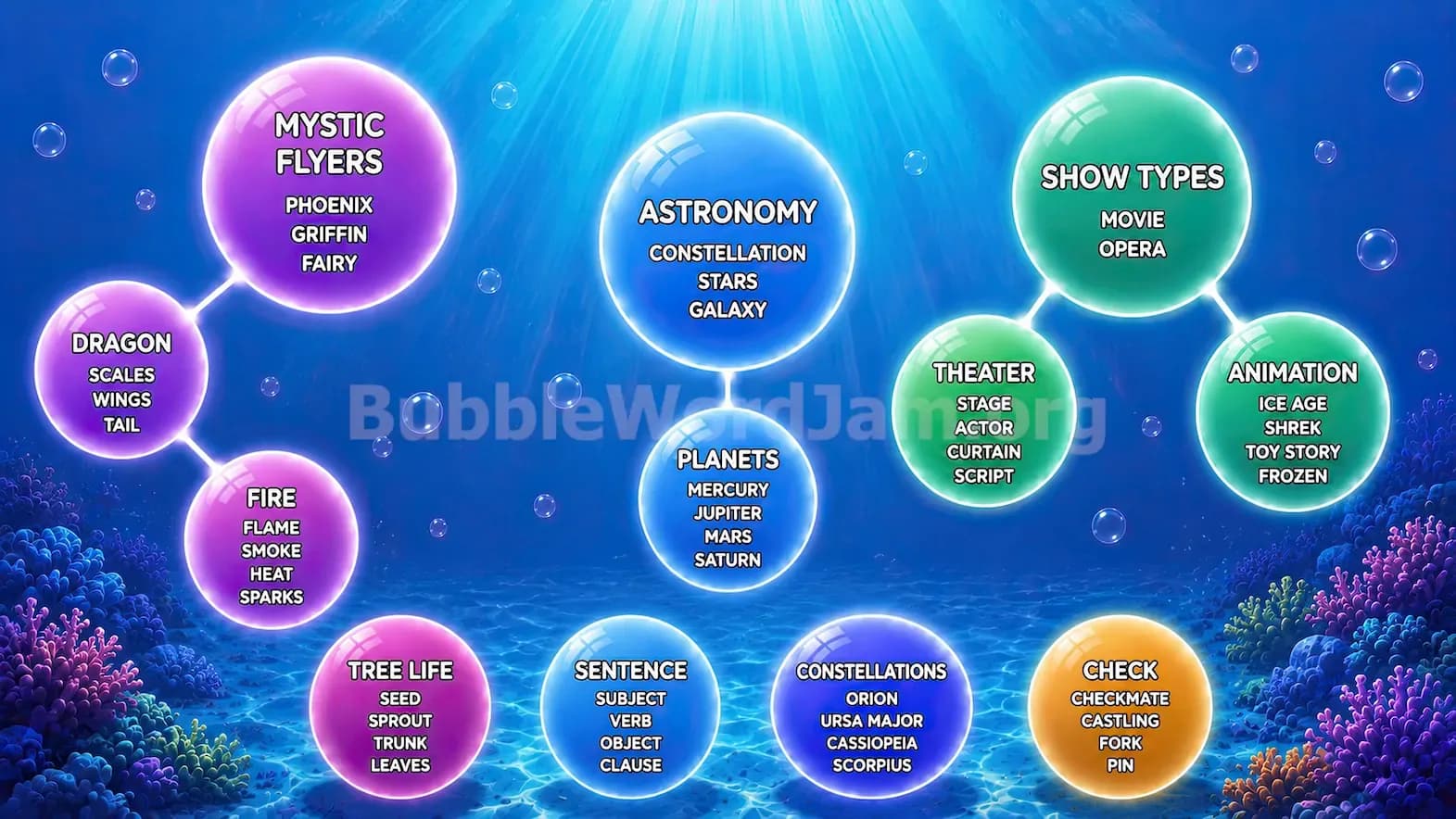
Level 70 is one of the best examples of why medium sorting matters. It includes “animation” with “Ice Age,” “Shrek,” “Toy Story,” and “Frozen.” That’s a named-work group: animated films. But the same level also includes “show types” with “movie,” “theater,” “animation,” and “opera.”
This is the exact moment where a careless player merges the wrong entertainment words and wonders why the board turned into a shambling corpse. “Animation” appears as both a category idea and a member of a broader category. Bubble Word Jam does this a lot. A word can be a parent in one group and a child in another.
The technique is simple: if the other clues are famous titles, group by franchise or work type. If the other clues are broad formats, group by medium. “Shrek” and “Frozen” tell you animation as a film category. “Movie” and “opera” tell you animation as a show type.
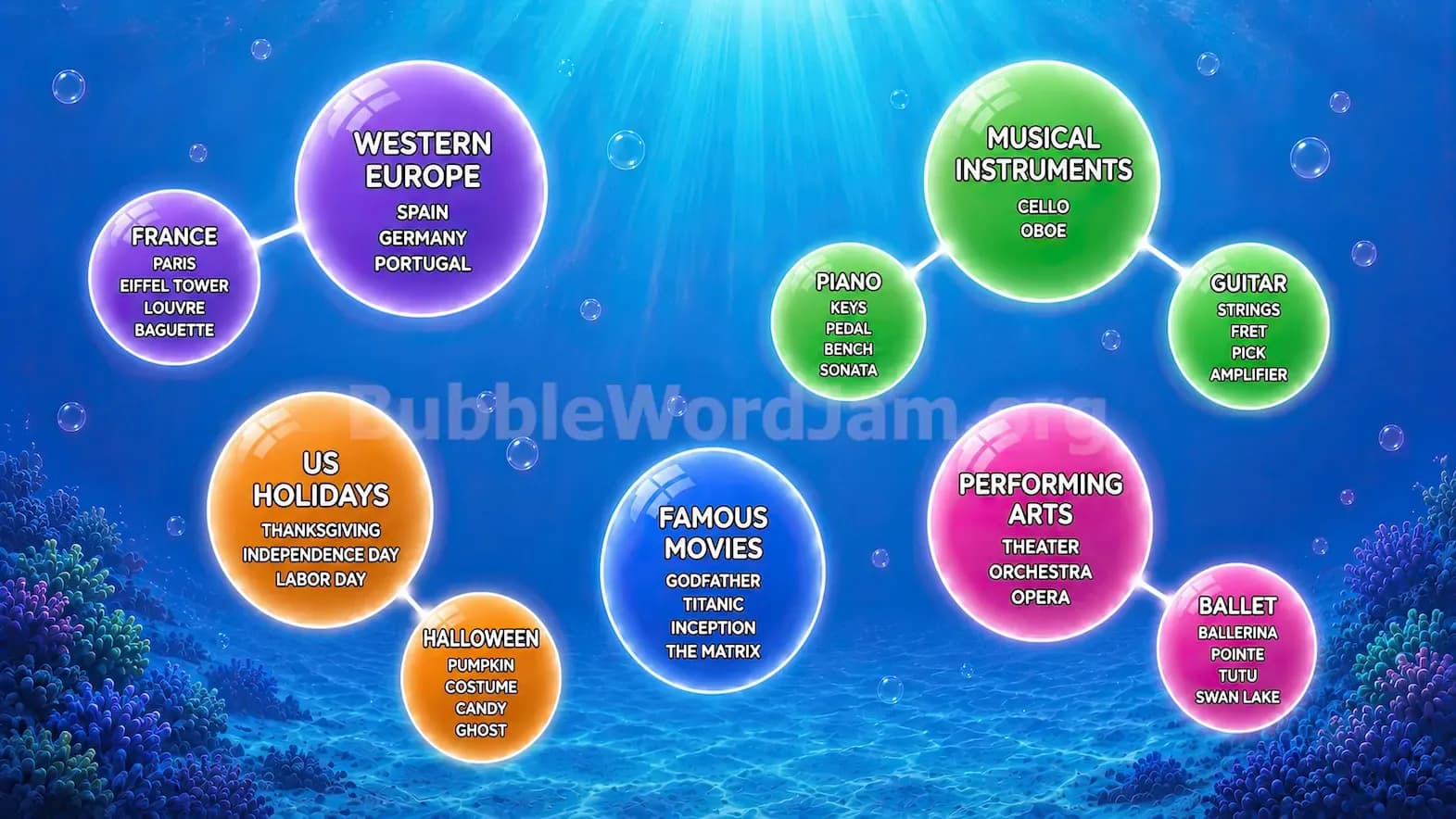
Level 72 brings in “famous movies” with “Godfather,” “Titanic,” “Inception,” and “The Matrix.” That’s a rock-solid category because all four are individual film titles. No venue, no genre, no performer type. Just named movies.
But the same entertainment zone also gives us “performing arts”: “theater,” “orchestra,” “opera,” and “ballet.” This group works differently. These are not specific works. They are performance traditions.
This is where Bubble Word Jam gets sneaky. “Opera” could be a venue clue, a genre clue, or a performance art. “Theater” could be a building or a live performance form. “Ballet” could point to dance, performing arts, or even a famous work like Swan Lake if the surrounding words support it. The best move is to identify the broadest shared identity. Here, they all belong to live performance culture.
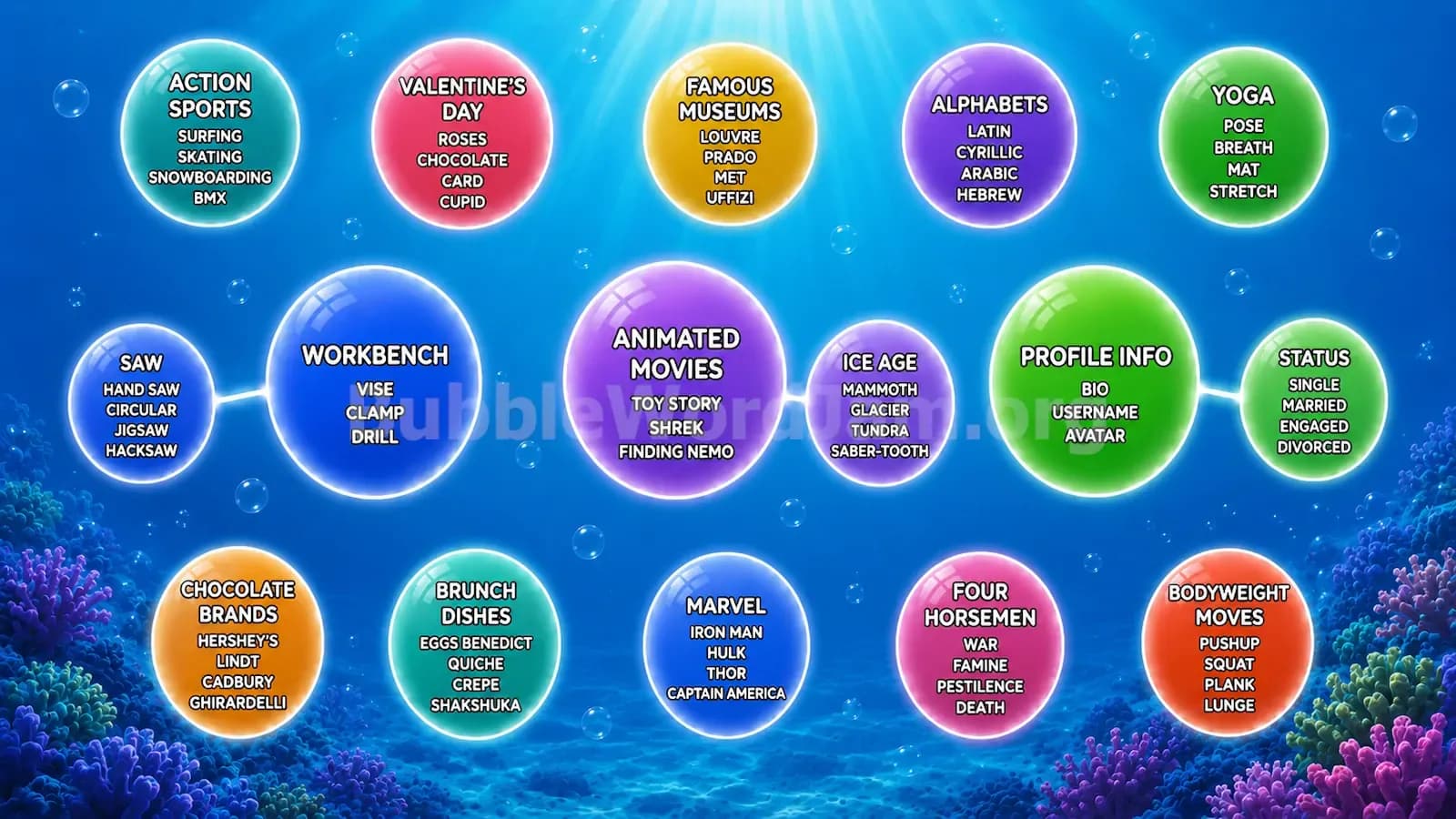
Level 165 is where franchise sorting finally earns its moment. “Ice Age,” “Toy Story,” “Shrek,” and “Finding Nemo” form animated movies. “Iron Man,” “Hulk,” “Thor,” and “Captain America” form Marvel.
This level teaches the opposite side of the rule. Once you have ruled out medium categories, franchise or universe categories become powerful. Marvel is not a medium. It’s not a venue. It’s a character universe. The four clues are characters associated with the same comic-book and movie brand, so the merge is clean.
The animated movies group is slightly different. It’s not one franchise; it’s a category of famous animated films. That means “Toy Story” and “Shrek” don’t need to share a studio or universe. They only need to share the medium and cultural role. Bubble Word Jam often asks for that level of grouping: not “same franchise,” but “same kind of pop culture object.”
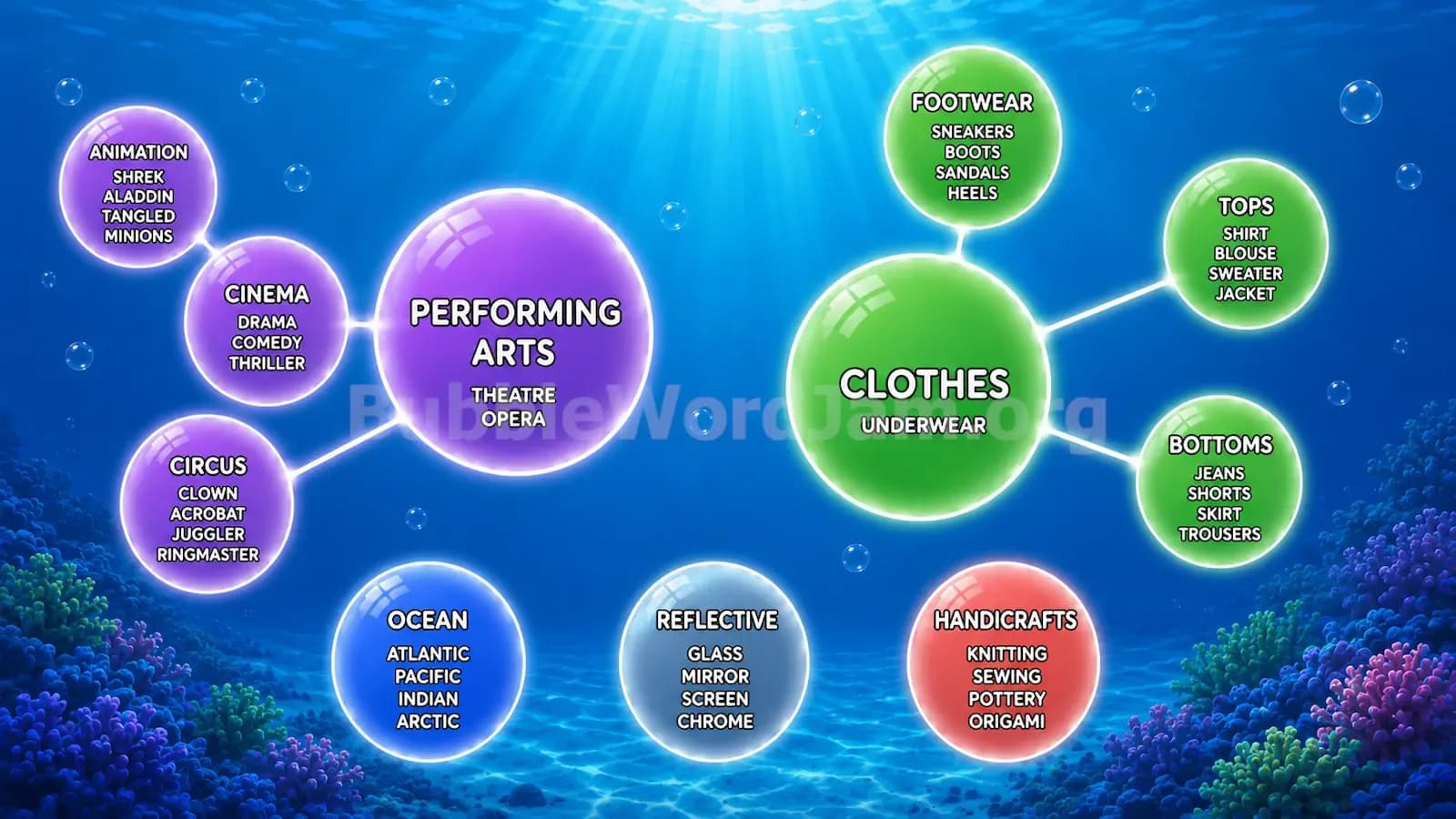
Level 222 is a proper entertainment stress test. “Performing arts” includes “cinema,” “theatre,” “opera,” and “circus.” Then “cinema” breaks down into “animation,” “drama,” “comedy,” and “thriller.” Then “animation” breaks down into “Shrek,” “Aladdin,” “Tangled,” and “Minions.” Then “circus” breaks down into “clown,” “acrobat,” “juggler,” and “ringmaster.”
This is a hierarchy puzzle, and I love it because it rewards patient sorting. The structure goes broad to narrow: performing arts → cinema → animation → specific animated titles. If you try to solve from the bottom only, you might still win, but the board feels messy. If you identify the parent categories first, the whole loop becomes cleaner.
The same logic applies to circus. “Circus” can sit under performing arts, but its internal clues are performer roles. That tells you to keep venue/performance labels separate from role labels.
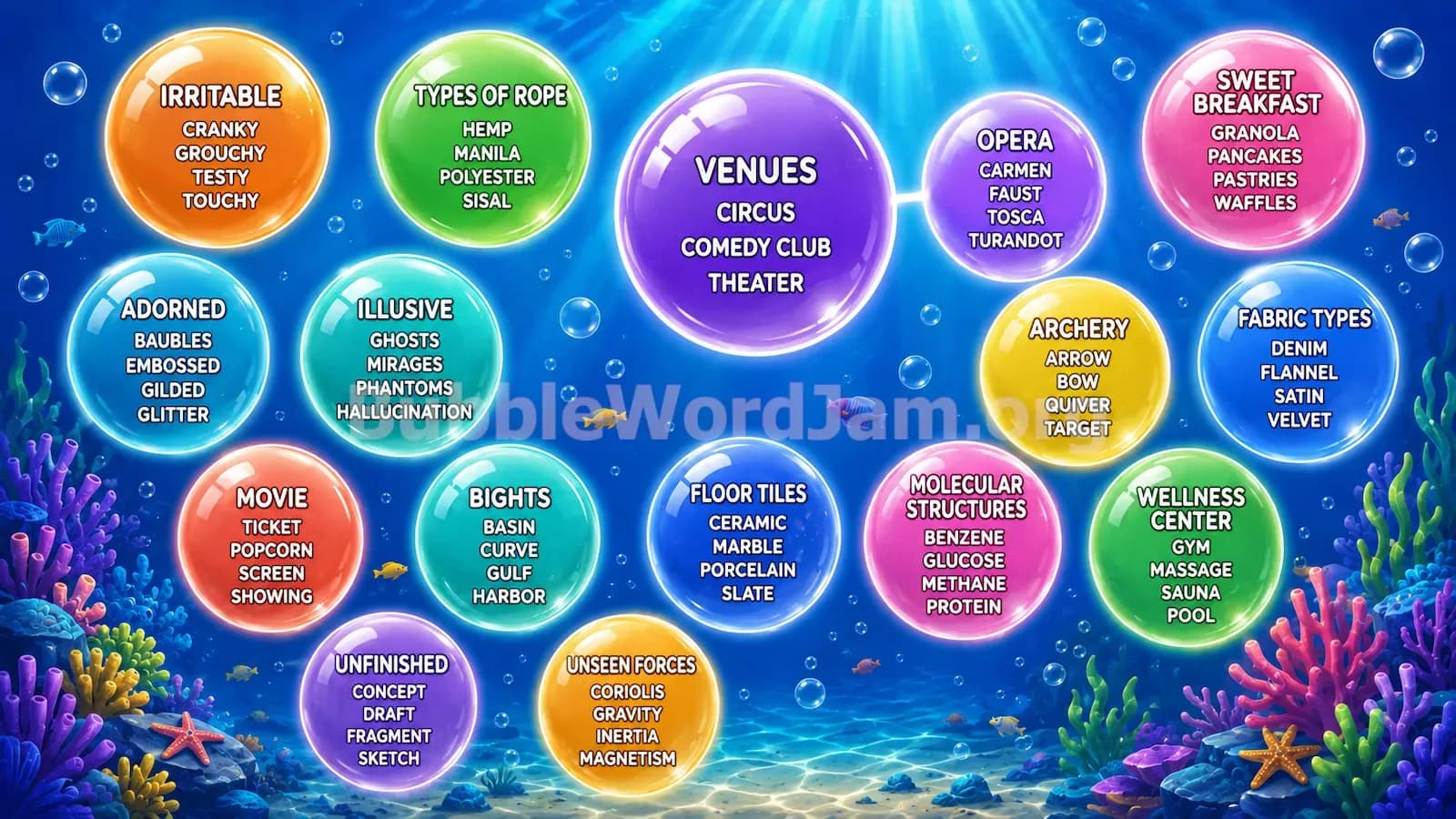
Level 415 is a late-game entertainment mix with three distinct lanes. “Circus,” “comedy club,” “opera,” and “theater” are venues. “Ticket,” “popcorn,” “screen,” and “showing” belong to movie. “Carmen,” “Faust,” “Tosca,” and “Turandot” belong to opera.
This level is brutal if you treat “opera” as only one thing. It appears as a venue-style word in one group, while famous operas form another. The safe approach is to separate general nouns from named works. “Opera” is general. “Carmen” and “Tosca” are titles. That alone prevents a bad merge.
Also notice how “ticket” returns from the movie theater logic, but here it sits with movie objects instead of the broader venue group. Bubble Word Jam reuses familiar entertainment clues, but the vibe changes depending on the surrounding set.
When a Bubble Word Jam entertainment category stalls, don’t guess. Run this quick mental checklist.
First, identify medium words: movie, cinema, animation, opera, theater, drama, comedy, thriller. These often describe format or genre.
Second, identify venue words: theater, cinema, circus, comedy club, opera. These answer “where does the audience go?”
Third, identify performance words: ballet, orchestra, actors, acrobat, juggler, ringmaster. These answer “who performs or what is performed?”
Fourth, identify named works or franchises: Titanic, Inception, The Matrix, Shrek, Aladdin, Marvel characters, Carmen, Tosca. These are usually narrower and should be grouped only after the broad categories are stable.
That order keeps the board from getting weird. Medium first, venue second, performance third, franchise last.
Entertainment puzzles in Bubble Word Jam work because they mess with recognition. The famous words pull your eye first. I see “The Matrix” and my brain wants to merge movie titles immediately. I see “Thor” and I want the Marvel group right now. Sometimes that’s correct. Sometimes it’s bait.
The smarter play is to treat pop culture like a category tree. A movie can belong to cinema. Cinema can belong to performing arts. A theater can be a venue, but theater can also be a performance form. An opera can be a venue clue, a performance type, or a named-work category depending on the neighboring bubbles.
Once you start sorting by role instead of recognition, these levels become much less chaotic. You stop chasing references and start reading the puzzle’s structure. That’s when Bubble Word Jam feels less like trivia and more like a satisfying little logic machine.