Learn how to solve Bubble Word Jam money, banking, economy, and business categories by tracking value flow: earn, store, pay, trade, redeem, and invest well.


Guide By Liam Stone
Updated on July 22, 2026
Liam Stone has been playing Bubble Word Jam since the mobile app first launched on the Apple App Store. He knew this game would pop, so he enjoys playing every level, collecting the answers, and running this site for other players. He loves mobile puzzle games and sometimes publishes his walkthroughs on his YouTube channel Puzzle Game Answer. Follow his channel if you are a puzzle game lover too.
Money puzzles in Bubble Word Jam have a sneaky rhythm. At first glance, they look simple: coins go with cash, banks go with vaults, and tickets go with entry. Then the game starts mixing category anchors into other categories, and suddenly “money” is not just a category. It is also a word inside “bank.” “Vault” is not just a place. It can become its own security-themed group. That is where these levels get crunchy.
The best way to beat money, banking, economy, and business categories is to stop treating them as random finance words. Instead, follow the value-flow logic: earn, store, pay, trade, redeem, and invest. A dollar pays. A vault stores. A coupon redeems. A trade exchanges. A stock invests. That mental shift can save a run before it tanks.
In Bubble Word Jam, money and business words usually sit in five lanes. Value is earned through jobs, profits, or economic activity. It is stored in banks, accounts, deposits, vaults, safes, or locks. It is paid through cash, coins, credit, cards, or named currencies. It is traded through goods, exports, exchange, deals, and deficits. It is redeemed through tickets, coupons, vouchers, tokens, and access passes.
That sounds obvious until a level throws “ticket,” “money,” “vault,” and “trade” onto the same board. The trick is to identify whether the word is a thing, a place, an action, or a system. “Yen” is a thing: a currency. “Bank” is a place or institution. “Deposit” is an action. “Economy” is a system. Sorting by function gives you a cleaner loop than sorting by vibe alone.
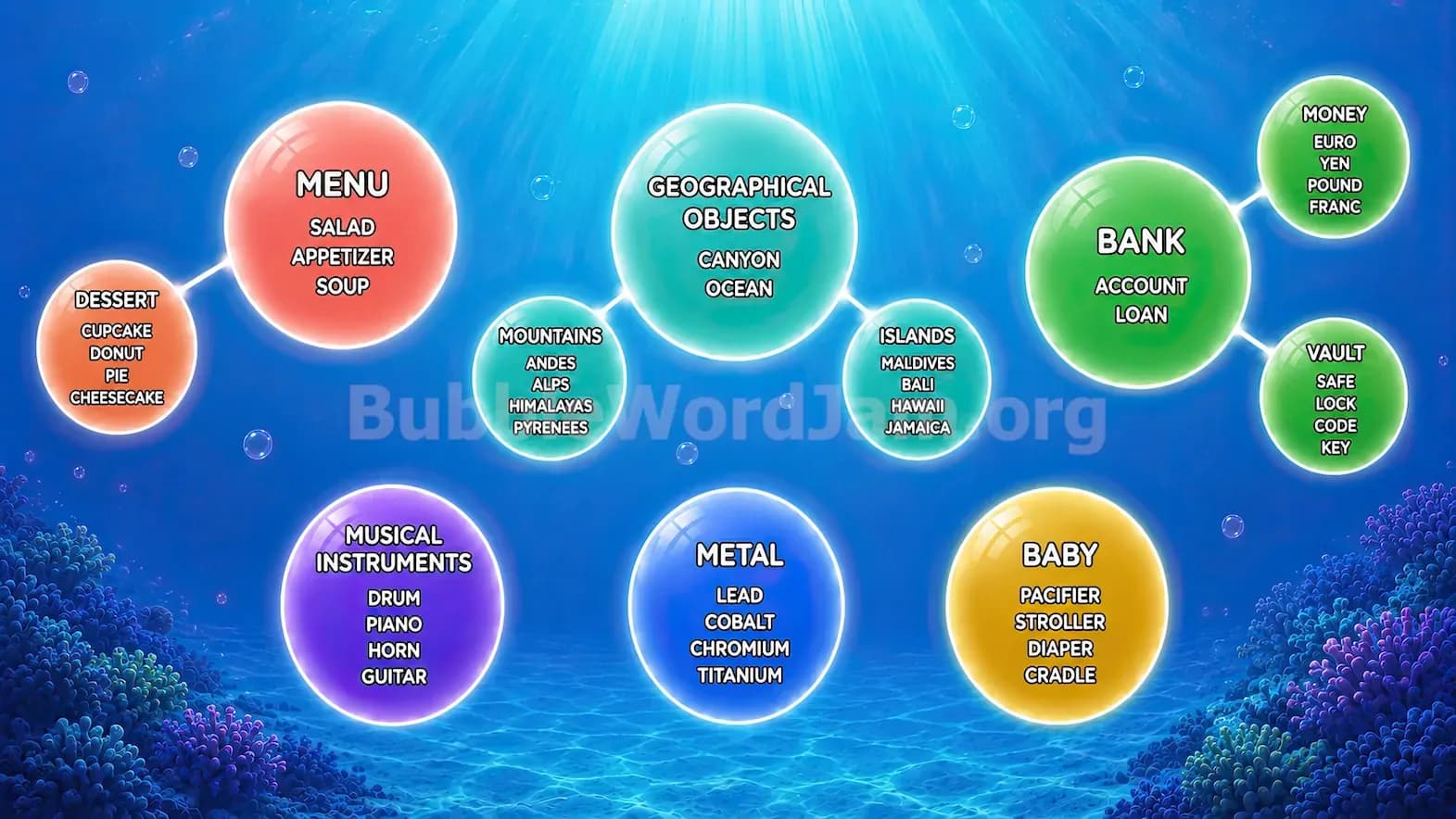
Level 18 connects money, vault, and bank in a neat hierarchy. The money group uses euro, yen, pound, and franc, so those are pure currencies. The vault group uses safe, lock, code, and key, making it a storage-and-security bucket. Then bank pulls in account, loan, money, and vault, which is the larger institution around those pieces.
This is classic Bubble Word Jam nesting. One category can become a word inside another category. I like to mark these mentally as parent-child categories: bank is the parent, vault is the child, and money is the resource moving through the parent.
Level 44 does a sharper version. Bank contains vault, loan, money, and deposit. Vault contains safe, lock, alarm, and security. Money contains cash, coins, credit, and currency. Security then branches into password, firewall, virus, and encryption. This is a banger teaching moment because “security” changes meaning depending on context: physical protection near vault, digital protection near firewall.
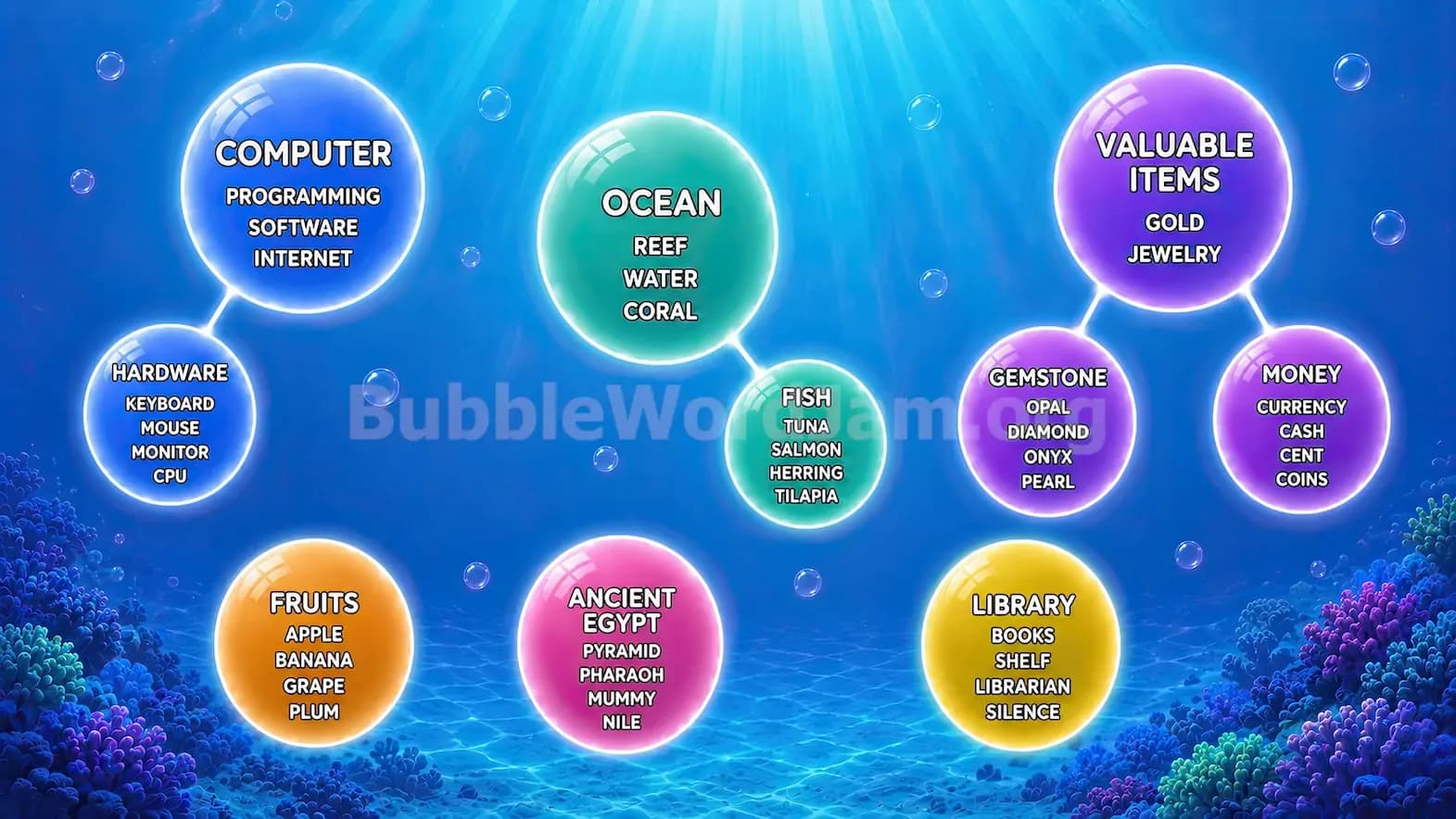
Payment categories tend to look friendly, but they can still bait you. Level 30 gives money as currency, cash, cent, and coins. That is a broad money-forms group: general term, physical cash, small unit, and coin form. Level 42 narrows the idea with dollar, quarter, nickel, and dime. Here, the group is more American-currency flavored, with one bill word and three coin words.
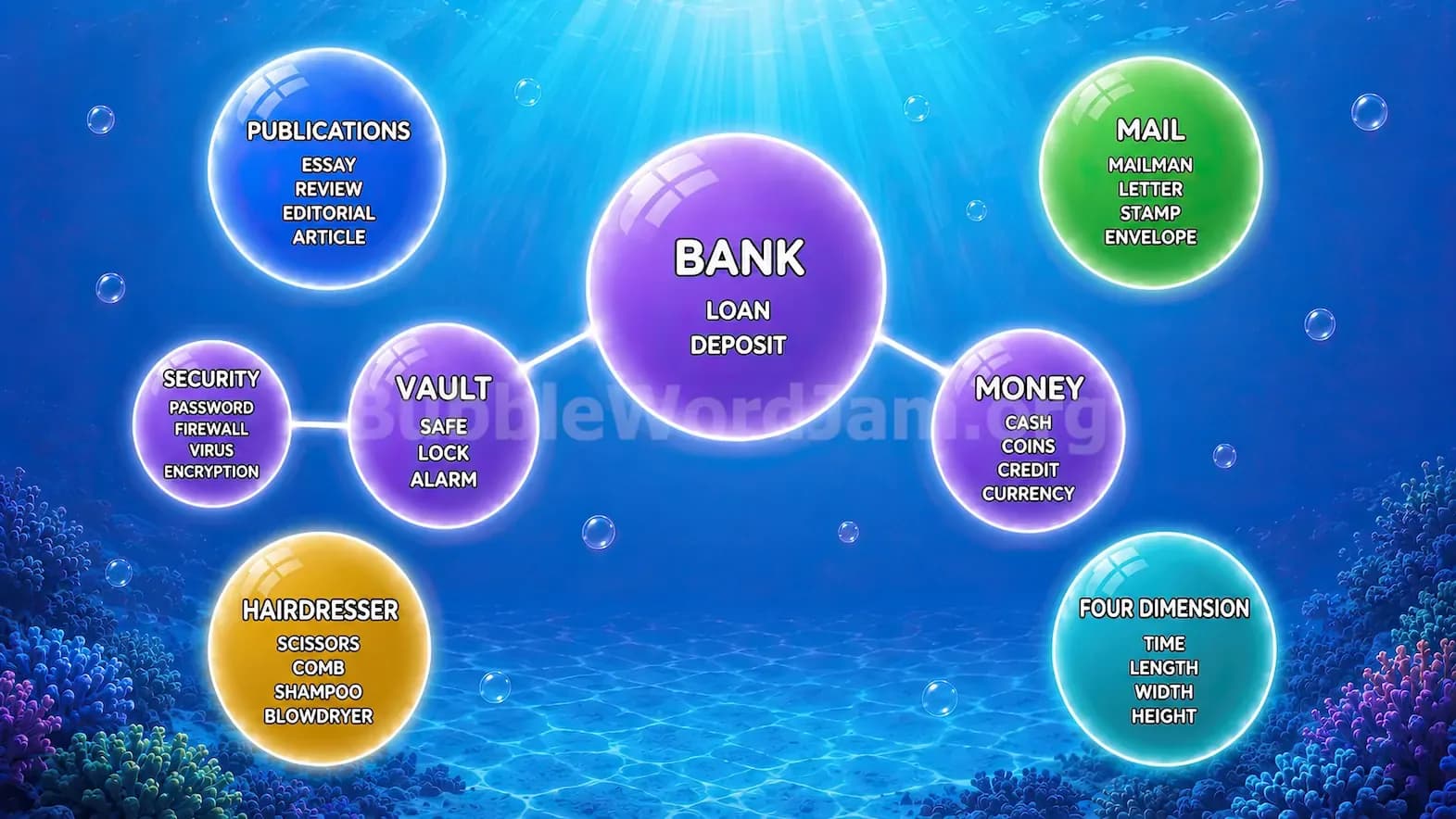
Level 44 expands the payment lane again with cash, coins, credit, and currency. “Credit” is the slippery one. It can feel like banking, debt, reputation, or payment. In this context, it belongs with payment forms because the neighboring bank group already owns loan and deposit.
Credit card language gets its own upgrade in Level 483. The credit card types group uses reward tier, Visa, Mastercard, and Discover. Then reward tier branches into gold, silver, bronze, and platinum. Visa and Mastercard are card networks. Gold and platinum are not random metals here; they are status labels. When Bubble Word Jam uses business language, the clue often lives in the commercial context.
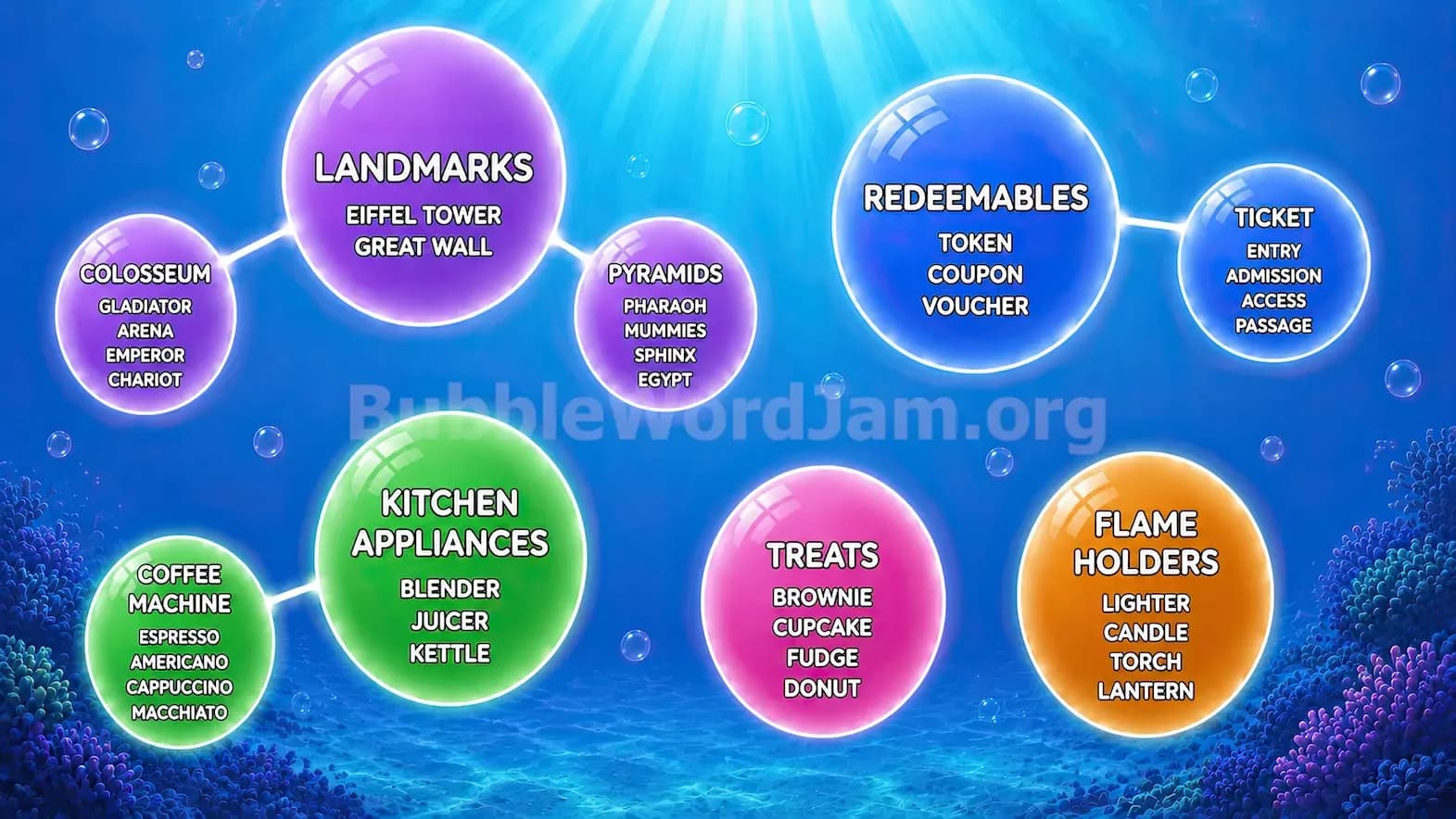
Redeemable items are money-adjacent because they trade stored value for a benefit. Level 38 gives ticket as entry, admission, access, and passage. The category is not about paper. It is about permission. In the same level, redeemables uses token, coupon, voucher, and ticket. That means ticket can be the object that grants access and also a member of a larger “redeem for value” family.
Level 774 twists the ticket idea again. Movie theater includes ticket, has a screen, popcorn, and projector, while ticket includes prepaid, cards, approve, and paper. The wording feels a little weird, but the value-flow logic still helps. A movie theater ticket grants access. A prepaid card stores value before payment. “Approve” points toward transaction permission. “Paper” points back to the physical ticket form.
Economy categories are broader than money categories. Level 42 makes this obvious with economy as trade, jobs, inflation, and money. Jobs create income. Trade moves goods and value. Inflation changes purchasing power. Money ties it together.
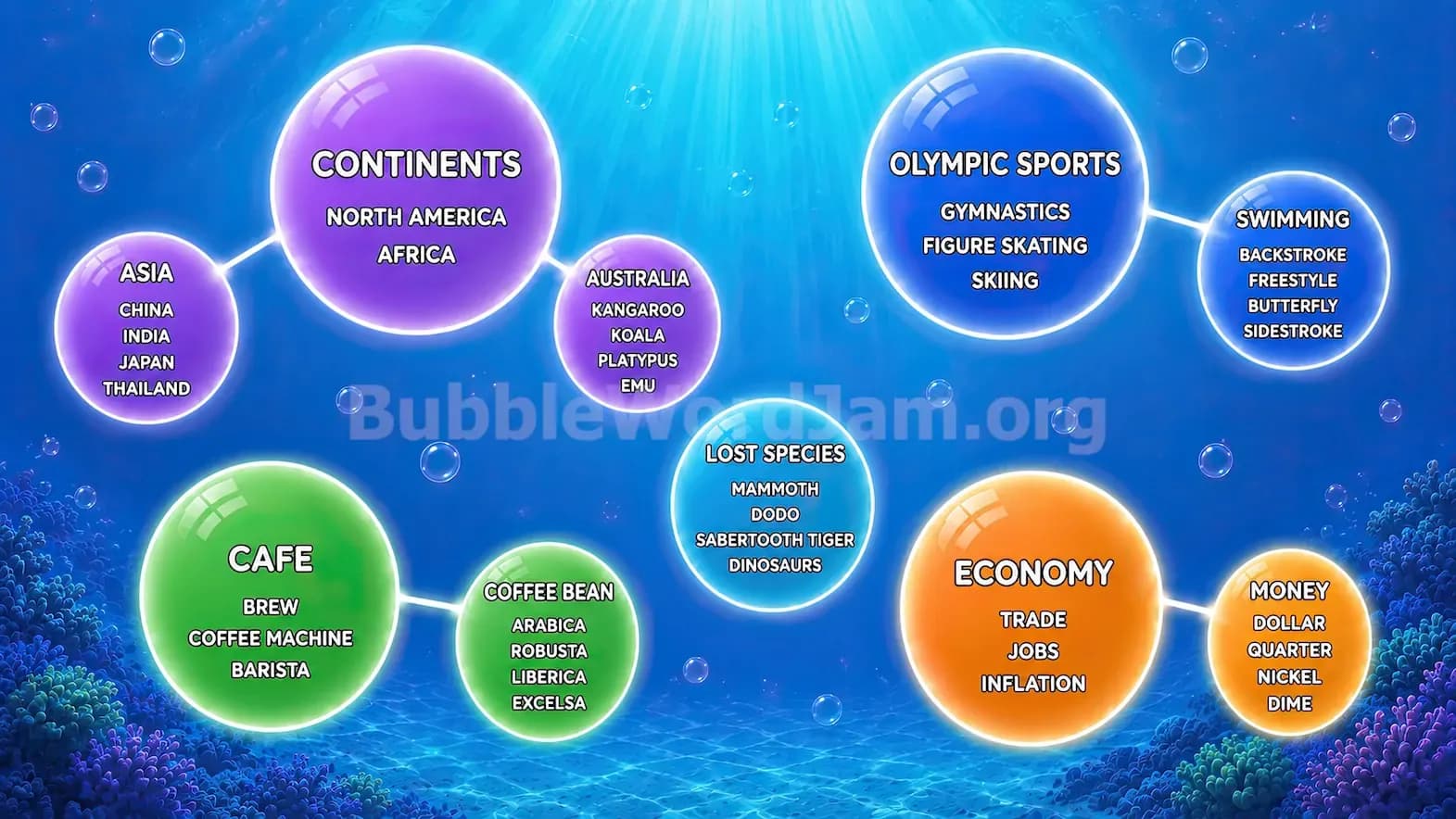
Trade categories push harder into business logic. Level 483 uses deficit, exchange, export, and goods. That is textbook trade vocabulary: what gets moved, how it moves, and what imbalance can result. Level 774 uses profits, finances, war, and deal for trade. “War” feels out of place until you think of trade wars. “Deal” is the commercial action. “Profits” and “finances” are the business outcome and resource base.
When a Bubble Word Jam level gives you trade words, avoid jumping straight to “money.” Trade is usually about exchange between parties. Money may appear nearby, but the category often wants the relationship: export, goods, deal, exchange, deficit, profits.
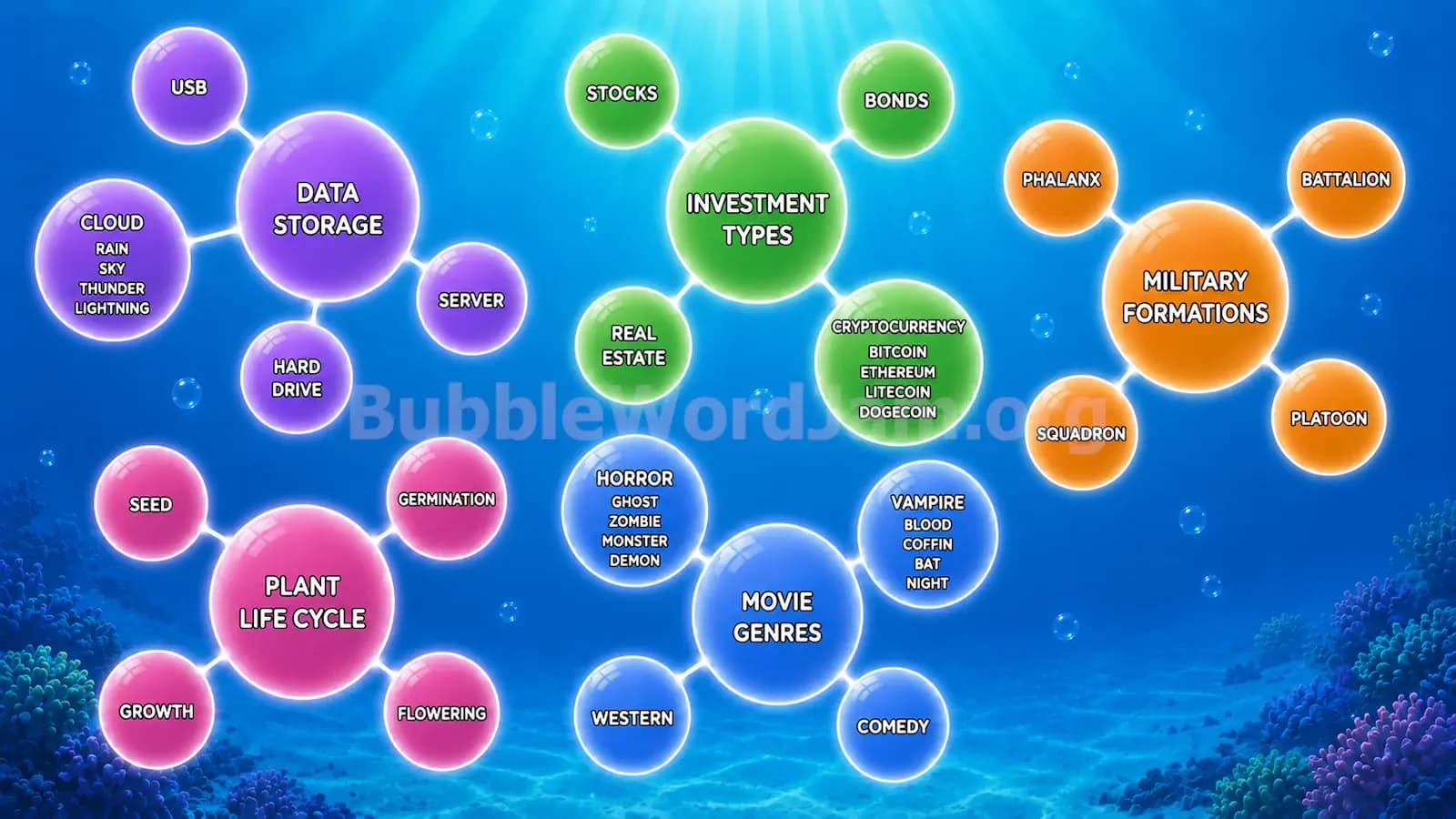
Investment categories can feel like a sudden difficulty spike. Level 117 puts stocks, bonds, real estate, and cryptocurrency into investment types. That is a clean asset-class group. The same level then breaks cryptocurrency into bitcoin, ethereum, litecoin, and dogecoin. Again, parent-child logic matters. Cryptocurrency is both an investment type and a category that contains specific coins.
Level 774 returns to cryptocurrency with buy, pay, innovative, and ethereum. This is less tidy than Level 117, but it still sits in the value-flow loop. Crypto can be bought, used to pay, marketed as innovative, and represented by Ethereum. Separate “crypto as a market category” from “crypto coin names.” Bitcoin, Ethereum, Litecoin, and Dogecoin are names. Buy and pay are actions.
Start by finding the most concrete money words: euro, yen, dollar, quarter, coupon, voucher, Visa, Mastercard, bitcoin, and ethereum. Proper nouns and named currencies are usually strong anchors. Then look for containers: bank, vault, safe, account, deposit. After that, sort the verbs and systems: trade, export, exchange, invest, approve, redeem.
My favorite rule is simple: do not merge a broad finance word until you know whether it is a parent or a child. Money can be a category, but it can also sit inside bank or economy. Vault can be a category, but it can also sit inside bank. Ticket can be a category, a redeemable, or a movie theater item. These words are not traps because they are unfair; they are traps because they are flexible.
Money and business categories in Bubble Word Jam work best when you track value like a little supply chain. It gets earned through jobs and profits. It gets stored in accounts and vaults. It gets paid through cash, cards, and currencies. It gets traded through goods, exports, and deals. It gets redeemed through tickets and vouchers. It gets invested through stocks, bonds, real estate, and crypto.
Once you see that loop, the whole category family stops feeling random. You are not just matching finance words. You are watching value move across the board. That is the crunchy little trick these levels are testing, and once it clicks, money puzzles become far more manageable.