Learn how to solve Bubble Word Jam math levels by sorting clues into numbers, shapes, units, formulas, and measurement tools before you merge bubbles.

Guide By Liam Stone
Updated on July 8, 2026
Liam Stone has been playing Bubble Word Jam since the mobile app first launched on the Apple App Store. He knew this game would pop, so he enjoys playing every level, collecting the answers, and running this site for other players. He loves mobile puzzle games and sometimes publishes his walkthroughs on his YouTube channel Puzzle Game Answer. Follow his channel if you are a puzzle game lover too.
Math levels in Bubble Word Jam can feel deceptively simple. You see “two,” “gram,” “cube,” or “ruler,” and your brain wants to snap them into place instantly. Then the game throws in “calculus,” “ohm,” “polynomial,” or “millennium,” and suddenly the whole board gets crunchy.
That’s the charm of these puzzles. Bubble Word Jam doesn’t just ask whether you know a word. It asks whether you know what kind of word it is. Is it a number? A unit? A shape? A tool? A math subject? A time period? That distinction matters, because a single wrong merge can tank your flow and waste moves.
The best way to beat math and measurement puzzles is to stop treating every clue as “math-ish.” Instead, sort each clue into one of four lanes: number, unit, shape, or formula-related term. Once you do that, these levels become much more readable.
When a Bubble Word Jam level leans into math, I use a quick mental filter before touching anything:
Number clues describe values or types of values. Think odd numbers, prime numbers, integers, even numbers, or number words like one, three, five, and seven.
Unit clues measure something. These can include length, weight, volume, energy, resistance, or time. Meter, gram, gallon, joule, and ohm all belong in this lane.
Shape clues describe geometry. Some are flat polygons, like hexagon or pentagon. Others are 3D solids, like cube, sphere, cylinder, and pyramid.
Formula clues point toward algebra or higher math. Variable, equation, polynomial, factor, calculus, statistics, and geometry usually belong here.
This sounds basic, but it prevents one of the most common Bubble Word Jam mistakes: merging words just because they share a school-subject vibe. “Geometry” and “cube” are connected, sure, but they may not belong in the same bubble group. One is a math field. The other is a geometric solid. That split is exactly where the game gets clever.
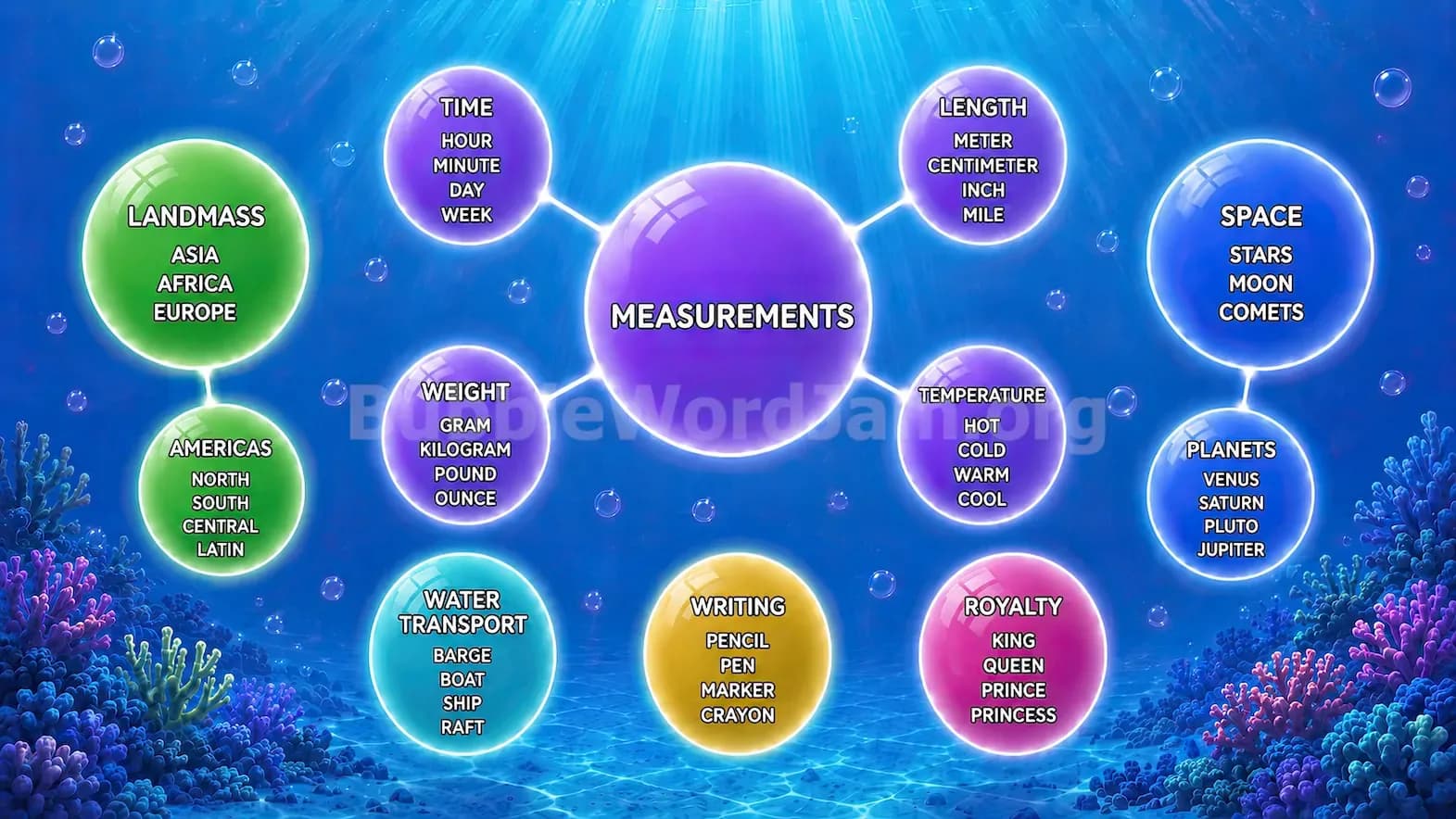
Level 7 is one of the cleanest early examples of how Bubble Word Jam introduces measurement logic. It separates time, length, weight, and temperature, then also includes a broader “measurements” category.
That’s a sneaky little tutorial. “Hour,” “minute,” “day,” and “week” are not just time-related words; they form a specific time group. “Meter,” “centimeter,” “inch,” and “mile” are length units. “Gram,” “kilogram,” “pound,” and “ounce” are weight units.
The trick is to avoid merging the parent idea too early. If you see “time,” “length,” “weight,” and “temperature,” those are category names inside the puzzle logic. They describe types of measurement, not the smaller units themselves.
So when Level 7 gives you both “length” and “meter,” don’t panic. “Length” belongs with other measurement types. “Meter” belongs with other units of length. That’s the core loop: separate the label from the example.
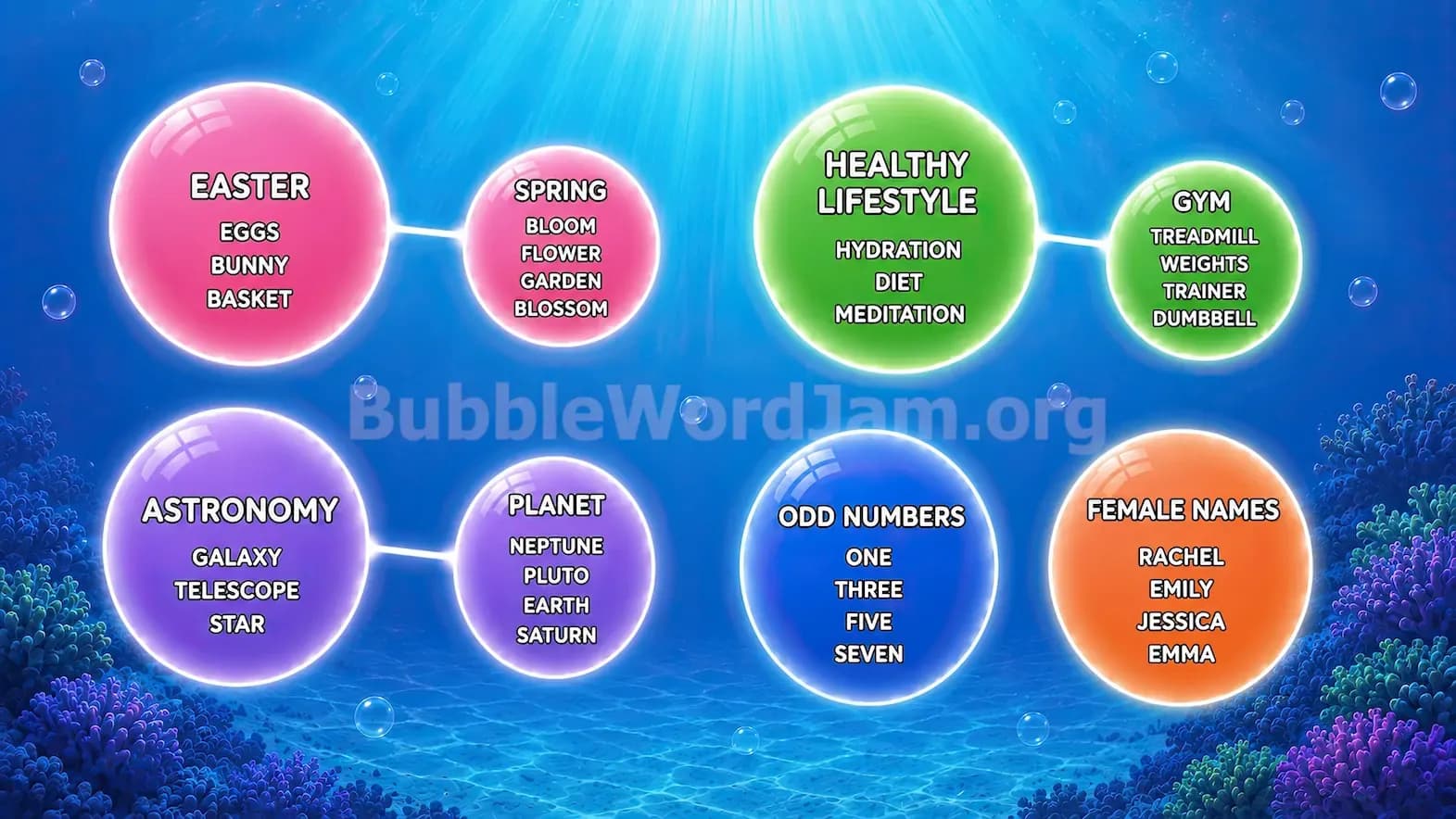
Number puzzles usually look easy until Bubble Word Jam asks for a specific property. Level 20 uses odd numbers: one, three, five, and seven. Level 71 uses prime numbers: two, three, five, and seven.
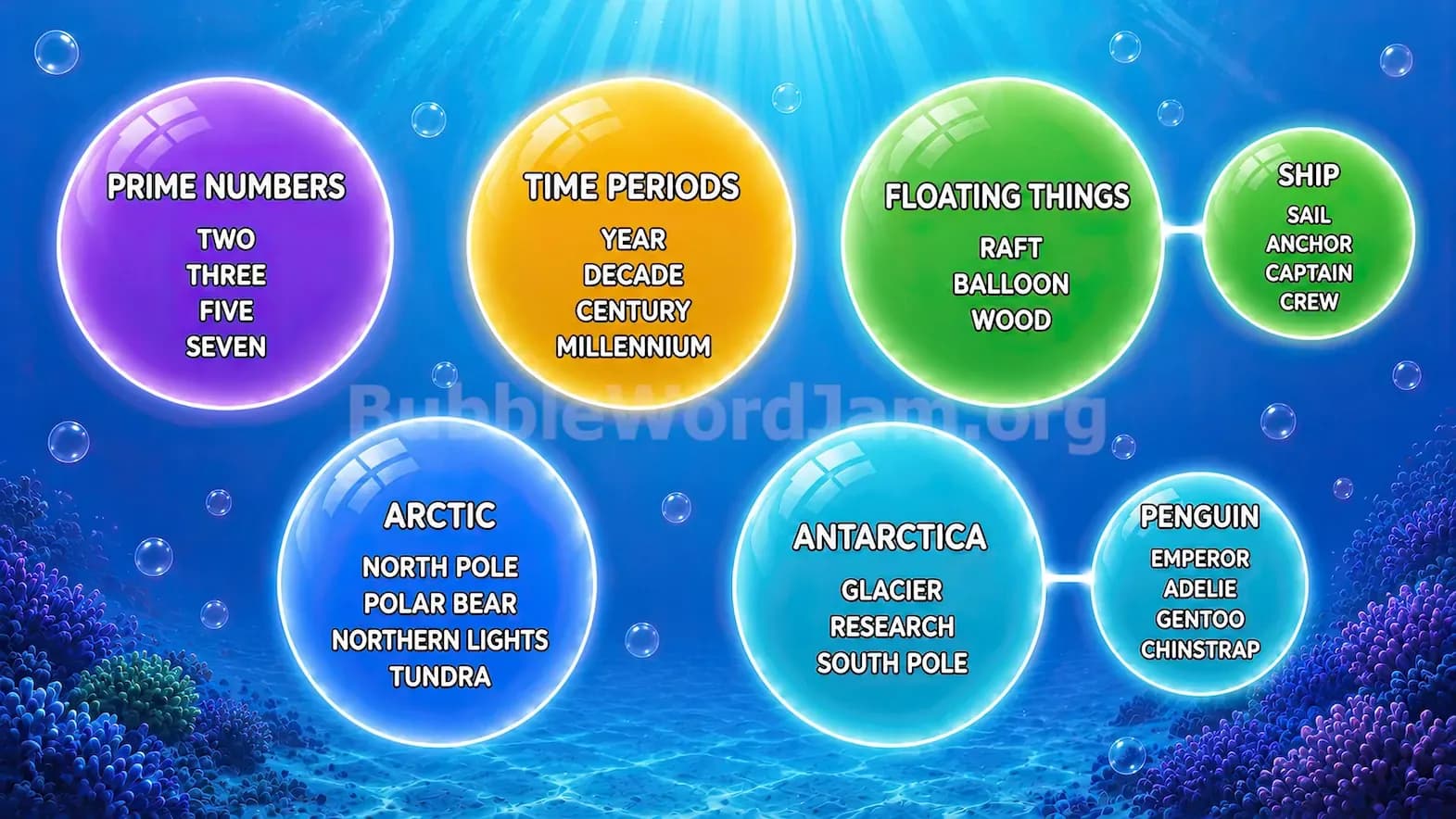
Here’s the fun part: three, five, and seven appear in both mental worlds. They are odd, and they are prime. But Bubble Word Jam doesn’t care about every true fact at once. It cares about the intended set.
When I see number words, I check the pattern before merging. Are all the numbers odd? Are they prime? Are they even? Are they counting words? Are they time-related values? One wrong assumption can make the board feel unfair, but the logic is usually sitting right there.
Level 71 also pairs prime numbers with time periods: year, decade, century, and millennium. That contrast matters. “Two” and “decade” both involve numbers, but only one is a number word. The other is a duration. That’s the exact split players need to make.
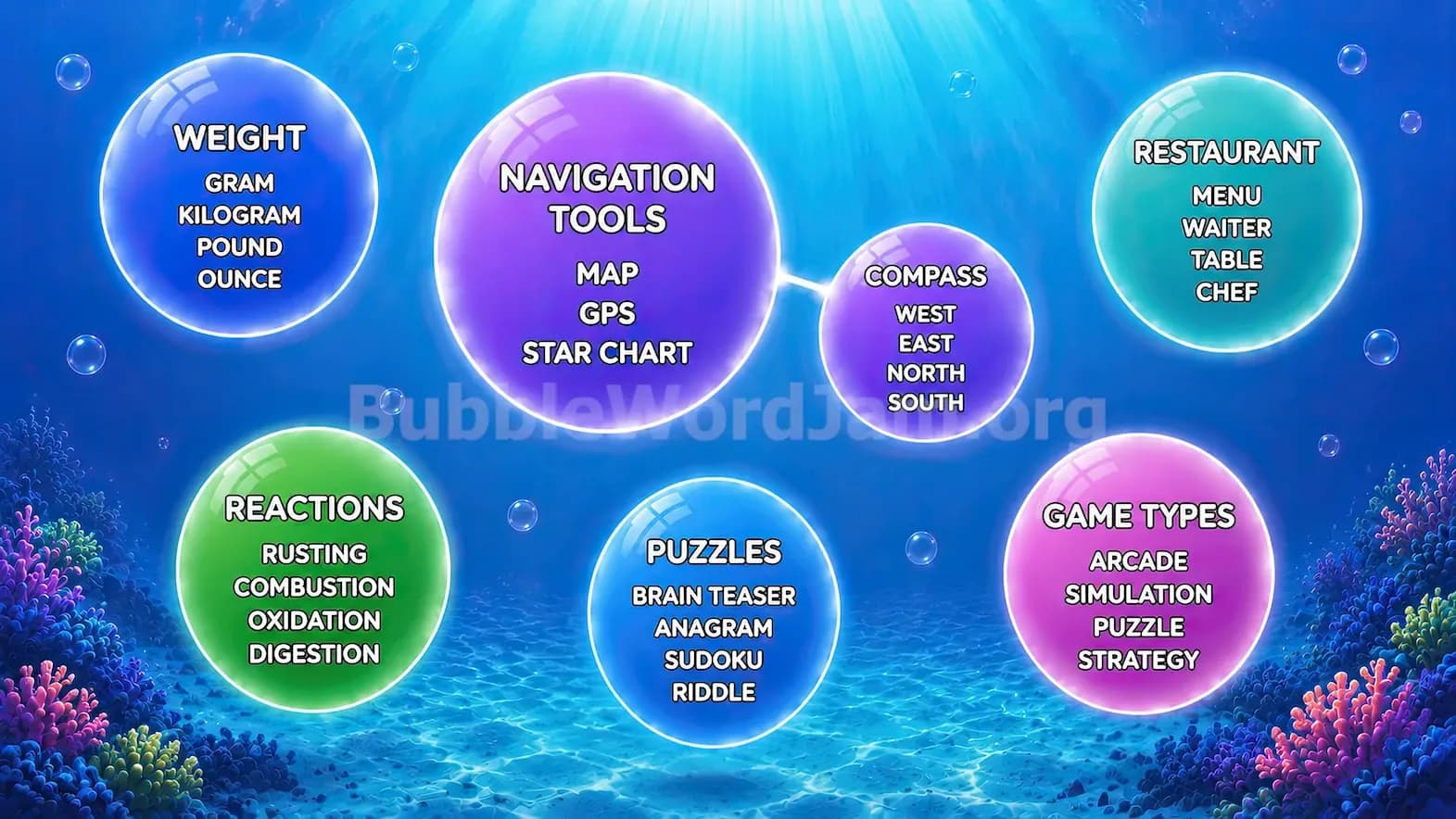
Units are one of the most flexible math-adjacent categories in Bubble Word Jam. Level 24 repeats the weight set with gram, kilogram, pound, and ounce. Level 123 shifts to volume with gallon, litre, pint, and millilitre. Level 196 widens the idea with joule, calorie, ohm, and gallon under units of measurement.
That last one is a banger because it mixes different measurement domains. Joule and calorie measure energy. Ohm measures electrical resistance. Gallon measures volume. They don’t look like a tidy family unless you recognize the higher-level label: measurement units.
This is where players should ask, “What does this word measure?” not “Where did I hear this word before?” A gallon might make you think of milk or gasoline. A calorie might make you think of food. An ohm might make you think of physics class. But in Bubble Word Jam, all three can click together because they function as units.
Shape clues come in two main flavors: flat shapes and solid shapes.
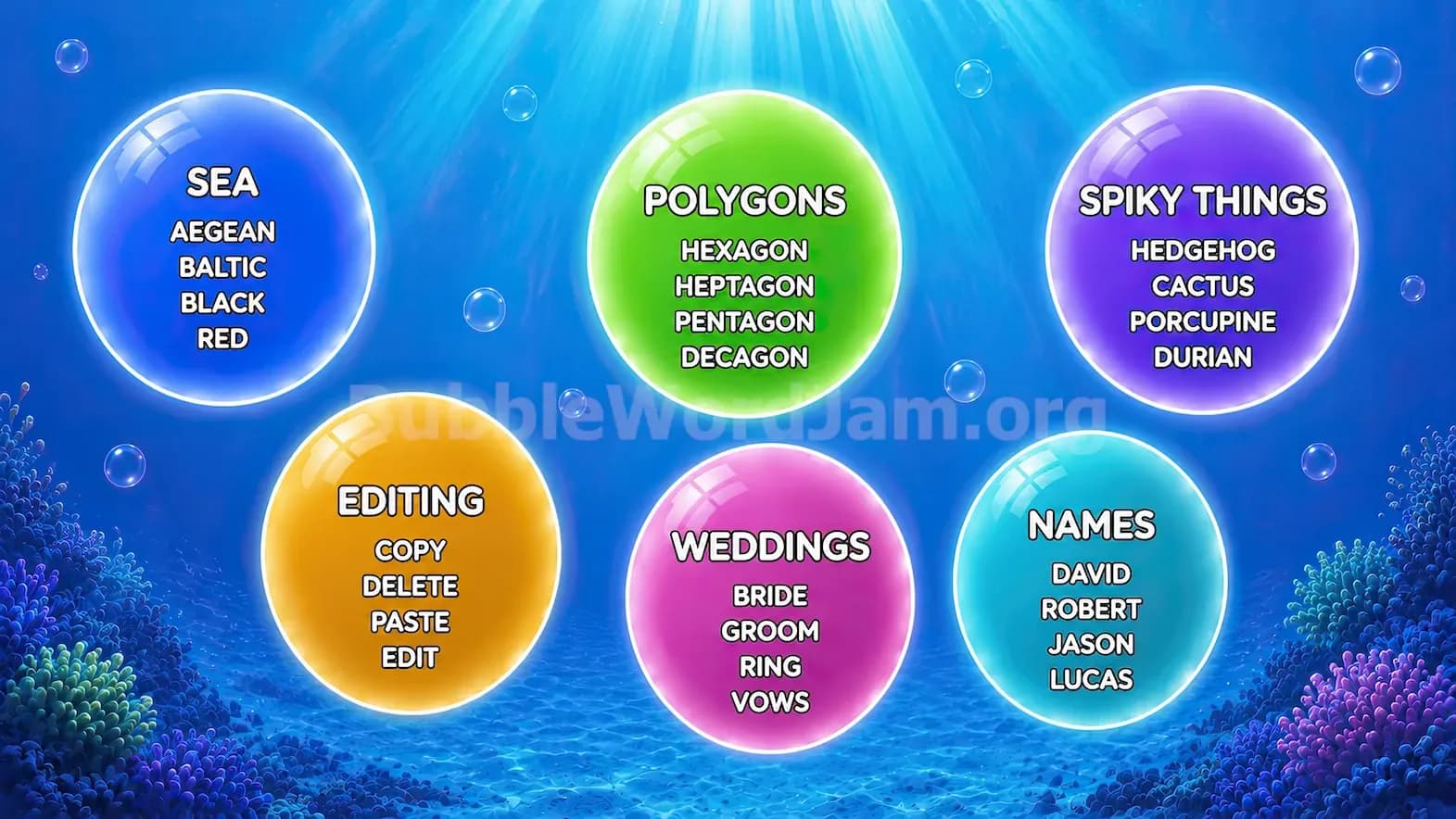
Level 50 focuses on polygons: hexagon, heptagon, pentagon, and decagon. These are flat, many-sided shapes. The suffix helps a lot here. “-gon” is your signal flare. If several words end that way, you probably have a polygon group ready to merge.
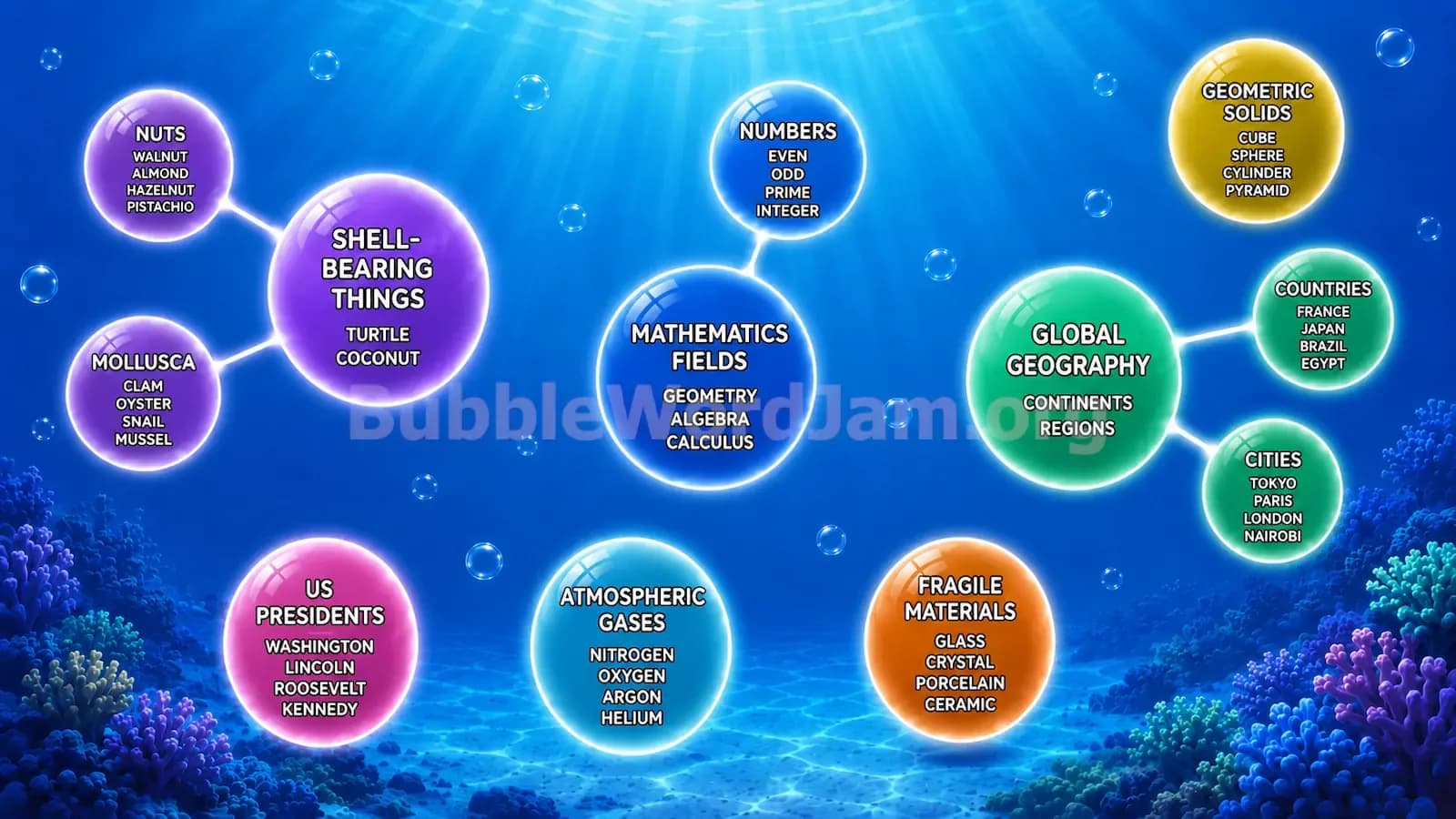
Level 273 moves into geometric solids: cube, sphere, cylinder, and pyramid. These are 3D forms, not flat polygons. That distinction is easy to overlook when the board gets crowded, but it matters. A pentagon and a pyramid both feel geometric, yet they sit in different lanes.
Level 273 also includes mathematics fields: numbers, geometry, algebra, and calculus. Again, Bubble Word Jam is testing whether you can separate the study area from the object being studied. “Geometry” is the field. “Cube” is the shape. Don’t let the shared vibe bait you into a mediocre merge.
By the time you reach Level 855, the math clues get more layered. You may see math subjects like algebra, calculus, geometry, and statistics. Then algebra breaks down further into variable, equation, polynomial, and factor. On the same board, tools for measurement can appear too: clock, microscope, ruler, and scales.
This is late-game Bubble Word Jam doing what it does best: nesting categories inside categories. Algebra can be a subject in one group, while algebra terms form another. Measurement can be a concept elsewhere, while measurement tools become their own object-based category.
The solving move is to identify the level of abstraction. “Algebra” is broad. “Variable” is specific. “Ruler” is physical. “Clock” is a tool. “Equation” is a math expression. If you sort by abstraction first, the puzzle stops feeling floaty and starts feeling fair.
Before making your first merge, scan the board for anchor words. These are clues that have very few possible homes.
“Hexagon” almost always points toward polygons. “Millilitre” screams volume. “Polynomial” screams algebra. “Ruler” screams measurement tools. “Millennium” belongs with time periods. These anchors give you safe starting points.
Next, look for sibling clues. A good Bubble Word Jam group usually has the same grammatical and conceptual weight. Gram, kilogram, pound, and ounce are all units. Cube, sphere, cylinder, and pyramid are all solid shapes. Algebra, calculus, geometry, and statistics are all math subjects.
Finally, watch for parent-child traps. “Numbers” can be a category label, while “prime” and “integer” can be types of numbers. “Measurement” can be a broad category, while “ruler” and “scales” are tools used for measuring. “Algebra” can be a subject, while “equation” is part of algebra.
That one habit will save you a lot of moves.
Numbers, shapes, units, and measurements work so well in Bubble Word Jam because they look familiar but behave differently depending on context. The game isn’t asking for classroom math homework. It’s asking for category discipline.
When a puzzle gives you math words, don’t rush the merge. Ask four questions: Is this a number? Is it a unit? Is it a shape? Is it a formula or math-field term?
That tiny checklist turns messy boards into clean clusters. And when the right bubbles finally slide together, the “aha” hit is still the reason this loop works.