Master Bubble Word Jam language puzzles with grammar, phonetics, silent letters, alphabets, and word-form clues from key levels across the game faster.

Guide By Liam Stone
Updated on July 29, 2026
Liam Stone has been playing Bubble Word Jam since the mobile app first launched on the Apple App Store. He knew this game would pop, so he enjoys playing every level, collecting the answers, and running this site for other players. He loves mobile puzzle games and sometimes publishes his walkthroughs on his YouTube channel Puzzle Game Answer. Follow his channel if you are a puzzle game lover too.
Some Bubble Word Jam puzzles feel like a clean vocabulary check. You see “apple,” “banana,” “orange,” and your brain instantly yells fruit. Easy. But the language, grammar, letters, and word-form puzzles play a different game. These levels don’t just ask, “Do you know this word?” They ask, “Do you know how this word works?”
That’s a sharper, crunchier loop. I like it because it turns Bubble Word Jam into something closer to a mini grammar lab than a simple word match. You’re not only sorting meanings; you’re sorting parts of speech, spelling patterns, sound systems, alphabets, and sentence roles. If you rely only on broad vocabulary, these stages can feel floaty and annoying. If you start watching structure, they become rock-solid.
The key shift is simple: stop asking what the word means first. Ask what job the word performs.
In language-focused Bubble Word Jam puzzles, words often connect through structure instead of topic. “Usually,” “sometimes,” “often,” and “rarely” are not linked because they describe the same object. They’re linked because they behave the same way in a sentence. That’s the vibe of Level 65’s adverbs of frequency category, and it’s a perfect teaching moment.
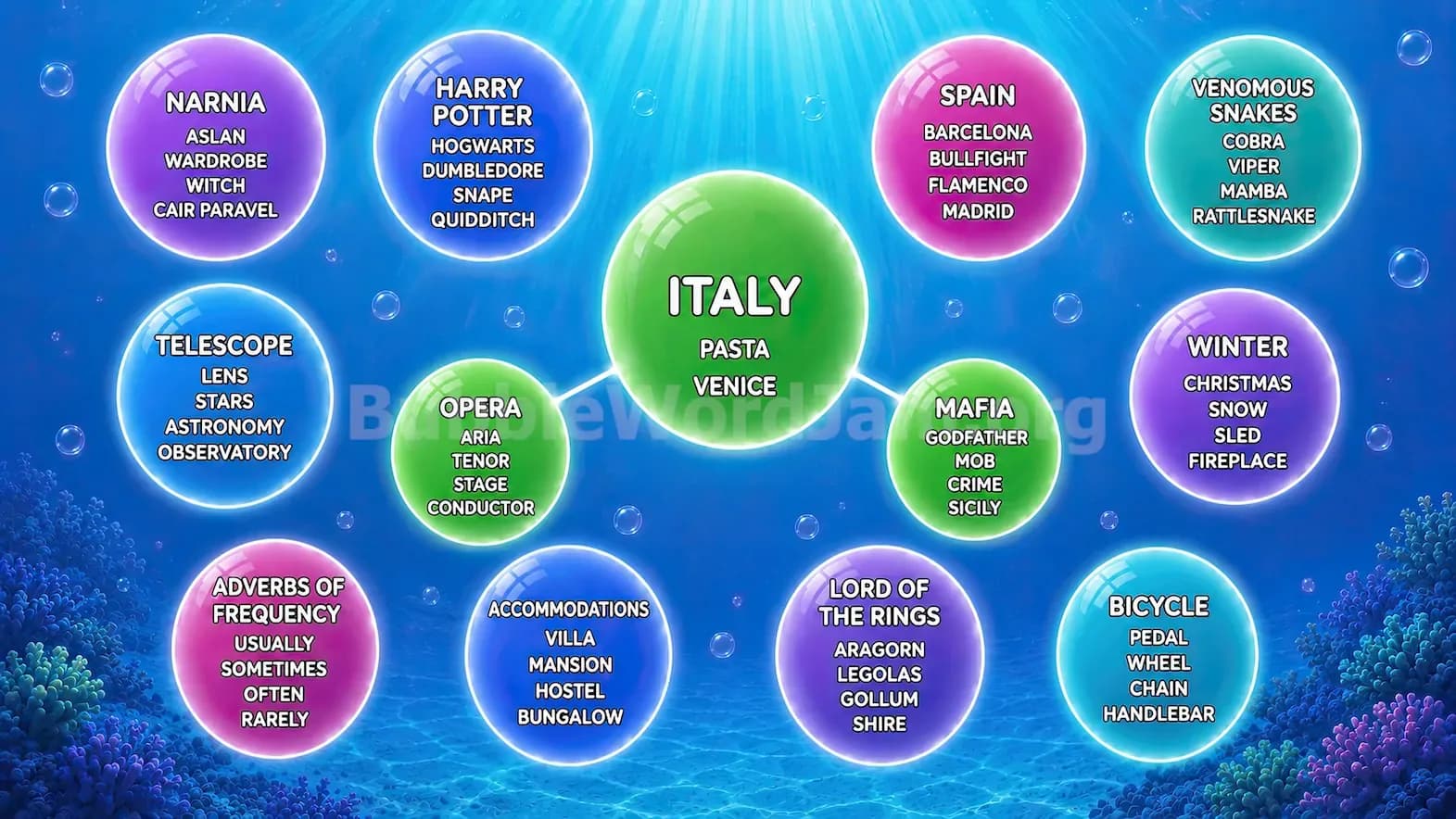
When you see words like these, don’t treat them as random everyday terms. Ask: do they modify a verb? Do they describe how often something happens? Can they sit before a main verb, as in “I usually play” or “they rarely miss”? If yes, you’ve probably found a grammar bucket.
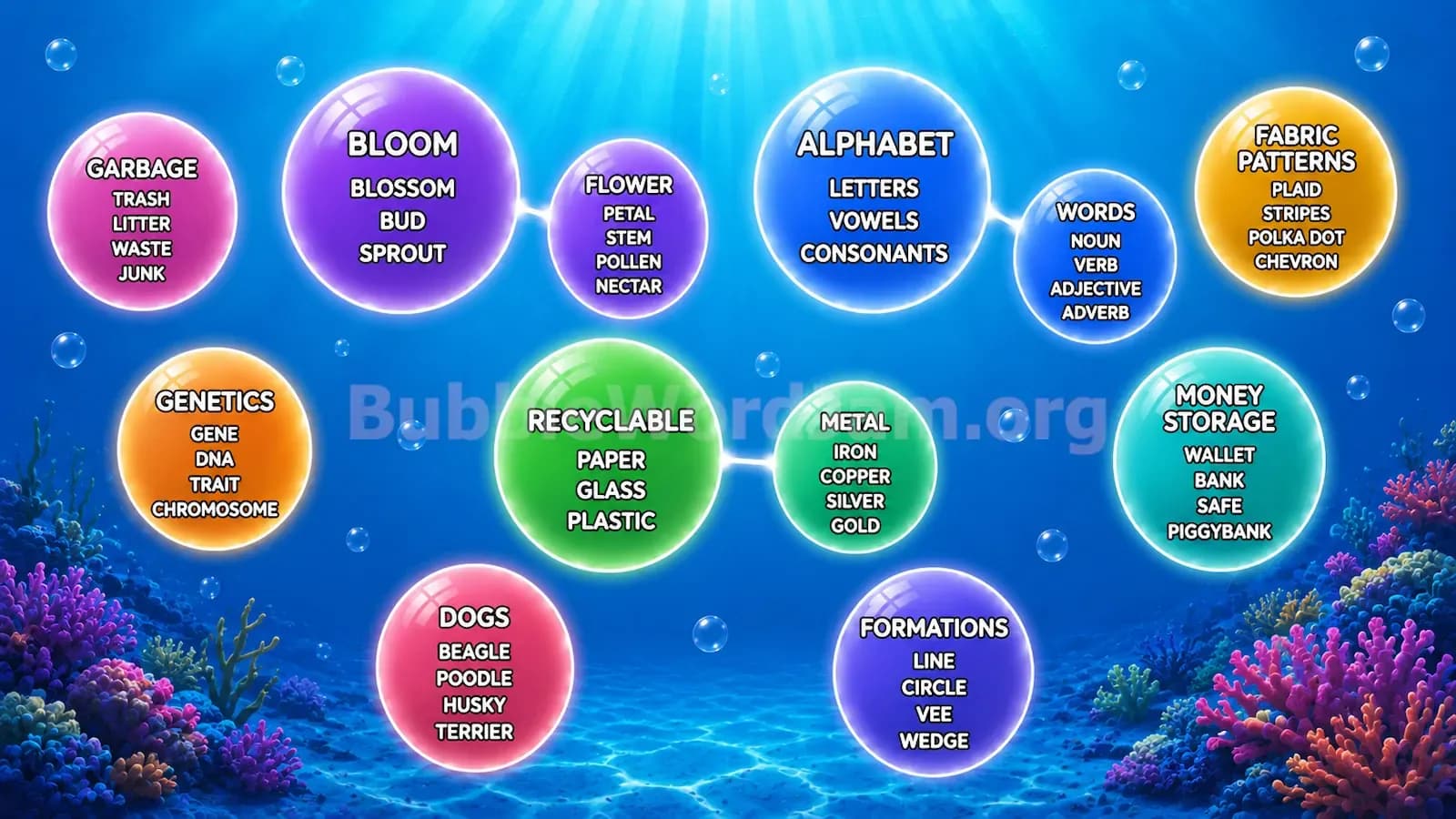
This same method helps with Level 253’s words category: noun, verb, adjective, adverb. That group is basically the game handing you a toolbox. Nouns name things, verbs show action or state, adjectives modify nouns, and adverbs modify verbs, adjectives, or other adverbs. Once you recognize that toolbox, you’ll solve grammar-heavy boards faster across the whole game.
Level 70’s sentence category is one of the cleanest examples: subject, verb, object, clause. This is where Bubble Word Jam tests whether you understand sentence architecture. It’s not about fancy vocabulary. It’s about knowing that a sentence has roles.
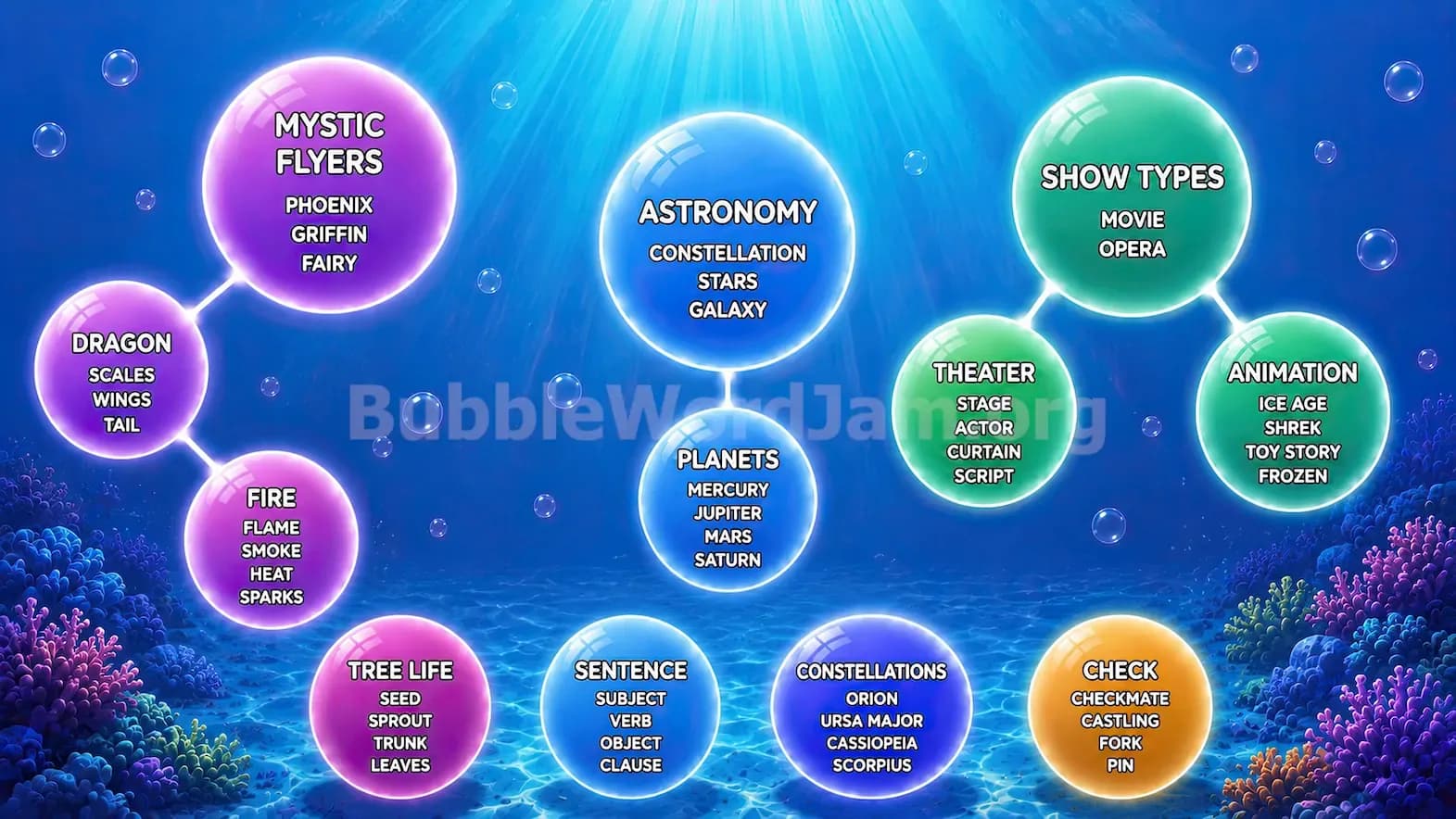
The subject is who or what the sentence is about. The verb is the action or state. The object receives the action. A clause is a larger unit that contains a subject and verb. That relationship matters because these terms can hide among theater, astronomy, fantasy creatures, or other stronger-looking categories. The game loves mixing obvious nouns with more abstract grammar terms, and that can bait you into wasting moves.
My quick rule: when three or four words sound like they belong in an English class, pause. Grammar sets often look “less visual” than categories like dragon, fire, or planets, but they’re usually more precise. Don’t let the flashier category tank your read.
Level 253 also gives us alphabet: letters, vowels, consonants, words. This is a different kind of language puzzle. Instead of sentence function, it focuses on building blocks.
Here’s how I sort these in my head: letters are the smallest written units, vowels and consonants are letter types, and words are larger units built from letters. That hierarchy is the whole trick. Bubble Word Jam often hides categories inside categories, so you need to spot when one term is the parent and the others are sub-parts.
The trap is that “words” could also belong to grammar, because noun, verb, adjective, and adverb are word forms. That makes Level 253 especially interesting. You have two language-adjacent groups sitting near each other: alphabet and words. One is about spelling units; the other is about grammatical roles. That difference is small, but in Bubble Word Jam, small differences are the banger.
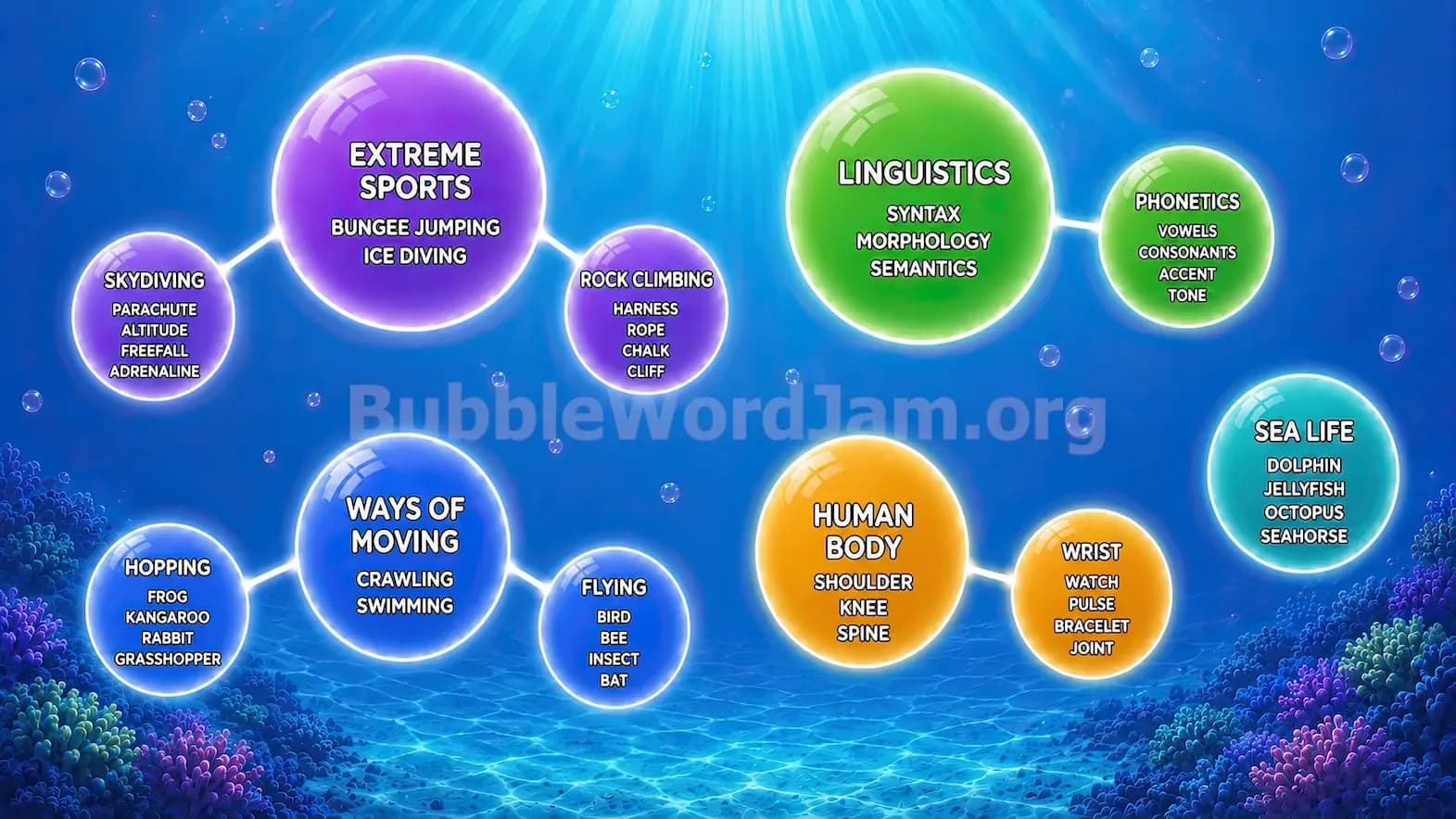
Level 68 is a standout because it includes both phonetics and linguistics. That’s where a lot of players get jammed. Phonetics includes vowels, consonants, accent, and tone. Linguistics includes syntax, phonetics, morphology, and semantics.
The difference? Phonetics is about speech sounds. Linguistics is the wider study of language. So phonetics can be both a category on its own and an item inside the broader linguistics category. That nested structure is classic Bubble Word Jam misdirection.
When I see this kind of board, I use a “discipline versus detail” check. Syntax, morphology, semantics, and phonetics are branches or areas of language study. Vowels, consonants, accent, and tone are features you can hear or analyze in speech. One group is academic fields. The other is sound-level material.
That little split turns a messy board into a clean one.
Silent-letter puzzles are some of my favorite language challenges because they punish autopilot. Level 414’s silent “b” words category uses thumb, lamb, crumb, and debt. You hear no strong “b” sound in normal pronunciation, but the spelling keeps it there. Level 426 does something similar with ends in silent e: flame, stone, globe, theme.
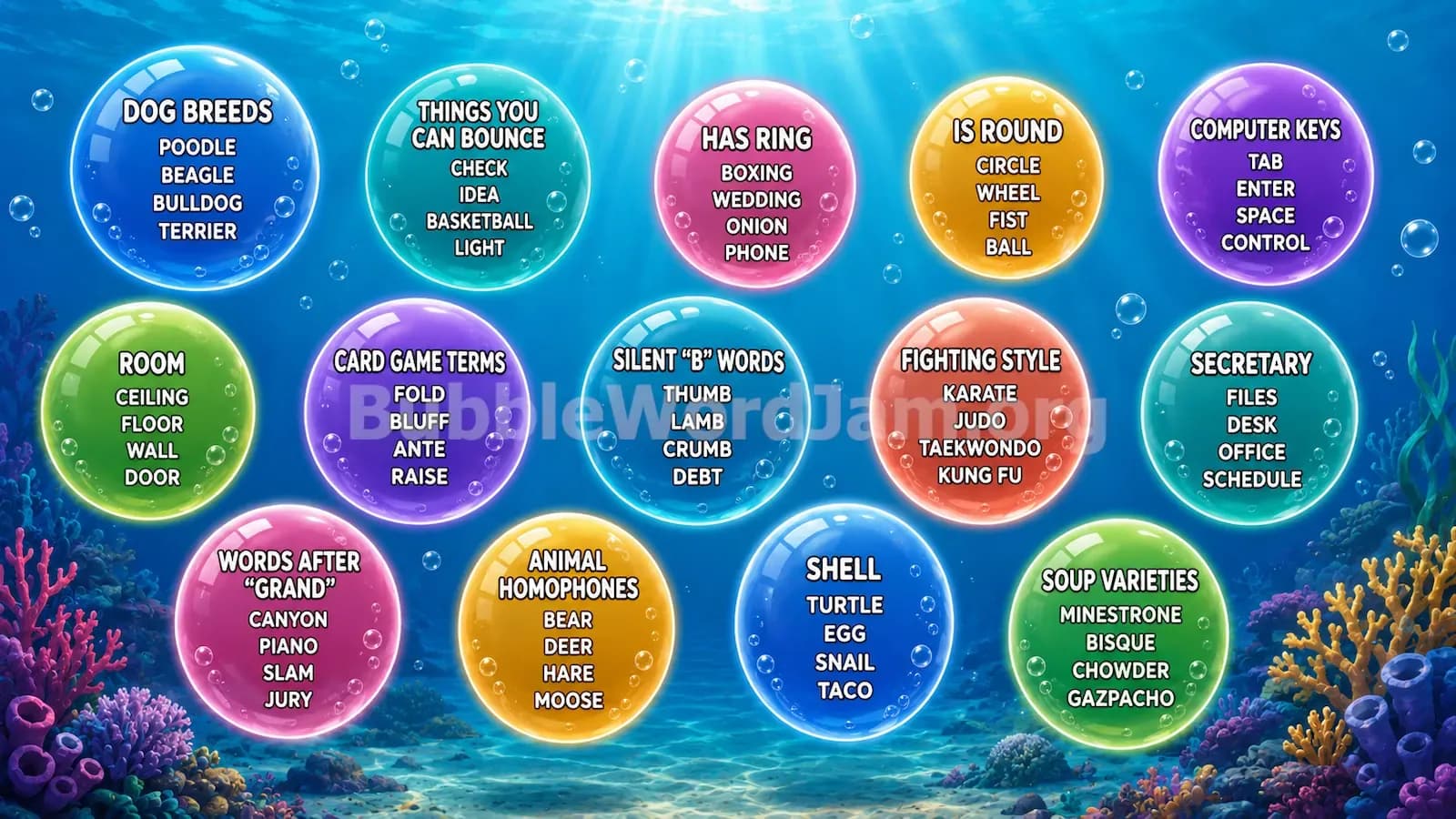
These are not meaning categories. They’re spelling-pattern categories. That means you should read the word visually, not just mentally pronounce it.
For silent “b,” ask: does the written word contain b, but the spoken word mostly hides it? Thumb, lamb, and crumb are easy once you notice the pattern. Debt is trickier because its spelling history makes it feel less obvious, but on the board, it still fits the silent-letter logic.
For silent “e,” look at the final letter. Flame, stone, globe, and theme all end with e, and that final e changes the word’s spelling profile. It can also influence vowel sound. The move here is to scan endings before meanings. That feels unnatural at first, but it’s a strong technique.
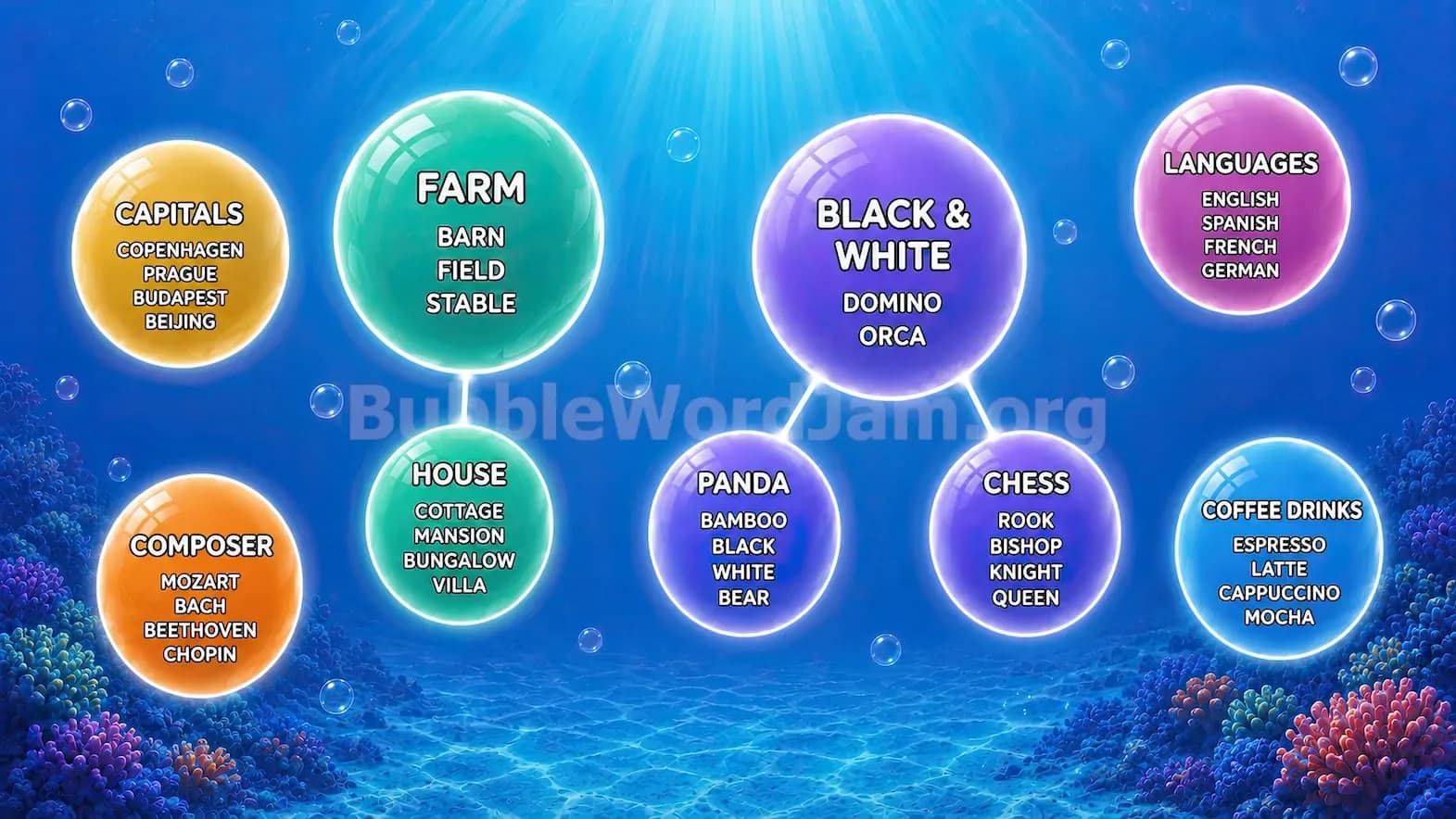
Level 31’s languages category is direct: English, Spanish, French, German. That’s a clean set, and most players will catch it instantly. Level 354 gets more interesting with language, French words, and Latin words.
The language group includes vocabulary, grammar, accent, and dialect. These are core features of language as a concept. French words include rendezvous, bouquet, guillotine, and deja vu. Latin words include caveat, ergo, pluribus, and quid.
This is where the puzzle asks for cultural and linguistic recognition. You don’t need to speak French or Latin fluently. You just need to recognize borrowed-word vibes. Rendezvous and bouquet have a very French feel in English. Caveat and ergo show up in formal or logical phrasing. Quid and pluribus are less common, so they may be the sticky ones.
The safe strategy is to group the most obvious borrowed words first, then use the leftovers to confirm. Don’t burn moves too early unless the whole set clicks.
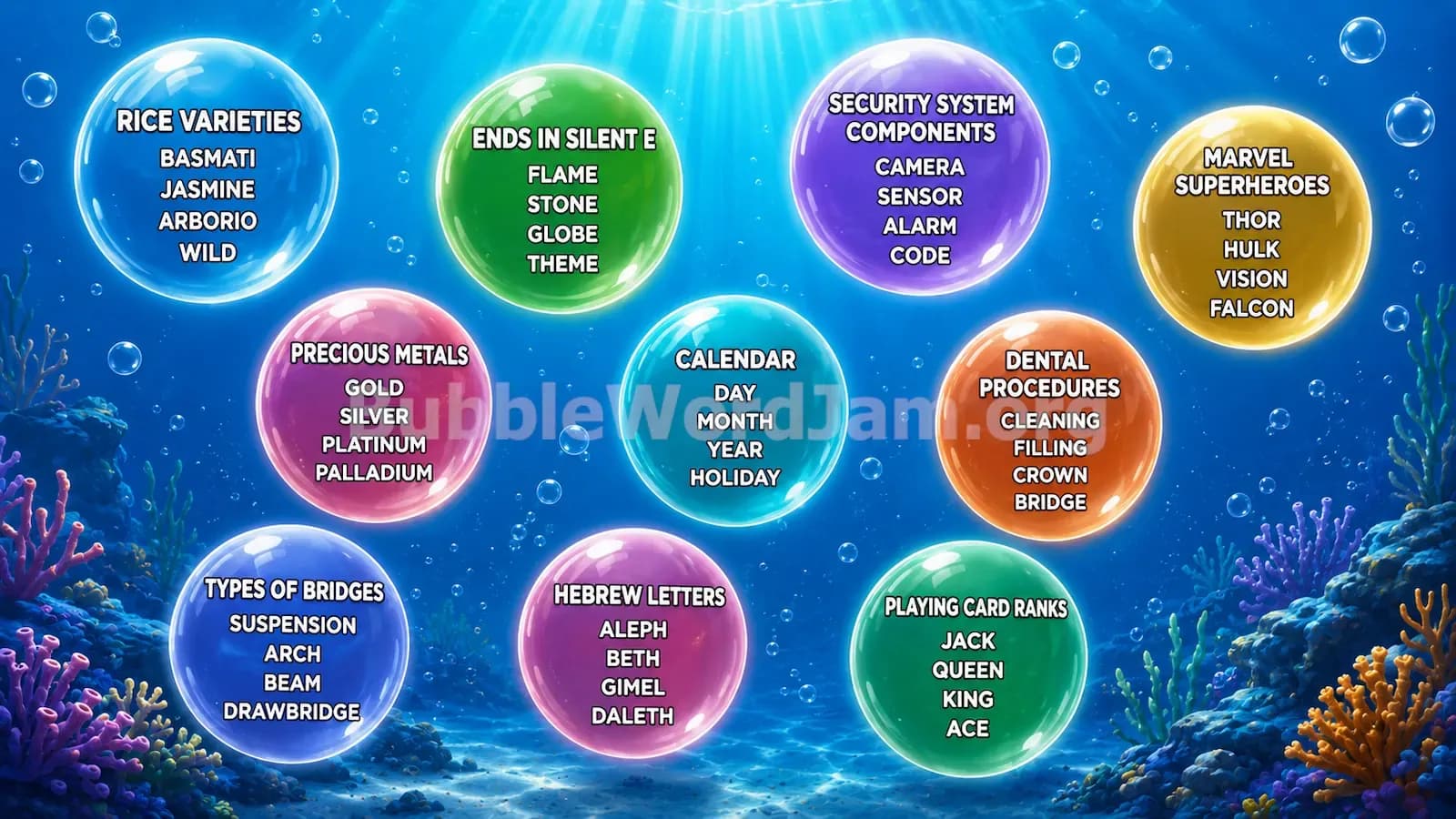
Level 426’s Hebrew letters category uses aleph, beth, gimel, and daleth. This is another alphabet-style puzzle, but it goes beyond the Latin alphabet most English-speaking players know.
The clue is the naming pattern. These terms don’t behave like common English words. They look like letter names from another writing system. If you see several unfamiliar terms with a similar rhythm or cultural origin, test whether they might be alphabet items instead of vocabulary words.
This also connects back to the Level 253 alphabet idea. Bubble Word Jam often repeats the same logic at a higher difficulty. First, it teaches letters, vowels, consonants, and words. Later, it asks whether you can apply “alphabet thinking” to a different script. That’s good puzzle design.

Level 440 brings back the language-study angle with branches of linguistics: morphology, phonetics, semantics, syntax. This is a great late-game check because the words are abstract, but the set is fair.
Morphology studies word structure. Phonetics studies speech sounds. Semantics studies meaning. Syntax studies sentence structure. If you remember those four, you can solve a surprising number of language puzzles faster.
The danger is that these terms can overlap with other categories. “Syntax” connects to sentence rules. “Semantics” connects to meaning. “Phonetics” connects to vowels and consonants. But when they appear together, they form the wider academic bucket. That’s the distinction: individual language feature or branch of study?
When a Bubble Word Jam board starts looking wordy, I run through four checks.
First, scan for parts of speech: noun, verb, adjective, adverb, or adverbs like usually and rarely. Second, scan for sentence roles: subject, object, clause, verb. Third, scan spelling patterns: silent letters, silent e, shared endings, or odd letter behavior. Fourth, scan for language families, alphabets, and academic terms: French words, Latin words, Hebrew letters, phonetics, syntax, morphology, semantics.
That order works because it moves from the most practical clue to the most specialized clue. It also keeps you from forcing a vocabulary category where a structure category is hiding.
The best Bubble Word Jam players don’t just know more words. They read the board more cleanly. Language puzzles prove that. They reward the player who notices how words are built, how they sound, how they behave in sentences, and where they come from.
Once you start solving that way, these levels stop feeling like grammar homework. They become a tight little logic loop: spot the structure, isolate the bucket, merge with confidence. That’s when Bubble Word Jam feels at its best.