Solve Bubble Word Jam job puzzles faster by linking each worker to tools, tasks, and places, from doctors and builders to lawyers, artists, and captains.

Guide By Liam Stone
Updated on July 20, 2026
Liam Stone has been playing Bubble Word Jam since the mobile app first launched on the Apple App Store. He knew this game would pop, so he enjoys playing every level, collecting the answers, and running this site for other players. He loves mobile puzzle games and sometimes publishes his walkthroughs on his YouTube channel Puzzle Game Answer. Follow his channel if you are a puzzle game lover too.
Job puzzles in Bubble Word Jam look simple at first. Chef, farmer, teacher, doctor — easy, right? Then the game starts doing that sneaky little puzzle-game thing where it stops asking, “Do you know this word?” and starts asking, “Do you understand the context around this word?”
That’s where profession categories become a surprisingly crunchy part of the game’s loop. A worker is rarely just a worker. A doctor brings a hospital, medicine, a stethoscope, and a patient. A lawyer brings a court, a judge, a case, and a trial. A captain might belong with a ship and crew, unless “captain” is being used as an army rank somewhere else. That’s the fun and the trap.
The best way to beat these levels is to stop treating jobs as standalone nouns. Instead, match each profession to four things: role, tool, workplace, and task. Once you do that, the bubbles start snapping into place with that banger “aha” feeling Bubble Word Jam is built around.
When I see a profession bubble, I immediately ask four questions.
Who is the worker? What tool do they use? Where do they work? What job do they perform?
That mental checklist is rock-solid because Bubble Word Jam often separates these ideas into nearby but different buckets. A level might have a broad “jobs” category, then a narrower “doctor” category. That means doctor can appear as a profession in one group, while hospital, medicine, patient, and stethoscope form the doctor’s context in another.
This is why job puzzles can feel floaty if you only chase obvious matches. “Doctor” and “hospital” obviously connect, but they may not belong in the same final group if the puzzle wants “jobs” as one bucket and “doctor-related words” as another. The game loves that tension.
Think of it like sorting a messy desk. One pile is name tags. One pile is tools. One pile is locations. One pile is duties. If you throw everything into one pile just because it shares the same theme, you’ll burn moves and tank the level.
Early profession puzzles usually give you a clean “jobs” or “professions” category. Level 4 is the perfect starter example, with chef, farmer, teacher, and doctor sitting together as a basic jobs group. It’s the game teaching the first rule: when several words are all people who do work, group the workers first.
But the same level also includes a doctor-themed set: stethoscope, patient, medicine, and hospital. That’s the second rule arriving immediately after the first. A job title can point to a second category, but that second category may be made of tools, people, objects, or places connected to the role.
So when you see “doctor,” don’t instantly drag every medical word toward it. First ask whether doctor itself belongs with other job titles. If chef, farmer, and teacher are nearby, doctor probably belongs in the broad worker group. The medical words then become their own bucket.
That small distinction saves a ton of moves later.
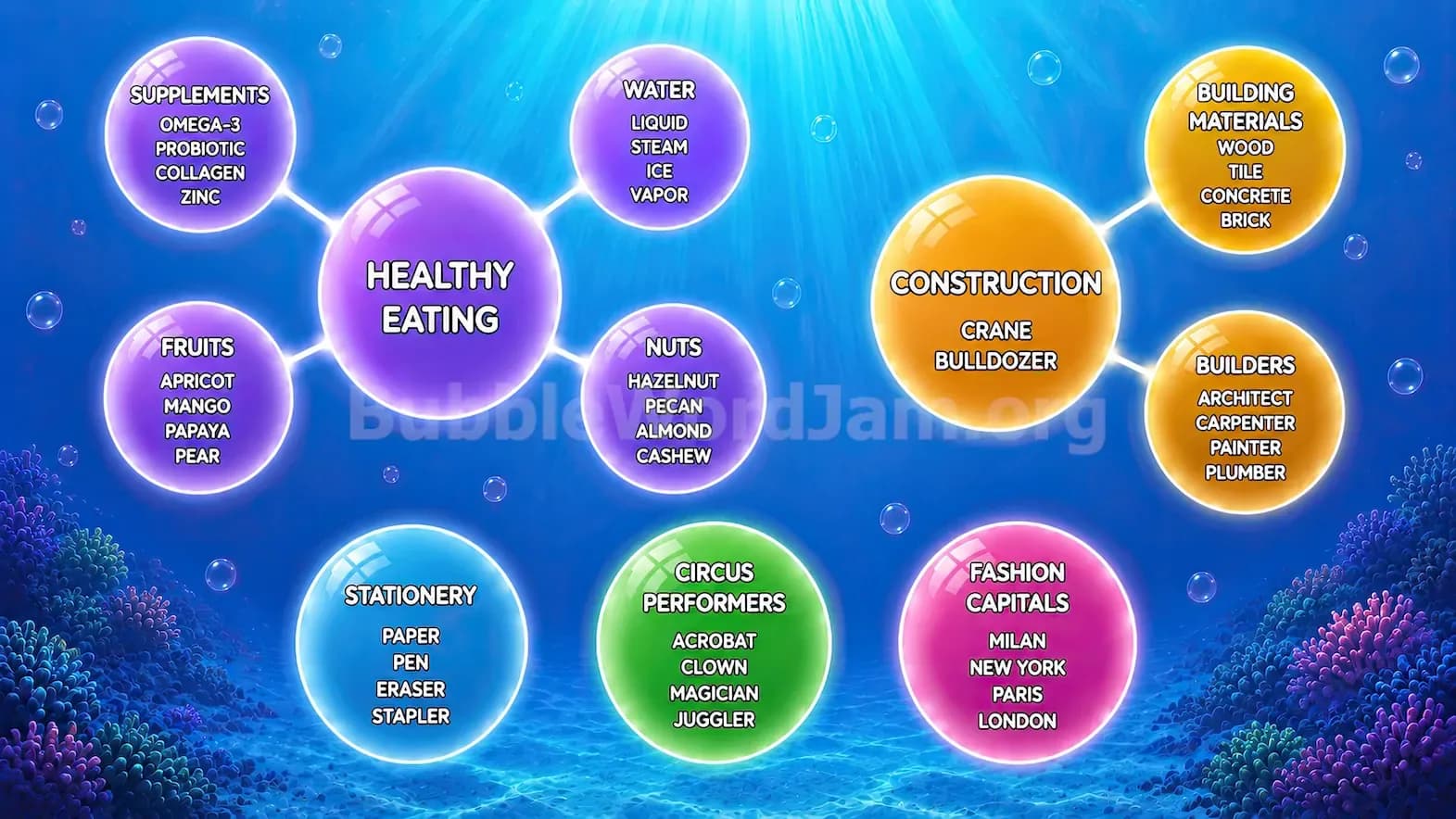
Level 17 is one of the better workplace examples because it links construction to both materials and workers. You get building materials like wood, tile, concrete, and brick. You also get builders such as architect, carpenter, painter, and plumber. The trap is that everything feels construction-related, so the whole board has one shared vibe.
That’s where you need sharper sorting.
“Wood” and “carpenter” connect in real life, but they answer different category questions. Wood is a material. Carpenter is a worker. Concrete is not a builder; plumber is not a material. Once you split “what is used?” from “who uses it?” the level becomes much cleaner.
This is the same logic you’ll use whenever Bubble Word Jam throws a workplace at you. A bank might produce vault, loan, money, and deposit. A hairdresser might bring scissors, comb, shampoo, and blowdryer. The worker may be implied by the category name, while the answer bubbles are the tools and objects around that workplace.
Creative job categories are some of my favorites because they’re less rigid than medical or legal groups. They have a nice vibe, but they can also get slippery. Level 26 uses artist as a focused category with canvas, brush, easel, and gallery. It also includes professions such as musician, sculptor, painter, and artist.
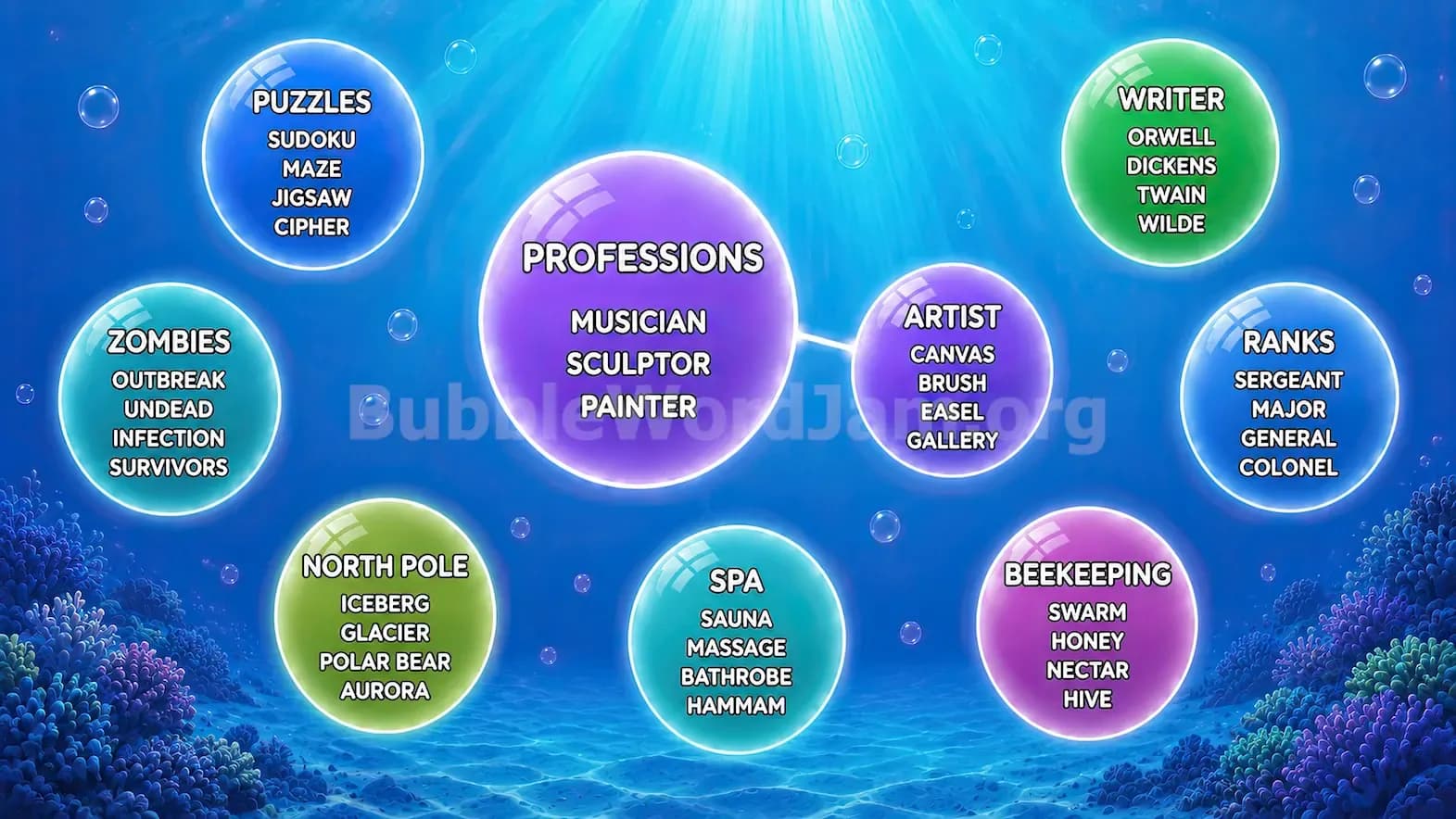
That means “artist” works on two levels. It’s a job title in the broad profession group, and it’s also a clue that points toward art-world objects. This double use is exactly where players get baited.
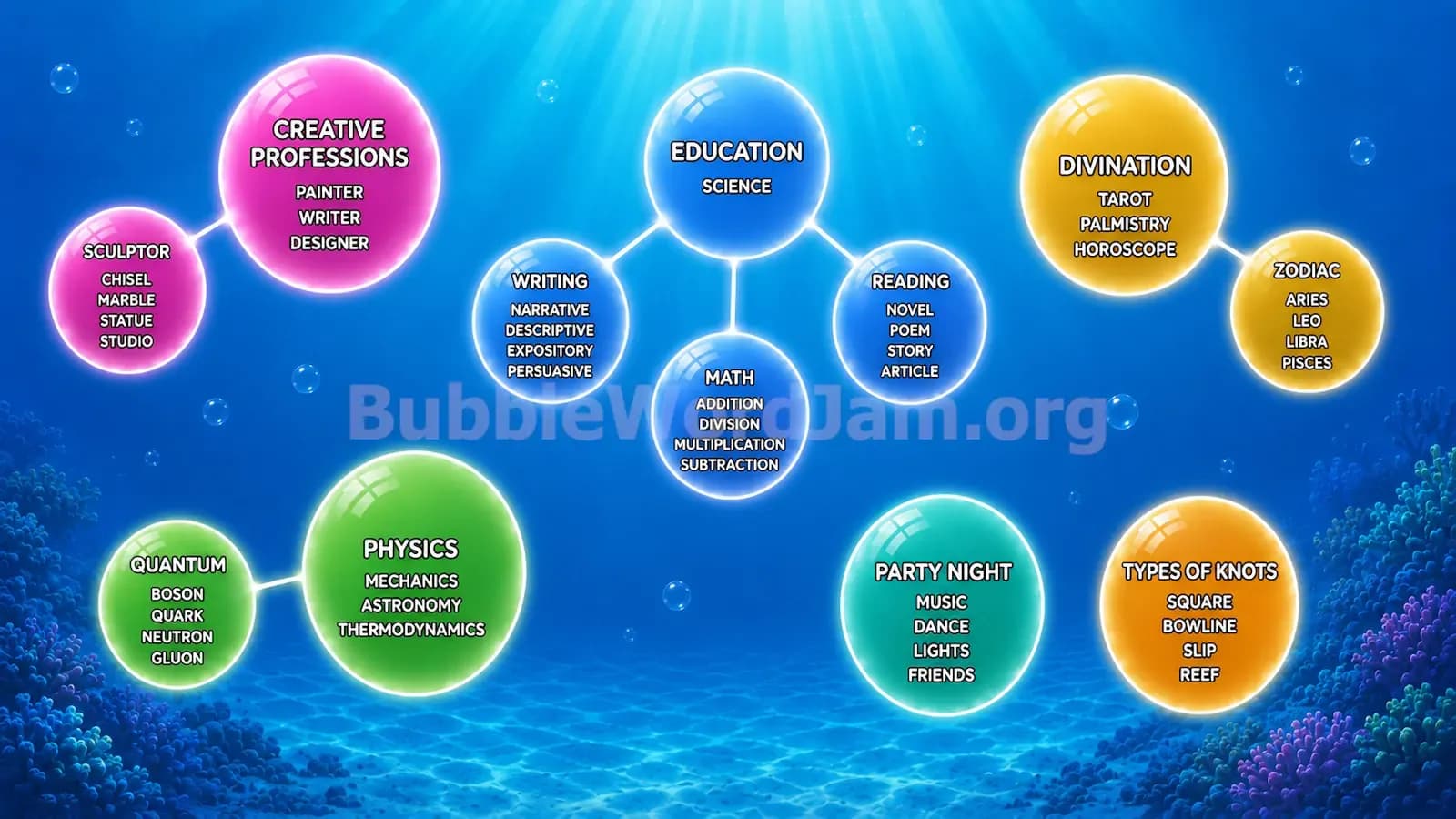
Level 110 goes deeper with creative professions: sculptor, painter, writer, and designer. It also gives sculptor its own context through chisel, marble, statue, and studio. Again, the game is saying: separate the worker from the worker’s toolkit.
My rule here is simple. If the bubbles are people, group the people. If they’re objects or outputs, group the craft. Painter belongs with sculptor and writer when the category is creative professions. Brush and canvas belong with artist tools or art spaces. Chisel and marble belong with sculptor context. Don’t let the shared creative theme blur the buckets.
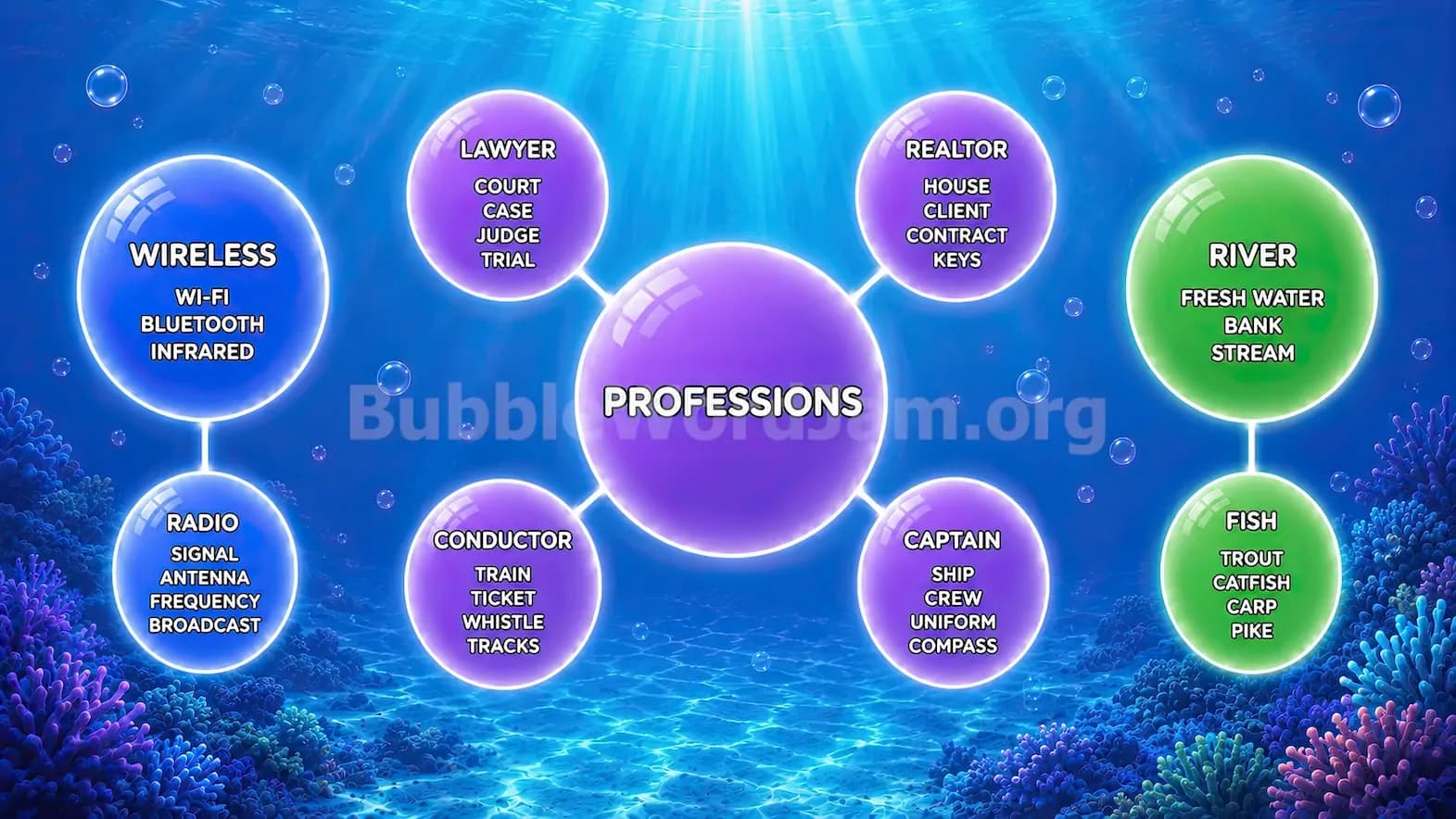
Level 69 is a great profession puzzle because it gives several roles that each come with a very clear context. Lawyer connects to court, case, judge, and trial. Realtor connects to house, client, contract, and keys. Conductor connects to train, ticket, whistle, and tracks. Captain connects to ship, crew, uniform, and compass.
This is the cleanest version of the role-context technique. Each profession has a little world around it.
A lawyer’s workplace is court. A realtor handles houses and contracts. A conductor belongs to trains. A captain belongs to ships and crews. Once you identify one anchor word, the rest of the set usually follows.
But be careful with “captain.” In another level, it may show up as a military rank rather than a ship role. That’s not unfair; it’s the game testing whether you’re reading the whole board instead of playing on autopilot. If captain is near major, general, and private, think army ranks. If captain is near ship, crew, and compass, think command at sea.
That distinction is the difference between a triumph and a mediocre restart.
Later job puzzles often lean harder on specialized vocabulary. Level 433 is a banger practice level for this because it includes several profession-centered groups: surveyor, detective, surgeon, and scribe.
Surveyor links to theodolite, benchmark, traverse, and plumb. Detective links to clue, mystery, badge, and investigation. Surgeon links to scalpel, operating, anesthesia, and incision. Scribe links to parchment, quill, ink, and manuscript.
This is where the tool-first method becomes powerful. Even if you don’t know every job deeply, tools give the category away. Scalpel screams surgeon. Quill and parchment scream scribe. Badge and clue scream detective. Theodolite is more niche, but once you pair it with benchmark and traverse, surveyor becomes the only sensible bucket.
When a level feels packed with unfamiliar job words, don’t panic. Find the most specific tool. The more specialized a word is, the more useful it becomes. “Ink” could belong to writing, tattoo, printer, or art. “Quill” narrows it. “Parchment” narrows it again. Now you’ve got the scribe set.
Level 459 shows another profession-adjacent trick: not every work-related word is a job title. The level includes jobs such as artist, teacher, chef, and diplomat, but it also includes economy terms like jobs, trade, GDP, and inflation. On top of that, it includes army ranks: major, general, private, and captain.
That’s a nasty little combo because “jobs” itself becomes an economy word instead of simply a category label. If you rush, you may try to build a profession group around it. Don’t. In this context, jobs belongs with trade, GDP, and inflation because the category is about economic concepts.
Army ranks are similar. Major, general, private, and captain are people, but the category isn’t “professions” in the everyday sense. It’s hierarchy. The solving move is to ask: are these job roles, or are these titles inside an organization?
A diplomat is a job. A captain can be a rank. A chef is a job. A general is a rank. That tiny split matters.
| Level | What It Teaches | Key Profession Angle | | --------- | ----------------------------- | -------------------------------------- | | Level 4 | Broad jobs vs. role context | Jobs and doctor-related words | | Level 17 | Workers vs. materials | Builders and construction | | Level 26 | Creative work | Artist tools and profession titles | | Level 44 | Workplace objects | Hairdresser and bank clues | | Level 69 | Role-to-context matching | Lawyer, realtor, conductor, captain | | Level 110 | Creative profession hierarchy | Sculptor tools and creative jobs | | Level 433 | Specialized tools | Detective, surveyor, surgeon, scribe | | Level 459 | Jobs vs. economy vs. ranks | Professions, economy terms, army ranks |
When a job puzzle starts getting messy, use this order.
First, group obvious workers together. Look for words like teacher, chef, artist, lawyer, doctor, captain, or diplomat. If there are four people with clear jobs, that’s probably a profession bucket.
Second, look for workplaces. Hospital, court, gallery, bank, studio, ship, and train are strong anchors. They usually pull in related tools or tasks.
Third, isolate tools. Stethoscope, scissors, chisel, scalpel, quill, whistle, and keys are almost never random. They point directly to a role.
Fourth, check for impostors. Some words look job-related but belong somewhere else. “Jobs” can be an economy term. “Captain” can be a rank. “Painter” can be a builder in one puzzle and a creative professional in another.
That’s the real loop. Bubble Word Jam isn’t just testing vocabulary; it’s testing context. The word itself is only half the answer. The surrounding bubbles tell you what kind of answer the game wants.
Jobs, professions, and workplace puzzles are satisfying because they reward practical knowledge. You don’t need obscure trivia most of the time. You need to map people to their world.
Doctor goes with hospital. Lawyer goes with court. Realtor goes with contract. Conductor goes with train. Sculptor goes with chisel. Detective goes with clue. Once you start seeing every profession as a mini ecosystem, these levels stop feeling like a shambling corpse of random nouns and start feeling like a clean, readable logic grid.
That’s the mindset I’d keep: worker, tool, workplace, task. Use it every time a profession appears, and Bubble Word Jam job levels become much easier to crack without wasting moves.