Learn how to solve Bubble Word Jam home and daily life categories using room-based scanning for kitchens, bathrooms, bedrooms, chores, and appliances.


Guide By Liam Stone
Updated on July 15, 2026
Liam Stone has been playing Bubble Word Jam since the mobile app first launched on the Apple App Store. He knew this game would pop, so he enjoys playing every level, collecting the answers, and running this site for other players. He loves mobile puzzle games and sometimes publishes his walkthroughs on his YouTube channel Puzzle Game Answer. Follow his channel if you are a puzzle game lover too.
Home and daily life puzzles in Bubble Word Jam have a sneaky vibe. At first, they look like comfort-zone categories: bed, chair, kitchen, shower, pillow, sofa. Nothing scary, right? We all know what belongs in a house. We all know the difference between a bedroom and a bathroom.
Then the game starts doing what Bubble Word Jam does best: it overlaps simple ideas until your brain has to slow down. A “bed” can belong to house, furniture, bedroom, bedtime routine, or even under-the-bed clues. “Knife” might be a kitchen tool in one puzzle, but a specific kitchen knife in another. “Table” can be furniture, kitchen, dining room, or part of a cozy living space.
That’s the crunchy part of these puzzles. Home categories aren’t hard because the words are obscure. They’re hard because they’re familiar. Familiar words have too many possible homes.
The best way through is room-based scanning. Instead of grabbing the first obvious match, mentally walk through the house: bedroom, bathroom, kitchen, garage, living room, office, laundry area. Once you place the word in a physical room, the category usually starts to reveal itself.
When I see a home-themed board, I don’t start by merging every obvious pair. That’s a good way to tank your moves. I scan the bubbles like I’m walking through a house.
First, I look for bedroom clues: bed, pillow, blanket, sleep, closet, dresser, lamp. These words usually create a tight group, but they also cross into routines. “Brush” might belong to bedtime routine, not bathroom. “Blanket” might belong to keeps you warm, not bedroom.
Next, I check the bathroom: shower, soap, shampoo, razor, towel, mirror, sink, basin. Bathroom sets tend to be clean and object-based, so they’re often safe early merges. The trap is when “mirror” appears near decor or furniture-adjacent words. Don’t auto-merge it until you see the rest of the room.
Then I scan the kitchen: spoon, fork, knife, plate, stove, fridge, oven, blender, toaster, kettle, mixer. Kitchen categories can split three ways: tools, appliances, or the room itself. That distinction matters. A “knife” is not the same kind of clue as “stove,” and “blender” usually points to appliances rather than general kitchen.
After that, I check chores and daily life: laundry, cleaning, moving, bedtime, sleepover, family, storage. These are the categories that feel floaty until you group them by action. A mop does something. A washer does something. A suitcase does something. If the words are verbs or task objects, think routine before room.
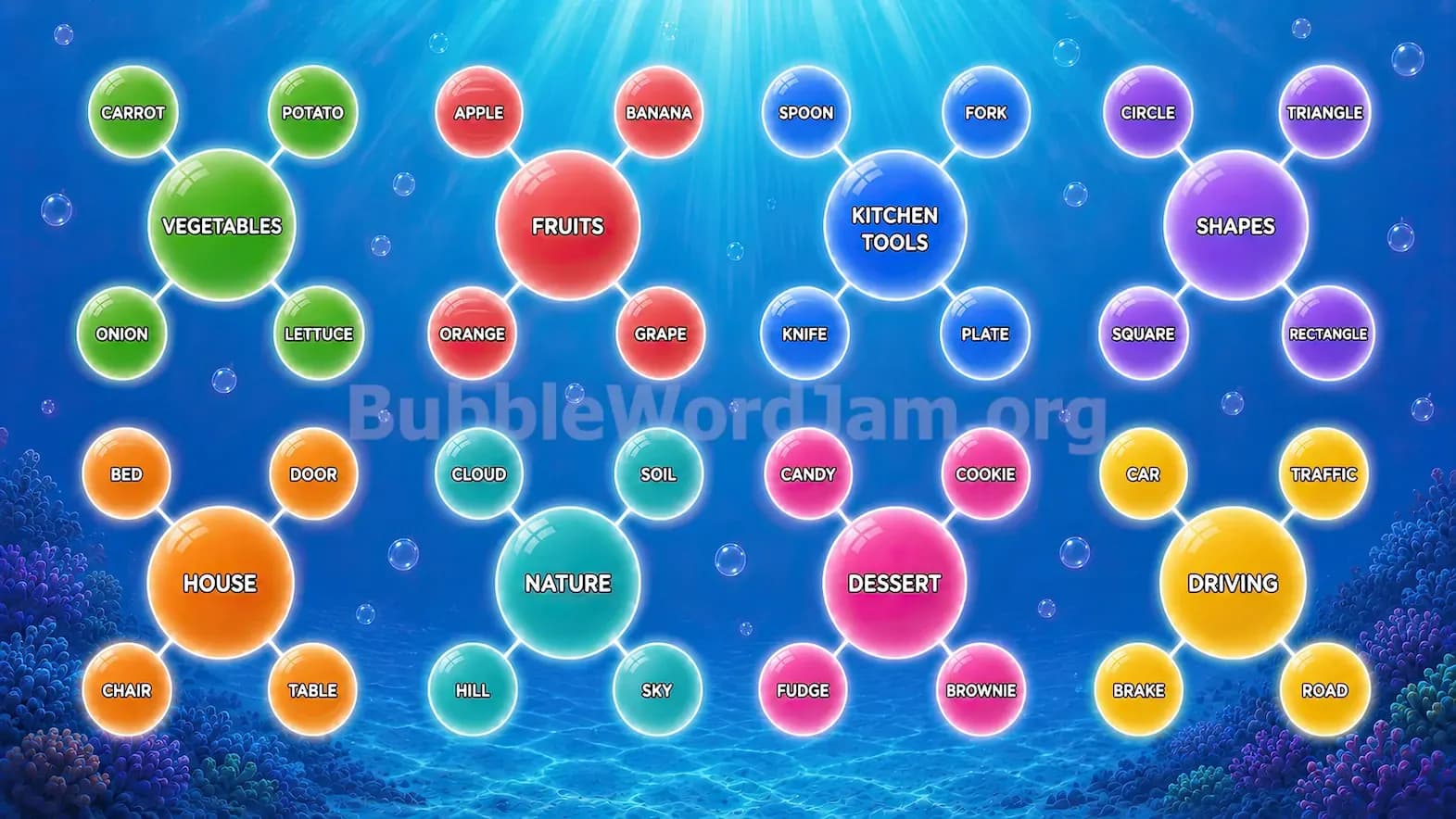
Level 2 is a great early lesson because it puts house and kitchen tools right next to broader everyday categories. The house group uses bed, door, chair, and table. The kitchen tools group uses spoon, fork, knife, and plate.
The key lesson is simple: room logic and object logic are not identical.
A chair and table could absolutely exist in a kitchen, but Level 2 treats them as general house items. Meanwhile, spoon, fork, knife, and plate are not “kitchen” as a room; they’re tools you use to eat or prepare food. That’s the split players need to respect.
My move here is to identify the most specific category first. Kitchen tools is more specific than house, so I lock that in before I touch bed, door, chair, or table. Specific beats general. That rule saves moves all over Bubble Word Jam.
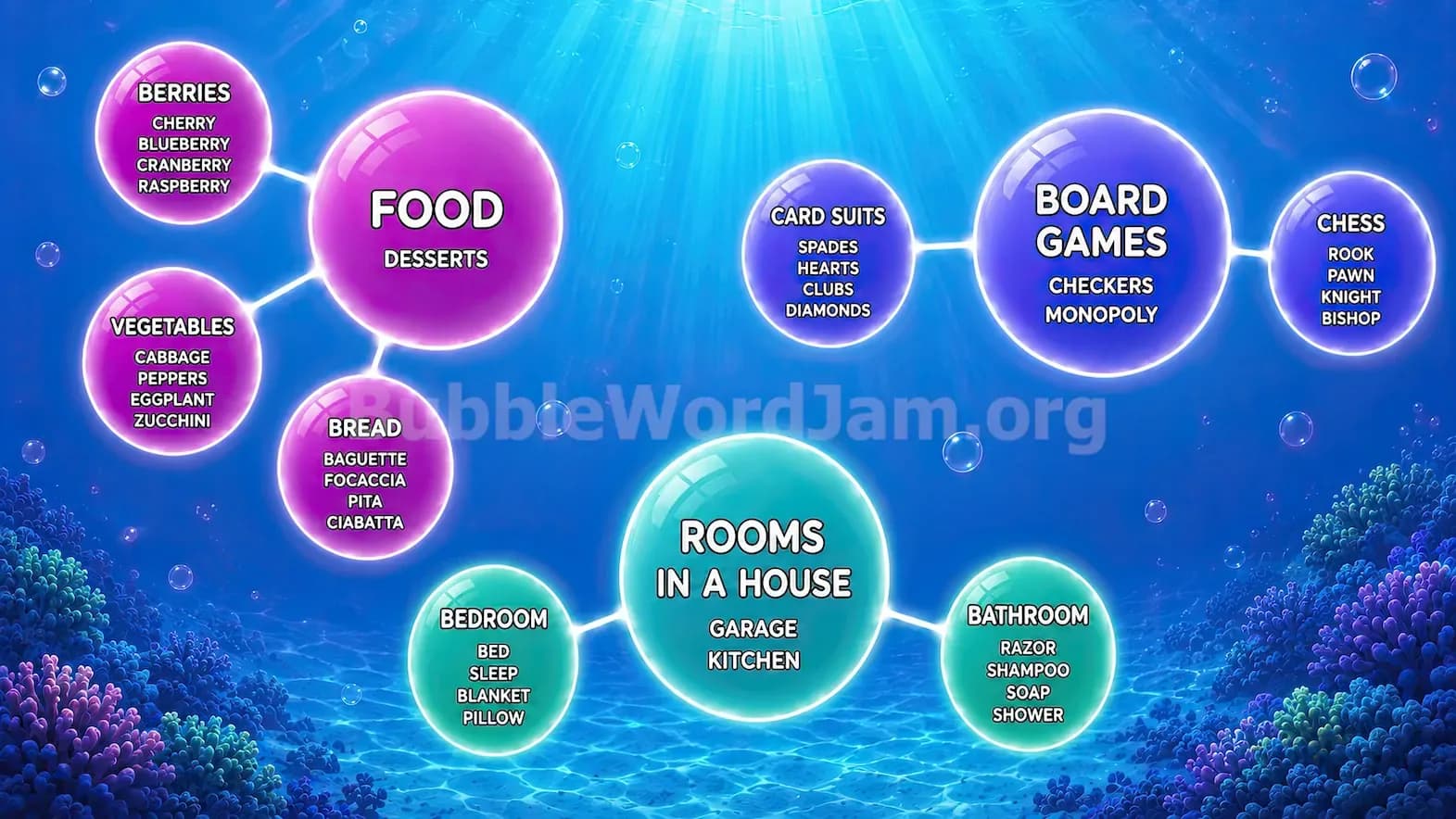
Level 14 is where the home theme becomes a proper category-sort test. You get bedroom with bed, sleep, blanket, and pillow. You get bathroom with razor, shampoo, soap, and shower. Then the bigger category appears: rooms in a house, using bedroom, bathroom, garage, and kitchen.
This is a perfect example of hierarchy. Bedroom and bathroom are categories by themselves, but they can also become items inside a larger category. That’s the moment Bubble Word Jam starts asking, “Are you sorting objects, rooms, or category names?”
Here’s the technique: separate physical objects from room labels.
Bed, blanket, pillow, and sleep belong inside the bedroom idea. Razor, shampoo, soap, and shower belong inside bathroom. But bedroom and bathroom as words can merge upward with garage and kitchen. That upward movement is the whole trick.
When a board includes both objects and room names, don’t panic. You’re probably dealing with a stack: item → room → house.
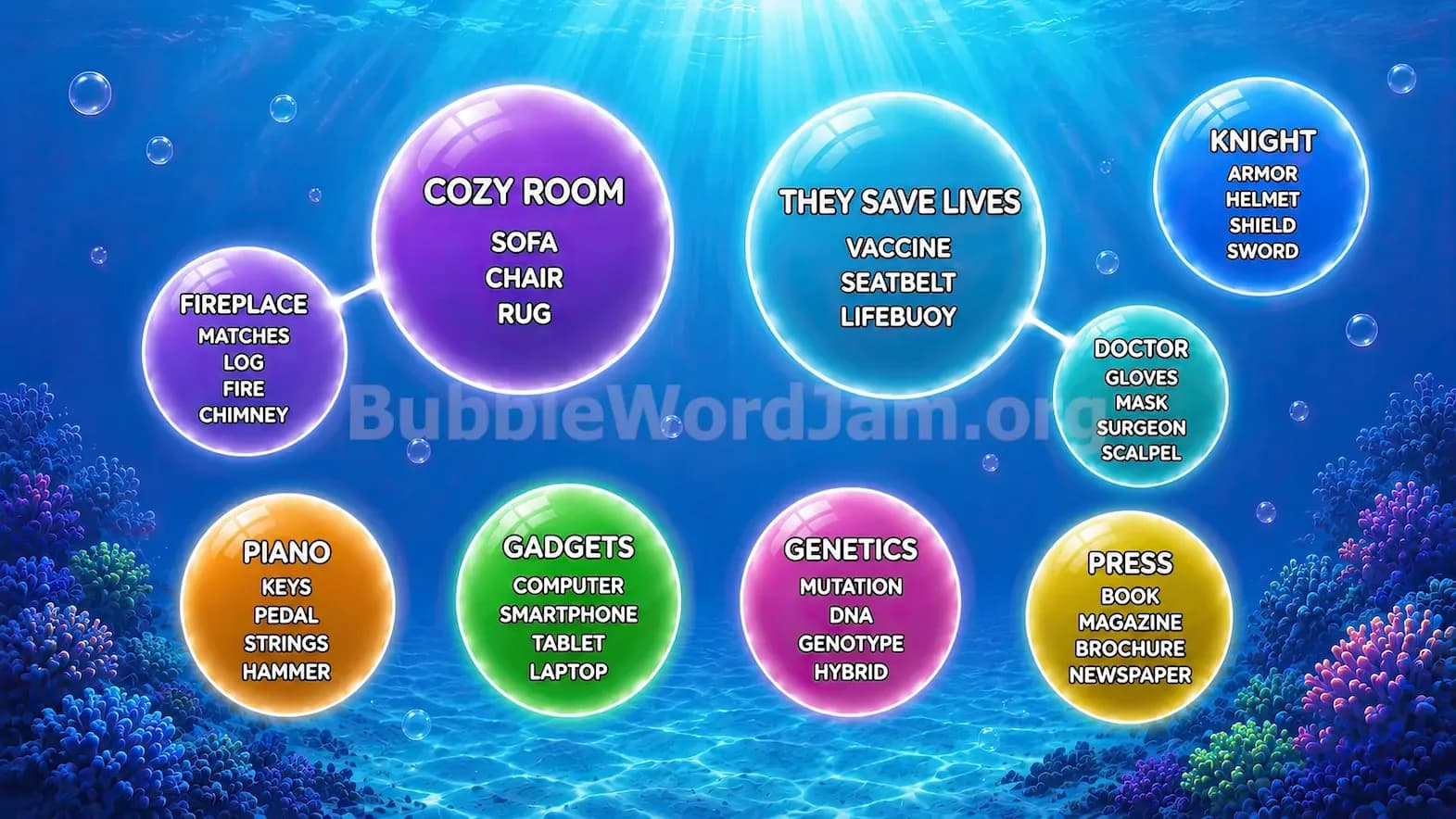
Level 29 throws in one of my favorite home-style categories: cozy room. The words sofa, chair, rug, and fireplace all belong together, but not because they’re all identical objects. Fireplace is not furniture. Rug is decor. Sofa and chair are furniture. The category works because the vibe connects them.
This is where home puzzles get less mechanical and more atmospheric. Bubble Word Jam sometimes asks for a mood category, not a strict object category.
If you see words that belong in the same scene but don’t share the same object type, think “room vibe.” Cozy room is a banger example. Sofa and chair give seating. Rug gives softness. Fireplace gives warmth. Together, they create the mental image of a comfortable living space.
That’s different from a furniture category, which would usually prefer sofa, table, chair, and bed. In Level 29, the fireplace pulls the set away from pure furniture and toward atmosphere.
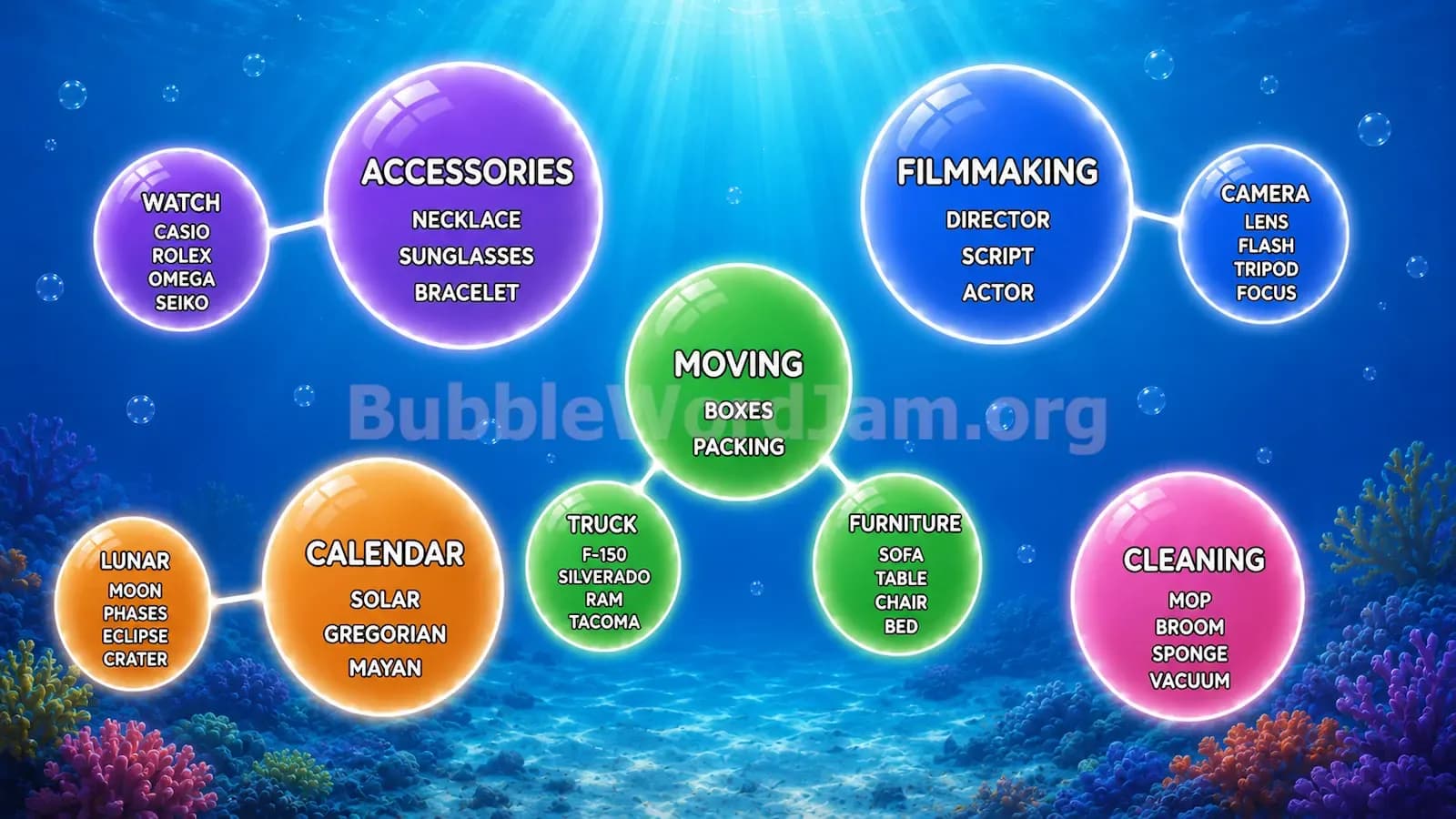
Level 87 is a great daily-life puzzle because it mixes cleaning, furniture, and moving. Cleaning uses mop, broom, sponge, and vacuum. Furniture uses sofa, table, chair, and bed. Moving uses boxes, truck, packing, and furniture.
That last one is the trap. Furniture appears as both a category idea and a word that can belong to moving. If you merge too quickly, you can jam yourself into a mediocre path.
The solution is to sort by action first.
Mop, broom, sponge, and vacuum all answer the question: “What do I use to clean?” Boxes, truck, packing, and furniture answer: “What is involved when moving?” Sofa, table, chair, and bed answer: “What are household furniture items?”
When one word feels broader than the others, pause. “Furniture” as a single word is not the same as sofa or chair. It may be a clue for a life event, not a furniture item.
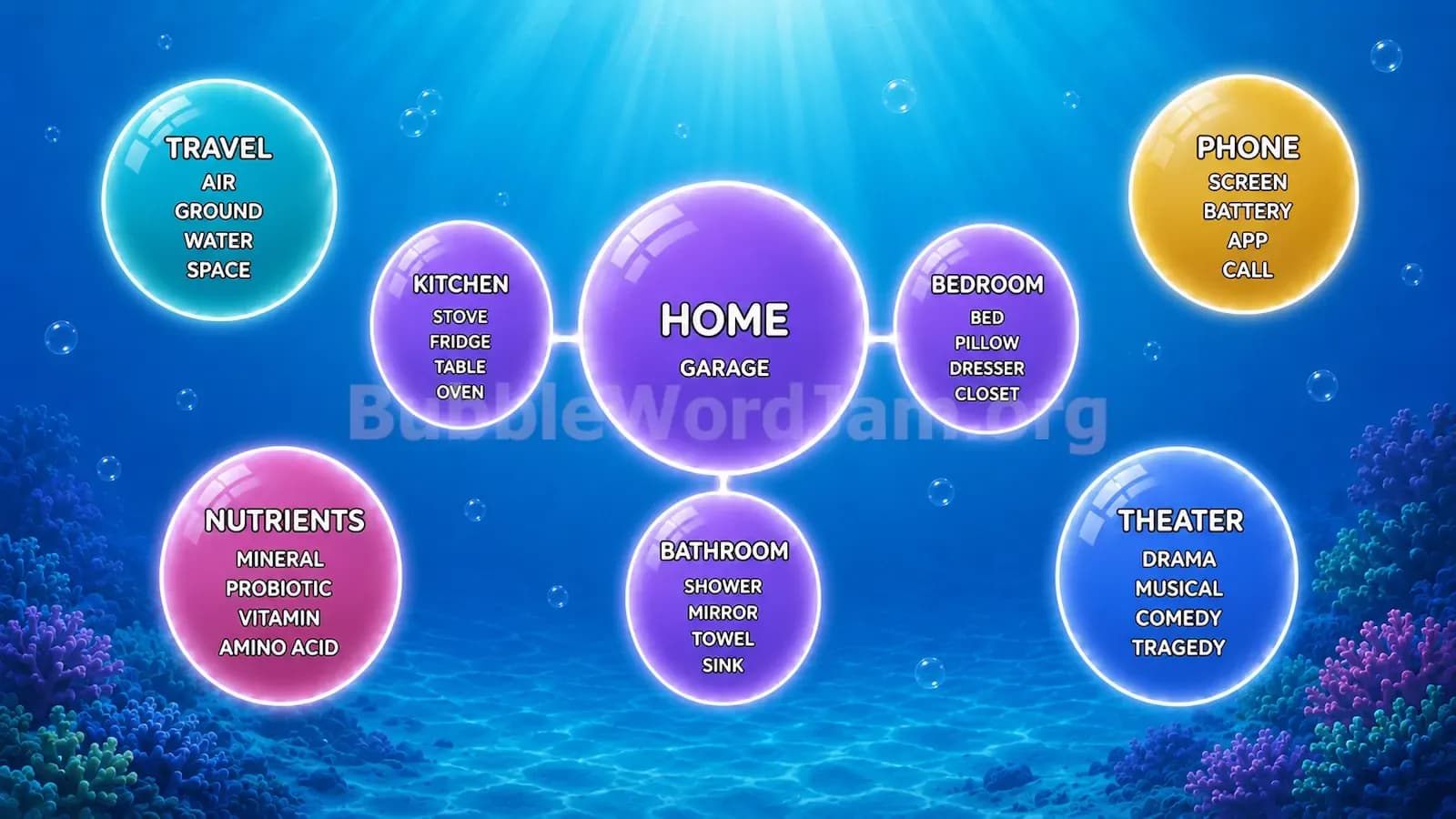
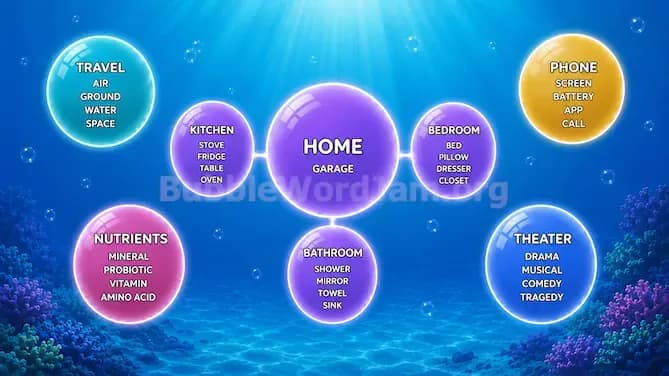
Level 112 is a clean example of the hub-and-room structure. Home includes kitchen, bedroom, bathroom, and garage. Then the puzzle breaks down kitchen with stove, fridge, table, and oven; bedroom with bed, pillow, dresser, and closet; bathroom with shower, mirror, towel, and sink.
This is the room-based scanning method in its purest form. You can almost solve it by drawing a tiny house in your head.
Kitchen: appliances and eating space. Bedroom: sleep and storage. Bathroom: washing, grooming, and reflection. Garage: the extra room that completes the home hub.
The smart play is to avoid merging kitchen, bedroom, and bathroom too early if their object groups are still visible. Let the specific rooms form first. Once those rooms are established, the larger home category becomes obvious.
Bubble Word Jam loves this layered loop. It feels simple, but it rewards patience.
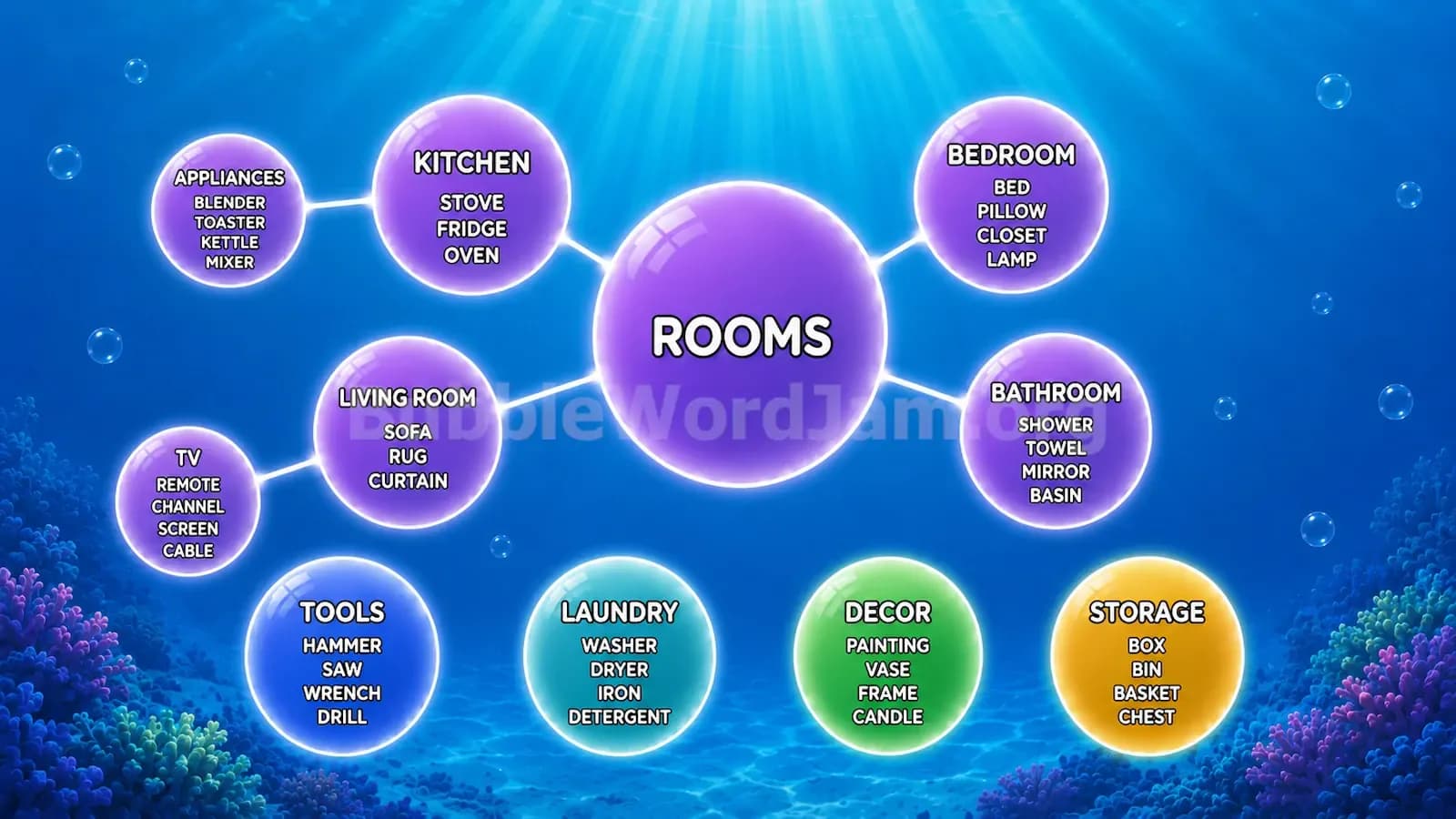
Level 233 is the full household checklist. You get rooms, tools, appliances, laundry, decor, storage, kitchen, bedroom, bathroom, living room, and TV. It’s busy, but it’s also fair if you scan room by room.
The kitchen group uses stove, fridge, appliances, and oven. Appliances uses blender, toaster, kettle, and mixer. Laundry uses washer, dryer, iron, and detergent. Decor uses painting, vase, frame, and candle. Storage uses box, bin, basket, and chest.
This is where players need to watch for category words hiding inside other categories. “Appliances” can be a standalone category, but it can also appear as an item inside kitchen. That’s not dirty design; that’s the whole loop.
My rule: when a word is plural and broad, treat it as a possible category label first. Appliances, rooms, tools, storage, and decor are all umbrella words. Don’t force them into a small object group unless the surrounding clues demand it.
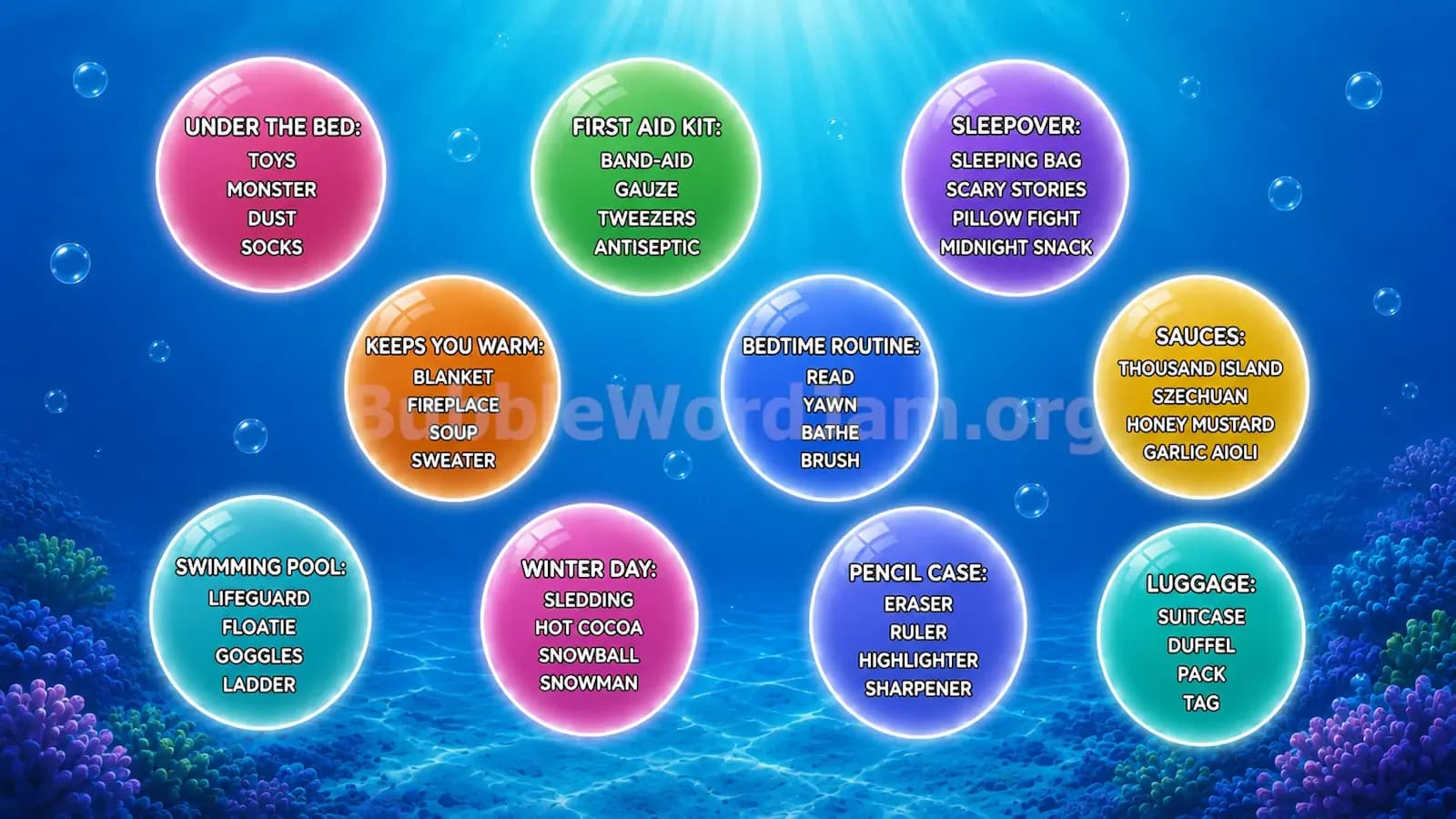
Level 302 shifts away from rooms and into lived-in household moments. Under the bed uses toys, monster, dust, and socks. Sleepover uses sleeping bag, scary stories, pillow fight, and midnight snack. Bedtime routine uses read, yawn, bathe, and brush. Luggage uses suitcase, duffel, pack, and tag.
This level has a playful domestic vibe, but the logic is sharp. “Dust” might make you think cleaning. “Socks” might make you think laundry. “Brush” might pull you toward bathroom. But the categories are built around situations.
Ask: where would these words appear together in real life?
Toys, monster, dust, and socks all belong under the bed because the category is location-based. Read, yawn, bathe, and brush belong to bedtime routine because the category is sequence-based. Sleeping bag, scary stories, pillow fight, and midnight snack belong to sleepover because the category is event-based.
Home puzzles aren’t always about rooms. Sometimes they’re about the mini-stories that happen inside them.
Level 502 gives us a narrower daily-life split: family relationships and kitchen knives. Family relationships uses brother, father, mother, and sister. Kitchen knives uses boning, cleaver, fillet, and paring.
This is a nice reminder that home and daily life categories don’t always mean furniture. A household puzzle can lean into family roles, cooking gear, routines, or objects from a shared domestic space.
Kitchen knives also teaches specificity. “Knife” as a general word can show up early in Bubble Word Jam, but boning, cleaver, fillet, and paring are specialized terms. When a puzzle uses precise vocabulary, the category is probably precise too. Don’t call it kitchen tools if the words are all types of knives. Name the smaller set.
The biggest trap is merging by location alone. Just because two things can be found in the same room doesn’t mean they belong together. A towel and a mirror both fit a bathroom, but a mirror can also fit decor. A table can fit kitchen, furniture, dining, or house. A blanket can be bedroom, sleepover, or keeps you warm.
The second trap is ignoring hierarchy. Bubble Word Jam often uses category words as playable words. Bedroom can be a category, then later become an item under rooms in a house. Appliances can be a category, then become part of kitchen. That’s the game’s favorite little flex.
The third trap is missing routine categories. Chores, bedtime, moving, laundry, and sleepover all depend on actions and scenarios. If the board feels messy, stop sorting objects and start sorting situations.
Use this order when home categories start to overlap:
That last point is the big one. Broad categories feel tempting, but they can burn moves. Bubble Word Jam rewards players who let the board explain itself before committing.
Home and daily life puzzles in Bubble Word Jam work because they turn familiar words into a layered sorting challenge. The words are easy. The relationships are the real puzzle.
When you scan by room, then by object type, then by routine, the whole board gets less noisy. Bedroom, bathroom, kitchen, garage, living room, laundry, and family clues each have their own rhythm. Learn that rhythm, and these comfort-zone categories become some of the most satisfying solves in the game.
The next time a board throws bed, towel, knife, sofa, washer, pillow, and garage into the same bubble soup, don’t rush. Walk through the house. Let each room claim its words. Then merge with confidence.