Learn how to solve Bubble Word Jam geography puzzles by separating landforms, bodies of water, and named places like the Nile, Amazon, and Baltic Sea.

Guide By Liam Stone
Updated on June 5, 2026
Liam Stone has been playing Bubble Word Jam since the mobile app first launched on the Apple App Store. He knew this game would pop, so he enjoys playing every level, collecting the answers, and running this site for other players. He loves mobile puzzle games and sometimes publishes his walkthroughs on his YouTube channel Puzzle Game Answer. Follow his channel if you are a puzzle game lover too.
Geography puzzles in Bubble Word Jam have a sneaky little trick: they don’t just ask whether you know what a mountain is. They ask whether you can tell the difference between a category, a physical feature, and a named example before the board eats your moves.
That’s why landforms and bodies of water can feel so crunchy. A word like “river” might belong under bodies of water, but “Nile” belongs under river. “Sea” is generic, but “Baltic” is specific. “Mountain” is a landform, while “Himalayas” is a named mountain range. Miss that split, and suddenly the puzzle goes from calm brain teaser to messy bubble traffic jam.
The good news? Once you learn the pattern, these puzzles become much more readable. The main technique is simple: separate generic geography words from named places.
When a Bubble Word Jam level includes natural places, ask one question first: “Is this word a type of place, or the name of a specific place?”
Generic geography words include terms like mountain, island, ocean, river, lake, pond, canyon, desert, forest, valley, plateau, and sea. These words describe a kind of place.
Named examples include words like Andes, Alps, Himalayas, Pyrenees, Maldives, Bali, Hawaii, Jamaica, Nile, Amazon, Mississippi, Danube, Aegean, Black, Mediterranean, and Baltic. These are specific places or named geographic examples.
That split matters because Bubble Word Jam loves hierarchy. It might give you a broad group like “geographical objects,” then tuck smaller groups inside it, such as mountains or islands. The loop is clean, but only if you don’t merge too early.
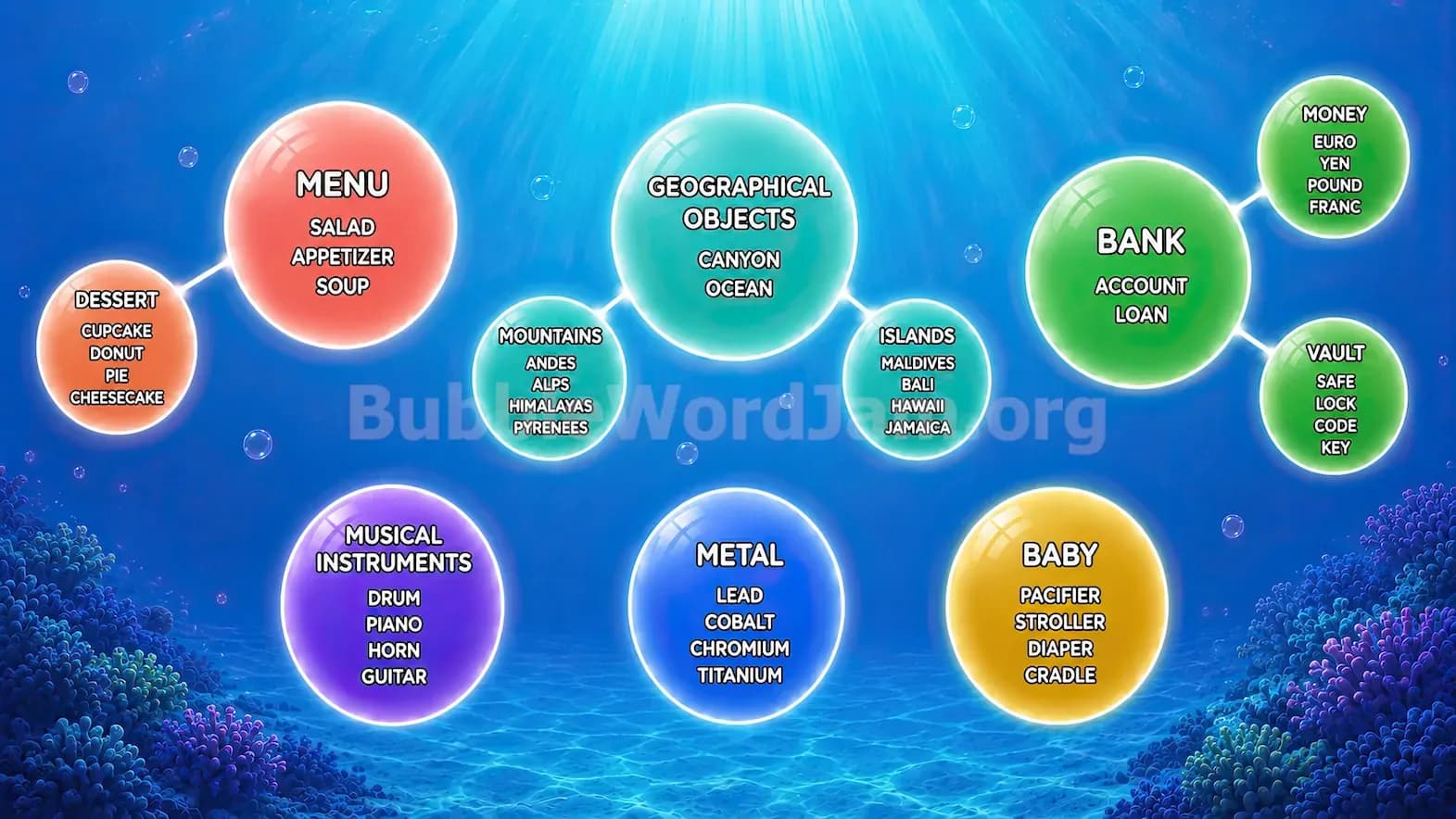
Level 18 is one of the cleanest examples of this pattern. It includes mountains: Andes, Alps, Himalayas, and Pyrenees. It also includes islands: Maldives, Bali, Hawaii, and Jamaica. Then it adds a bigger group: geographical objects, with canyon, ocean, mountains, and islands.
That last category is the trap. “Mountains” and “islands” are not individual examples here. They are category words sitting inside a broader geography bucket. If you rush and treat “mountains” like it belongs beside Andes or Alps, the whole solve gets floaty.
The move is to build from the most specific group first. Andes, Alps, Himalayas, and Pyrenees clearly form mountains. Maldives, Bali, Hawaii, and Jamaica clearly form islands. Once those are safe, the broader set becomes obvious: canyon, ocean, mountains, islands.
This is the geography version of sorting animals by “dog breeds” before using “dog” in a pet category. Specific first, category labels second.
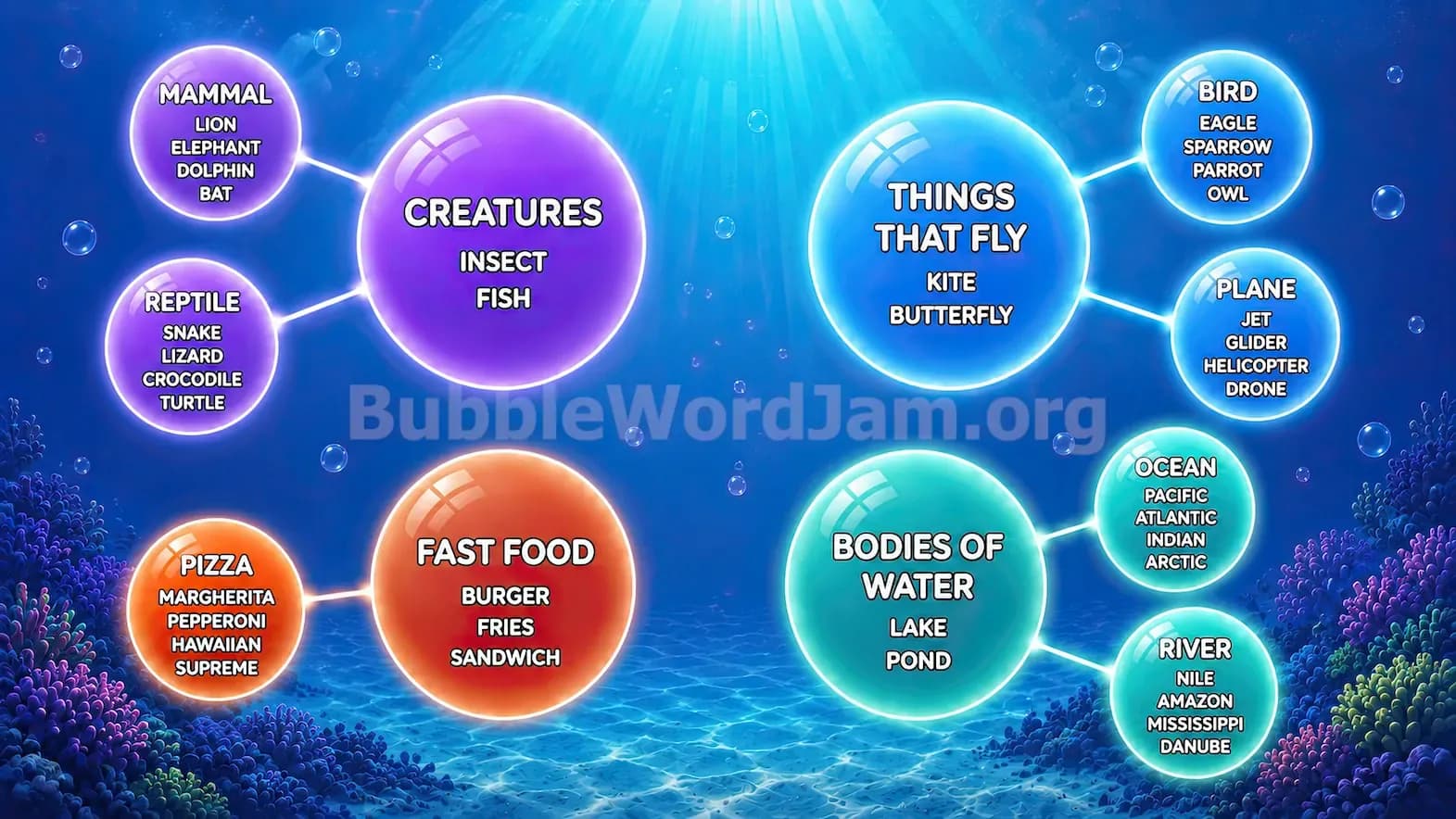
Level 32 turns the same idea into a water puzzle. Pacific, Atlantic, Indian, and Arctic belong to ocean. Nile, Amazon, Mississippi, and Danube belong to river. Then ocean, river, lake, and pond combine into bodies of water.
This is a banger teaching level because it shows the full ladder:
Specific names → generic water type → broad water category.
Pacific is not just “water.” It is an ocean. Nile is not just “water.” It is a river. Ocean and river then become members of the bigger “bodies of water” group.
When you see named places, don’t throw them straight into the broadest bucket. Bubble Word Jam usually wants that middle layer. The game is testing whether you can spot the taxonomy, not just the topic.
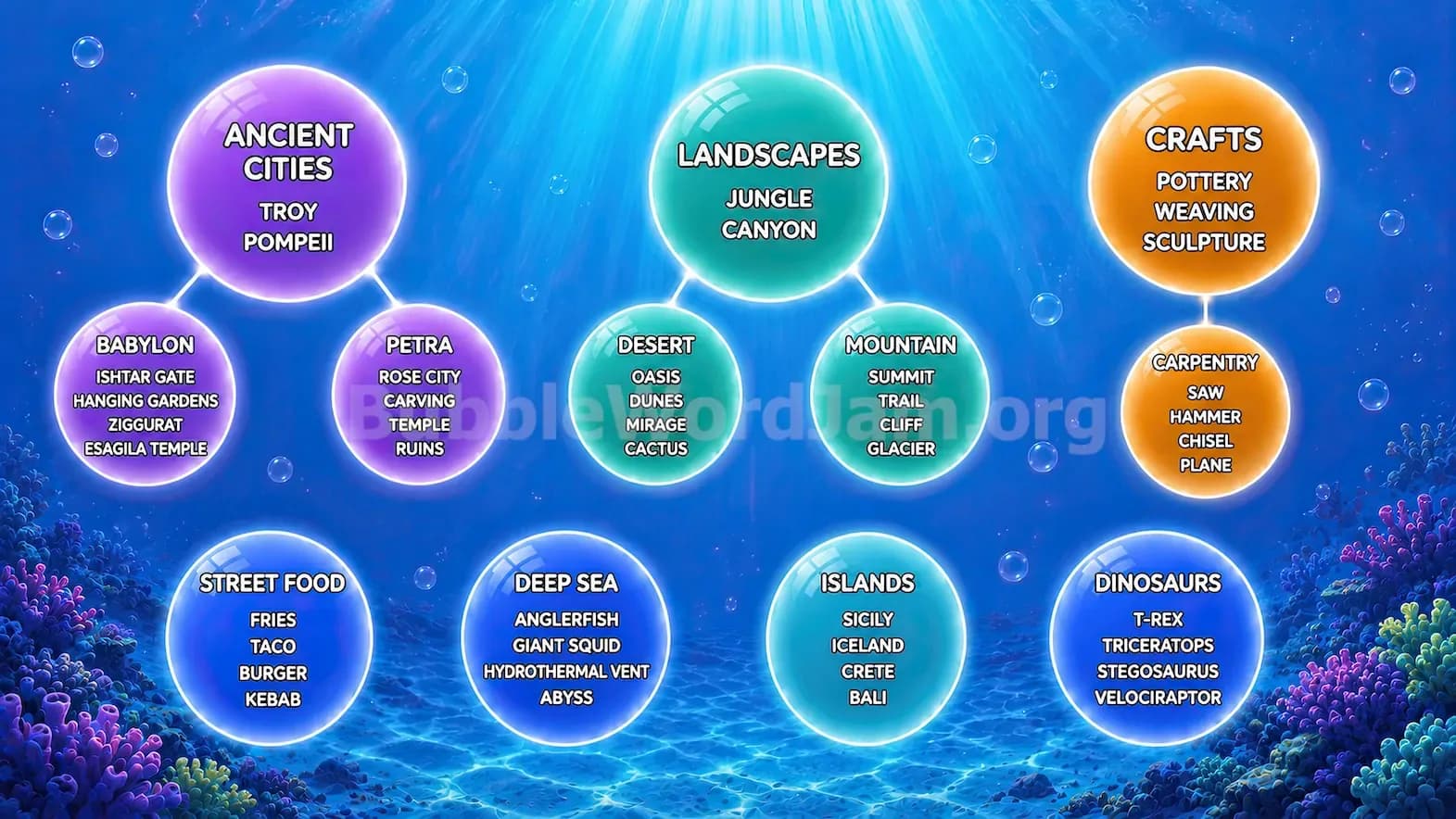
Level 45 gets more textured. It includes landscapes: jungle, desert, mountain, canyon. Then it breaks down specific natural environments, including deep sea, desert, and mountain.
Deep sea uses words like anglerfish, giant squid, hydrothermal vent, and abyss. Desert uses oasis, dunes, mirage, and cactus. Mountain uses summit, trail, cliff, and glacier.
This level feels harder because not every word is a place name. Some are features, creatures, or conditions tied to a natural environment. “Giant squid” points to deep sea. “Mirage” points to desert. “Glacier” points to mountain.
The technique here is to stop looking only for map labels. Natural-place puzzles can use ecosystem clues. If the word describes what lives there, what forms there, or what you experience there, it probably belongs to that environment.
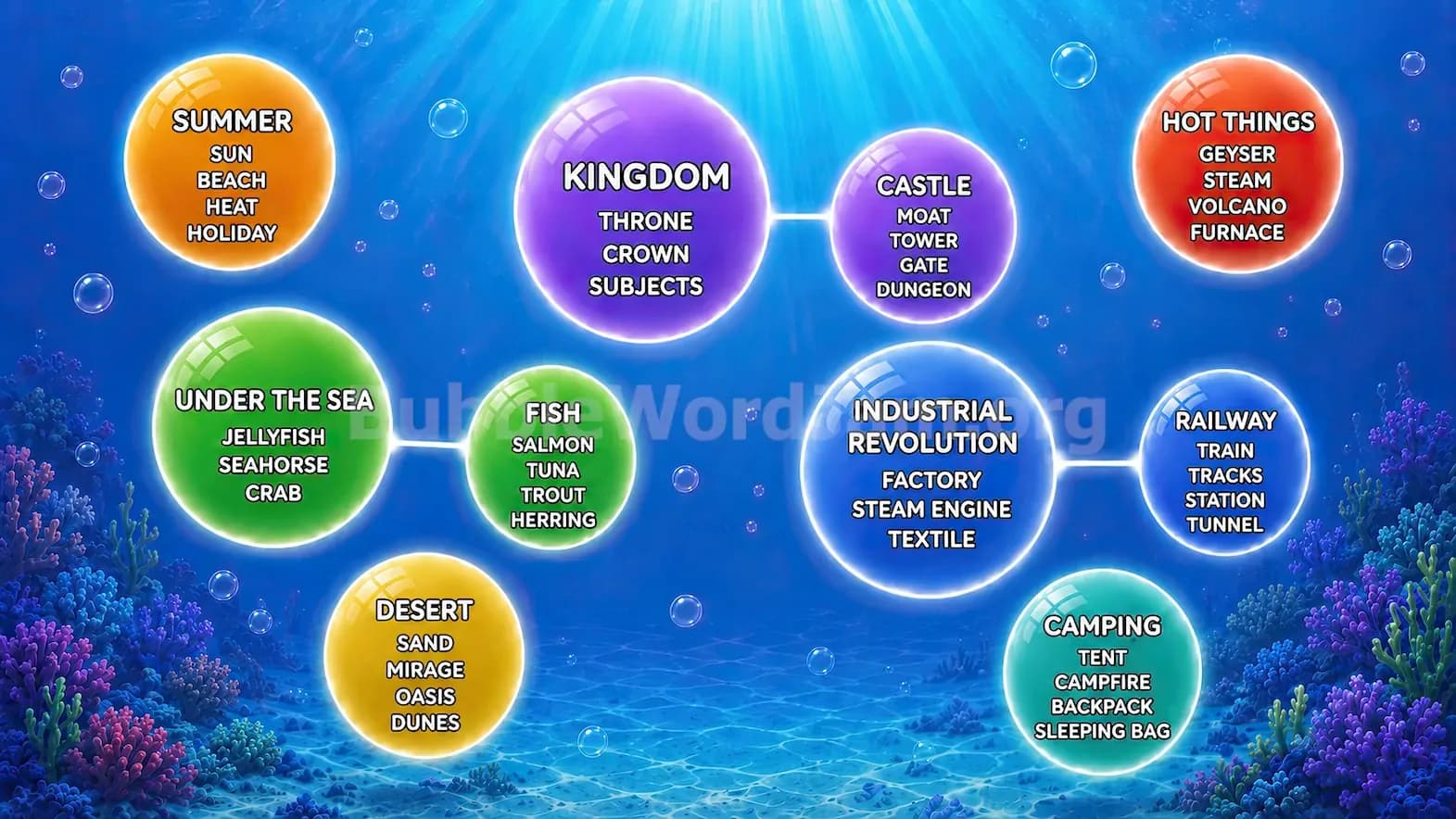
Level 57 gives a nice contrast between two environments: under the sea and desert. Under the sea includes jellyfish, seahorse, crab, and fish. Desert includes sand, mirage, oasis, and dunes.
This one is less about named geography and more about habitat recognition. It asks, “Where would this thing naturally fit?”
Jellyfish and seahorse scream ocean life. Mirage and dunes scream desert. The only word that might make players pause is “fish,” because it can also appear as its own category in other levels. That’s where Bubble Word Jam gets spicy. A word can have a different role depending on the board.
Don’t solve words in isolation. Solve them against the whole field. If salmon, tuna, trout, and herring are also present, “fish” may be a category label. If jellyfish, seahorse, and crab are nearby, “fish” is probably part of under the sea.
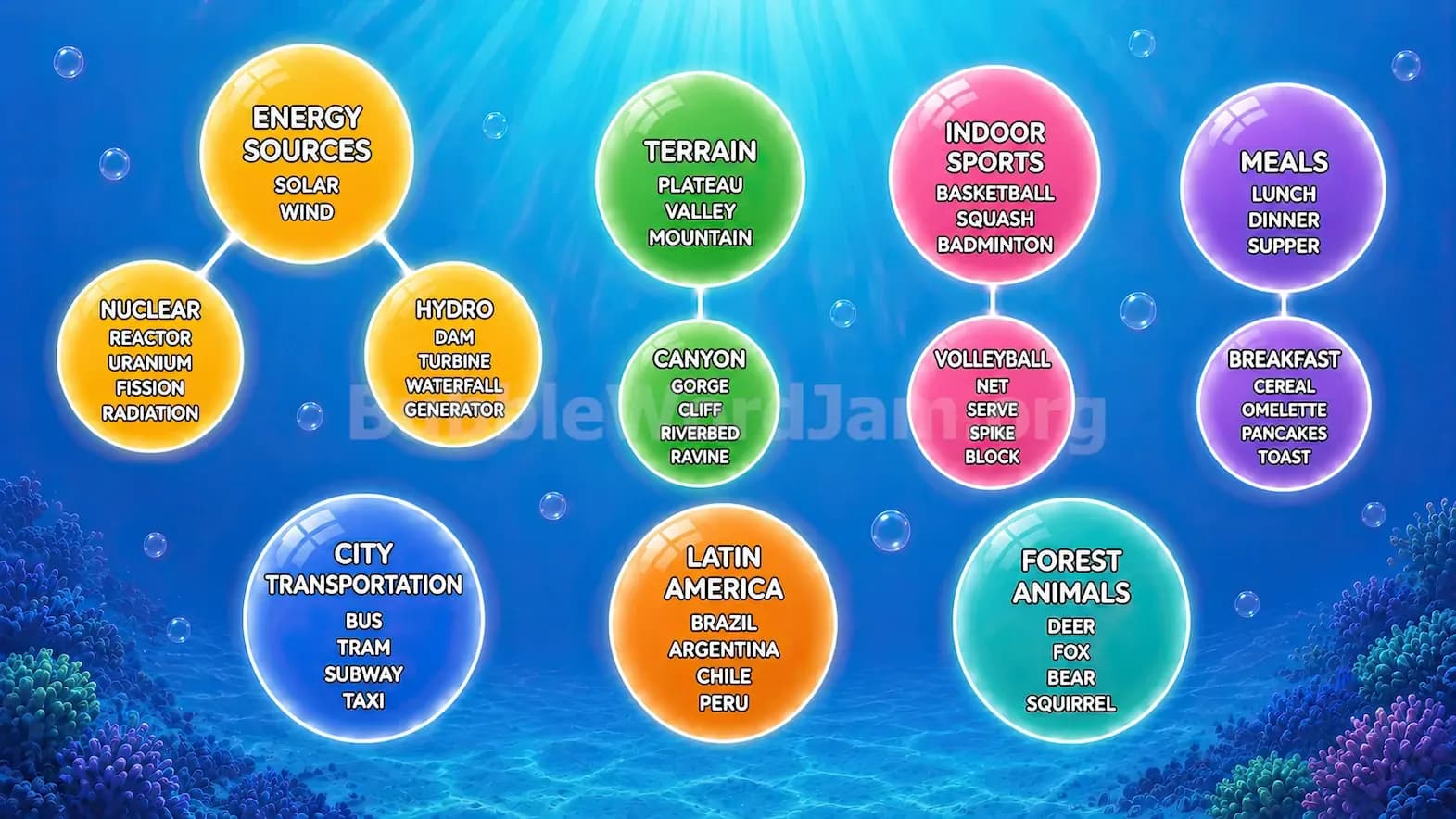
Level 59 leans into landforms with terrain: canyon, plateau, valley, mountain. It also includes canyon as its own smaller group: gorge, cliff, riverbed, and ravine.
That is classic Bubble Word Jam hierarchy. Canyon is both a landform and a category anchor. First, build the detailed canyon group. Gorge, cliff, riverbed, and ravine all point to the anatomy or close relatives of a canyon. Then use canyon as part of the broader terrain group.
The lesson: when a geography word appears as both a possible answer and a possible category, check whether supporting words describe its parts. If yes, complete the smaller category first.
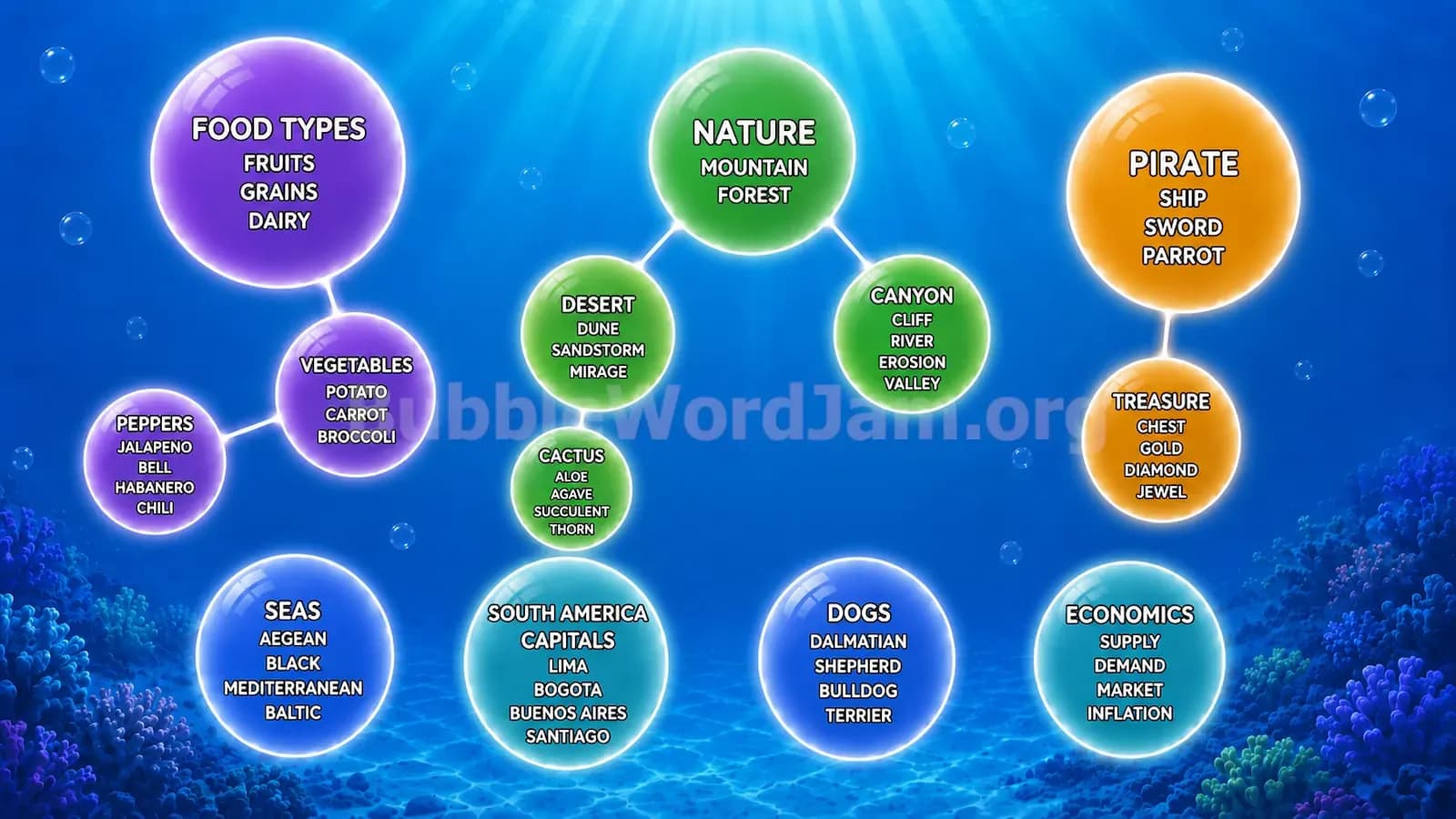
Level 105 is a strong mid-game geography check. Seas includes Aegean, Black, Mediterranean, and Baltic. Desert includes cactus, dune, sandstorm, and mirage. Canyon includes cliff, river, erosion, and valley. Nature includes mountain, canyon, desert, and forest.
This level can bait sloppy merging because it mixes named seas with natural systems and broad labels. Baltic is not simply a “body of water” clue here; it belongs with named seas. Canyon is not immediately solved by cliff and valley alone; the group also wants erosion and river.
I like this one because it rewards patience. You need to recognize both geography vocabulary and process vocabulary. Erosion is not a place, but it is deeply connected to canyon formation. Sandstorm is not a desert object, but it is a desert event. Bubble Word Jam often uses that kind of sideways clue to keep the loop from becoming a rehash.
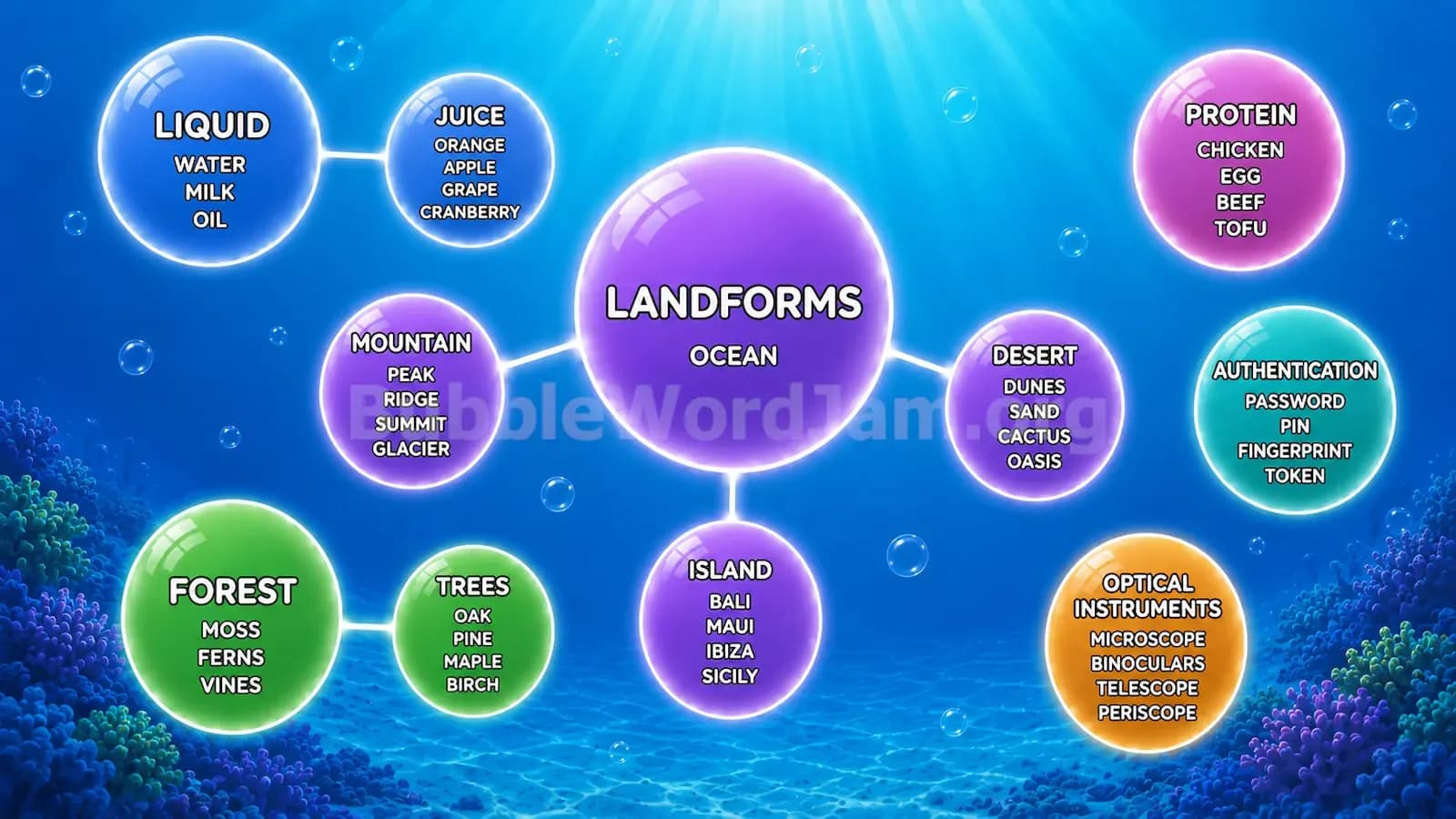
Level 210 brings several natural-place ideas together. Landforms includes mountain, desert, ocean, and island. Island includes Bali, Maui, Ibiza, and Sicily. Forest includes trees, moss, ferns, and vines. Trees includes oak, pine, maple, and birch. Desert includes dunes, sand, cactus, and oasis. Mountain includes peak, ridge, summit, and glacier.
This is where the hierarchy becomes the whole game. The level has broad categories, named examples, plant groups, and feature groups all tangled together.
The best solve order is usually specific to broad. Build island from named islands. Build trees from tree types. Build desert from desert clues. Build mountain from mountain features. Then the broader landforms group becomes much easier.
If you try to solve “landforms” too early, you may steal mountain or desert away from their smaller clue clusters. That can tank your board position fast.
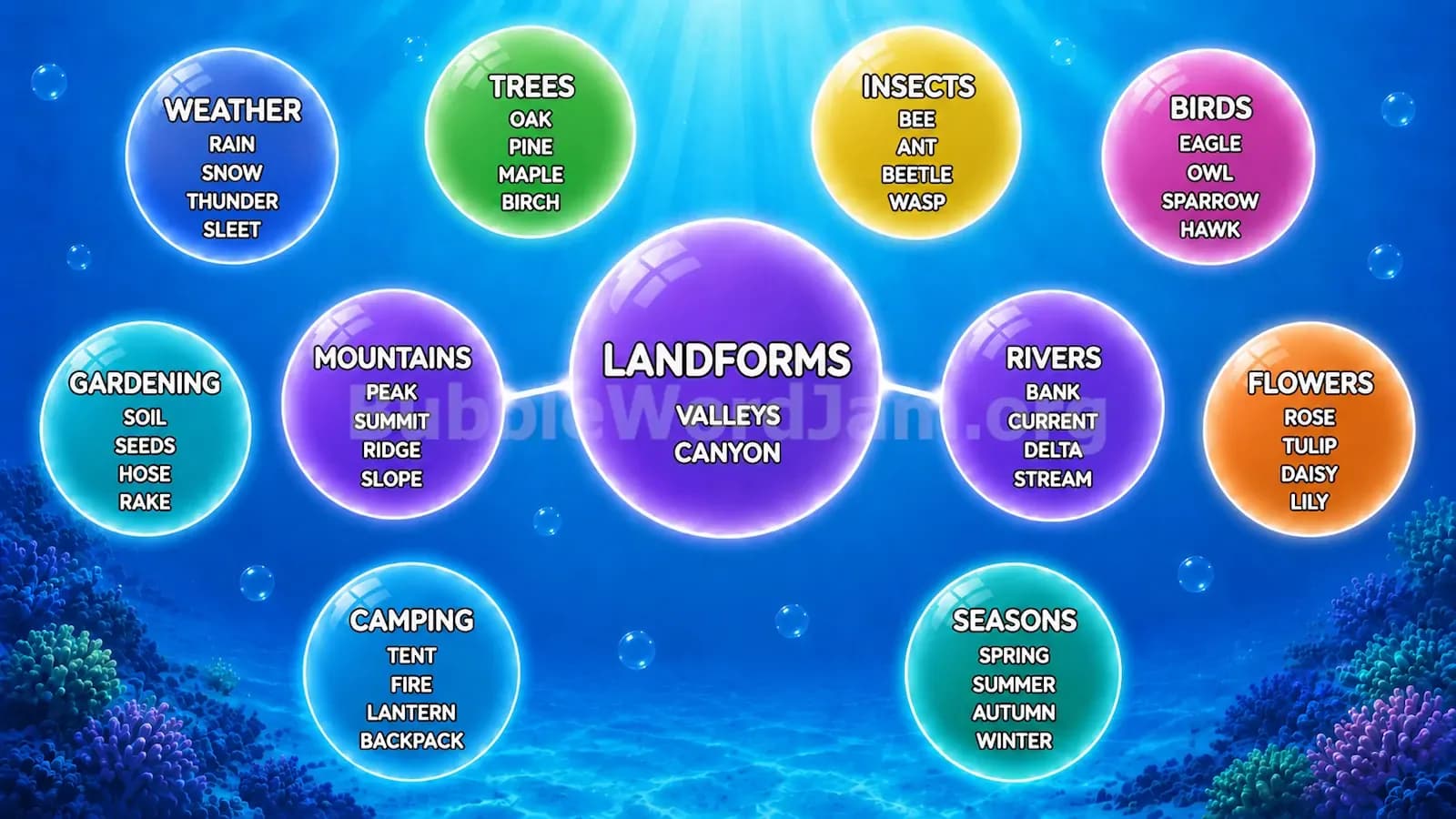
Level 232 revisits the clean geography stack with landforms: rivers, mountains, valleys, and canyon. Then it includes mountains with peak, summit, ridge, and slope, plus rivers with bank, current, delta, and stream.
This is a perfect reminder that plural category labels matter. “Rivers” can be an answer inside landforms, while “bank,” “current,” “delta,” and “stream” form the rivers category. “Mountains” can be an answer inside landforms, while “peak,” “summit,” “ridge,” and “slope” form the mountains category.
When you see plural geography words, treat them like folder names. They might not be the final category; they might be pieces inside a bigger one.
When a Bubble Word Jam board starts showing natural places, use this quick mental checklist:
First, mark named places. Nile, Amazon, Baltic, Bali, Andes, and Himalayas almost always belong to a specific geography category.
Second, identify generic landforms and water types. Mountain, island, ocean, river, canyon, desert, forest, valley, and sea often act as middle-layer words.
Third, watch for broad umbrella categories. Landforms, bodies of water, landscapes, terrain, nature, and geographical objects usually collect the generic terms.
Fourth, don’t ignore feature clues. Delta points to rivers. Glacier points to mountains. Mirage points to desert. Erosion points to canyon. These clues are not random; they’re the connective tissue.
Landforms and bodies of water in Bubble Word Jam are less about memorizing every geography word and more about reading the category ladder. Named examples sit at the bottom. Generic place types sit in the middle. Umbrella categories sit at the top.
Once you see that structure, levels like 18, 32, 45, 57, 59, 105, 210, and 232 stop feeling like a messy map quiz. They become a rock-solid sorting loop: name the place, classify the place, then merge it into the bigger natural-world idea.
That’s the vibe to chase. Don’t just ask, “Is this geography?” Ask, “What layer of geography is this?” That one habit will save moves, reduce wrong merges, and make Bubble Word Jam’s natural-place puzzles feel way more satisfying.