Learn how to solve Bubble Word Jam geography levels by sorting countries, continents, capitals, regions, landmarks, and cultural clues with fewer wasted moves.


Guide By Liam Stone
Updated on June 3, 2026
Liam Stone has been playing Bubble Word Jam since the mobile app first launched on the Apple App Store. He knew this game would pop, so he enjoys playing every level, collecting the answers, and running this site for other players. He loves mobile puzzle games and sometimes publishes his walkthroughs on his YouTube channel Puzzle Game Answer. Follow his channel if you are a puzzle game lover too.
Geography levels in Bubble Word Jam have a sneaky little habit: they look obvious until they aren’t. You see “Paris,” “Tokyo,” “Africa,” “Japan,” “Eiffel Tower,” and “Maple,” and your brain wants to slam them all into one big “places” bucket. That’s the trap. Bubble Word Jam doesn’t just ask, “Do you know geography?” It asks, “Can you tell what kind of geography clue this is?”
That distinction matters because geography puzzles in Bubble Word Jam often mix countries, continents, capitals, regions, cities, landmarks, languages, currencies, and cultural markers in the same board. The loop is crunchy: identify the category, test the relationship, then merge only when the words belong at the same level of meaning.
A country is not the same thing as a capital. A continent is not the same thing as a region. A landmark is not the same thing as a country, even if the two are strongly connected. Once you train yourself to ask the right question, these levels become much less floaty.
The best technique for geography levels is simple: before merging, ask what role each word plays.
Is it a place? Is it a region? Is it a capital? Is it a cultural marker?
That one question saves moves. In Bubble Word Jam, a word like “Paris” might appear in a capitals category, a France category, a fashion capitals category, or a famous cities group. “Japan” might be a country, but it can also lead into sushi, samurai, Mount Fuji, Tokyo, anime, or kimono depending on the puzzle’s structure.
The game loves this kind of semantic overlap. It’s not unfair, but it does punish lazy sorting. If you treat every recognizable location as “geography,” you’ll tank your board fast. If you separate the role of the word from the word itself, you get a much cleaner solve.
When a level includes broad map terms, solve those first. They act like the puzzle’s skeleton.
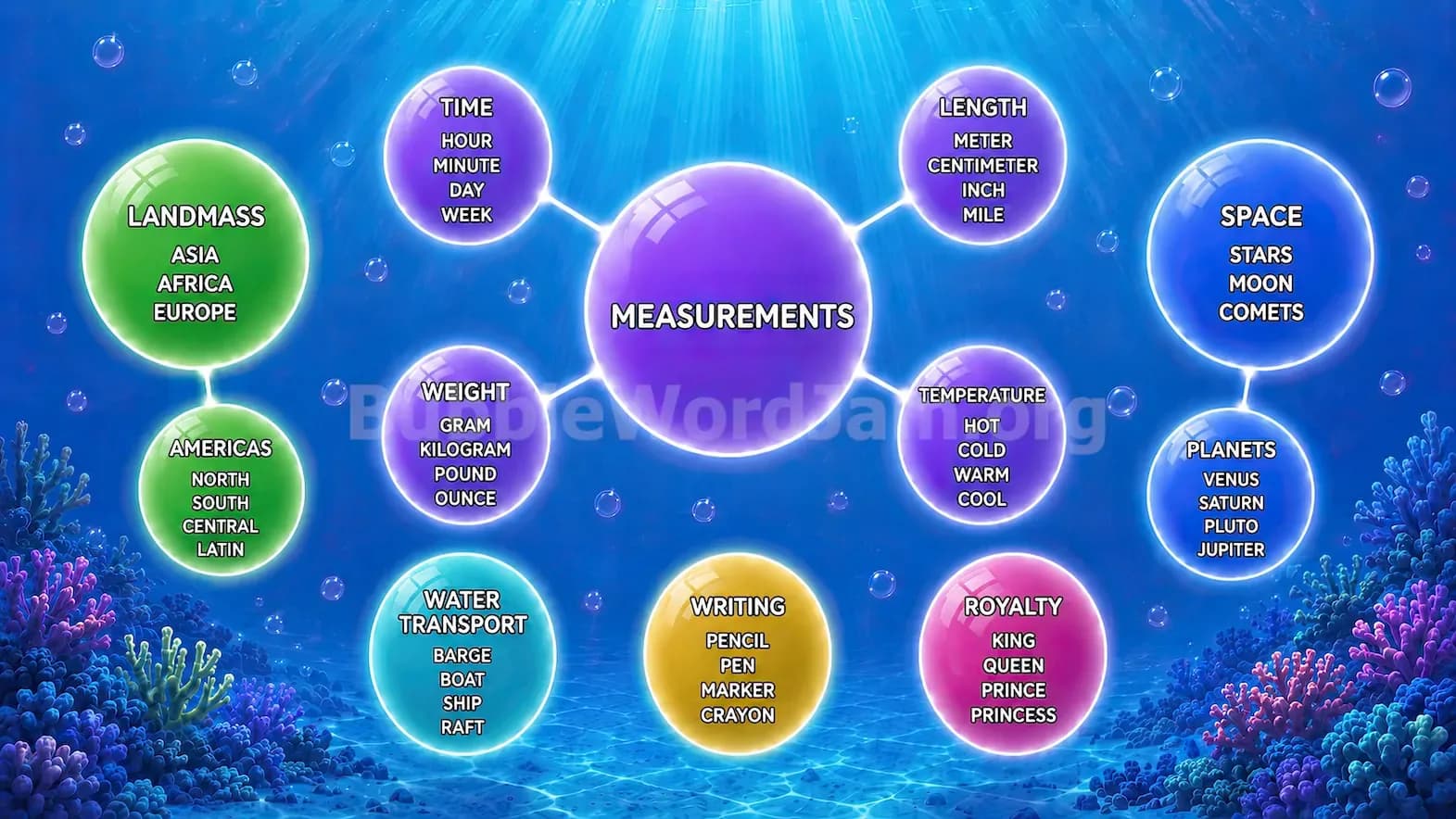
Level 7 is a great early example. It includes “landmass” with Asia, Africa, Europe, and Americas. Then it zooms in with “Americas,” using North, South, Central, and Latin. That’s a classic Bubble Word Jam geography hierarchy: big category first, sub-region second.
The trick here is not to merge “Asia” with “North” just because both feel geographical. “Asia” is a continent. “North” is a modifier inside the Americas set. Same subject area, different layer. That’s the kind of distinction geography levels keep testing.
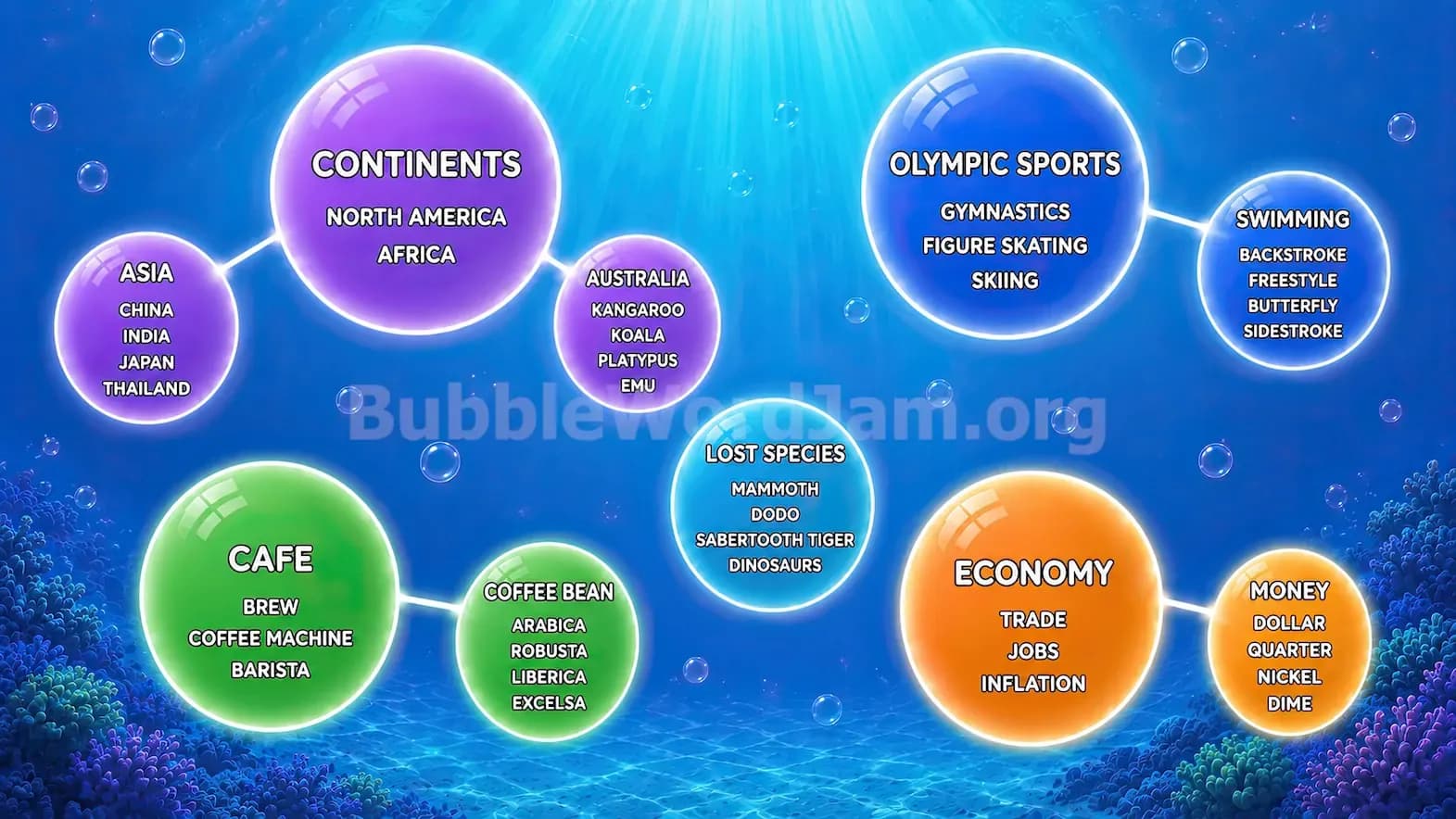
Level 42 goes even harder with “continents”: Asia, North America, Africa, and Australia. But the same level also includes “Asia” as its own category, with China, India, Japan, and Thailand. Then “Australia” becomes a local-icon category with kangaroo, koala, platypus, and emu. That’s a banger example of how Bubble Word Jam stacks geography: continent, country cluster, then cultural or wildlife identity.
Countries often sit between continents and local clues. If you see several country names together, check whether they share a continent, language family, region, or political grouping.
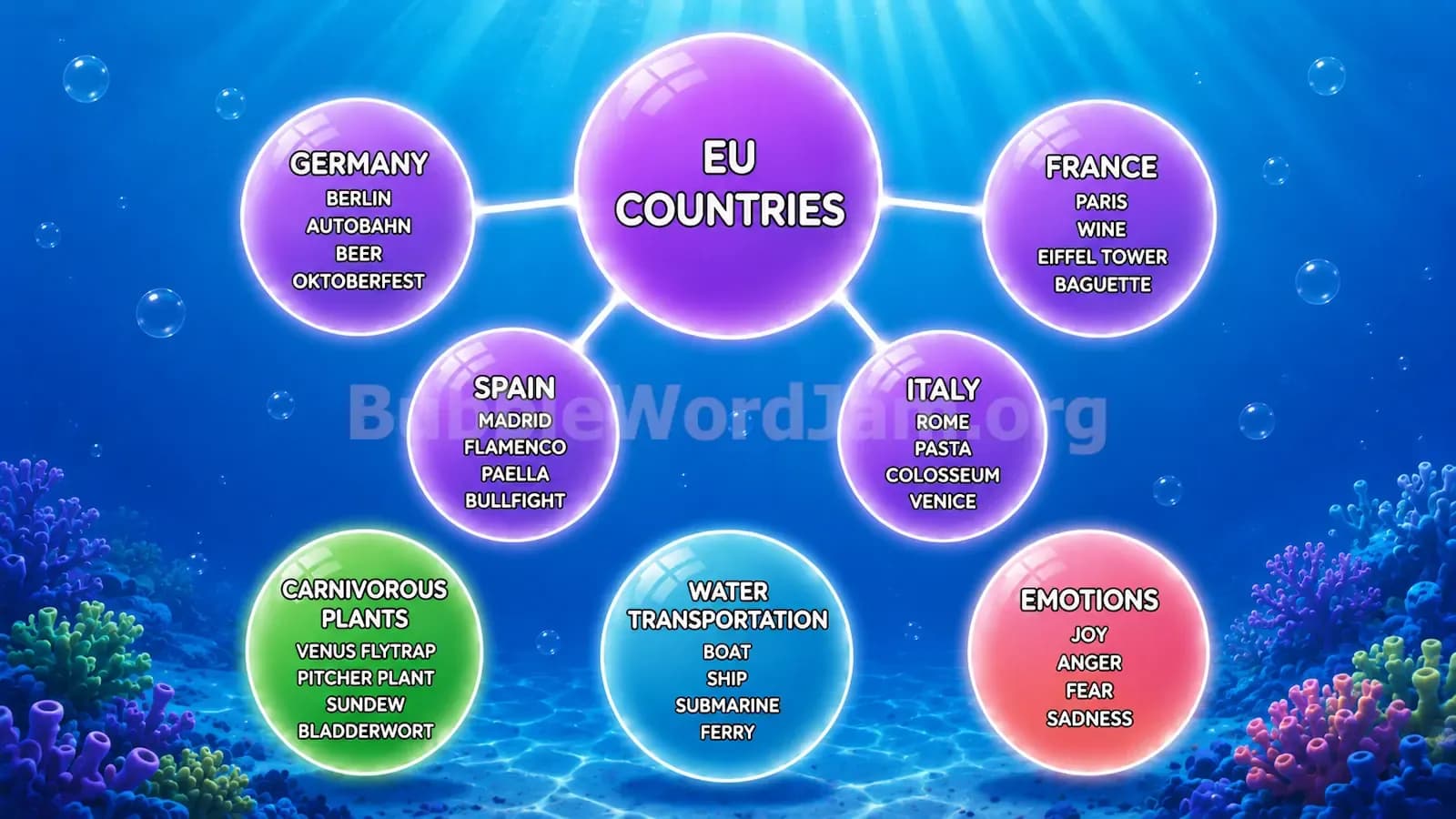
Level 91 uses “EU countries” with Germany, Italy, France, and Spain. But it doesn’t stop there. Each country then expands into recognizable markers: Germany has Berlin, autobahn, beer, and Oktoberfest; France has Paris, wine, Eiffel Tower, and baguette; Spain has Madrid, flamenco, paella, and bullfight; Italy has Rome, pasta, Colosseum, and Venice.
That’s the perfect model for solving country-based levels. First, spot the country set. Then avoid stealing words that belong to the country’s cultural bubble. “Paris” should not jump into “EU countries,” because it’s not a country. “Eiffel Tower” should not merge with France’s neighbors, because it’s a landmark attached to France.
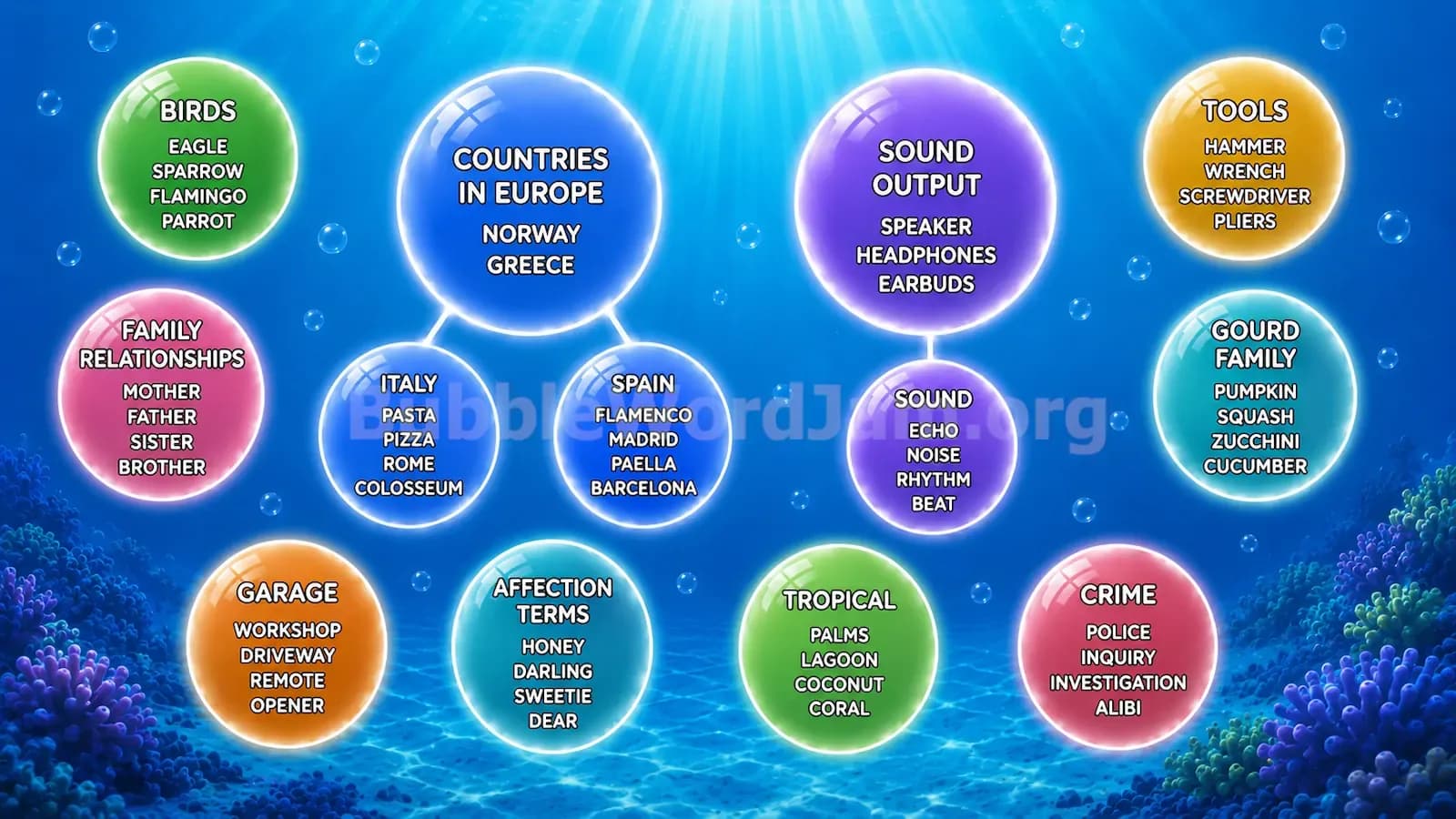
Level 137 repeats the same idea with “countries in Europe”: Norway, Spain, Greece, and Italy. Nearby, Italy uses pasta, pizza, Rome, and Colosseum, while Spain uses flamenco, Madrid, paella, and Barcelona. The board is testing whether you can separate the label from the evidence.
Capital categories are some of the easiest to overthink. When you see Paris, London, Tokyo, and Cairo in Level 12, don’t ask what country each belongs to first. Ask: “Are these all the same kind of place?” Yes—they’re capitals.
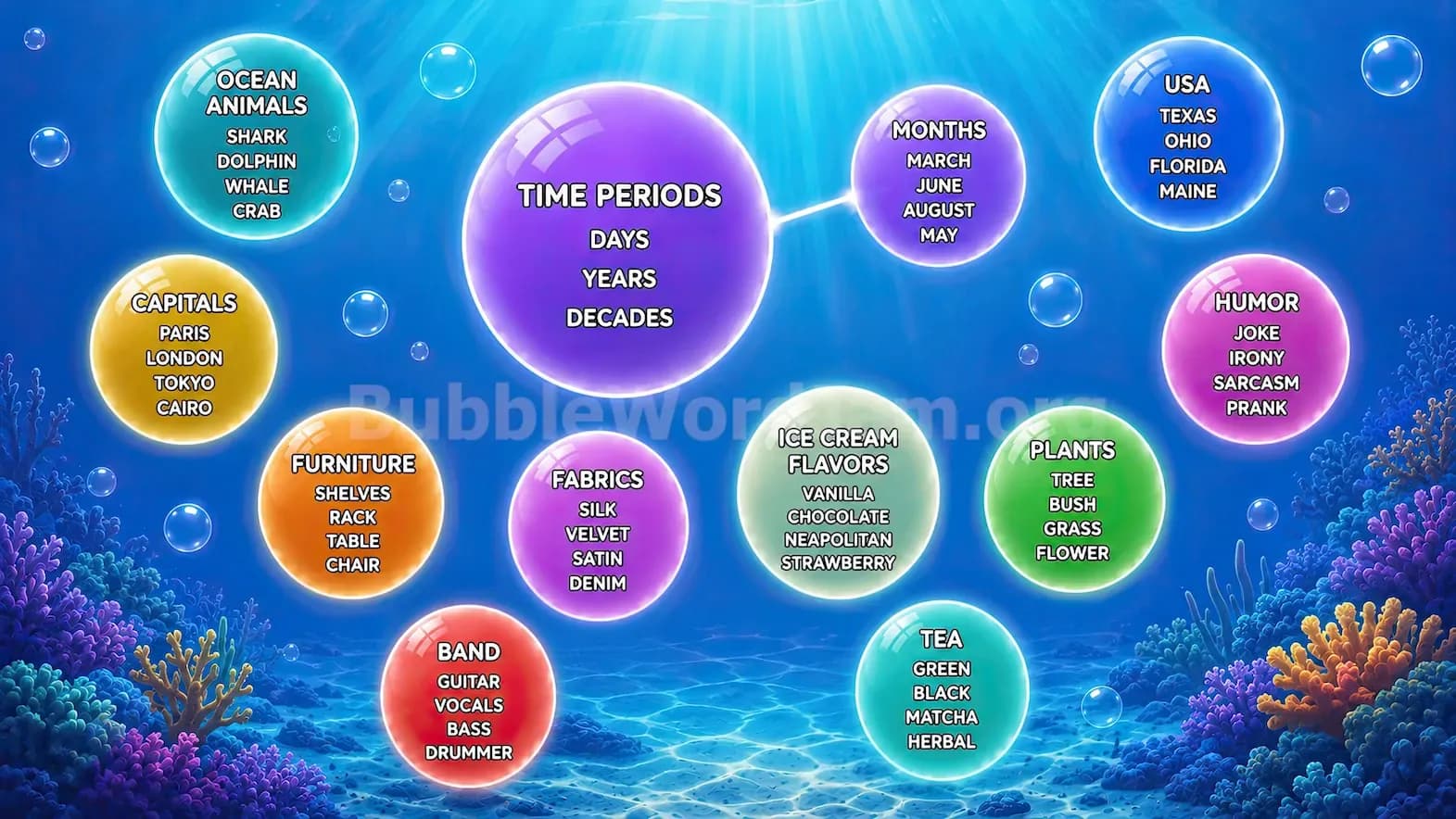
That’s the clean merge.
The same level also includes “USA” with Texas, Ohio, Florida, and Maine. Notice the difference: those are U.S. states, not cities and not capitals. Bubble Word Jam often places a capital category beside a country or state category just to see whether you panic. Don’t.
A good rule: if every word is a major city and at least several are world-famous seats of government, test “capitals.” If the words are Texas, Florida, Maine, or Ohio, you’re looking at state-level geography instead. If the words are Paris, Tokyo, Berlin, and Ottawa, you’re likely staring at capitals.
The tougher geography levels stop being about maps and start being about identity. Level 64 uses “English-speaking world”: Canada, Australia, USA, and New Zealand. That category is not a continent, not a political union, and not a simple country list. It’s a language-and-culture grouping.
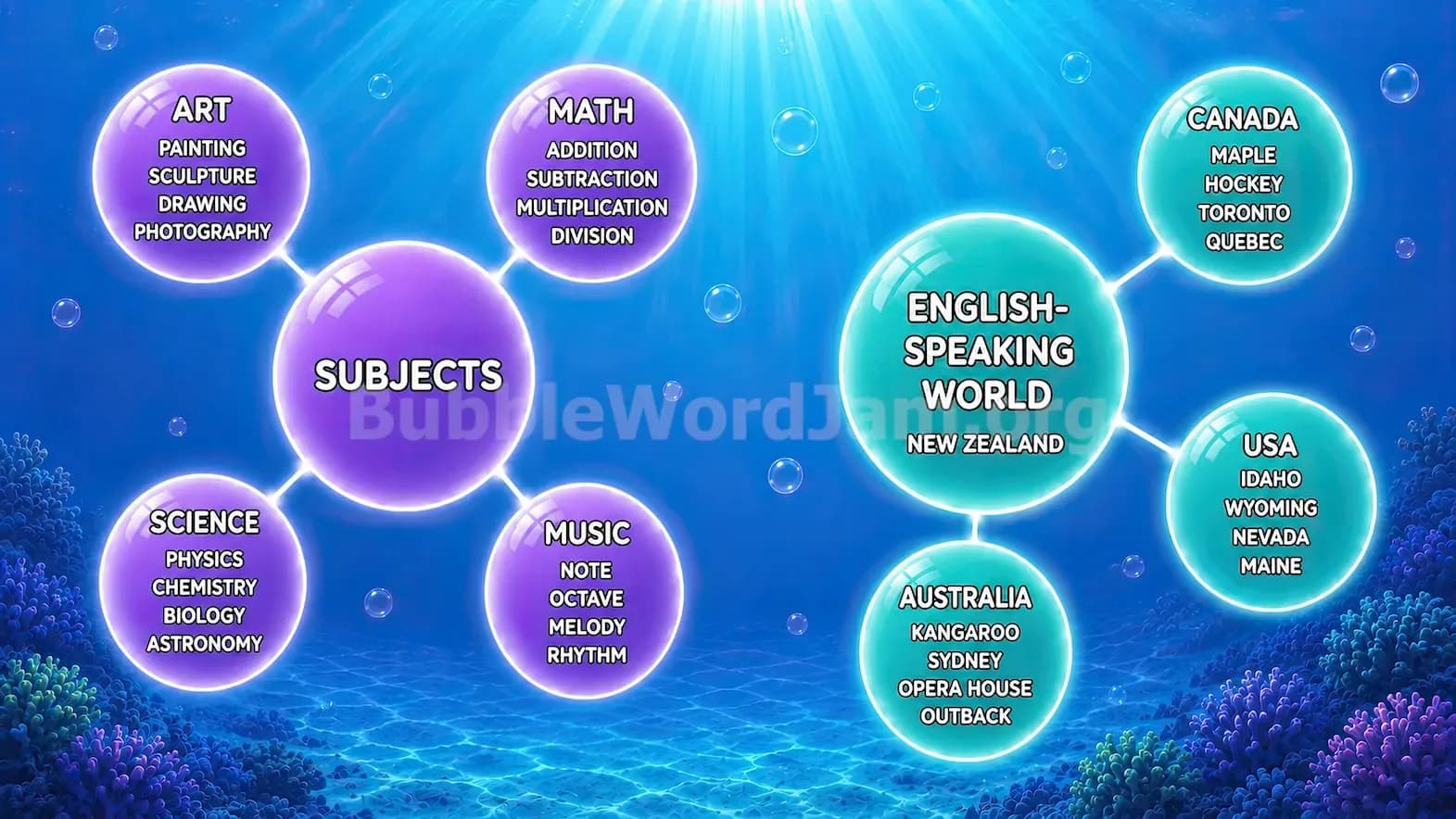
Then the level breaks several of those countries into local icons. Canada has maple, hockey, Toronto, and Quebec. USA has Idaho, Wyoming, Nevada, and Maine. Australia has kangaroo, Sydney, Opera House, and outback.
That’s where geography turns into a cultural marker puzzle. “Maple” is not a place, but it points to Canada. “Opera House” is not a country, but in this context it screams Australia. “Hockey” isn’t geography by itself, but Bubble Word Jam uses it as a national association.
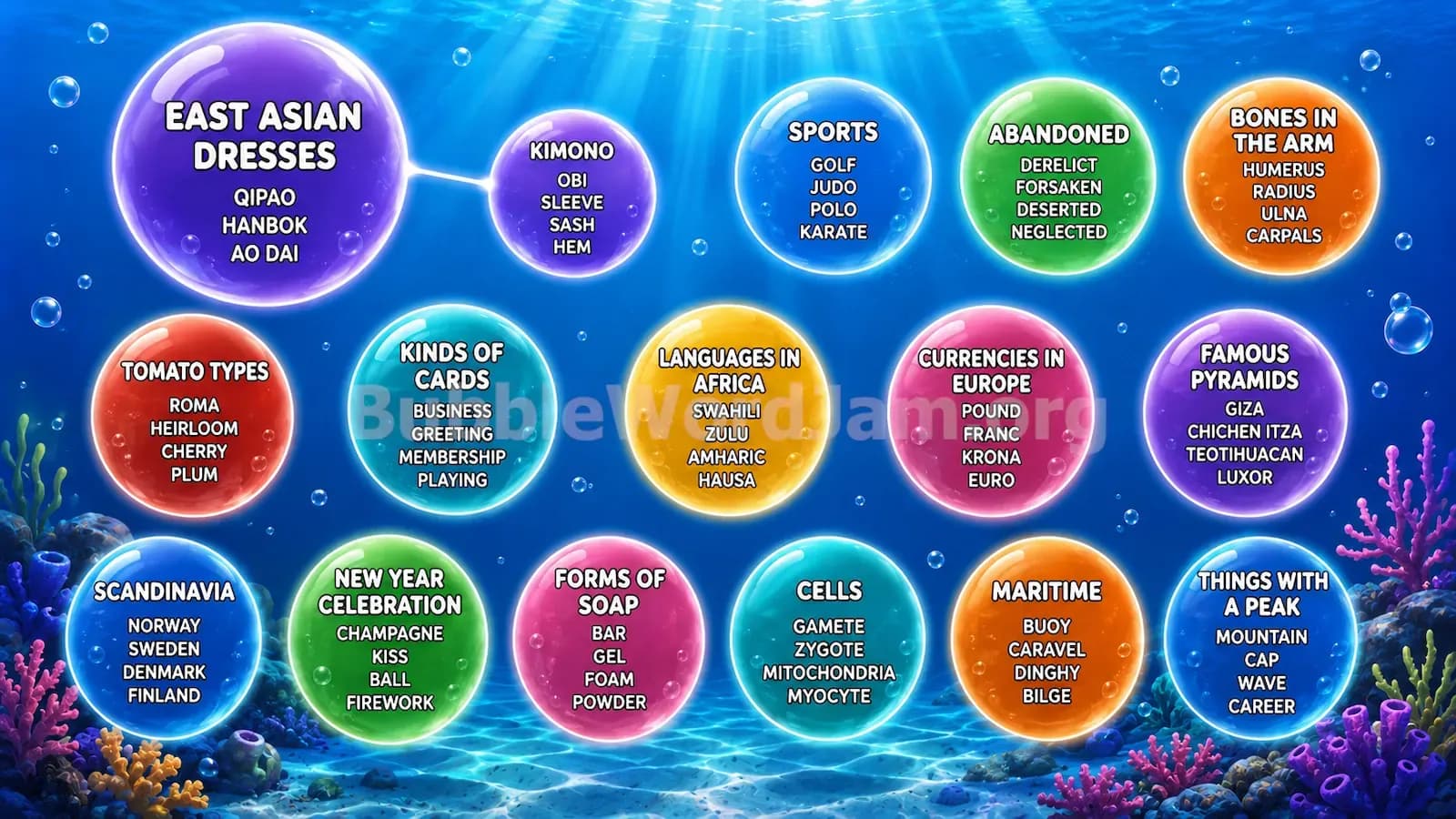
Level 390 does something similar from a different angle. It includes “languages in Africa”: Swahili, Zulu, Amharic, and Hausa. It also has “currencies in Europe”: pound, franc, krona, and euro, plus “Scandinavia”: Norway, Sweden, Denmark, and Finland. That level is spicy because the clues are geographical without always being places. Languages, currencies, and regions all sit in the geography family, but they don’t merge together.
Island-country puzzles are usually fair, but they can still get messy. Level 120 gives “island countries”: Japan, Iceland, New Zealand, and Maldives. Then Japan expands into Tokyo, samurai, sushi, and Mount Fuji. New Zealand expands into Auckland, kiwi, Hobbiton, and rugby.
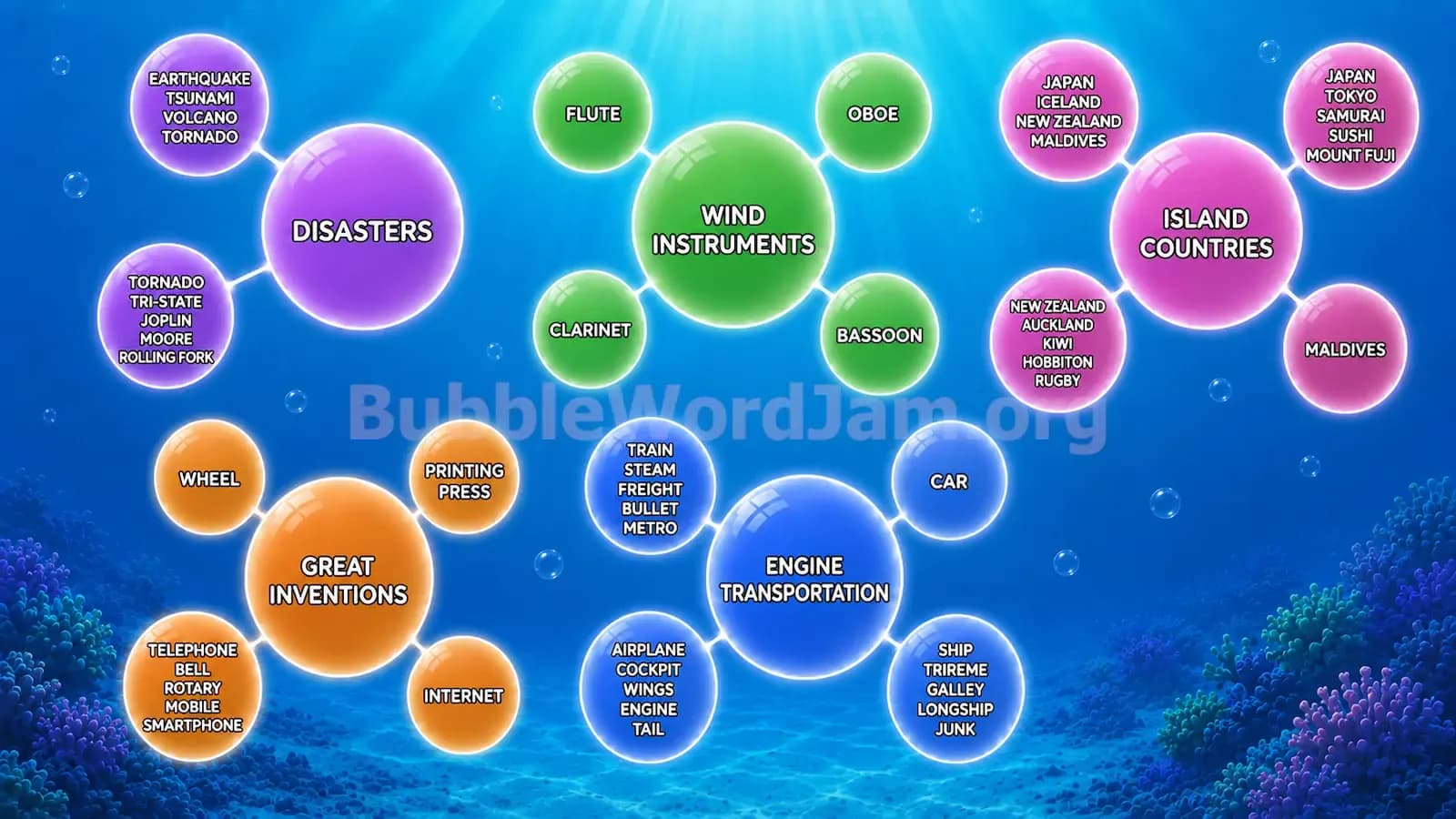
The key is to avoid merging famous clues too early. “Tokyo” belongs with Japan, not with island countries. “Auckland” belongs with New Zealand, not with capitals. “Maldives” belongs in the island-country set, not a beach or resort group unless the level clearly says so.
Landmark clues work the same way. Eiffel Tower, Colosseum, Mount Fuji, Opera House, and pyramids are cultural anchors. They usually point toward a country, city, or famous landmarks category. Before merging, ask whether the game wants the object itself or the place it represents.
Here’s the method I use when a Bubble Word Jam geography board starts getting crowded.
First, scan for the widest category. Continents, landmass, global geography, countries, or regions should come before individual cities. If the board contains Asia, Africa, Europe, and Americas, that set probably anchors the puzzle.
Second, separate proper nouns by type. Countries go in one mental pile. Cities and capitals go in another. Regions like Scandinavia, Latin America, East Europe, and the Americas need a third pile. Landmarks and cultural icons get their own pile.
Third, watch for “zoom levels.” Bubble Word Jam loves going from continent to country to city to icon. Level 42 does continents, Asia, and Australia. Level 91 does EU countries, then Germany, France, Spain, and Italy. Level 120 does island countries, then Japan and New Zealand. When you see that zoom pattern, the whole board starts to click.
Fourth, don’t merge based on vibes alone. “Paris” and “Eiffel Tower” feel connected, but they may belong in different groups if the level has capitals and landmarks separately. That hesitation can feel annoying, but it’s the difference between a rock-solid solve and a wasted move.
Use Level 7 if you want to practice landmass and regional hierarchy. It teaches the difference between continents and Americas sub-regions.
Use Level 12 for capitals versus U.S. states. It’s clean, direct, and great for learning not to mix city names with state names.
Use Level 42 for continent-to-country-to-icon thinking. Asia, Australia, and continents all sit close together, making it a strong geography training level.
Use Level 64 for language-world and national-symbol clues. Canada, USA, Australia, and New Zealand are easy to recognize, but the cultural markers make the board more interesting.
Use Level 91 for EU countries and national identity clues. It’s one of the best examples of country names branching into capitals, food, landmarks, and traditions.
Use Level 120 for island countries and country-specific clue chains. Japan and New Zealand both turn into compact cultural mini-puzzles.
Use Level 137 for European countries, cities, and food markers. Italy and Spain are especially useful for spotting country-to-culture relationships.
Use Level 390 for advanced geography logic. Languages in Africa, currencies in Europe, Scandinavia, and famous pyramids all test whether you can classify non-place clues as geography-adjacent concepts.
Geography in Bubble Word Jam isn’t just about knowing maps. It’s about reading the category layer. The best players don’t simply recognize France, Japan, Africa, or Sydney. They ask what job each word is doing on the board.
Is it the place itself? A region? A capital? A landmark? A language? A currency? A cultural marker?
Once that question becomes automatic, geography levels shift from confusing rehash to one of the most satisfying puzzle loops in the game. You stop guessing, start sorting, and those tricky bubbles finally snap into place.