Use this Bubble Word Jam food category guide to solve levels faster by spotting fruits, dairy, grains, meat, herbs, fungi, and pantry word traps in seconds.

Guide By Liam Stone
Updated on May 22, 2026
Liam Stone has been playing Bubble Word Jam since the mobile app first launched on the Apple App Store. He knew this game would pop, so he enjoys playing every level, collecting the answers, and running this site for other players. He loves mobile puzzle games and sometimes publishes his walkthroughs on his YouTube channel Puzzle Game Answer. Follow his channel if you are a puzzle game lover too.
Food levels in Bubble Word Jam look friendly at first. You see bread, milk, egg, berries, pasta, or cheese and think, “Great, this is the easy part.” Then the game pulls its favorite trick: one food word is not always a final answer. Sometimes it is an item inside a group. Sometimes it is the name of a smaller category. Sometimes it is bait sitting between two different food families.
That is why food categories in Bubble Word Jam can feel crunchy in the best and worst ways. The loop is simple: drag related bubbles together, merge the correct set, and clear the category. But the thinking behind food levels is not just “find edible things.” The stronger move is to ask what layer of food knowledge the puzzle is testing. Is this level asking for broad pantry groups? Specific ingredients? Meal types? Plant categories? Fancy foods? Once you learn that habit, a messy food board starts to make sense.
Here is the cheat sheet I use: start broad, then split narrow. First look for pantry words and everyday food-group anchors: fruit, vegetables, grains, meat, dairy, bread, egg, pasta, herbs, mushrooms, nuts, and cheese. Then ask whether those anchors should merge together into a larger category, or whether each anchor has its own four-word family hiding nearby.
The earliest food pattern in Bubble Word Jam is the broad-bucket setup. Level 14 is a clean banger example because it stacks berries, vegetables, food, and bread on the same board. “Berries” contains cherry, blueberry, cranberry, and raspberry. “Vegetables” contains cabbage, peppers, eggplant, and zucchini. “Bread” contains baguette, focaccia, pita, and ciabatta. Then the broader “food” group pulls berries, vegetables, desserts, and bread together.
That level teaches the core rule: do not merge a broad food word too early. If you see “berries” beside actual berry names, it probably belongs to a higher-level category, not the berry group itself. The same goes for vegetables, bread, desserts, meat, dairy, and grains. In Bubble Word Jam, a word can be both a category label and a bubble used inside a larger category. That is the whole trick.
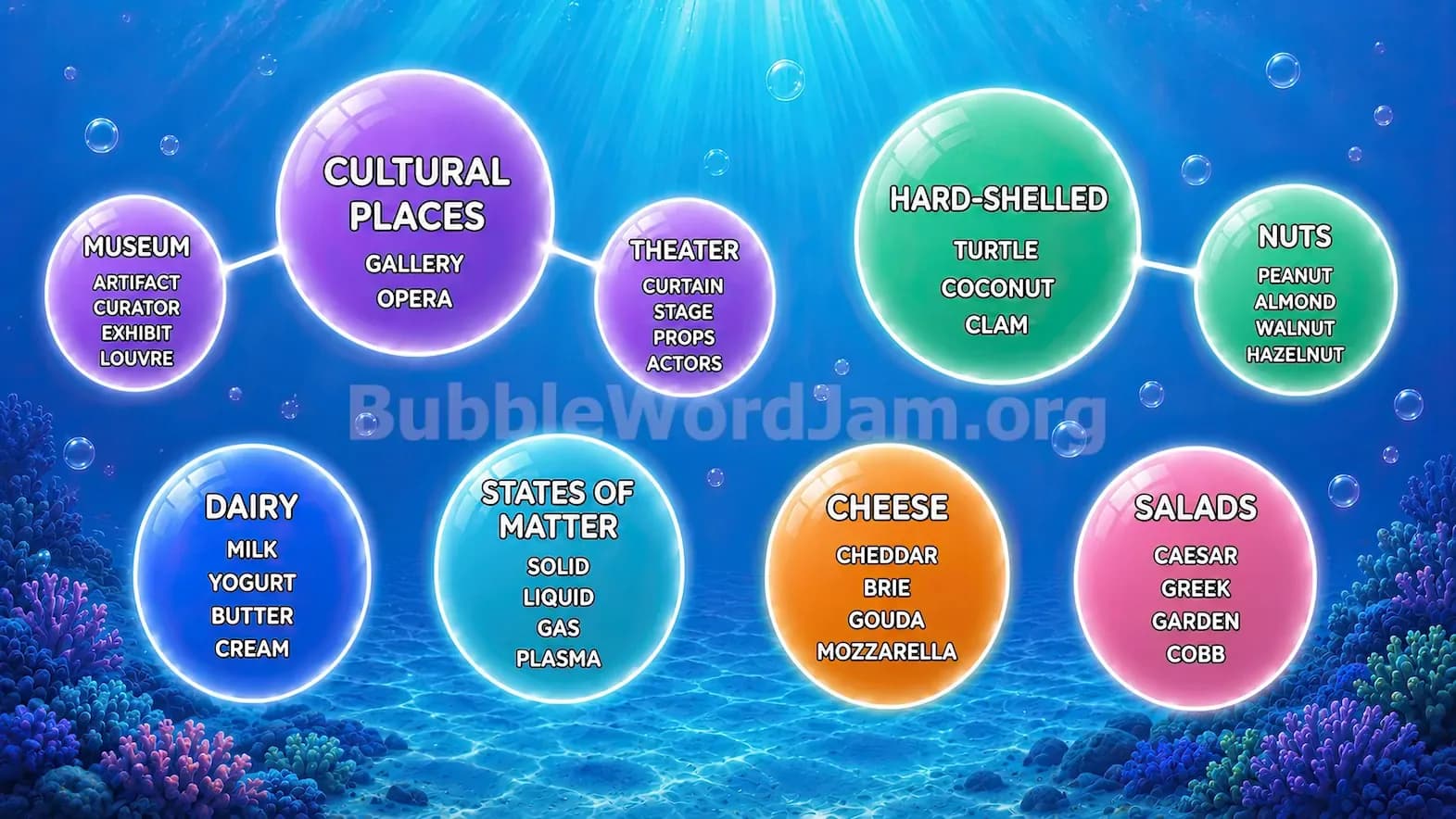
Level 23 is one of the best Bubble Word Jam food lessons because it turns a normal grocery list into a nested category puzzle. “Dairy” includes milk, yogurt, butter, and cream. “Cheese” includes cheddar, brie, gouda, and mozzarella. “Nuts” includes peanut, almond, walnut, and hazelnut. “Salads” includes caesar, greek, garden, and cobb.
The danger is obvious: cheese is dairy in real life, but on this level cheese is its own category. Nuts are food, but they are also used in a different non-food clue, “hard-shelled,” where nuts sits beside turtle, coconut, and clam. That is a classic Bubble Word Jam vibe: the game makes you respect context, not just dictionary meaning.
My rule is simple. When a food word could belong to two places, solve the four most specific matches first. Cheddar, brie, gouda, and mozzarella have almost no better home than cheese. Milk, yogurt, butter, and cream belong to dairy. Once those are locked, the broader or trickier category becomes safer.
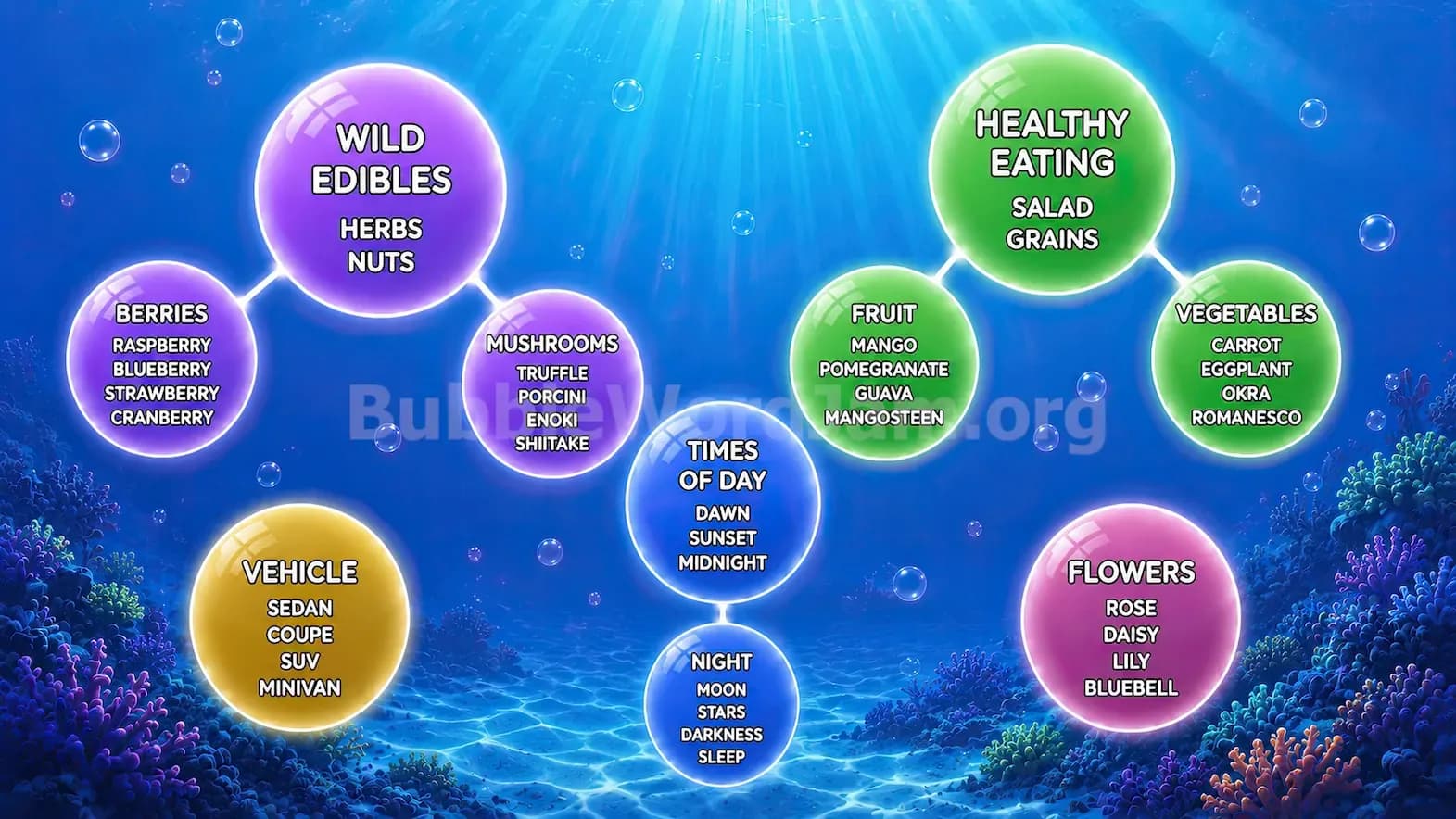
Level 37 is where the food tree gets more outdoorsy. It includes mushrooms, wild edibles, healthy eating, berries, fruit, and vegetables. That is a lot of edible vocabulary on one board, and it can feel floaty if you treat every plant-like word as interchangeable.
The trick is to split by precision. “Mushrooms” gets truffle, porcini, enoki, and shiitake. “Berries” gets raspberry, blueberry, strawberry, and cranberry. “Fruit” gets mango, pomegranate, guava, and mangosteen. “Vegetables” gets carrot, eggplant, okra, and romanesco. Then “wild edibles” uses berries, mushrooms, herbs, and nuts as higher-level concepts.
This level teaches a powerful Bubble Word Jam habit: labels can merge with labels. When berries and mushrooms appear as standalone bubbles, do not panic. They may be part of a higher category, especially if the board also contains matching specific examples elsewhere.
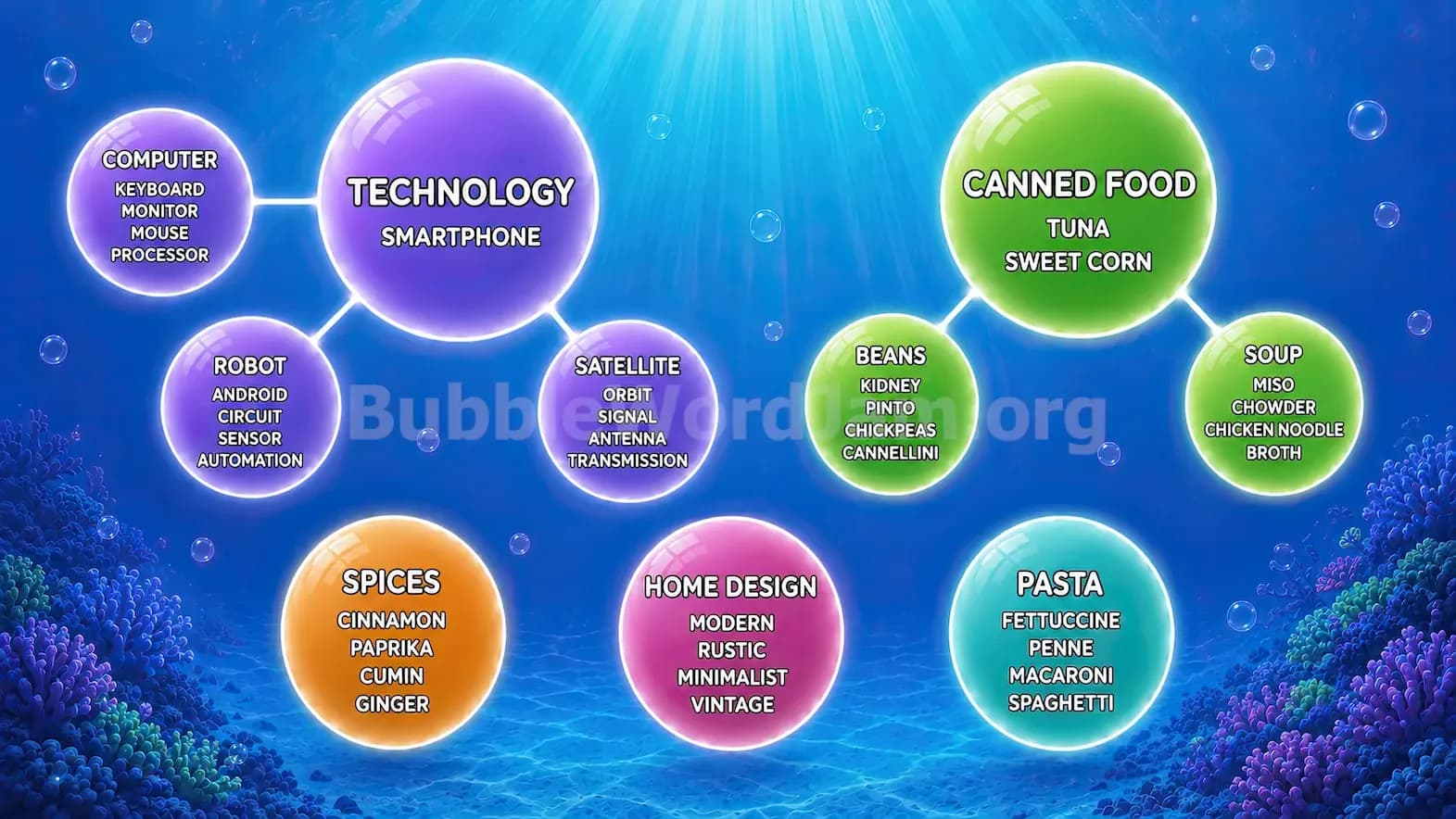
Level 43 shifts the food lesson into pantry mode. Here you get canned food, beans, spices, soup, and pasta. “Canned food” uses beans, tuna, soup, and sweet corn. “Beans” uses kidney, pinto, chickpeas, and cannellini. “Spices” uses cinnamon, paprika, cumin, and ginger. “Soup” uses miso, chowder, chicken noodle, and broth. “Pasta” uses fettuccine, penne, macaroni, and spaghetti.
This is the same nested logic with a kitchen-cabinet skin. Identify the most locked four-word sets first. Pasta types are usually safe. Spice names are usually safe. Bean varieties are usually safe. Once you clear those, the broader pantry category stops being a jumble.
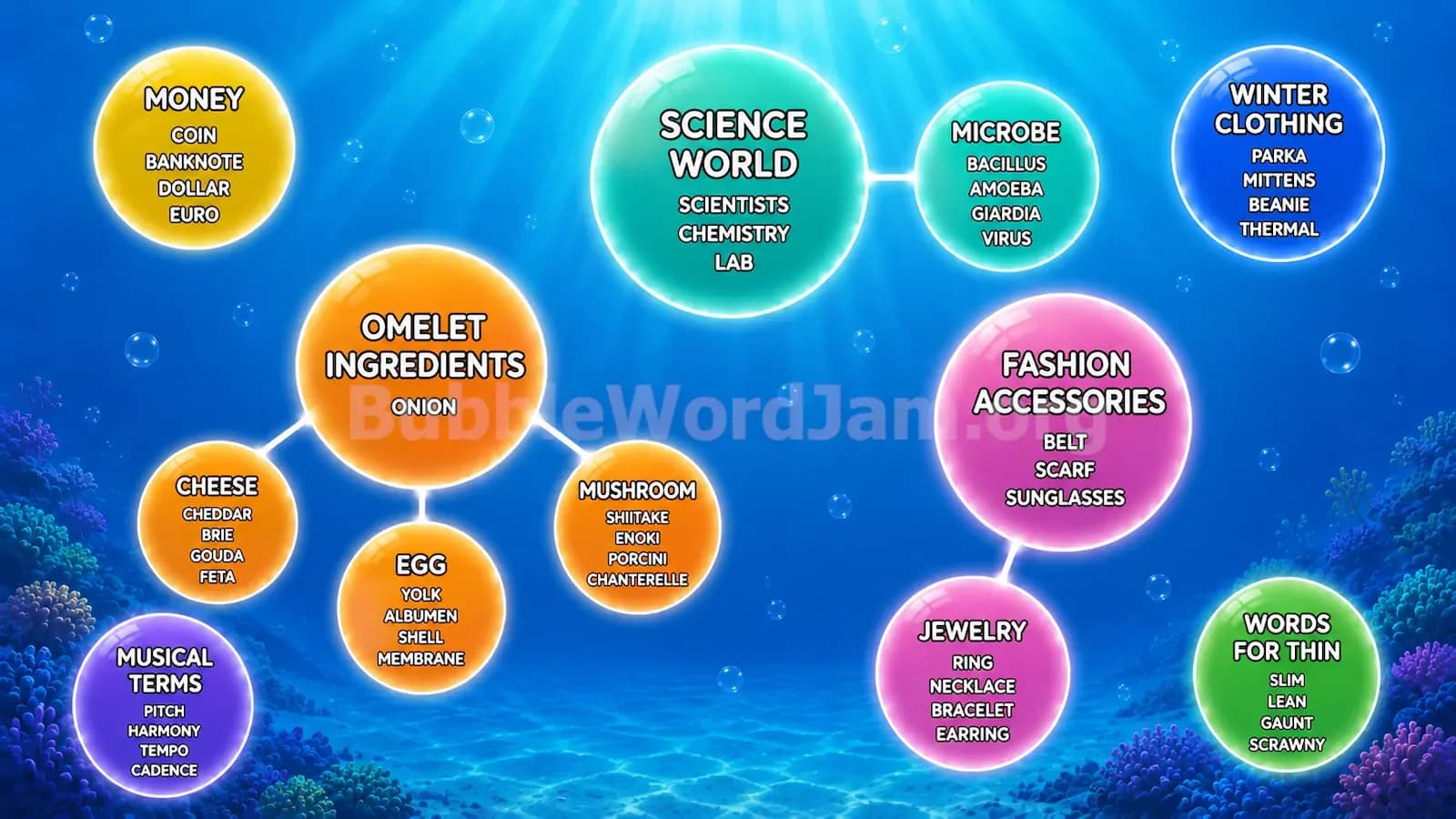
By Level 278, Bubble Word Jam starts mixing recipe logic with ingredient families. “Omelet ingredients” includes cheese, onion, egg, and mushroom. But the same level also gives “egg” with yolk, albumen, shell, and membrane; “cheese” with cheddar, brie, gouda, and feta; and “mushroom” with shiitake, enoki, porcini, and chanterelle.
This is the game at its most devious. Cheese, egg, and mushroom are not just food items; they are also category labels. Treat the recipe category as the final pass. Build egg anatomy first. Build cheese types first. Build mushroom types first. Then use the remaining ingredient labels to complete the omelet.
I like this level because it proves Bubble Word Jam food puzzles are order-of-operations puzzles. Get the sequence wrong and the board feels mediocre. Get it right and the whole level snaps into place.
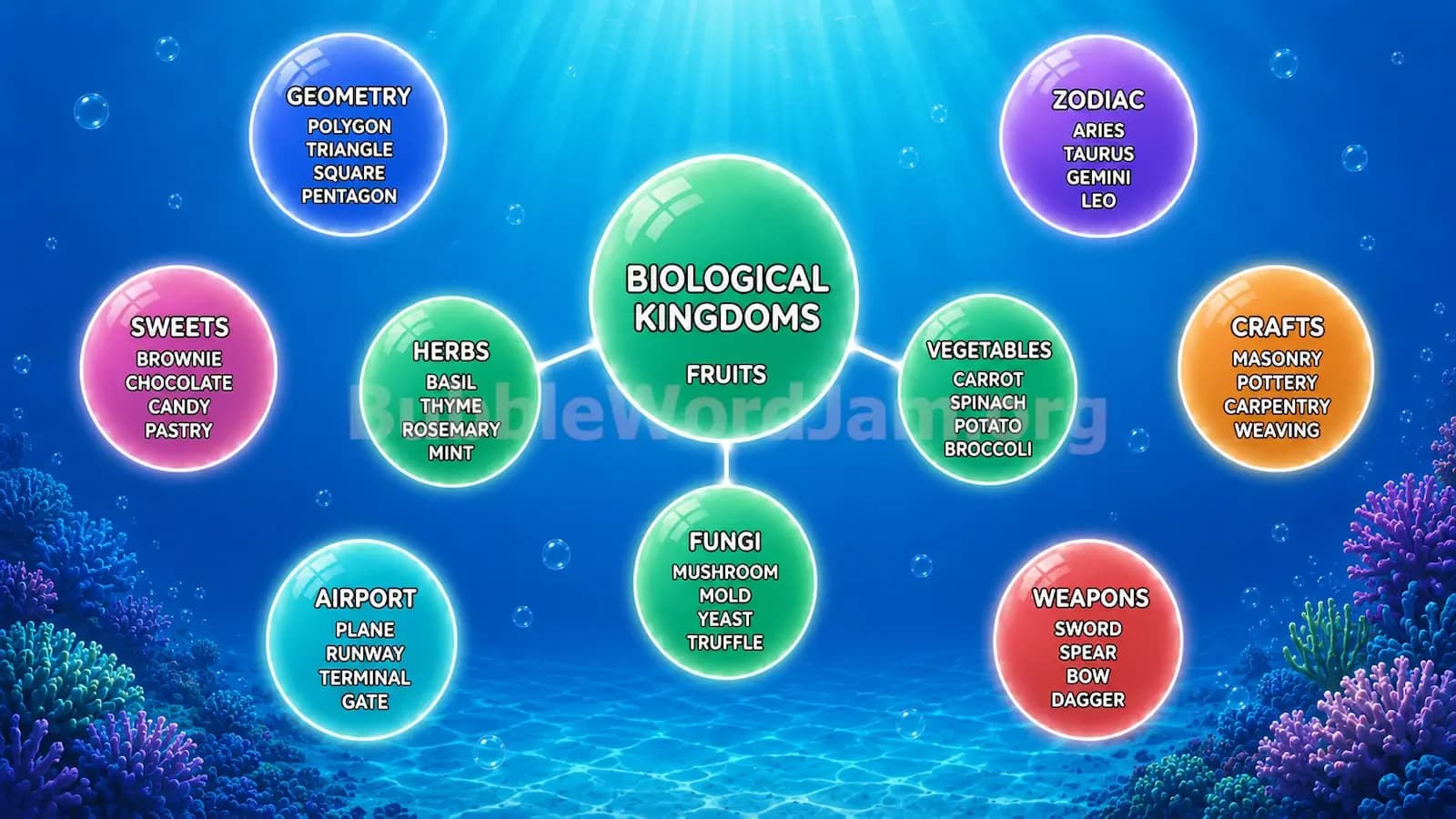
Level 300 uses “biological kingdoms” as the top layer: herbs, fungi, vegetables, and fruits. Then the board breaks down herbs into basil, thyme, rosemary, and mint; vegetables into carrot, spinach, potato, and broccoli; and fungi into mushroom, mold, yeast, and truffle.
This level asks you to think like a sorter, not a chef. Herbs are not just seasoning. Fungi are not just mushrooms. Vegetables and fruits are not just grocery sections. Food words can belong to culinary, botanical, biological, or pantry logic depending on the level.
Late levels keep the pattern alive. Level 613 gives citrus fruits, mushroom types, pasta types, cocktail ingredients, and expensive foods. Citrus fruits includes lime, tangerine, clementine, and pomelo. Mushroom types includes portobello, shiitake, chanterelle, and morel. Pasta types includes fusilli, penne, ravioli, and rigatoni. Expensive foods uses truffle, caviar, saffron, and wagyu.
Level 742 brings in tom yum, herbs, bakeshop, and seasoning types. “Herbs” includes basil, oregano, thyme, and rosemary, while “seasoning types” uses herbs, spices, salt, and umami. That last one is the same nested-category trick from early levels, just with a sharper late-game edge.
When a Bubble Word Jam level looks food-heavy, use this order:
Food puzzles in Bubble Word Jam are satisfying because they are not random grocery lists. They are category trees. Once you see the tree, the board stops feeling like a messy fridge and starts feeling like a clean solve. Start with pantry anchors, split them into fruit, vegetable, dairy, grain, meat, herbs, and fungi, then merge the broader categories last. That is the whole loop, and honestly, it is a rock-solid way to stop food levels from eating your moves.