Solve Bubble Word Jam drink categories with smart tips for coffee, tea, wine, juice, bottled drinks, and tricky beverage word groups from real levels.
Guide By Liam Stone
Updated on May 27, 2026
Liam Stone has been playing Bubble Word Jam since the mobile app first launched on the Apple App Store. He knew this game would pop, so he enjoys playing every level, collecting the answers, and running this site for other players. He loves mobile puzzle games and sometimes publishes his walkthroughs on his YouTube channel Puzzle Game Answer. Follow his channel if you are a puzzle game lover too.
Drink categories in Bubble Word Jam look friendly at first. Coffee? Tea? Juice? Soda? Easy merge, right?
Not always.
The sneaky thing about Bubble Word Jam is that beverage puzzles rarely stay inside one clean “drinks” bucket for long. One level might ask you to group broad beverages like tea, coffee, juice, and soda. Another level might split coffee into espresso, latte, cappuccino, and mocha. Later, the game starts mixing drink types with preparation styles, ingredients, serving situations, and even verbs like sip, gulp, chug, and guzzle. That’s where the loop gets crunchy.
I like these puzzles because they test real category sense instead of simple vocabulary. You’re not just asking, “Is this a drink?” You’re asking, “What kind of drink category does this word belong to right now?” That one shift can save you moves, boosters, and a lot of frustration.
The biggest mistake players make in Bubble Word Jam drink levels is merging the first four beverage-related words they see. It feels correct, but it can tank your board if one of those words belongs to a more specific group.
For example, coffee can be a drink, but it can also point toward a coffee category. Tea can be a drink, but it can also belong in tea types. Wine can be a beverage, but it can also open a wine category with grape varieties or wine styles.
So before you merge, use a three-filter method:
First, sort by base liquid. Is the level asking for broad drink names like coffee, tea, juice, soda, wine, cider, or water?
Second, sort by preparation method. Are the words actually made or served in a particular style, like espresso, latte, cappuccino, mocha, affogato, americano, cortado, or flat white?
Third, sort by serving context. Does the drink appear in a scene, like breakfast, a sauna, a bottle, a cafe, or a tea table?
That’s the whole technique. Base liquid, preparation method, serving context. Once you start reading drink puzzles this way, the category structure becomes much less floaty.
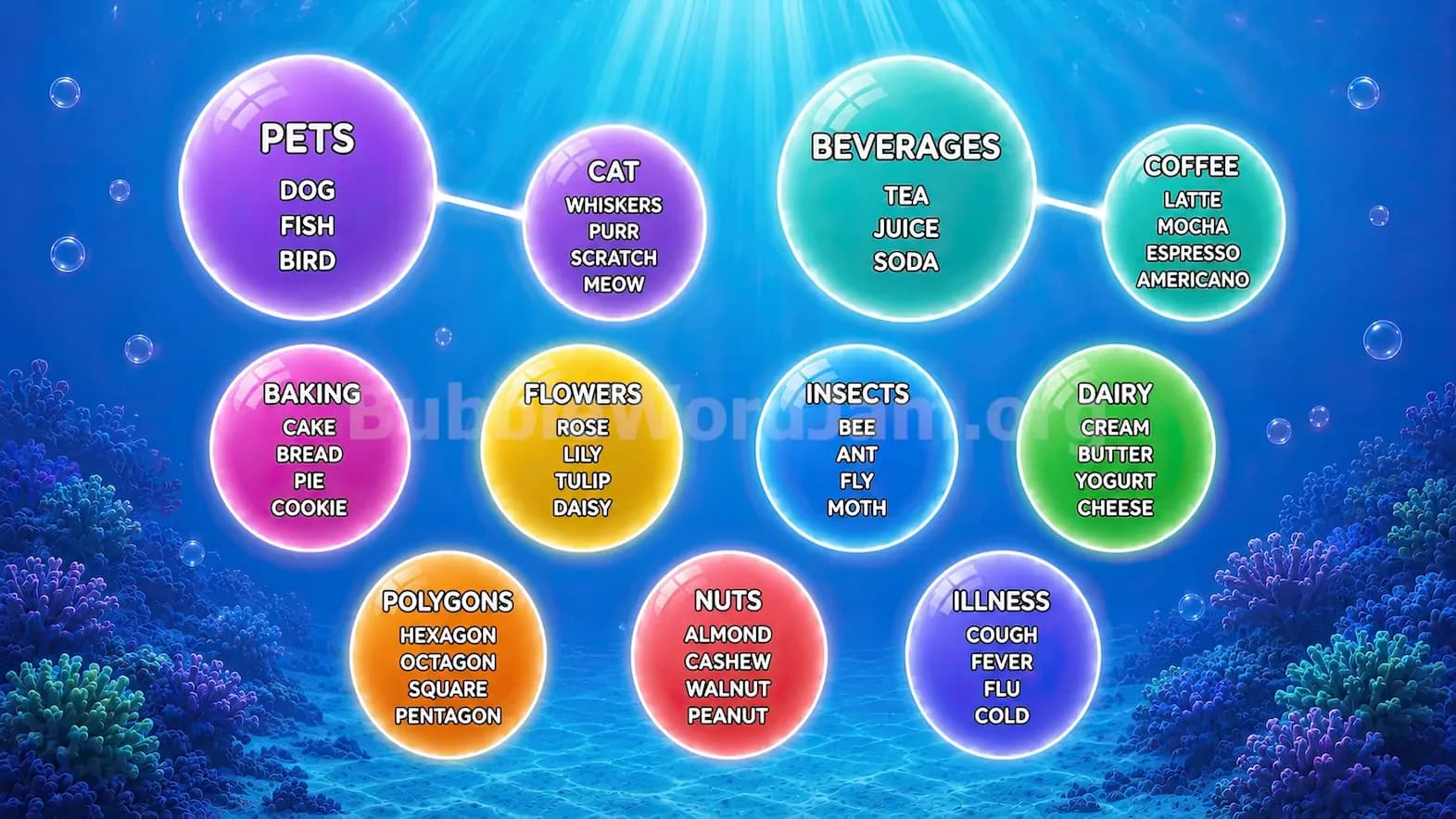
Level 5 is the classic starting point for drink logic. It includes a broad “beverages” group: tea, coffee, juice, and soda. It also includes a separate “coffee” group: latte, mocha, espresso, and americano.
This is Bubble Word Jam teaching a vital lesson early: a general category and a subcategory can appear in the same level. Coffee belongs inside beverages in real life, but in this puzzle, coffee is also the parent idea for latte, mocha, espresso, and americano.
That means you should not treat every coffee-related word as interchangeable. If you see “coffee” as a standalone word, it may belong with tea, juice, and soda. If you see “latte” or “espresso,” you’re probably looking at the coffee subcategory.
The solve feels simple, but the design is a banger tutorial for later levels. Bubble Word Jam is quietly telling you, “We will use category trees, not just word lists.”
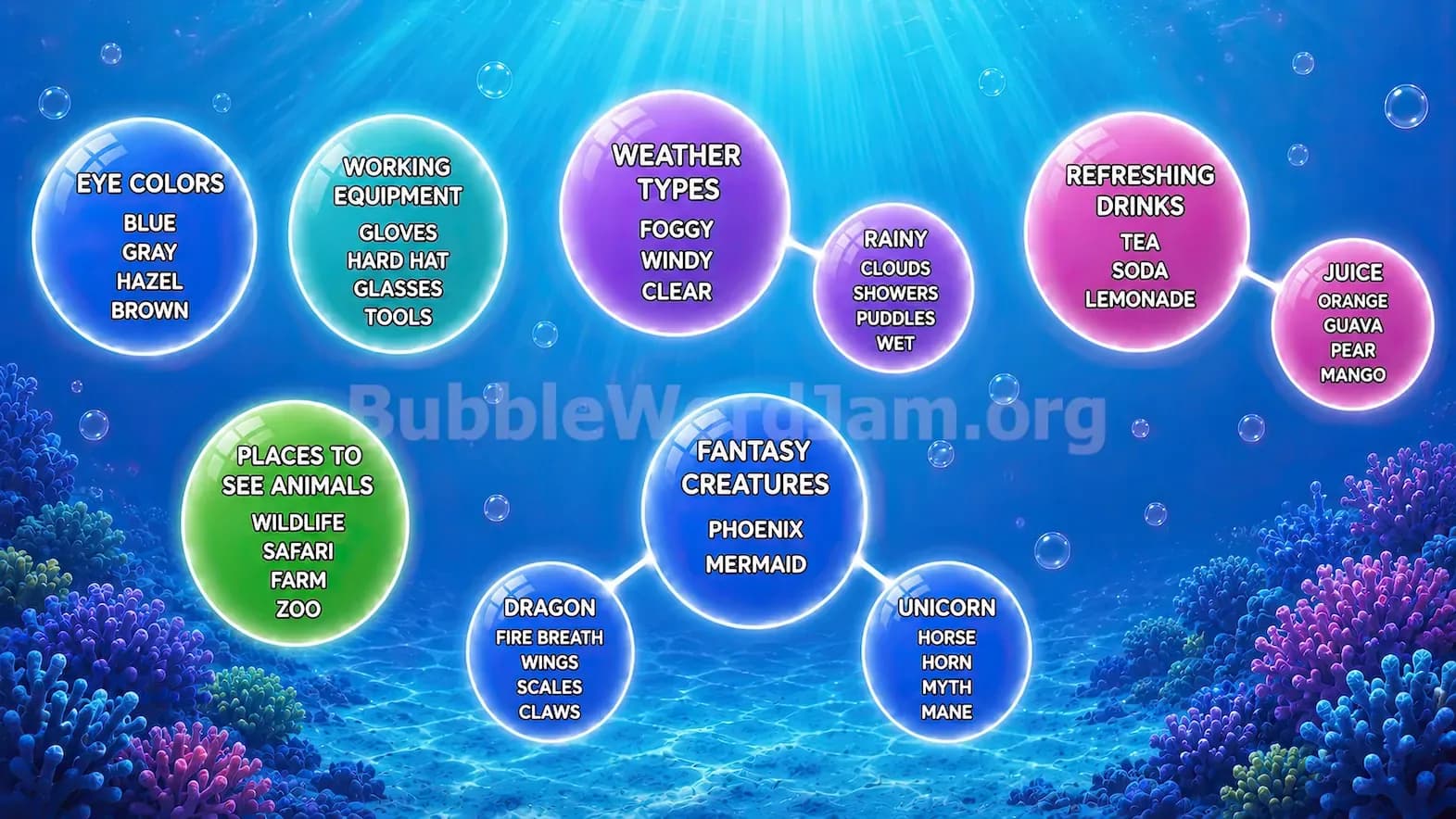
Level 22 makes the same move with juice. The level includes “refreshing drinks” with tea, soda, lemonade, and juice. Then it adds a “juice” category with orange, guava, pear, and mango.
This is a perfect example of the base-liquid filter. “Juice” itself is a drink type, but orange and guava are not the same category level. They’re flavors or fruit sources. If you merge orange with lemonade too quickly, you’re probably drifting into the wrong lane.
When you see one broad beverage word and several fruit names, pause. The broad word may be the category item, while the fruits form the subcategory. Bubble Word Jam loves that trick because it feels natural but punishes lazy sorting.
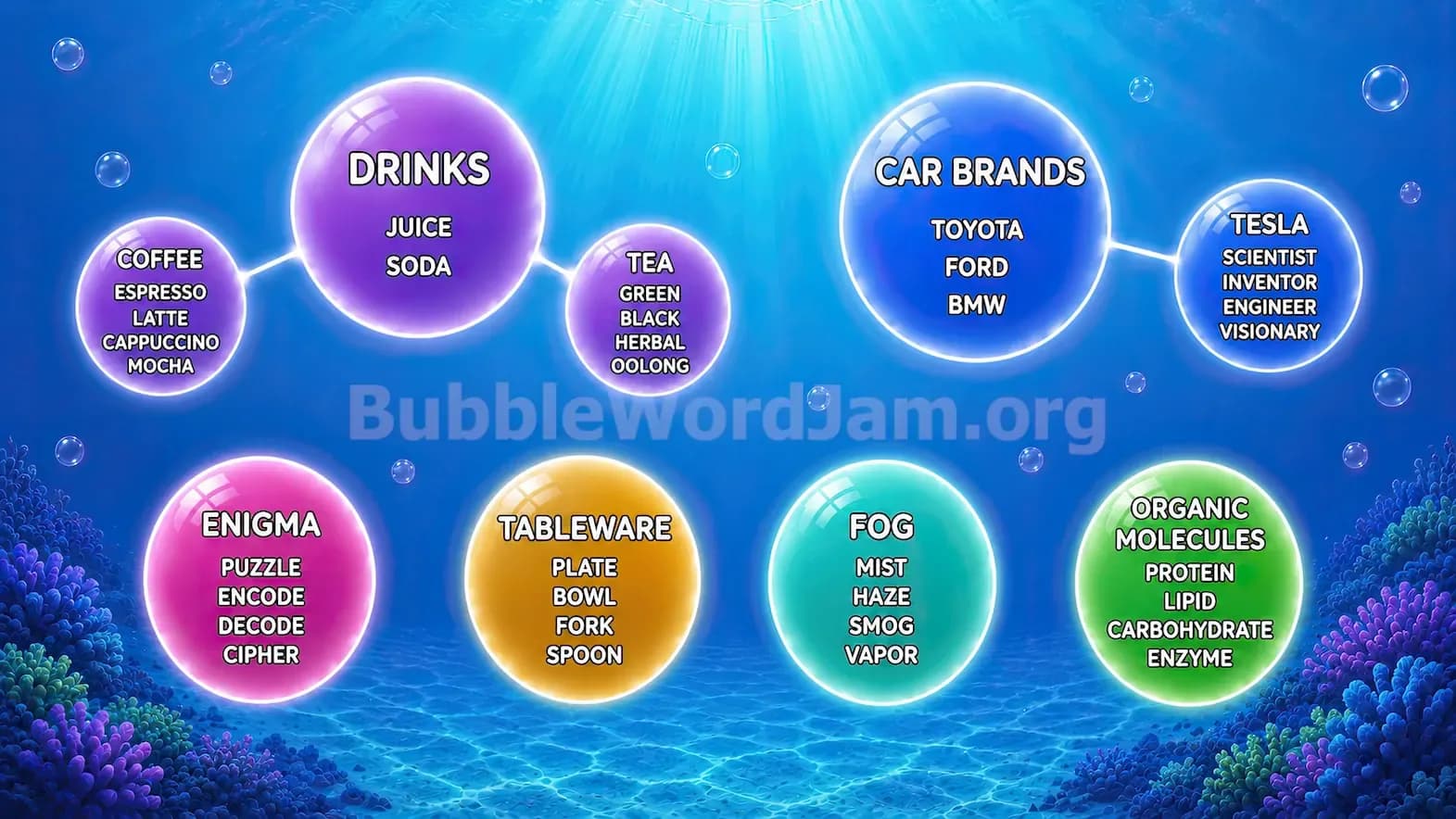
Level 61 is where the drink puzzle becomes a proper test. It includes “drinks” with coffee, tea, juice, and soda. It also includes “tea” with green, black, herbal, and oolong. Then it includes “coffee” with espresso, latte, cappuccino, and mocha.
This level is basically a mini beverage taxonomy exam. You have the top-level drink group, then two branches underneath it: tea types and coffee drinks.
My advice for Level 61 is to solve the most specific categories first. Green, black, herbal, and oolong clearly belong together. Espresso, latte, cappuccino, and mocha clearly belong together. Once those are locked in, coffee and tea are freed up to sit beside juice and soda in the broader drinks group.
This is the safest solve order in many Bubble Word Jam drink puzzles: specific first, general later. It reduces category overlap and keeps your board from turning into a shambling corpse of half-right merges.
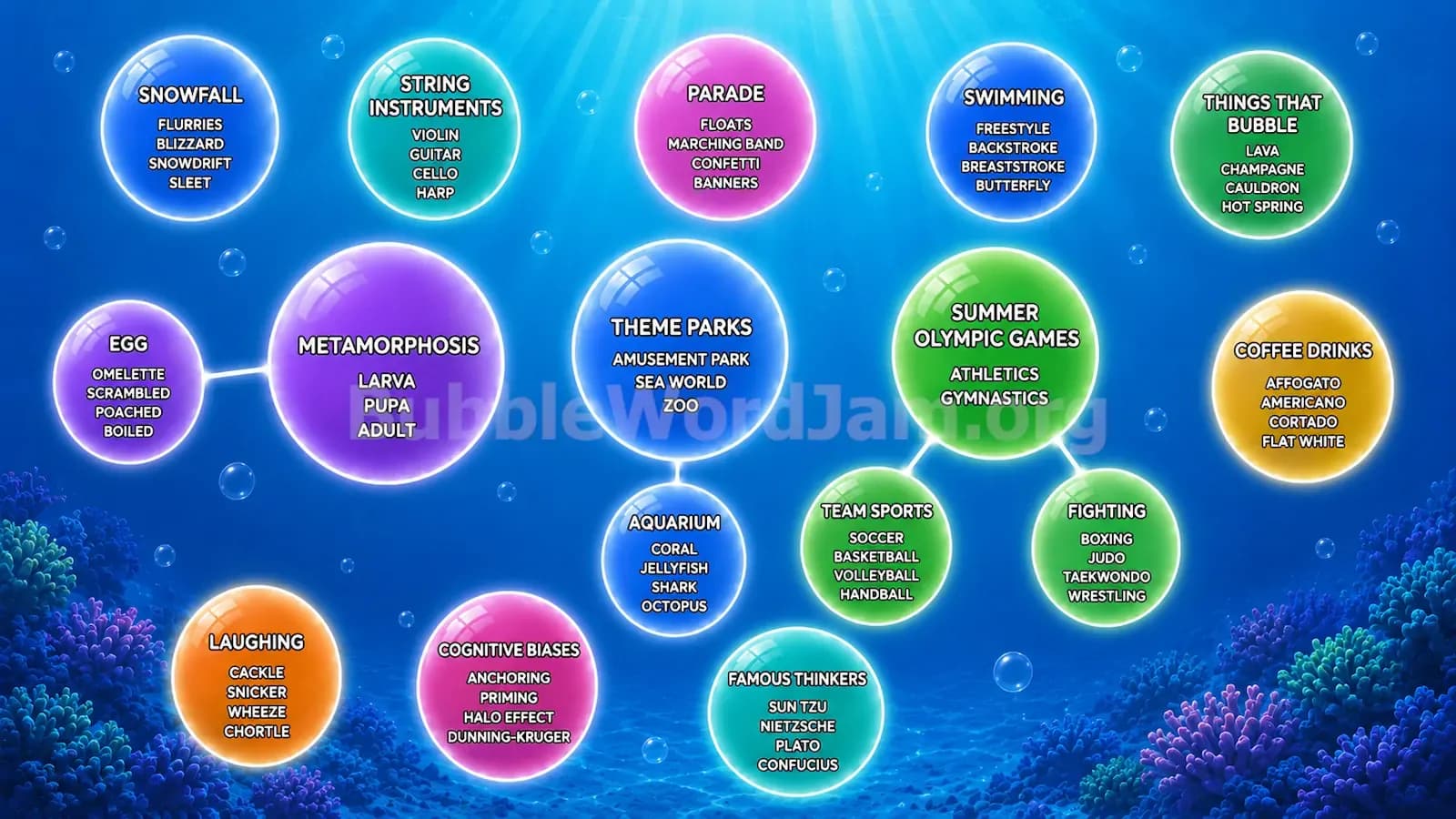
Level 164 raises the coffee difficulty with “coffee drinks”: affogato, americano, cortado, and flat white. This is a noticeable jump from the easier espresso-latte-mocha set.
The technique here is preparation method. These are not random cafe words. They are specific coffee orders or coffee drink styles. If you don’t know cortado or flat white, the pairing can feel unfair at first, but the clue is in the category shape. Americano and affogato are strong anchors. Once you identify two coffee drinks, the others become more likely.
This level also includes “things that bubble”: lava, champagne, cauldron, and hot spring. Champagne can pull your brain toward wine or alcohol, but here the shared trait is bubbling. That’s a classic Bubble Word Jam misdirect. Don’t just ask what the word is. Ask what the word is doing.
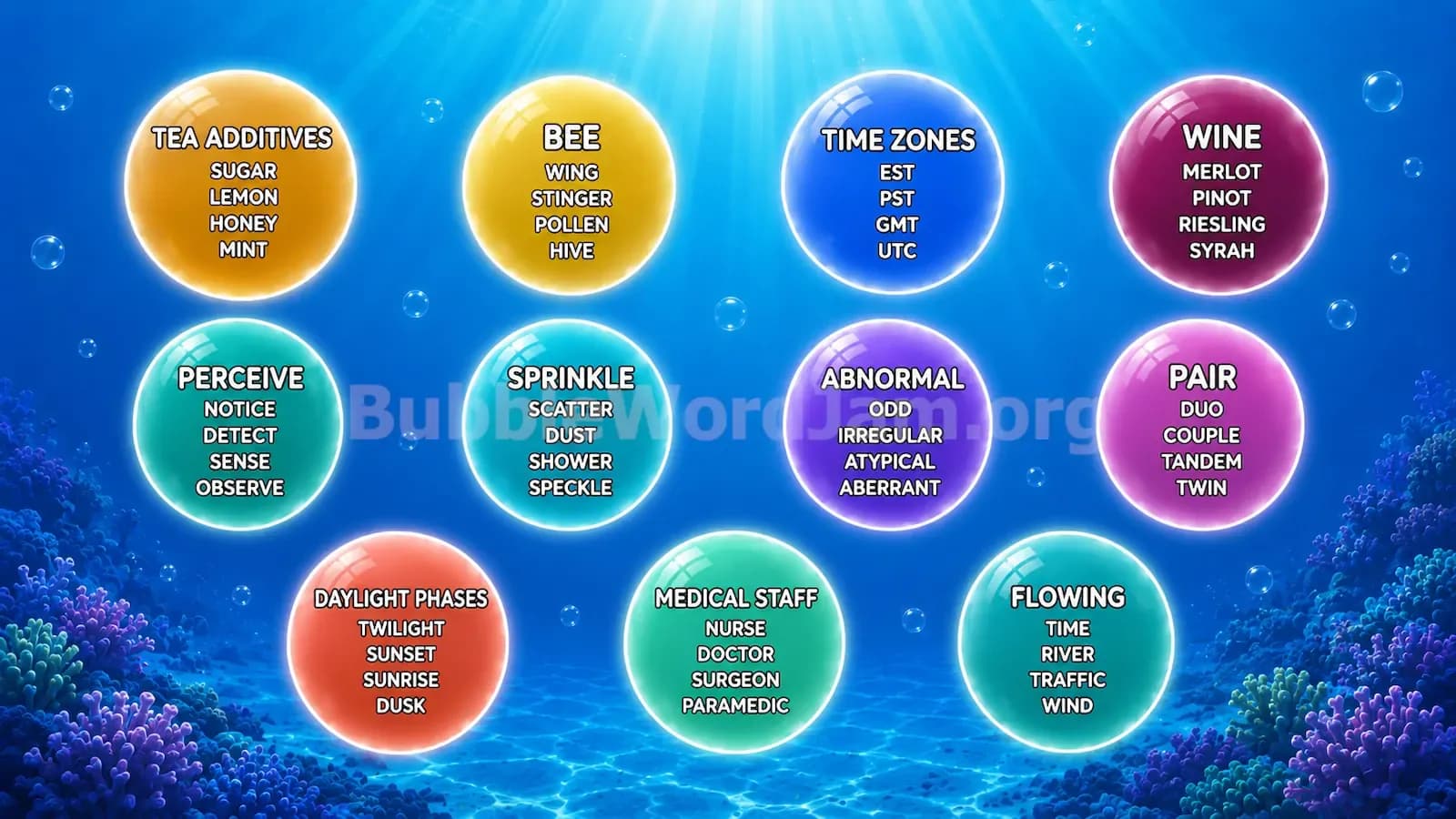
Level 252 is one of my favorite drink-category examples because it splits beverages into ingredients and drink families. “Tea additives” includes sugar, lemon, honey, and mint. “Wine” includes merlot, pinot, riesling, and syrah.
This is where preparation context matters. Sugar, lemon, honey, and mint are not tea types; they are things you add to tea. Meanwhile, merlot, pinot, riesling, and syrah are wine varieties.
The danger word here is mint. Mint can show up in herb categories, tea categories, flavor categories, or garnish-style categories. In Level 252, it belongs with additives because the other three words tell you the serving context.
Bubble Word Jam often uses one flexible word as bait. Let the surrounding words judge the category. That’s the cleaner loop.
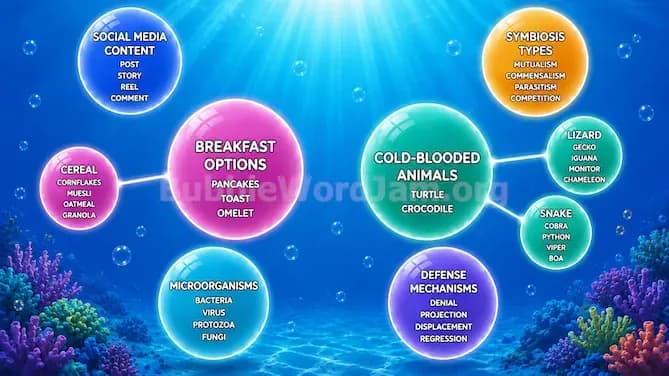
Level 418 brings in “bottled drinks”: juice, soft drink, kefir, and water. It also includes “breakfast”: pancake, coffee, eggs, and morning.
Coffee is the trap. Your instinct might be to group it with juice or water, but in this level coffee is part of the breakfast scene. That’s serving context again.
This is why drink categories can be deceptively easy. A drink word doesn’t always belong in a drink category. Sometimes it belongs in a meal, a place, a routine, or a vibe. Coffee at breakfast is different from coffee as a drink type, and Bubble Word Jam absolutely expects you to notice that.
Level 532 stacks several drink-related groups into one board. It has “beverages”: wine, cider, tea, and juice. Then it has “coffee bean”: excelsa, arabica, liberica, and robusta. It also has “tea”: oolong, black, herbal, and green.
This is the mature version of the Level 61 pattern. You still have a broad beverage group, but the subcategories are more specialized. Coffee is not represented by espresso or latte here. It’s represented by bean varieties. Tea is represented by types again.
The key move is to recognize category depth. Wine, cider, tea, and juice are broad drink names. Arabica and robusta are not drinks you order; they are coffee bean varieties. Oolong and herbal are tea types. Three drink-adjacent groups, three different logic layers.
Level 568 flips the whole idea. Its “drink” category is chug, gulp, guzzle, and sip. This is not about beverages at all. It’s about verbs.
That’s a clever little nerf to automatic thinking. After dozens of coffee, tea, wine, and juice puzzles, you may see “drink” and start hunting for liquids. But Bubble Word Jam can use “drink” as an action category, not a noun category.
This is the final lesson: always check whether the category label points to objects, types, ingredients, tools, places, or actions. “Drink” can mean the thing in the cup or the act of consuming it.
When a drink puzzle starts to feel messy, run this checklist:
Are the words broad drinks, like tea, coffee, juice, soda, wine, or cider?
Are they specific drink orders, like latte, mocha, americano, cappuccino, cortado, or flat white?
Are they varieties, like oolong, herbal, merlot, pinot, arabica, or robusta?
Are they ingredients or add-ins, like lemon, honey, mint, bitters, or syrup?
Are they part of a scene, like breakfast, cafe, sauna, bottled drinks, or celebration?
Are they verbs, like sip, chug, gulp, or guzzle?
That checklist handles most drink-category levels from the early game through the later stretch. It also helps you avoid wasting moves, which matters because Bubble Word Jam gives every merge a cost. When you’re unsure, don’t force the first “almost right” group. Look for the most specific set first, clear it, then come back to the broader beverage category.
Drink puzzles are a rock-solid example of why Bubble Word Jam works. The game takes everyday words and makes them slippery through context. Coffee can be a beverage, a breakfast item, a cafe order, a bean, or a morning routine clue. Tea can be a drink, a type, an additive target, or even slang in another puzzle. Wine can be a beverage, a grape variety, a region, or a tasting term.
Once you learn to sort by base liquid, preparation method, and serving context, these puzzles stop feeling random. They become readable. And when the right bubbles finally merge? That little aha moment still hits.