Master Bubble Word Jam cooking terms with action-word strategy, level examples, restaurant roles, utensils, herbs, dishes, cuisine clues, and kitchen tools.

Guide By Liam Stone
Updated on May 25, 2026
Liam Stone has been playing Bubble Word Jam since the mobile app first launched on the Apple App Store. He knew this game would pop, so he enjoys playing every level, collecting the answers, and running this site for other players. He loves mobile puzzle games and sometimes publishes his walkthroughs on his YouTube channel Puzzle Game Answer. Follow his channel if you are a puzzle game lover too.
Some Bubble Word Jam categories feel easy until the kitchen shows up. Then the board suddenly turns into a tiny restaurant shift: bake, grill, fry, boil, chef, menu, utensils, sushi, guacamole, herbs, sauces, and a dozen dishes that look like they could merge in three different directions. I like these levels, but I’ll be honest: they can also be sneaky little tanks if you treat every food word as just “food.”
The trick is to stop reading cooking categories as one big pantry. Bubble Word Jam usually builds cooking levels around smaller, repeatable patterns. Once you learn those patterns, the loop gets much smoother. You’re not guessing whether “pan” belongs with “stove” or “chef.” You’re asking a better question: is this level testing cooking actions, tools, restaurant words, dish parts, cuisine names, or ingredients?
That shift matters because Bubble Word Jam is a category-sorting word puzzle. Cooking terms are perfect for this design because they are familiar, but not always simple. “Grill” can be a verb, a tool, or a clue inside a burger category. “Menu” can point to a restaurant category or become its own category with appetizer, main course, dessert, and drinks. That’s the crunchy part of the puzzle.
My favorite cooking strategy is action words first. When you see verbs like bake, grill, boil, fry, simmer, sauté, blanch, broil, braise, poach, roast, steam, or puree, pause and scan the board for other verbs before touching the obvious foods. Bubble Word Jam often uses these verbs as a clean “cooking” or “cooking methods” set, and solving them early gives you a banger anchor category.
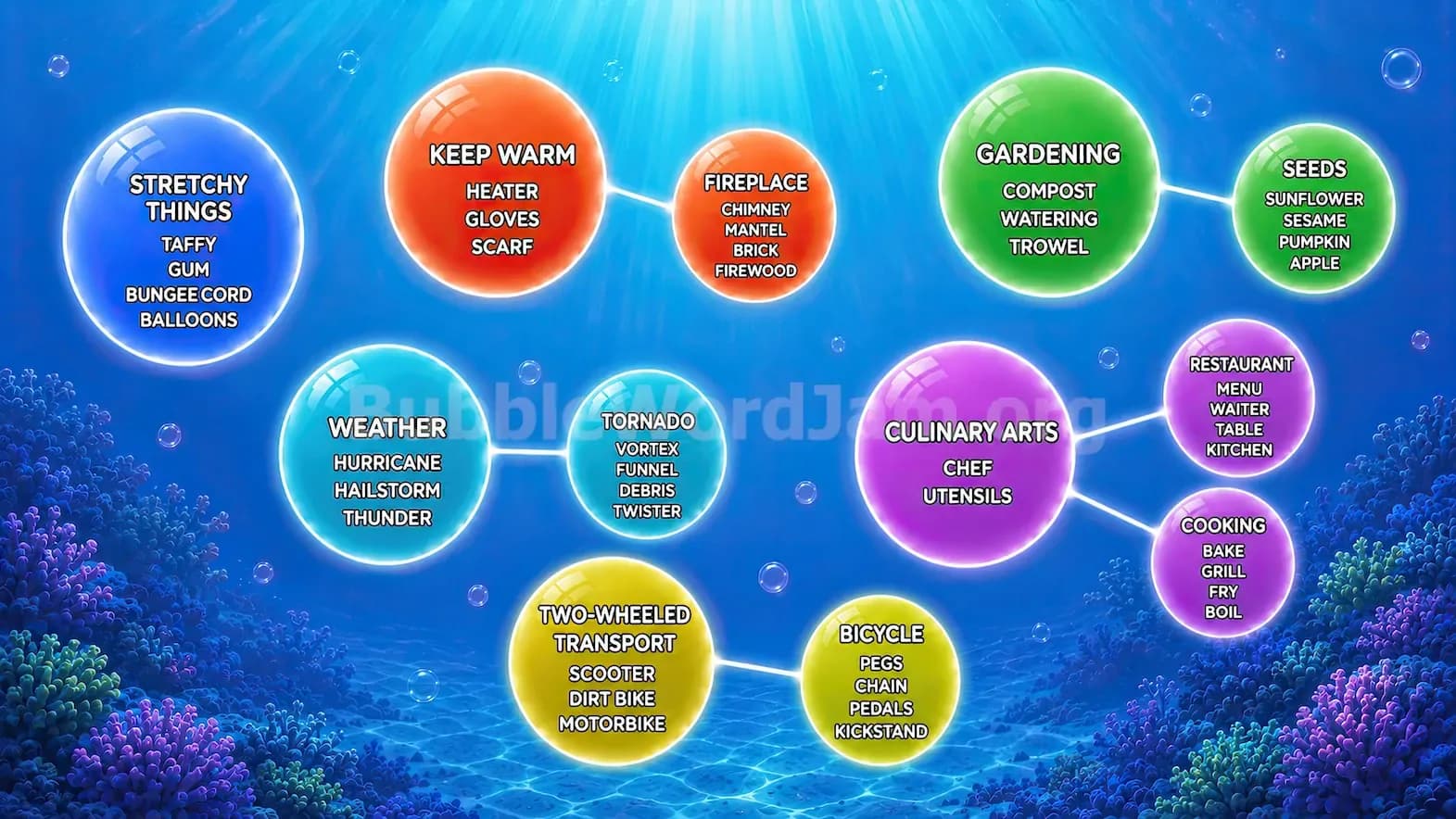
Level 27 is the clean beginner version of this idea. It includes “cooking” as bake, grill, fry, and boil. That category is almost too honest, which makes it a great teaching level. The same level also adds “restaurant” with menu, waiter, table, and kitchen, plus “culinary arts” with chef, restaurant, cooking, and utensils. See the trap? “Cooking” is both a category and a word inside another category. If you merge too fast, you can waste moves chasing the wrong parent group.
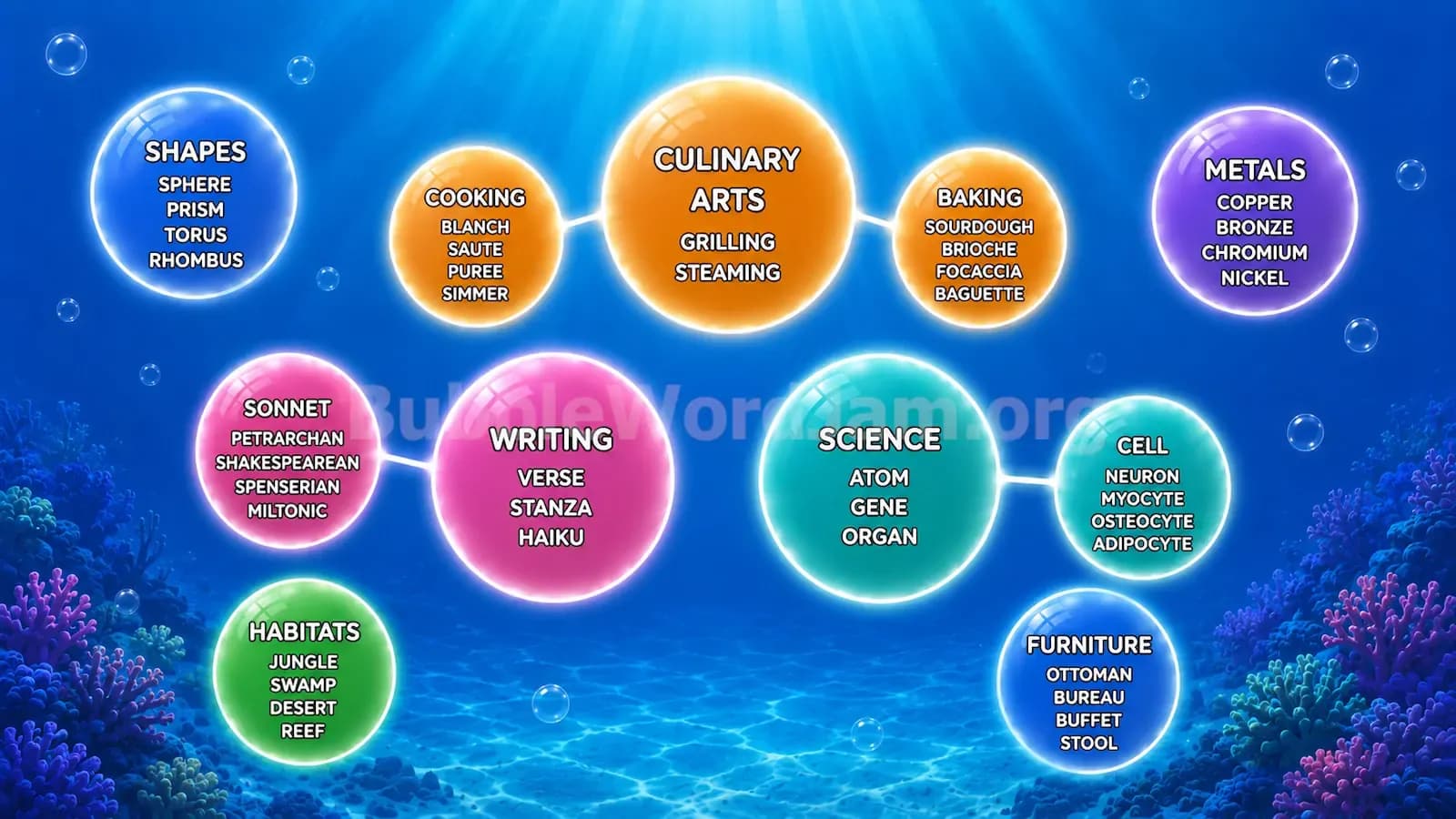
Later, Bubble Word Jam gets less generous. Level 257 pushes the technique harder with “culinary arts” as cooking, baking, grilling, and steaming, then separates “cooking” into blanch, saute, puree, and simmer. This is where the game stops being a casual food list and becomes a real categorization test. Baking and grilling are not just activities anymore; they can be members of “culinary arts,” while blanch and simmer belong to the more specific action set.
Level 450 keeps the same vibe but makes it more grown-up: “cooking methods” includes broil, saute, braise, and poach. Those words are not everyday snack terms. They are kitchen-skill vocabulary, and Bubble Word Jam expects you to recognize the verbs as a family before you get distracted by pasta, meat, vegetables, and rice under “can be cooked.”
The second rule is simple: tools are not techniques. This sounds obvious until the board is packed and your brain starts merging anything kitchen-shaped. Fork, spoon, knife, plate, spatula, whisk, pot, saucepan, stove, and pan belong to the equipment side of the kitchen. Bake, fry, simmer, and poach belong to the action side.
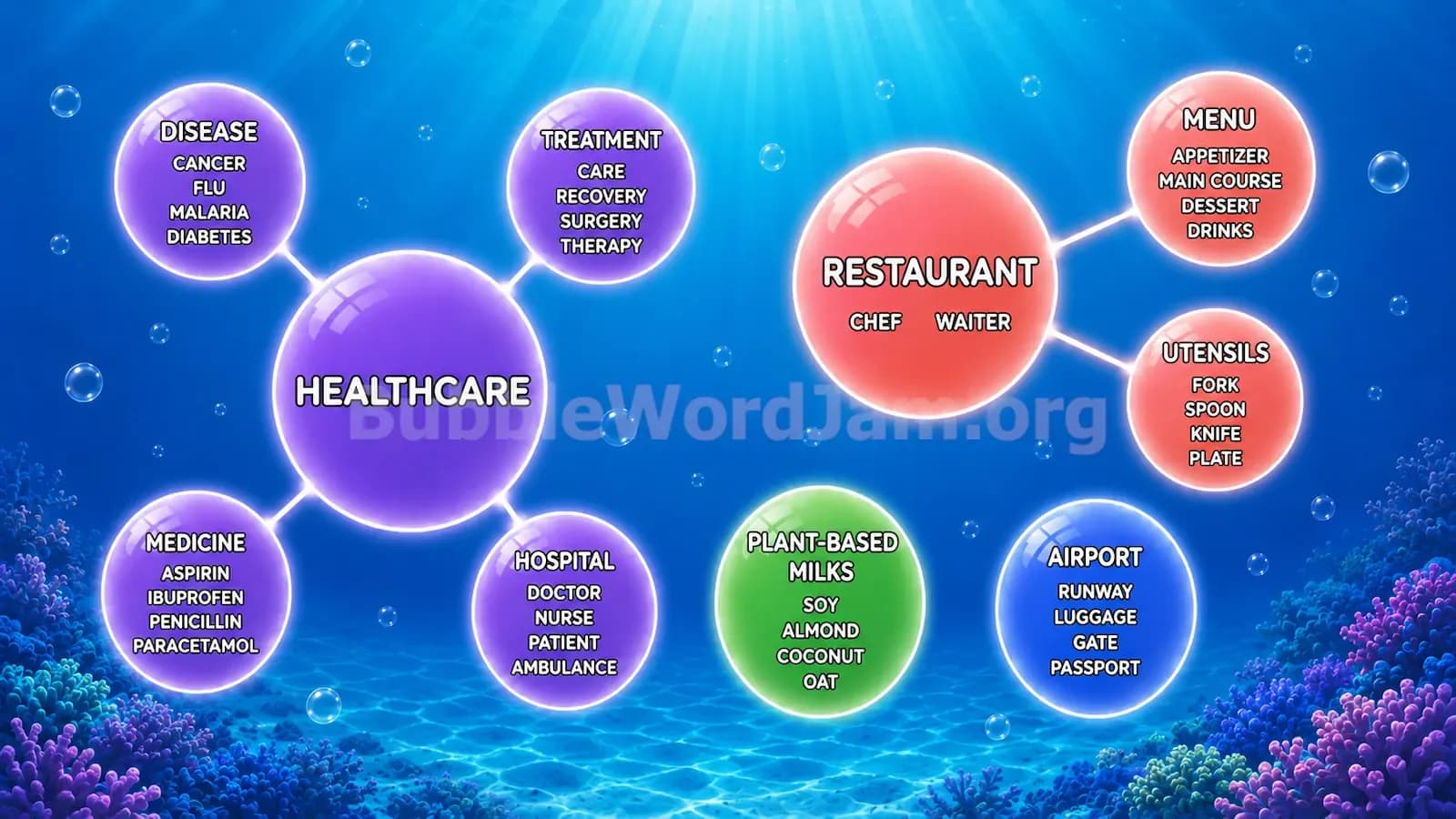
Level 94 is the perfect tool lesson. It has “restaurant” as chef, waiter, menu, and utensils. Then it breaks “utensils” into fork, spoon, knife, and plate. Then it breaks “menu” into appetizer, main course, dessert, and drinks. That is a gorgeous little category tree. Restaurant is the hub. Utensils and menu are branches. The individual words are leaves.
When Bubble Word Jam does this, don’t solve only by meaning. Solve by hierarchy. Ask yourself which words are category labels hiding as bubbles. “Menu” may be a bubble now, but it can also lead to its own group. “Utensils” may look like the answer, but the actual merge might need fork, spoon, knife, and plate first.
Level 450 backs this up with “cooking tools” as spatula, whisk, pot, and saucepan, sitting near cooking methods and spice varieties. The board is basically asking: do you know the difference between what you cook with, how you cook, and what you season with?
Food levels often become messy because dishes are both complete items and collections of ingredients. Bubble Word Jam loves that ambiguity. Level 48 is a textbook example. “Dish” contains pizza, sushi, burger, and salad. But the same level also gives “pizza” as slice, crust, cheese, and topping; “sushi” as rice, fish, seaweed, and wasabi; and “burger” as patty, grill, bun, and lettuce.
That level teaches one of the most useful cooking-term habits in the whole game: identify whether a word is the dish itself or part of the dish. Pizza can belong to “dish,” while crust belongs to “pizza.” Sushi can belong to “dish,” while seaweed belongs to “sushi.” Burger can belong to “dish,” while patty belongs to “burger.” Once you see that structure, the level stops feeling floaty.
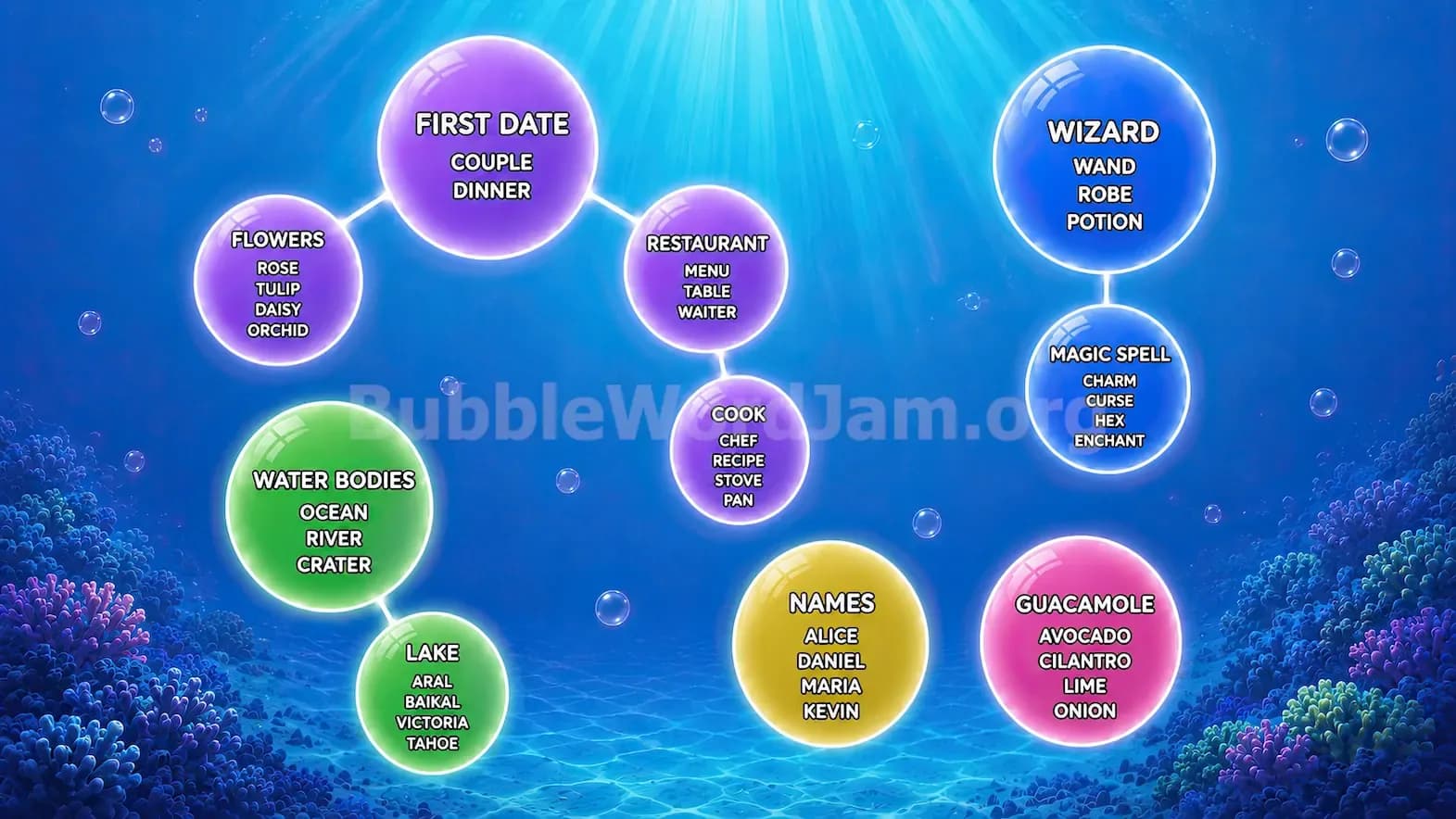
Level 58 uses a smaller version of the same trick. It includes “guacamole” as avocado, cilantro, lime, and onion. Those are ingredients, not random vegetables or herbs. The level also includes “cook” as chef, recipe, stove, and pan, plus “restaurant” as menu, table, waiter, and cook. Again, the word “cook” can act like a job, an action idea, and a category member. That’s exactly why action words first helps.
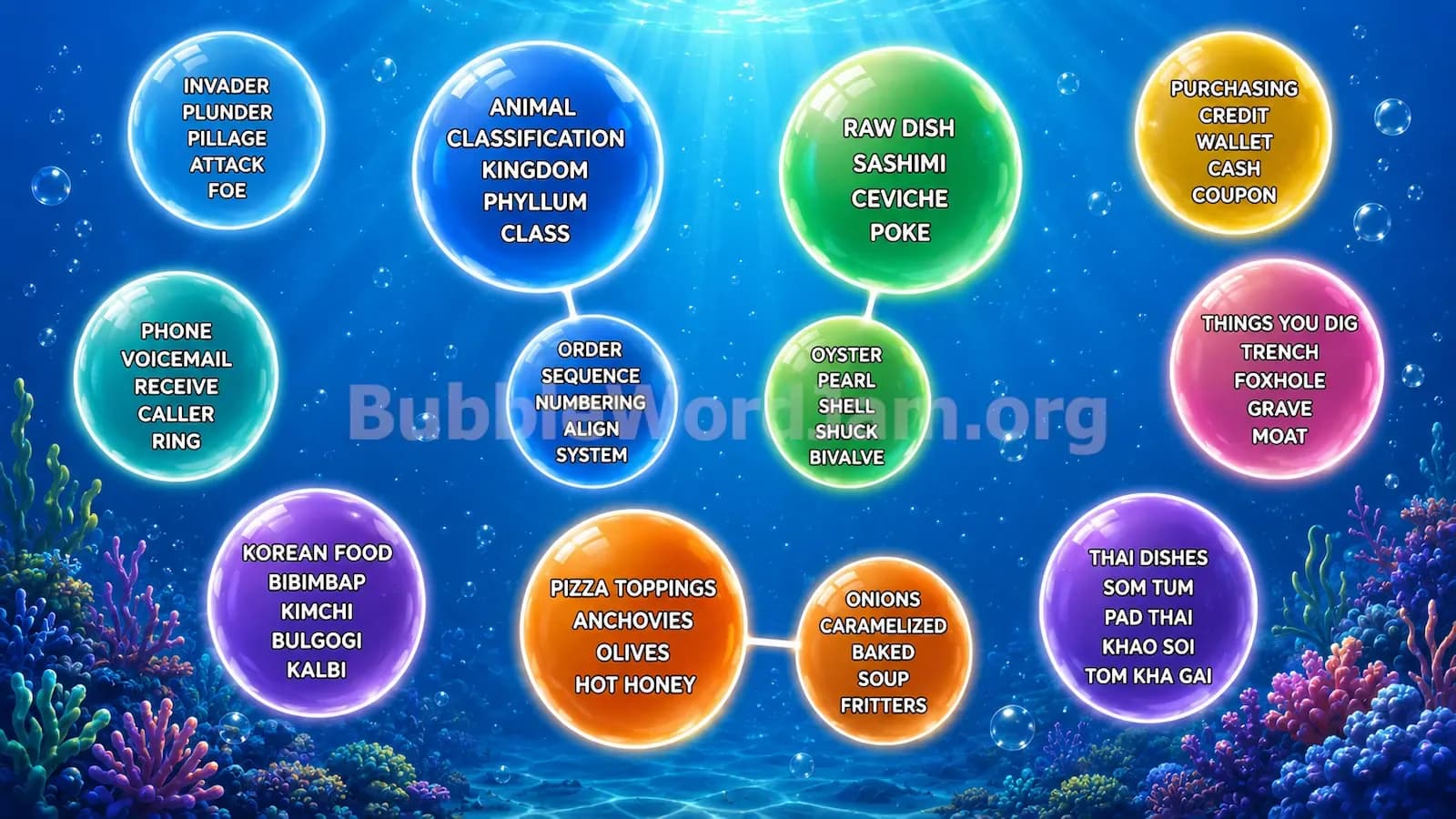
Cuisine categories are some of the cleanest anchors in Bubble Word Jam because they often use proper dish names. Level 353 is packed with them. “Korean food” includes bibimbap, kimchi, bulgogi, and kalbi. “Thai dishes” includes som tum, pad thai, khao soi, and tom kha gai. Those sets are not just food trivia; they are cultural cuisine clusters.
This level also includes “raw dish” as sashimi, oyster, ceviche, and poke, plus “pizza toppings” as anchovies, olives, onions, and hot honey. Then it twists “onions” into caramelized, baked, soup, and fritters. I rolled my eyes the first time I saw onion behave like a mini-category, but it’s a fair puzzle move. Bubble Word Jam often takes a familiar ingredient and asks, “Do you know the different ways this appears in food?”
When you spot cuisine names like Korean food, Thai dishes, Japanese cuisine, Italian cuisine, or Mexican food, solve those early. They are usually less ambiguous than generic words like dish, food, meal, or cooking.
By the time you reach higher levels, Bubble Word Jam starts using more specialized kitchen vocabulary. Level 615 is a good example because it mixes restaurant knowledge, media, herbs, and food identity. “Restaurant roles” includes chef, commis, sommelier, and waiter. “Cooking shows” includes Chopped, MasterChef, Iron Chef, and Top Chef. “Culinary herbs” includes chervil, tarragon, marjoram, and dill. There is also “vegan food” with berry, chickpeas, falafel, and hummus.
This is not beginner pantry stuff anymore. “Commis” and “sommelier” are restaurant-role clues. Chervil and marjoram are herb clues. MasterChef and Iron Chef are not chefs in the level; they are show titles. That’s a classic Bubble Word Jam move: same kitchen vibe, different semantic lane.
The best play is to name the lane before merging. Roles are people. Tools are objects. Methods are actions. Herbs and spices are ingredients. Dishes are finished foods. Cuisines are cultural groups. Menus are meal structure. Once you sort those lanes mentally, the board becomes much less chaotic.
When a cooking-heavy Bubble Word Jam level starts to feel jammed, use this order:
First, pull out cooking verbs: bake, grill, fry, boil, simmer, sauté, broil, braise, poach, roast, steam. Second, group obvious tools: fork, spoon, knife, plate, spatula, whisk, pot, pan, stove. Third, separate dishes from ingredients: pizza versus crust, sushi versus rice, guacamole versus avocado. Fourth, lock in cuisine clusters: Korean, Thai, Italian, Japanese, Mexican. Fifth, check restaurant words: chef, waiter, menu, table, commis, sommelier. Finally, handle herbs and seasonings: cilantro, dill, tarragon, basil, paprika, saffron.
Cooking terms keep showing up because they are flexible. They can be easy comfort words or spicy category traps. That’s why I think they are one of Bubble Word Jam’s better recurring themes. The best levels don’t just ask whether you know food. They ask whether you can see the system behind the food.
So next time the board throws bake, grill, menu, sushi, pan, waiter, onion, and tarragon at you, don’t brute-force it. Read the kitchen like a puzzle map. Actions first, tools second, dishes third, cuisine anchors early. That loop won’t solve every level for free, but it will save moves, calm the chaos, and make Bubble Word Jam’s cooking categories feel a lot more satisfying.