Learn how to solve Bubble Word Jam color clues by separating true colors, tricky shades, visual symbols, and red or green objects before merging any bubble.
Guide By Liam Stone
Updated on August 5, 2026
Liam Stone has been playing Bubble Word Jam since the mobile app first launched on the Apple App Store. He knew this game would pop, so he enjoys playing every level, collecting the answers, and running this site for other players. He loves mobile puzzle games and sometimes publishes his walkthroughs on his YouTube channel Puzzle Game Answer. Follow his channel if you are a puzzle game lover too.
Color categories in Bubble Word Jam feel harmless at first. Red, blue, green, yellow—easy, right? Then the game starts doing that classic puzzle-game thing where the simple idea mutates into something crunchy. Suddenly, “orange” might be a color, a fruit, or a juice flavor. “Navy” might be a shade of blue, but it might also drag your brain toward ships, admirals, and submarines. That’s the fun trap.
The key is not to ask, “What color is this word?” Ask a sharper question: is the answer the color itself, a shade of a color, or an object strongly linked to that color?
That one mental switch saves a ton of wasted moves in Bubble Word Jam. Color clues are rarely just about color. They often overlap with food, gems, animals, flags, weather, clothes, art, and symbols. When the board gets crowded, guessing by vibe can tank your run. A cleaner method is to split every suspicious word into three buckets: true color words, shade words, and colored objects.
Early color puzzles teach the cleanest version of the loop. Level 1 gives the basic colors group: red, blue, green, and yellow. This is the tutorial brain at work. No tricks, no extra layers, no “gotcha” symbol logic. If you see four basic color names together, merge them before you overthink it.
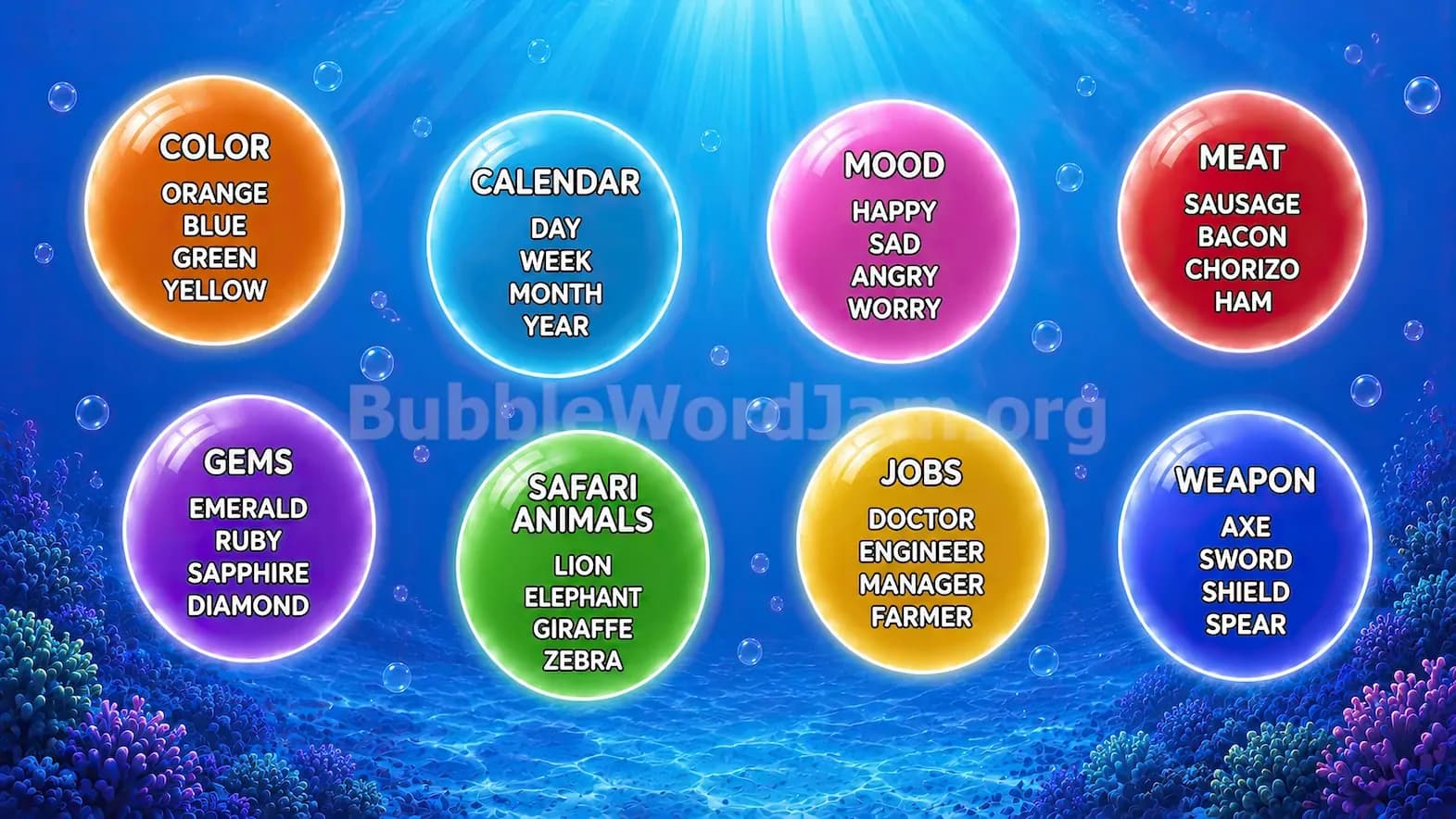
Level 10 builds on that same pattern with orange, blue, green, and yellow. This is where Bubble Word Jam starts nudging you into danger, because “orange” has more than one identity. It can sit inside a color category, but it can also belong with fruit, juice, citrus, or flavor clues in other puzzles. The move here is context. If orange appears beside blue, green, and yellow, it’s almost certainly acting as a color. If it appears beside guava, pear, and mango, it’s not.
That’s the first rule of color solving: never judge one word alone. Judge its neighbors. A single word can lie to you; a four-word cluster usually tells the truth.
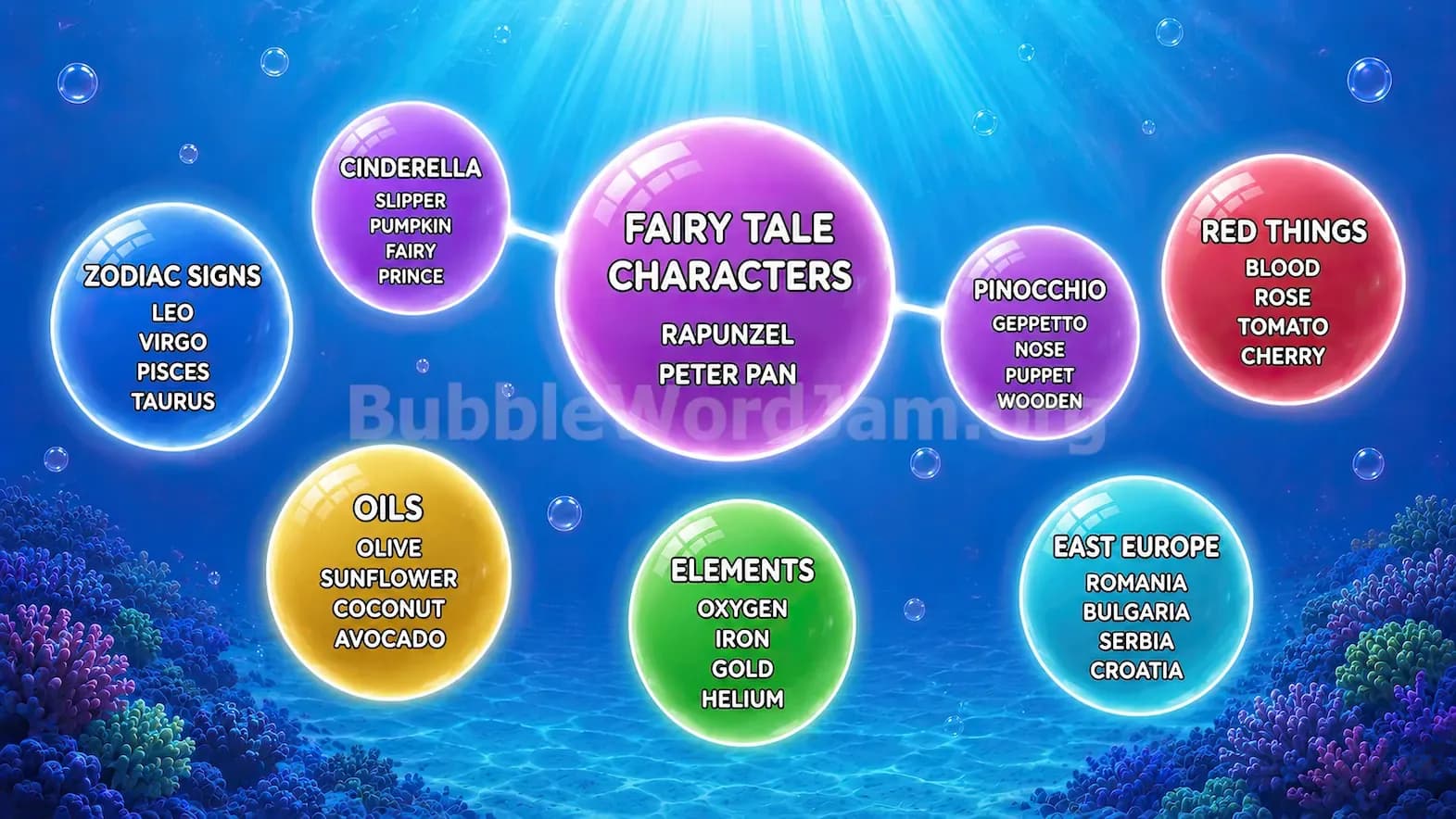
The next step is where the game gets more interesting. Level 21 uses “red things” with blood, rose, tomato, and cherry. None of those words are the color red, but all of them carry a strong red association. This is a different category shape. You’re no longer sorting color names. You’re sorting objects by visual identity.
This is where I’ve seen players burn moves. They spot “blood” and immediately want to link it with medical terms. They see “rose” and think flowers. They see “tomato” and think vegetables or food. All of those instincts are valid, which is why the puzzle has a nice little bite. Bubble Word Jam often uses words that could live in multiple houses, then asks you to identify which house is active right now.
The trick is to test the category label in your head: “things that are commonly red.” Blood? Yes. Rose? Yes. Tomato? Yes. Cherry? Yes. That’s a rock-solid set. Once all four pass the same visual test, stop shopping for alternatives.
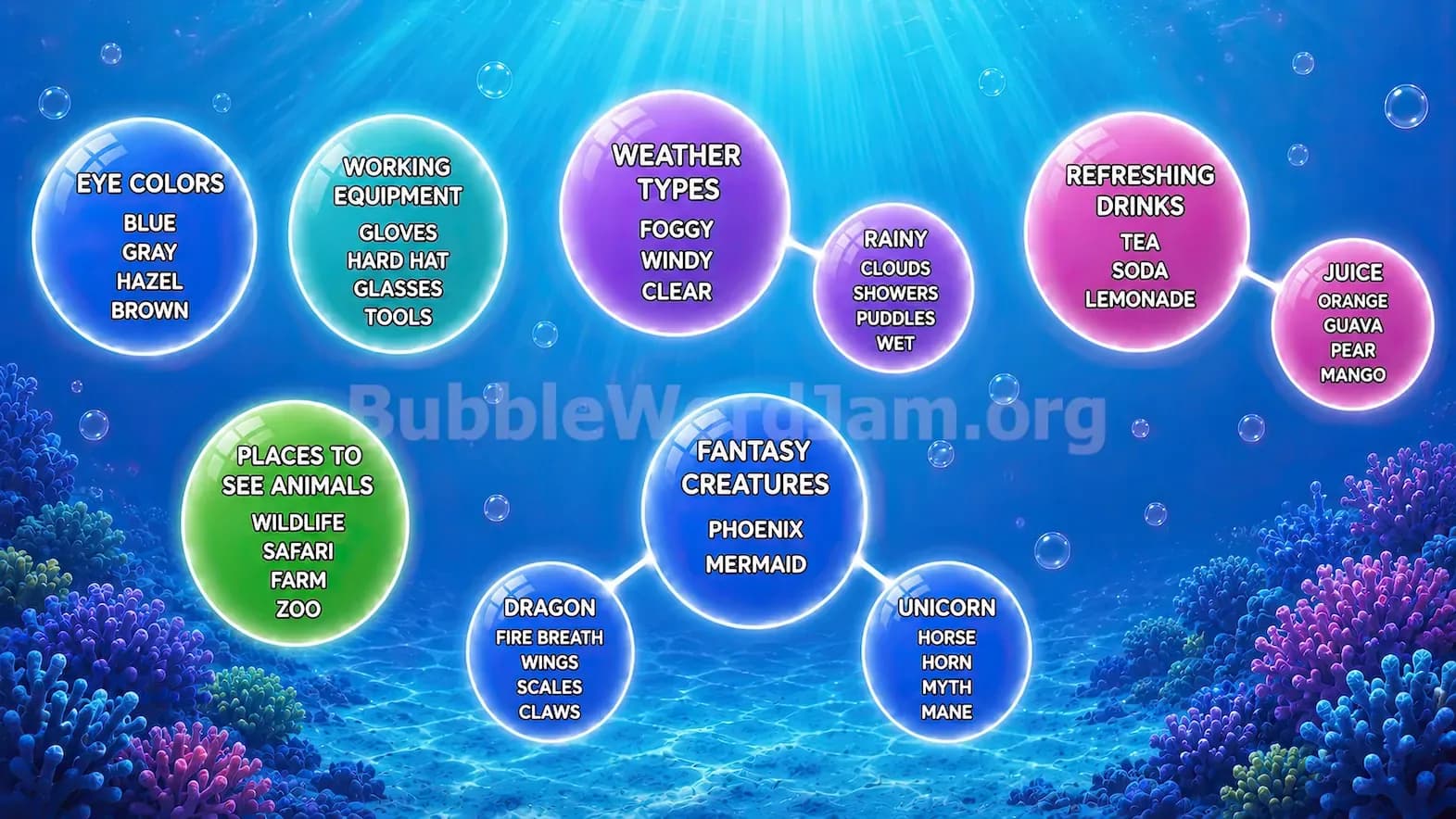
Level 22 is a great example of a more specific color category: eye colors. Blue, gray, hazel, and brown are not just colors in general; they’re colors tied to one body feature. That tiny context shift matters.
If you treat “hazel” as a random shade, you might hesitate. If you treat it as an eye-color clue, it snaps into place. This is the same reason “brown” can be tricky. Brown can belong to chocolate, wood, soil, bears, coffee, or eyes. The category is doing the steering.
When a color word feels too common, look for a noun anchor. Eye colors has a clear anchor: eyes. Red liquids has a clear anchor: liquids. Shades of blue has a clear anchor: blue. Bubble Word Jam loves these anchored color groups because they feel fair but still force you to read carefully.
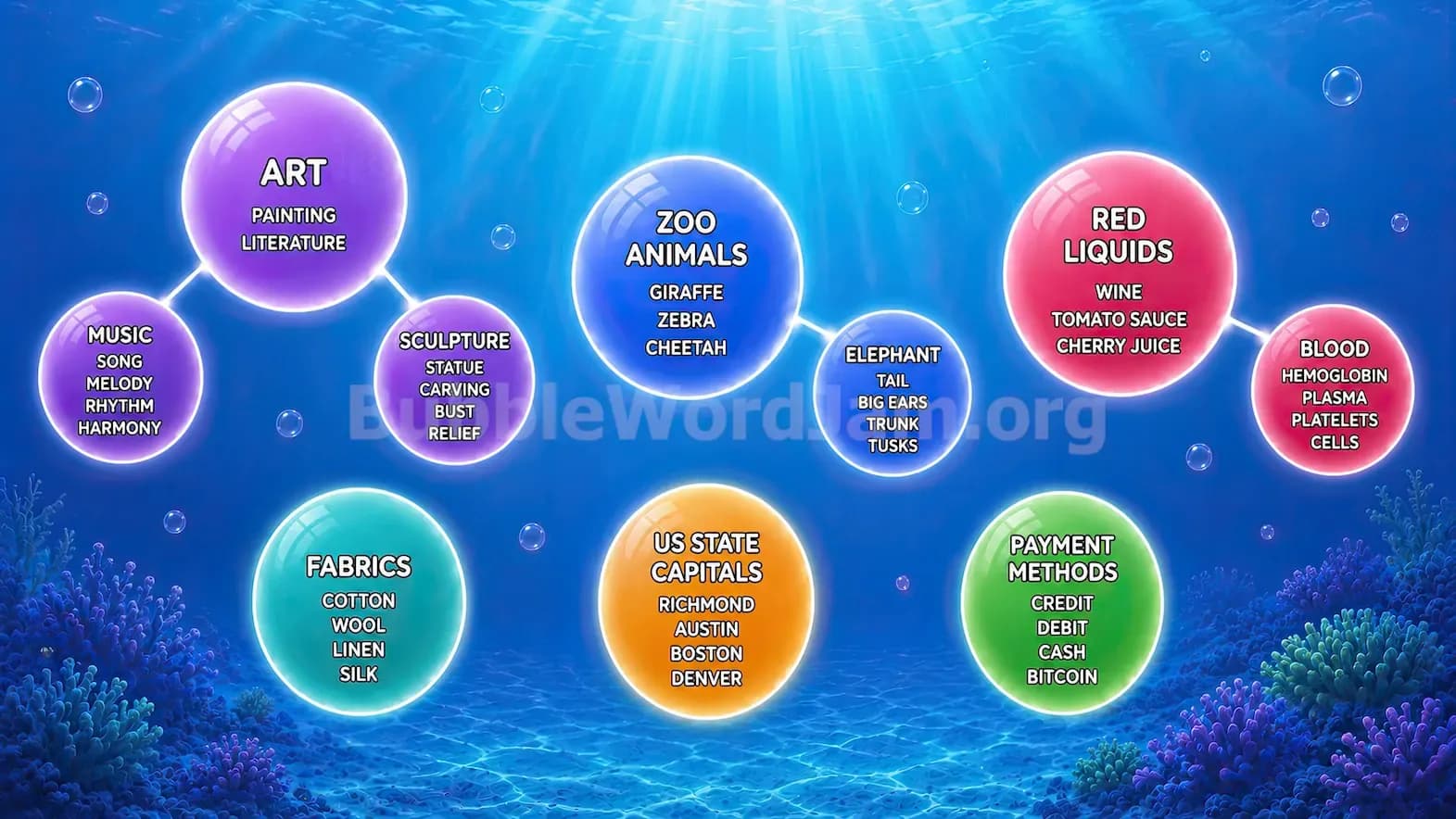
Level 28 takes the red-object idea and narrows it: blood, wine, tomato sauce, and cherry juice. The obvious connection is red, but the winning connection is red liquids. That extra condition is everything.
Blood and wine are easy. Tomato sauce and cherry juice are the real test. “Tomato sauce” could go with food. “Cherry juice” could go with drinks. But if the board includes multiple red liquid candidates, they form a cleaner group together than they do separately.
This is one of the best habits for Bubble Word Jam: when a category seems too broad, check whether there’s a tighter version. “Red things” is broad. “Red liquids” is tighter. “Blue things” is broad. “Shades of blue” is tighter. The tighter category usually wins because it gives the puzzle a more deliberate shape.
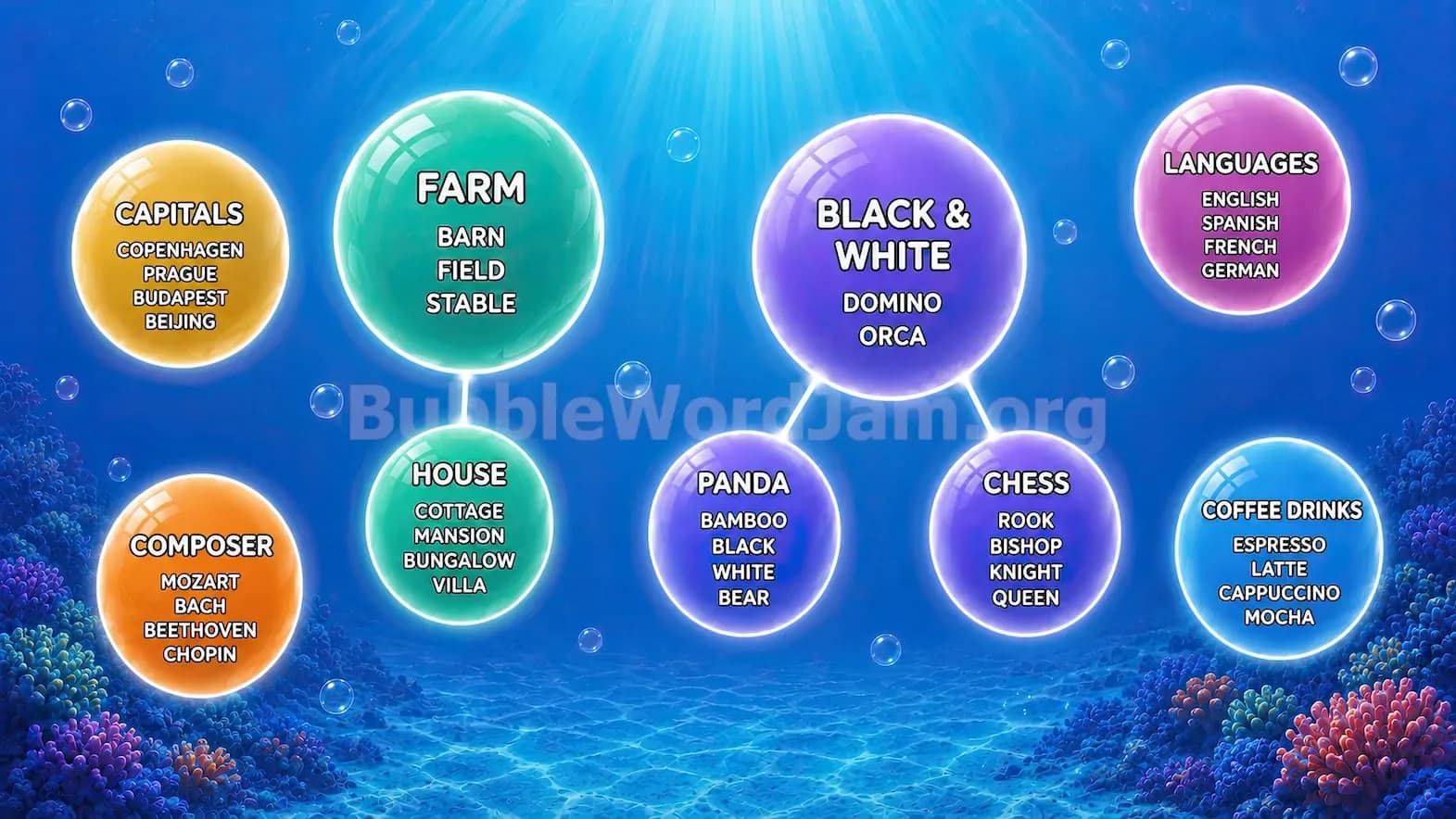
Level 31’s black & white group—domino, panda, orca, and chess—is a banger because it mixes objects, animals, and a game. The category is not “animals,” even though panda and orca might tempt you. It’s not “games,” even though chess and domino might pull you there. The shared clue is visual contrast.
This kind of category asks you to think like a designer. What do these things look like? A panda is black and white. An orca is black and white. Chess pieces and boards are commonly black and white. Domino tiles are also visually defined by that contrast.
For visual descriptor puzzles, don’t only ask what something is. Ask what it looks like on screen, in a photo, or as an icon. Bubble Word Jam sometimes uses visual memory as much as word meaning, and that’s what gives these color puzzles their weird little spark.
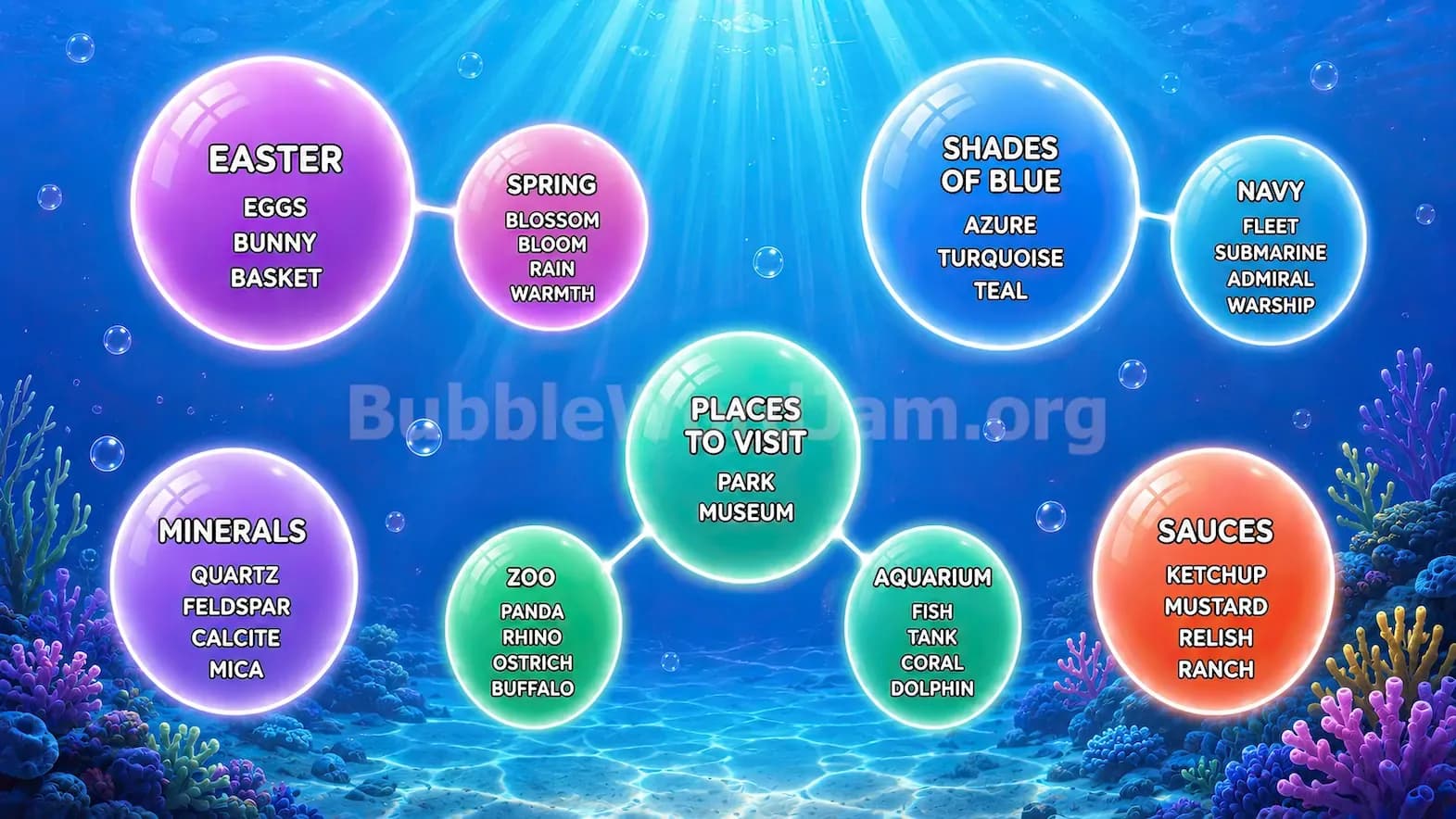
Shades of blue show up beautifully in Level 66: navy, azure, turquoise, and teal. These are not objects with blue coloring. They are named shades. That means the category is tighter and more vocabulary-driven.
The danger word is “navy.” In the same level, navy also connects to fleet, submarine, admiral, and warship. That’s a nasty but fair fork. Is navy a color, or is Navy a military branch? The answer depends on the neighbors. If navy is sitting beside azure, turquoise, and teal, it’s a shade. If it’s sitting beside fleet and submarine, it’s military.
Level 313 returns to shades of blue with baby, navy, powder, and royal. This one is even trickier because “baby,” “powder,” and “royal” don’t look like colors until you attach “blue” after them. Baby blue. Powder blue. Royal blue. Navy blue. That’s the loop: mentally add the base color and see whether the phrase becomes familiar.
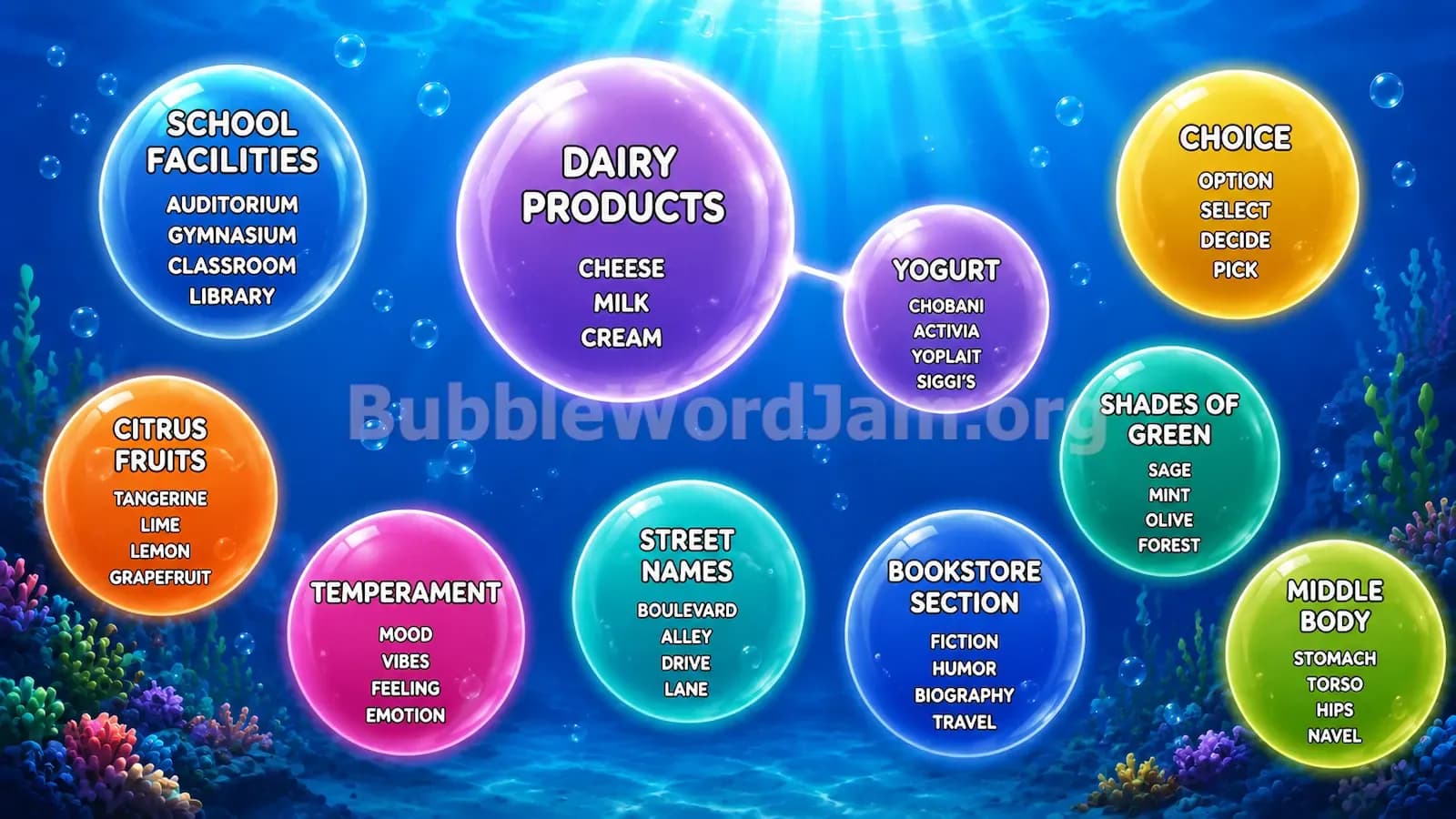
Level 377 gives shades of green: sage, mint, olive, and forest. This is one of my favorite visual clue sets because every word has a second life. Sage is an herb. Mint is a flavor or plant. Olive is a food. Forest is a place. But as shades, they all become green.
This is the exact moment where Bubble Word Jam rewards restraint. Don’t instantly merge mint with food or sage with herbs just because that association hits first. Pause and check whether those words also work as color names. If four words can all sit before or after the same color idea, you probably found the intended set.
A quick test: say “green” after each word. Sage green. Mint green. Olive green. Forest green. If all four sound natural, the category is strong.
When color clues start crowding the board, I use a simple ladder:
First, look for pure colors: red, blue, green, yellow, orange, black, white, gray, brown.
Second, look for shade terms: navy, azure, teal, turquoise, sage, mint, olive, forest, royal, powder, baby.
Third, look for colored objects: blood, rose, tomato, cherry, panda, orca, domino, chess.
Fourth, look for narrowed visual groups: eye colors, red liquids, black & white objects, shades of blue, shades of green.
That ladder keeps the solving loop clean. It stops you from throwing every color-adjacent word into one messy pile. Bubble Word Jam doesn’t reward messy thinking. It rewards category discipline.
The biggest trap is double meaning. Orange can be a color or fruit. Navy can be a shade or military term. Mint can be a flavor, plant, or color. Olive can be a food or shade. Forest can be an ecosystem or shade. These aren’t unfair tricks; they’re the core vibe of the game.
The second trap is category width. “Red things” and “red liquids” might look similar, but one accepts objects while the other demands substances you can pour, spill, or drink. “Colors” and “eye colors” also overlap, but eye colors has a body-feature filter.
The third trap is symbol logic. Domino, panda, orca, and chess don’t share a normal category like animal, game, or object. They share a look. When a group seems impossible, switch from meaning to appearance.
Color puzzles in Bubble Word Jam are at their best when they make you slow down for one extra beat. The easy play is to merge anything that feels colorful. The better play is to ask what kind of color clue you’re dealing with.
Is the word a color itself? Is it a shade name? Is it an object known for that color? Is it part of a visual symbol, like black-and-white contrast? That question turns a floaty guess into a controlled solve.
Once you learn that pattern, levels like 1, 10, 21, 22, 28, 31, 66, 313, and 377 stop feeling random. They become a clear progression: basic colors, color-linked objects, body-feature colors, red liquids, black-and-white symbols, and named shades. That’s the real trick. Bubble Word Jam isn’t only testing whether you know colors. It’s testing whether you can see how words change roles when the category shifts.