Solve Bubble Word Jam civic and military categories faster by separating authority roles, institutions, ranks, weapons, and conflict terms in each puzzle.


Guide By Liam Stone
Updated on July 25, 2026
Liam Stone has been playing Bubble Word Jam since the mobile app first launched on the Apple App Store. He knew this game would pop, so he enjoys playing every level, collecting the answers, and running this site for other players. He loves mobile puzzle games and sometimes publishes his walkthroughs on his YouTube channel Puzzle Game Answer. Follow his channel if you are a puzzle game lover too.
Bubble Word Jam loves a clean category. Then, right when you’re feeling comfortable, it throws a crunchy civic or military set onto the board and dares you to sort “senator,” “captain,” “court,” “fleet,” “mace,” and “campaign” without wasting moves. That’s the fun little trap here: all of these words feel powerful, official, or conflict-adjacent, but they don’t all belong in the same bucket.
The best way to handle law, government, military, and weapon puzzles in Bubble Word Jam is simple: separate authority words from combat words. Authority words usually point to institutions, roles, laws, decisions, elections, and leadership. Combat words usually point to weapons, formations, wars, soldiers, ranks, or battlefield action.
Once you see that split, these levels stop feeling like a messy pile of “serious words” and start playing like a tight sorting loop.
When a civic or military theme appears, I use two mental columns before I merge anything.
First, I look for authority words. These are words connected to rules, offices, public systems, and decision-making. “President,” “senator,” “congress,” “judiciary,” “court,” “judge,” “trial,” “verdict,” “ballot,” “election,” and “campaign” all live in this zone. They may involve conflict in a dramatic sense, but they’re not combat words. They’re about power, order, procedure, and institutions.
Then I look for combat words. These include weapons, army structures, formations, explosives, warriors, and war types. “Sword,” “spear,” “gun,” “platoon,” “battalion,” “fleet,” “submarine,” “trench,” “guerrilla,” “crossbow,” “lance,” “mace,” “phalanx,” and “testudo” all push toward battle or military organization.
That distinction saves moves. In Bubble Word Jam, every careless merge can tank your board state. The game rewards players who pause for five seconds and ask, “Is this word about authority, or is it about combat?”
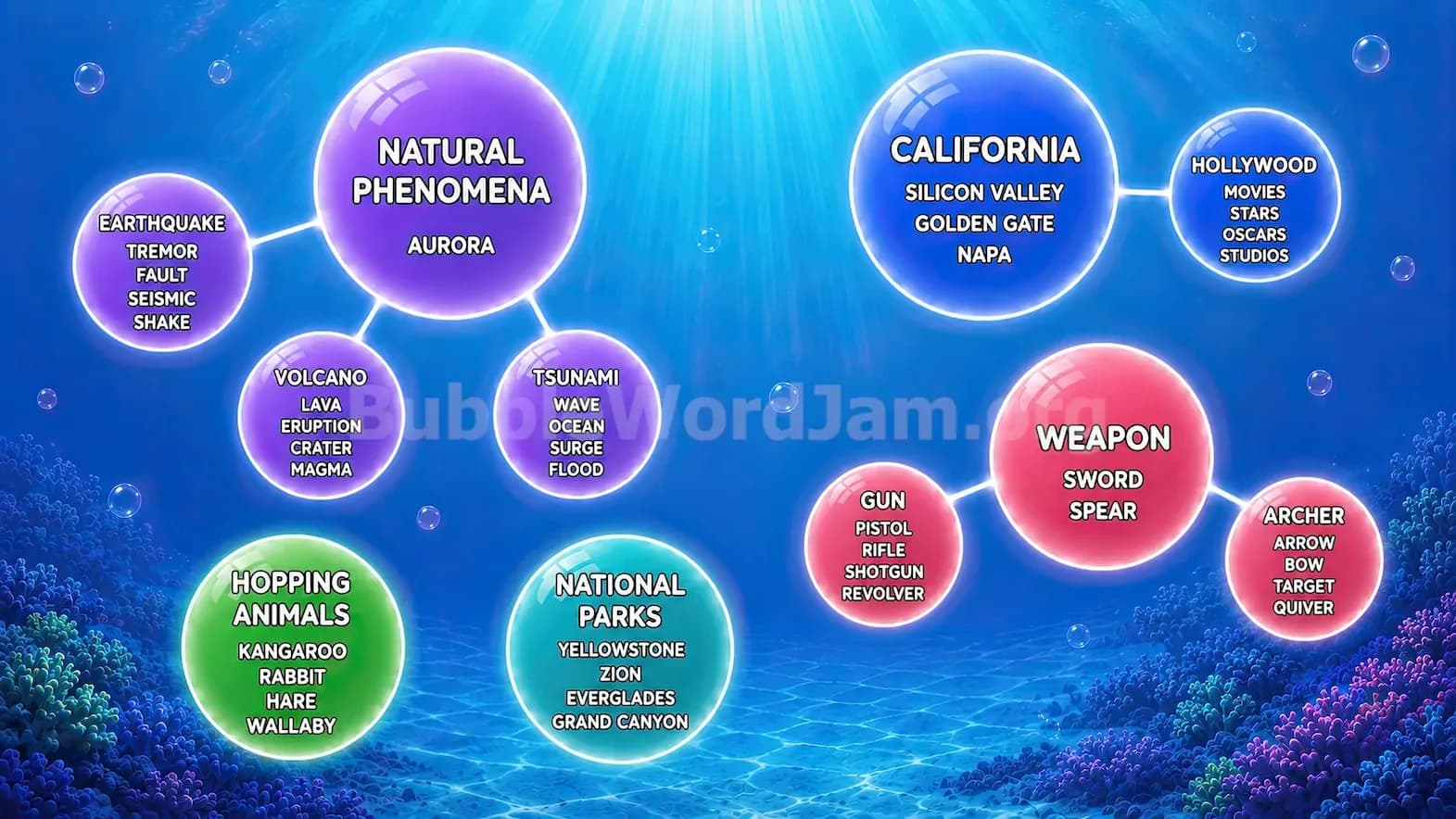
Level 33 is a great early teaching moment because it gives you a very readable combat chain: weapon, gun, and archer. “Weapon” gathers broad tools like gun, archer, sword, and spear. Then “gun” narrows into pistol, rifle, shotgun, and revolver. “Archer” narrows again into arrow, bow, target, and quiver.
That hierarchy matters. Don’t just see “gun” and instantly drag it toward every violent-looking word. In Bubble Word Jam, a word can be both an item inside a larger category and the parent of its own smaller category. “Gun” belongs under weapon, but pistol and rifle belong under gun. “Archer” may look like a person, but in this level it behaves like a category hub for archery equipment.
The trick is to ask: is this the parent, or is this one of the children? That question is a banger for weapon puzzles because the game often stacks broad and narrow ideas together.
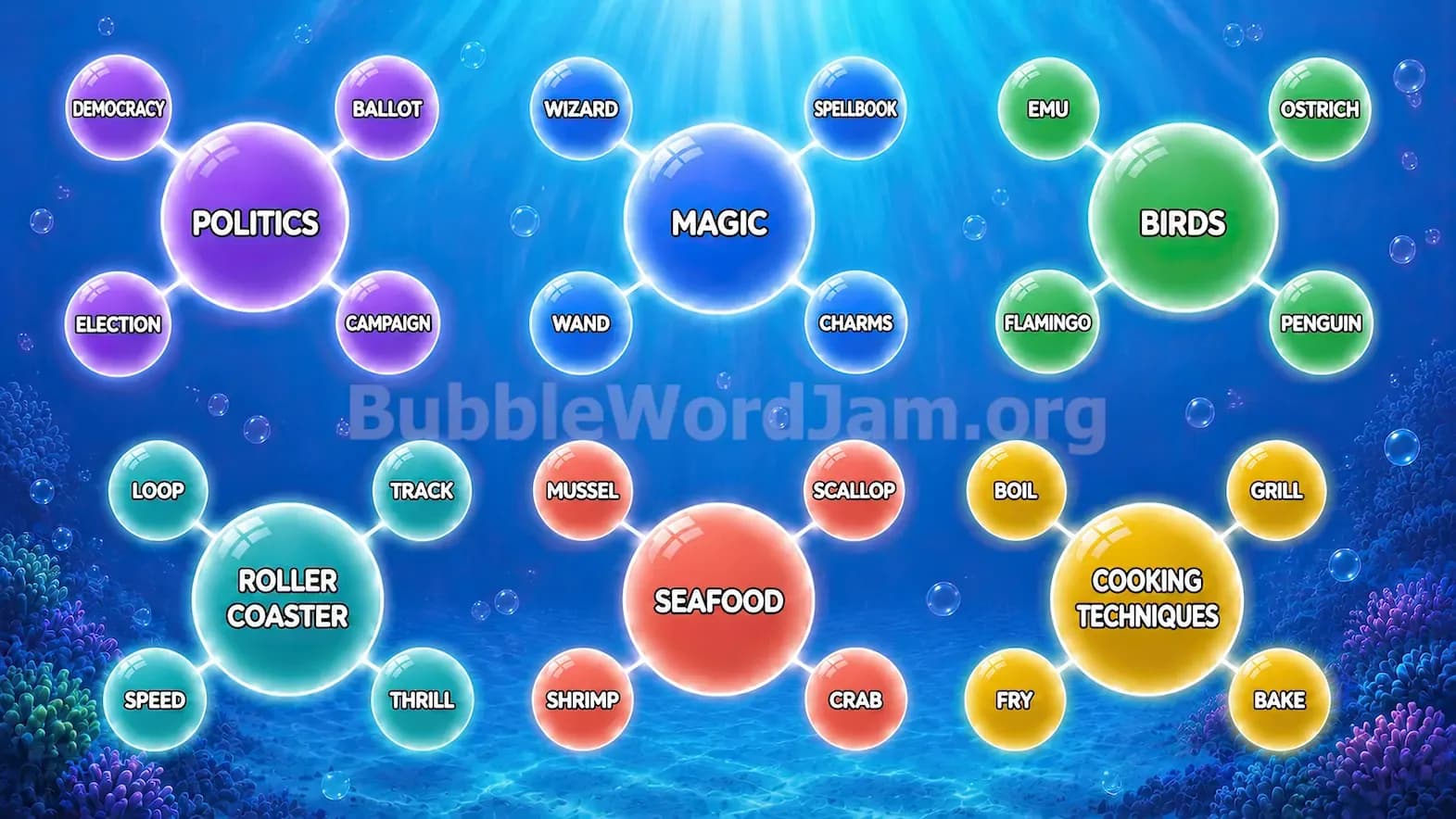
Level 36 introduces politics through democracy, ballot, election, and campaign. This has a very different vibe from the later government and court sets. Politics is about public choice and competition. Government is about institutions and offices. Law is about rules, courts, and judgment.
That sounds obvious until Bubble Word Jam tosses all the bubbles into one board and your brain starts merging anything that smells official. Don’t do that.
“Ballot,” “election,” and “campaign” belong together because they share the electoral process. “Democracy” anchors the category as the system behind those words. If you see “president,” “congress,” or “senator” elsewhere, those are government-office words, not necessarily campaign words. They may overlap in real life, but the puzzle wants the cleanest common bond.
This is where the game feels more like semantic sorting than trivia. You’re not proving you know politics; you’re proving you can identify the exact category boundary.
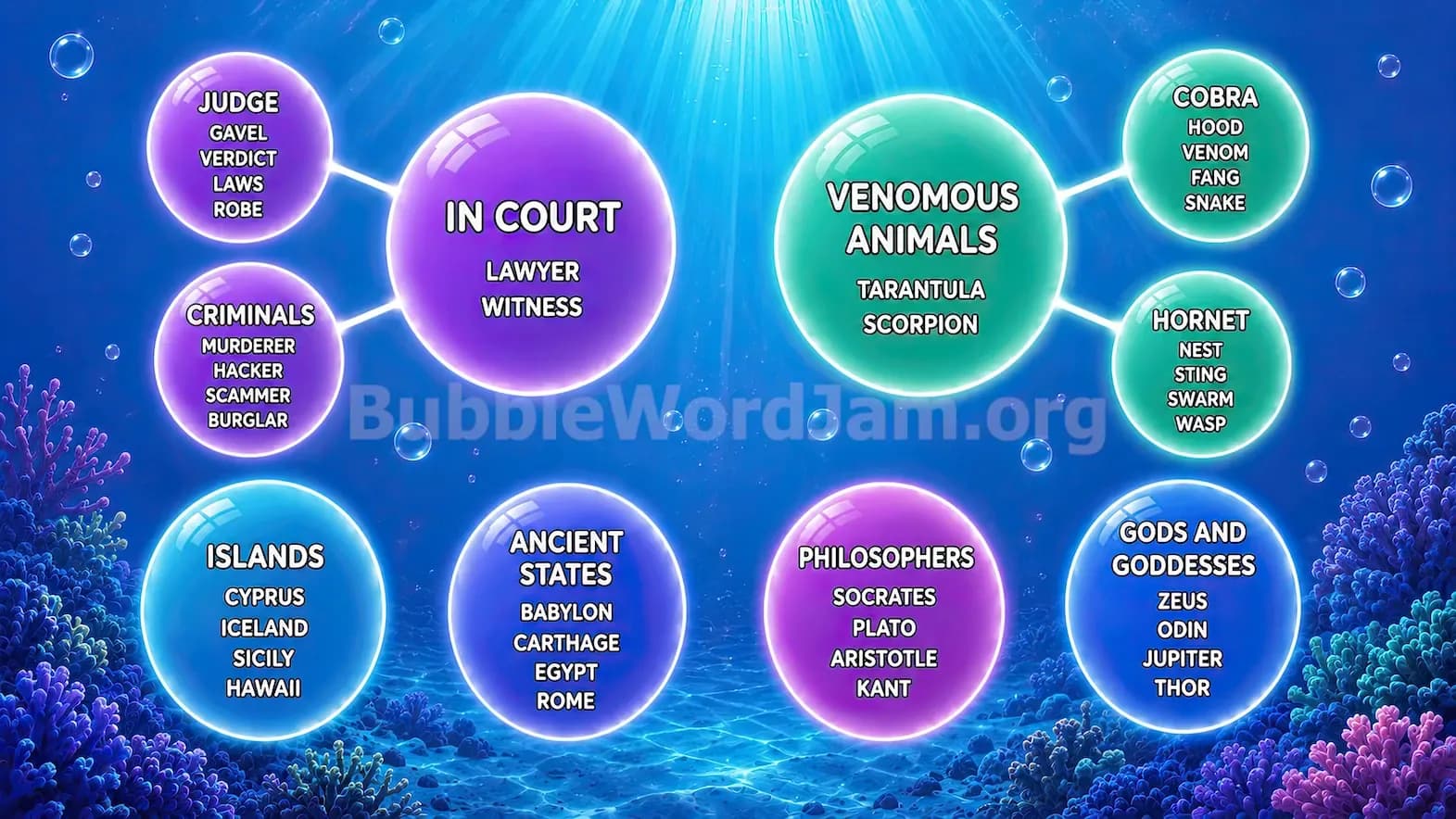
Level 41 is one of the most useful law examples because it separates judge, in court, and criminals. “Judge” pulls in gavel, verdict, laws, and robe. “In court” groups criminals, judge, lawyer, and witness. “Criminals” then narrows into murderer, hacker, scammer, and burglar.
This is a classic Bubble Word Jam move: one legal word may act as a bridge between categories. “Judge” appears as a person in the courtroom group, but it also becomes its own category with objects and concepts attached to the role.
My rule here is to sort legal words by function. A person can be a role. A role can have tools. A court can have participants. A crime category can have offender types. When you keep those layers separate, the level becomes much less floaty.
So, “gavel” should not go with “lawyer” just because both feel legal. “Gavel” belongs to judge. “Lawyer” belongs to in court. “Burglar” belongs to criminals. The cleaner your function sorting, the smoother the solve.
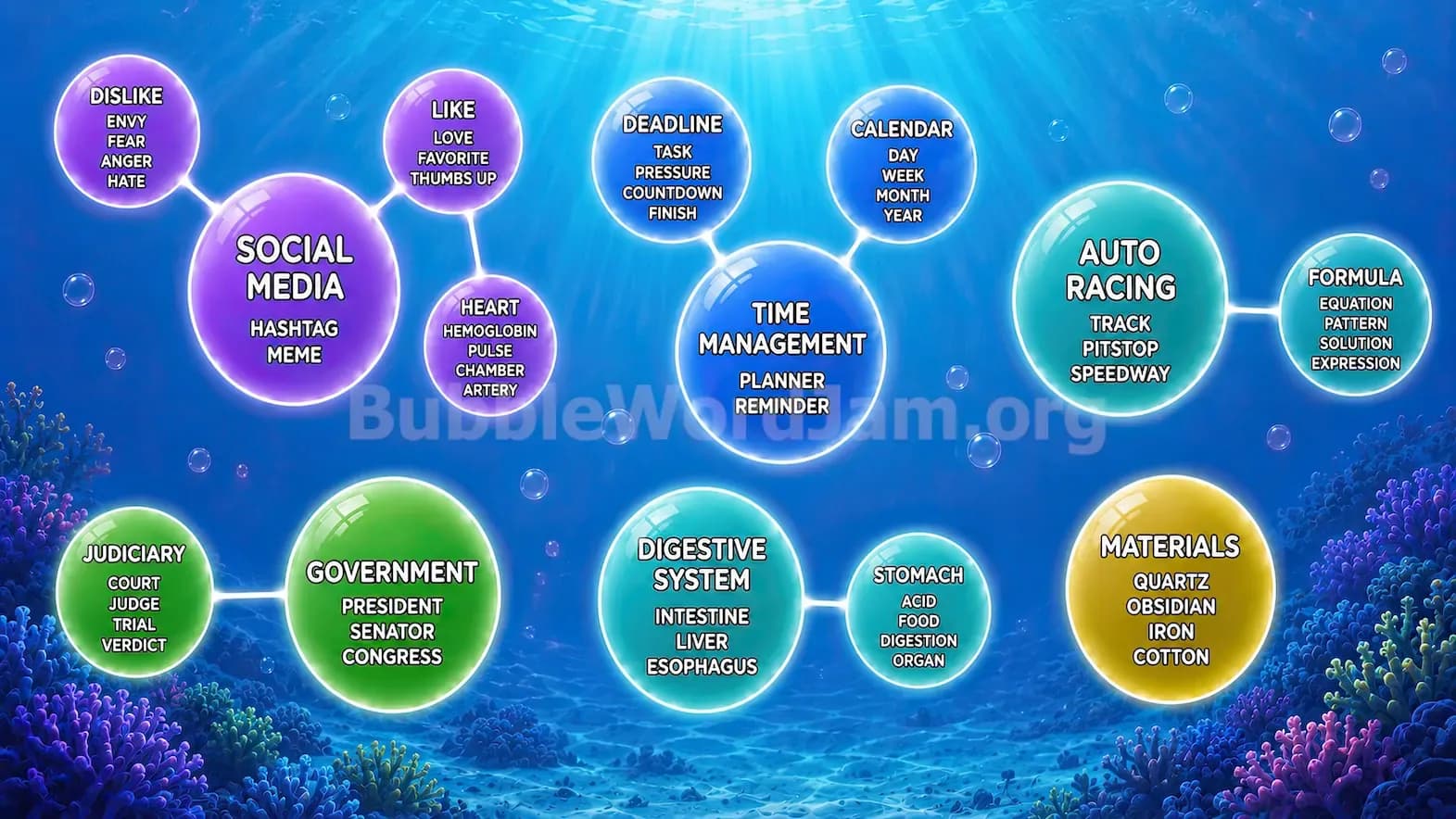
Level 55 brings in two big authority categories: judiciary and government. “Judiciary” connects court, judge, trial, and verdict. “Government” connects president, judiciary, senator, and congress.
This is where Bubble Word Jam gets sneaky in a good way. “Judiciary” is part of government, but it also has its own legal category. That means you need to think in layers again. Government is the umbrella. Judiciary is a branch or institution. Court, trial, and verdict are the legal process under that branch.
The safe play is to identify the highest-level institution first. If “government” is on the board with president, senator, congress, and judiciary, that’s your civic hub. Then build the judiciary group around court procedure.
This is also a good reminder that Bubble Word Jam often rewards common knowledge, not specialist knowledge. You don’t need a law degree. You just need to know which words describe offices, which describe systems, and which describe court actions.
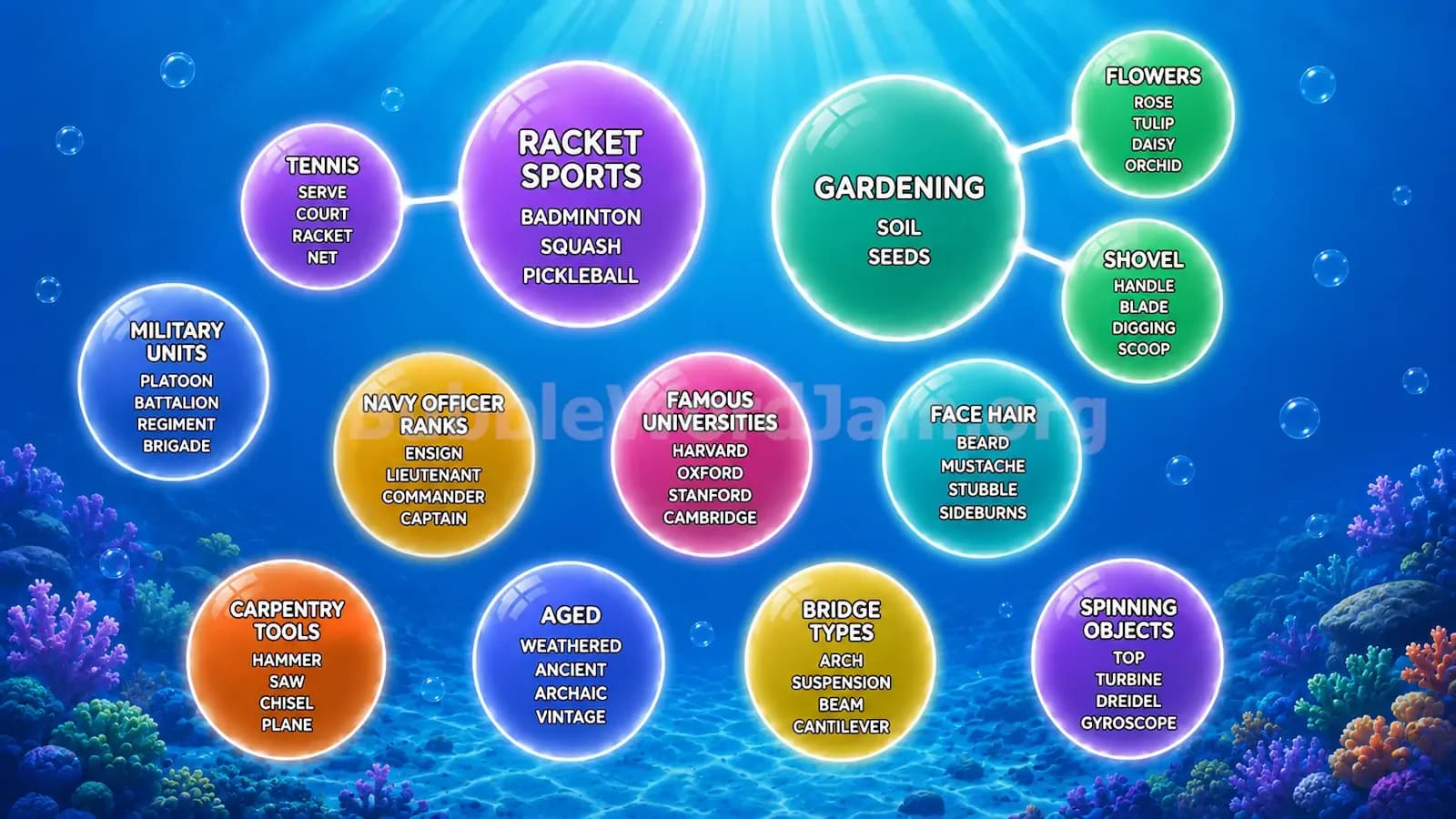
Level 149 shifts from civic authority to military organization. The key groups are military units and navy officer ranks. “Military units” includes platoon, battalion, regiment, and brigade. “Navy officer ranks” includes ensign, lieutenant, commander, and captain.
This is one of those levels where a rushed player can absolutely burn moves. “Captain” might make you think of ships. “Brigade” might make you think of battle. But these aren’t weapon words. They’re structure words. One group describes unit size or organization. The other describes rank.
I like to treat military puzzles as three separate lanes: people, groups, and tools. Ranks are people labels. Units are group labels. Weapons are tools. If you keep those lanes clean, the board stops wobbling.
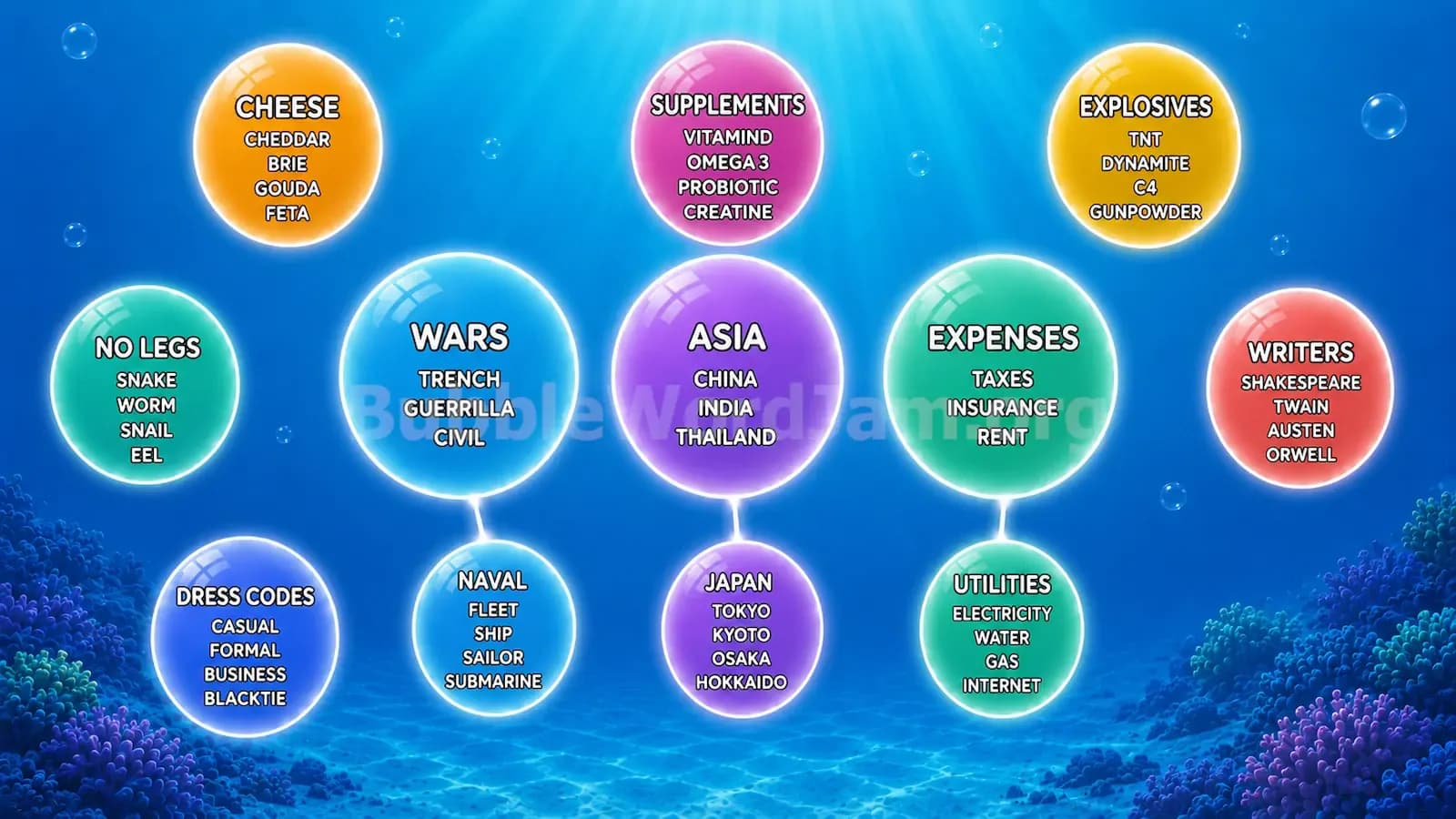
Level 220 stacks several combat-adjacent ideas: wars, explosives, and naval. “Wars” includes trench, guerrilla, civil, and naval. “Explosives” includes TNT, dynamite, C4, and gunpowder. “Naval” includes fleet, ship, sailor, and submarine.
This level teaches a sharp lesson: “naval” can describe a type of war, but it can also anchor a sea-military category. In the wars group, “naval” describes conflict type. In the naval group, fleet and submarine point to maritime forces.
Explosives are easier because they’re object-based. TNT and dynamite don’t belong with “trench” just because they both feel dangerous. One group is about conflict categories. One group is about materials or devices.
When in doubt, ask whether the word describes a type of fighting, a military environment, or a thing used in combat. That one question clears a lot of fog.
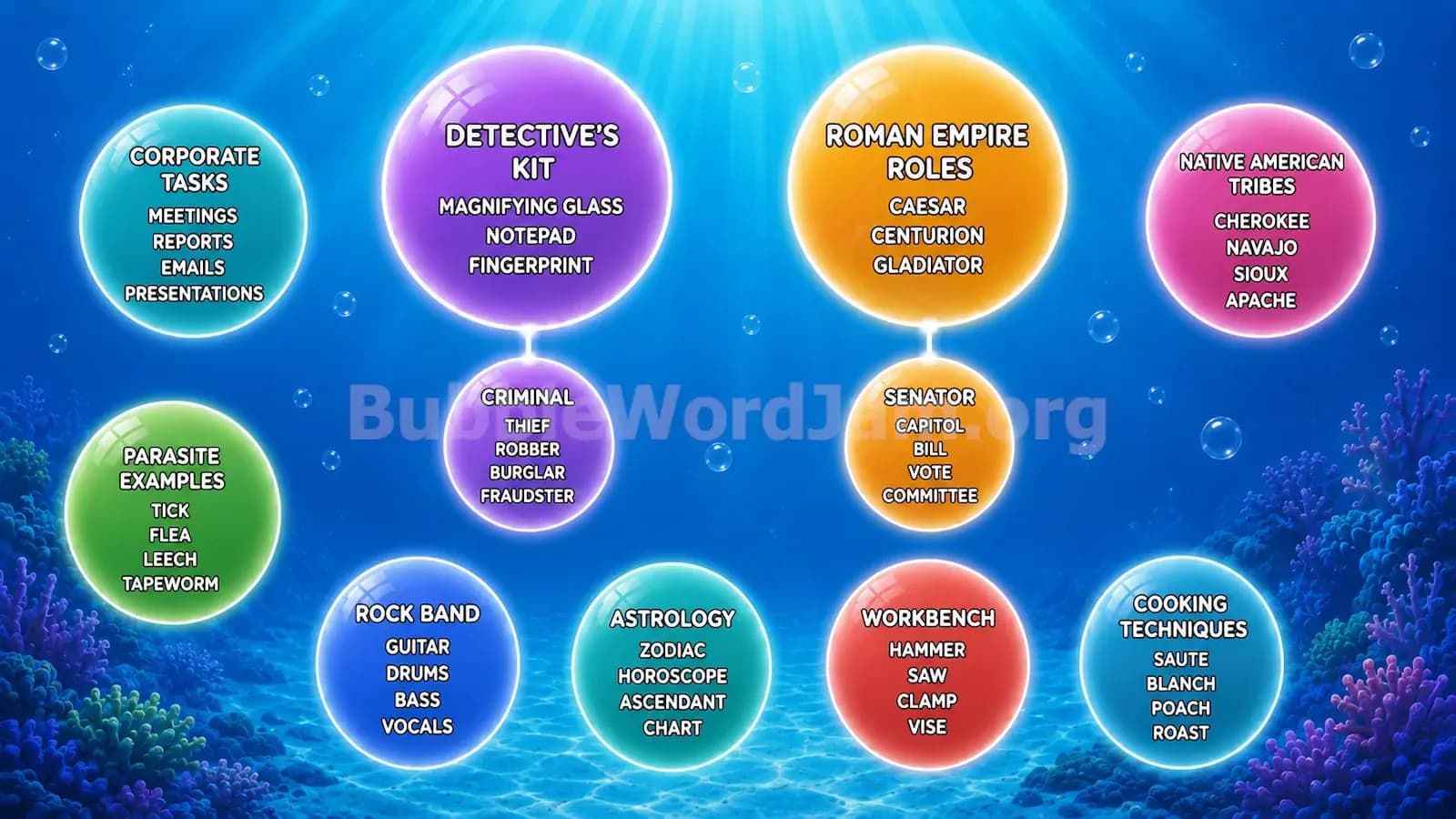
Level 289 brings civic vocabulary into a historical lane with senator and Roman empire roles. “Senator” connects capitol, bill, vote, and committee. “Roman empire roles” includes Caesar, centurion, gladiator, and senator.
This is a great example of context doing the heavy lifting. “Senator” can be modern government vocabulary, but it can also appear in a historical Rome category. Bubble Word Jam is asking you to read the surrounding words, not just react to the first association in your head.
If “bill,” “vote,” and “committee” are nearby, senator probably points to modern legislative work. If “Caesar,” “centurion,” and “gladiator” are nearby, senator belongs in the Roman set. Same word, different vibe, different merge.
Later examples like Level 579 and Level 679 make the combat side more specialized. Level 579 uses medieval weapons such as axe, crossbow, lance, and mace, while also featuring ancient warriors like knight, viking, samurai, and hoplite. Level 679 moves into military formations with phalanx, testudo, echelon, and flanking.
These are not beginner-friendly categories, but the technique still holds. Weapons are tools. Warriors are people. Formations are arrangements. A knight is not a weapon. A lance is not a formation. A phalanx is not a rank.
That’s the satisfying part of Bubble Word Jam. Even when the vocabulary gets tougher, the sorting logic stays rock-solid. The words change, but the category grammar stays readable.
Before merging, scan for the category’s role. Is it an institution, like government or judiciary? Is it a role, like senator, judge, captain, or commander? Is it a combat object, like sword, mace, TNT, or crossbow? Is it a conflict type, like civil, guerrilla, trench, or naval? Is it a formation, like phalanx or testudo?
Once you answer that, the puzzle usually opens up. Authority words cluster around offices, decisions, courts, and elections. Combat words cluster around units, weapons, ranks, wars, and formations.
That’s the core trick. Bubble Word Jam doesn’t just test whether you know the words. It tests whether you can sort the same broad theme into smaller, cleaner buckets. Master that, and law, government, military, and weapon levels become less intimidating and a lot more fun.