Solve Bubble Word Jam literature puzzles faster by sorting book genres, writing formats, publishing roles, and writing systems with confidence today.
Guide By Liam Stone
Updated on June 22, 2026
Liam Stone has been playing Bubble Word Jam since the mobile app first launched on the Apple App Store. He knew this game would pop, so he enjoys playing every level, collecting the answers, and running this site for other players. He loves mobile puzzle games and sometimes publishes his walkthroughs on his YouTube channel Puzzle Game Answer. Follow his channel if you are a puzzle game lover too.
Books and writing categories in Bubble Word Jam can feel deceptively calm at first. You see words like pencil, poetry, article, writer, or sonnet, and your brain thinks, “Easy, I know this stuff.” Then the puzzle starts mixing formats, roles, tools, genres, and old-school writing systems, and suddenly the board gets crunchy.
That’s the fun of this category. Bubble Word Jam doesn’t just ask whether you recognize bookish words. It tests whether you understand what kind of bookish word you’re looking at. Is fiction a genre? Is article a publication type? Is editor a role? Is calligraphy a writing system, a craft, or a visual style?
The key is to stop treating every literature-related word as one giant “books” pile. That loop will tank your moves fast. Instead, sort the words by function: what the word is, what it does, and where it belongs in the world of reading, writing, and publishing.
The best way to beat writing and literature categories is to separate three ideas before you merge anything.
A genre tells you what kind of story or content it is. Fantasy, mystery, romance, horror, biography, memoir, and poetry all point toward genre or literary type. These words describe the content’s flavor.
A format tells you the shape the writing takes. Essay, review, editorial, article, novel, poem, story, and drama are formats or forms. These words describe how the writing is packaged.
A role tells you who works on the writing. Writer, editor, publisher, proofreader, author, librarian, and scribe are people or jobs. These words describe the human side of the publishing chain.
Once you see those three lanes, Bubble Word Jam starts to feel less floaty. You’re no longer guessing. You’re sorting.
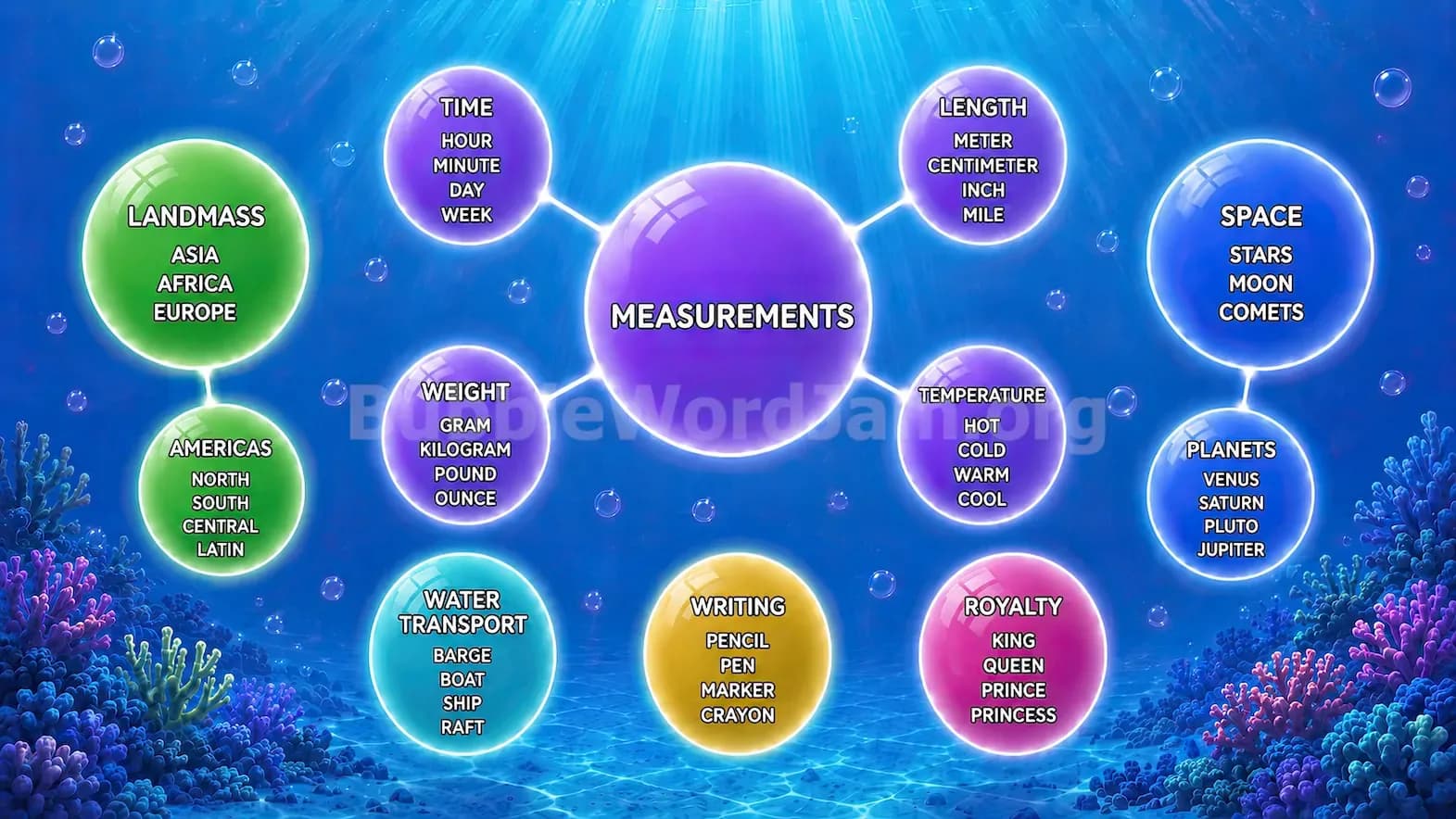
Level 7 keeps the writing idea simple with pencil, pen, marker, and crayon. I like this early example because it teaches the most basic version of the category: writing can mean instruments, not just books.
That matters later. When Bubble Word Jam shows you a word like brush or ink, don’t instantly throw it into art. In a writing puzzle, those could point toward calligraphy. When you see pencil or marker, don’t overthink it. These are tools used to make marks, draft ideas, or write by hand.
The smart move is to ask, “Is this a tool, a text, a person, or a category of text?” In Level 7, the answer is tool. That’s your clean merge.
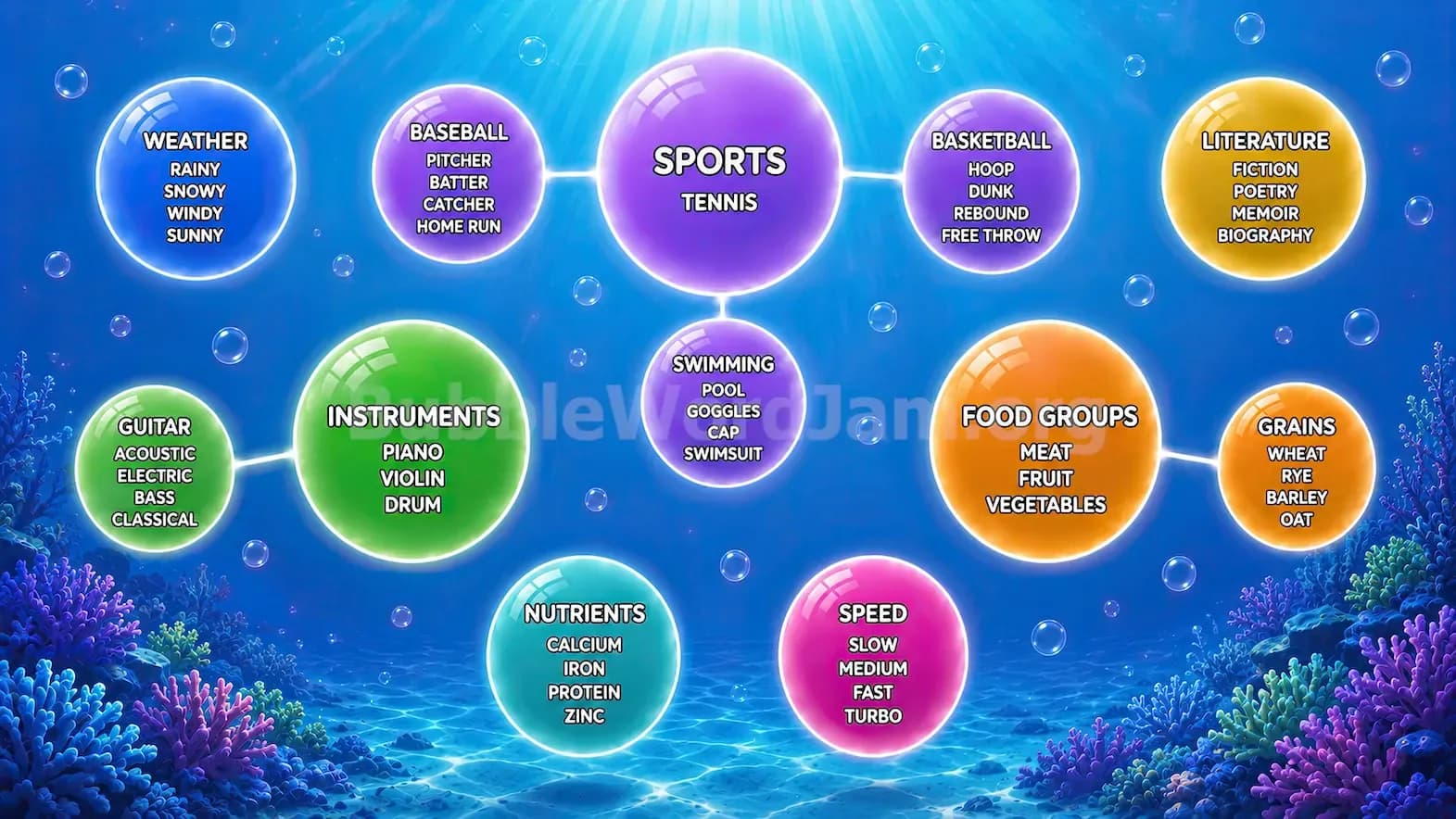
Level 11 brings in literature through fiction, poetry, memoir, and biography. This is where the category gets more interesting, because these words are not all identical.
Fiction is broad. Poetry is a literary form. Memoir and biography are nonfiction life-writing formats. But Bubble Word Jam groups them because they all live comfortably under the larger literature umbrella.
This is a good reminder: the game often rewards practical association over textbook-perfect taxonomy. You don’t need to debate whether poetry is a genre or form when the board clearly wants “things you read in literature.” That said, recognizing the subtle difference helps when a later puzzle splits literary forms from genres.
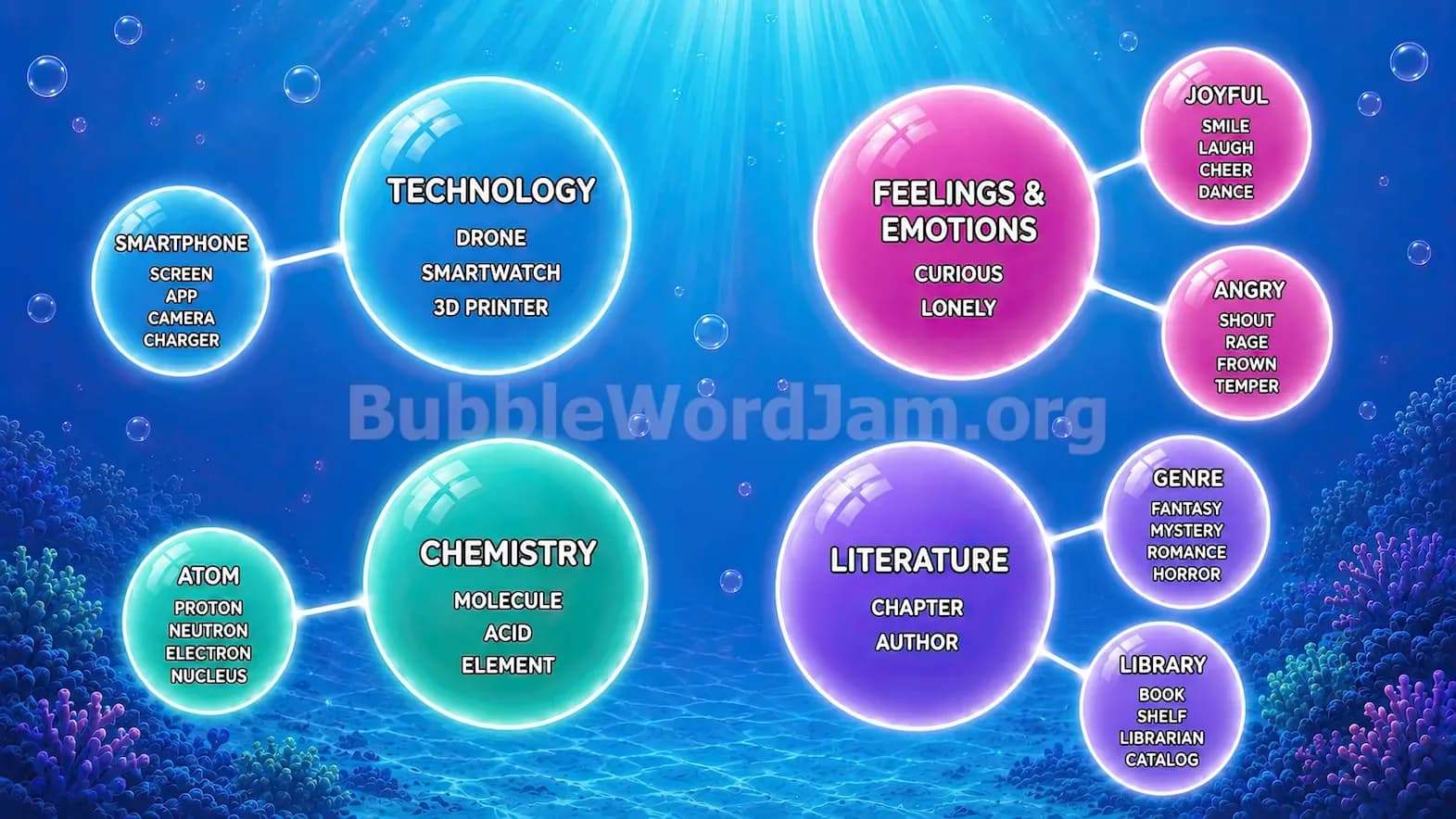
Level 35 is a banger for learning how Bubble Word Jam layers book concepts. It includes genre with fantasy, mystery, romance, and horror, then literature with chapter, author, genre, and library. It also has library with book, shelf, librarian, and catalog.
This is where players often make a messy first move. Fantasy and mystery look book-related, so it’s tempting to toss them near book or author. But fantasy, mystery, romance, and horror form a tighter group because they answer the same question: “What kind of story is it?”
Chapter, author, genre, and library work differently. They are structural or contextual literature words. A chapter is part of a book. An author creates the book. A genre classifies it. A library stores it.
Then library gets its own practical set: book, shelf, librarian, catalog. That’s a place-based category. When a puzzle gives you both “literature” and “library” vibes, sort by environment. Genre words belong together. Library objects and people belong together.
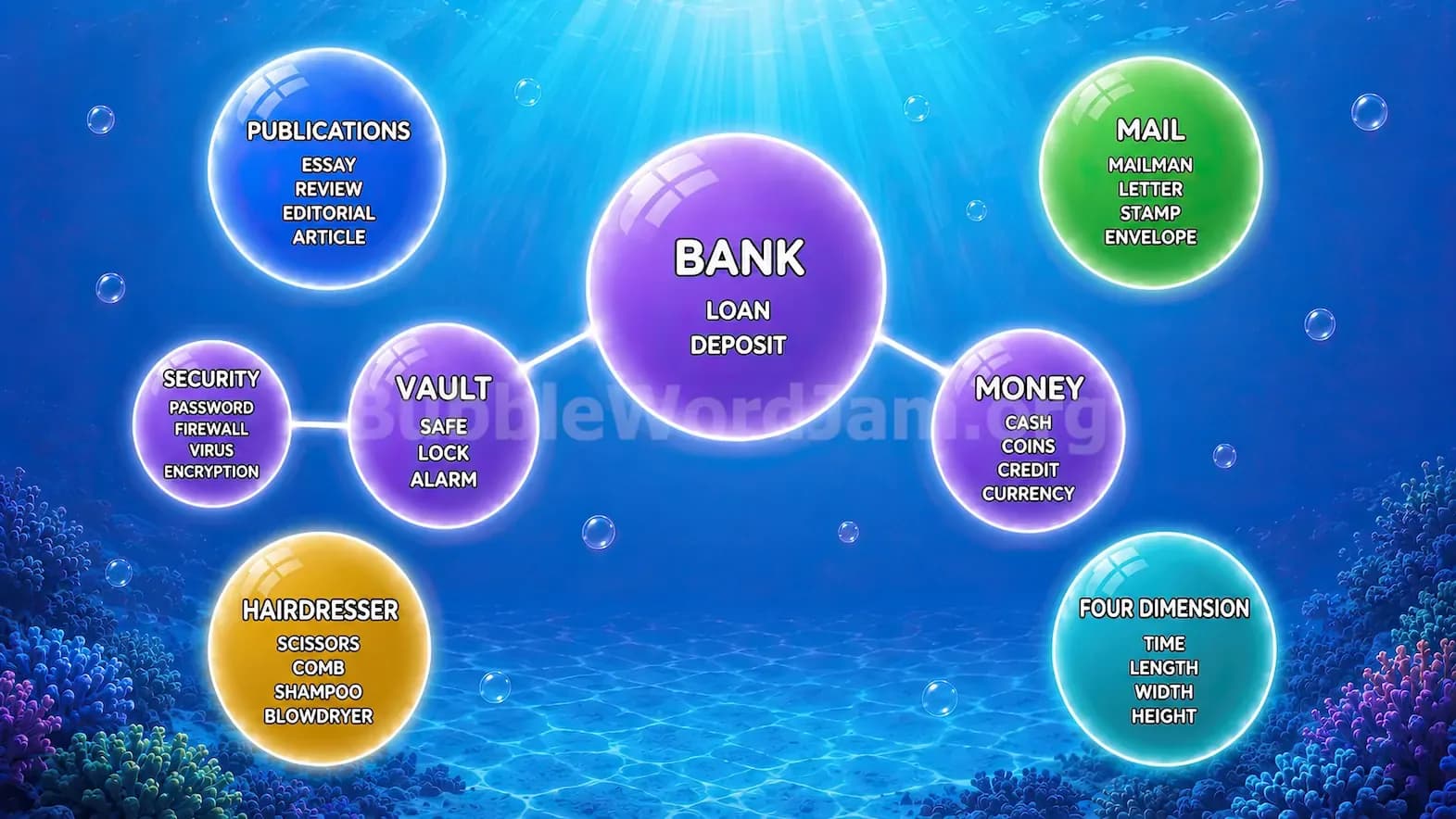
Level 44 focuses on publications: essay, review, editorial, and article. This is one of the cleanest examples of format recognition.
None of these words are genres in the fantasy-romance-horror sense. They’re types of written pieces. You might find them in a magazine, newspaper, school assignment, website, or opinion section. The category asks you to notice the publishing shape, not the subject matter.
This is also a useful warning for the word review. In gaming spaces, review can feel like an action or a verdict. In Bubble Word Jam, it often behaves as a publication type. If review appears near article, editorial, or essay, don’t get cute. Merge the format group.
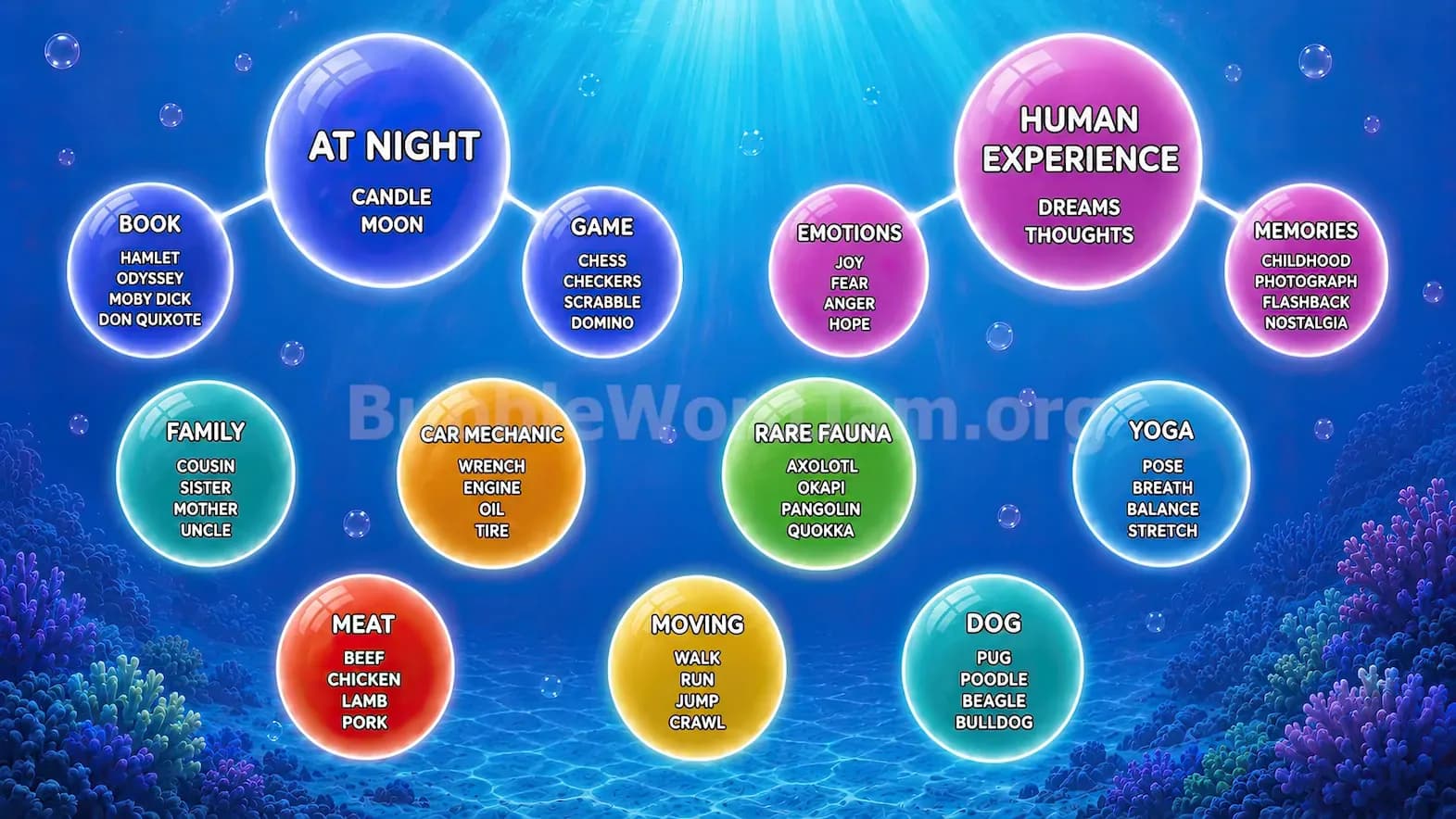
Level 60 shifts from categories of writing to actual books: Hamlet, Odyssey, Moby Dick, and Don Quixote. This one checks cultural recognition more than technical sorting.
The move here is to identify proper-title energy. These are famous literary works, not genres, roles, or book parts. Hamlet can mislead you because it’s also a character, a play, and a title. Odyssey can feel like a journey word. Don Quixote may read like a person. Bubble Word Jam loves that kind of ambiguity.
When words are capitalized in your mind, even if the bubbles don’t visually shout it, ask whether they might be titles. If several famous works appear together, that’s your match.
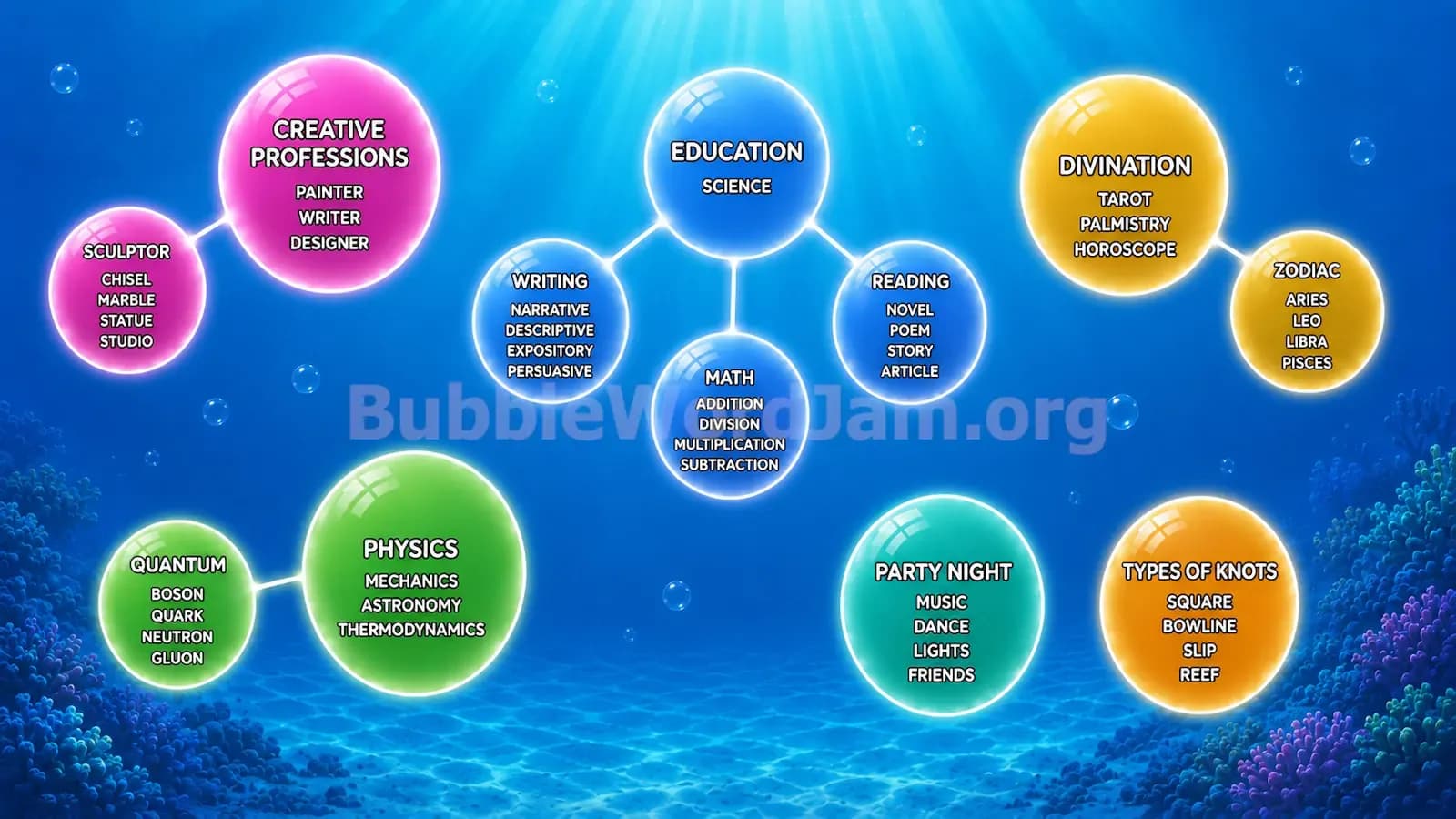
Level 110 gives you writing with narrative, descriptive, expository, and persuasive. It also gives you reading with novel, poem, story, and article. This level is a fantastic teaching moment because the two groups sit close together but solve differently.
Narrative, descriptive, expository, and persuasive are modes of writing. They describe how a piece communicates. Narrative tells. Descriptive paints. Expository explains. Persuasive argues.
Novel, poem, story, and article are things you read. They are finished forms or reading materials.
That distinction matters. If you merge “article” with persuasive too early, you may break the cleaner category. Yes, an article can be persuasive. But it is not the same type of word as persuasive. Bubble Word Jam usually wants the strongest shared identity, not the most flexible connection.
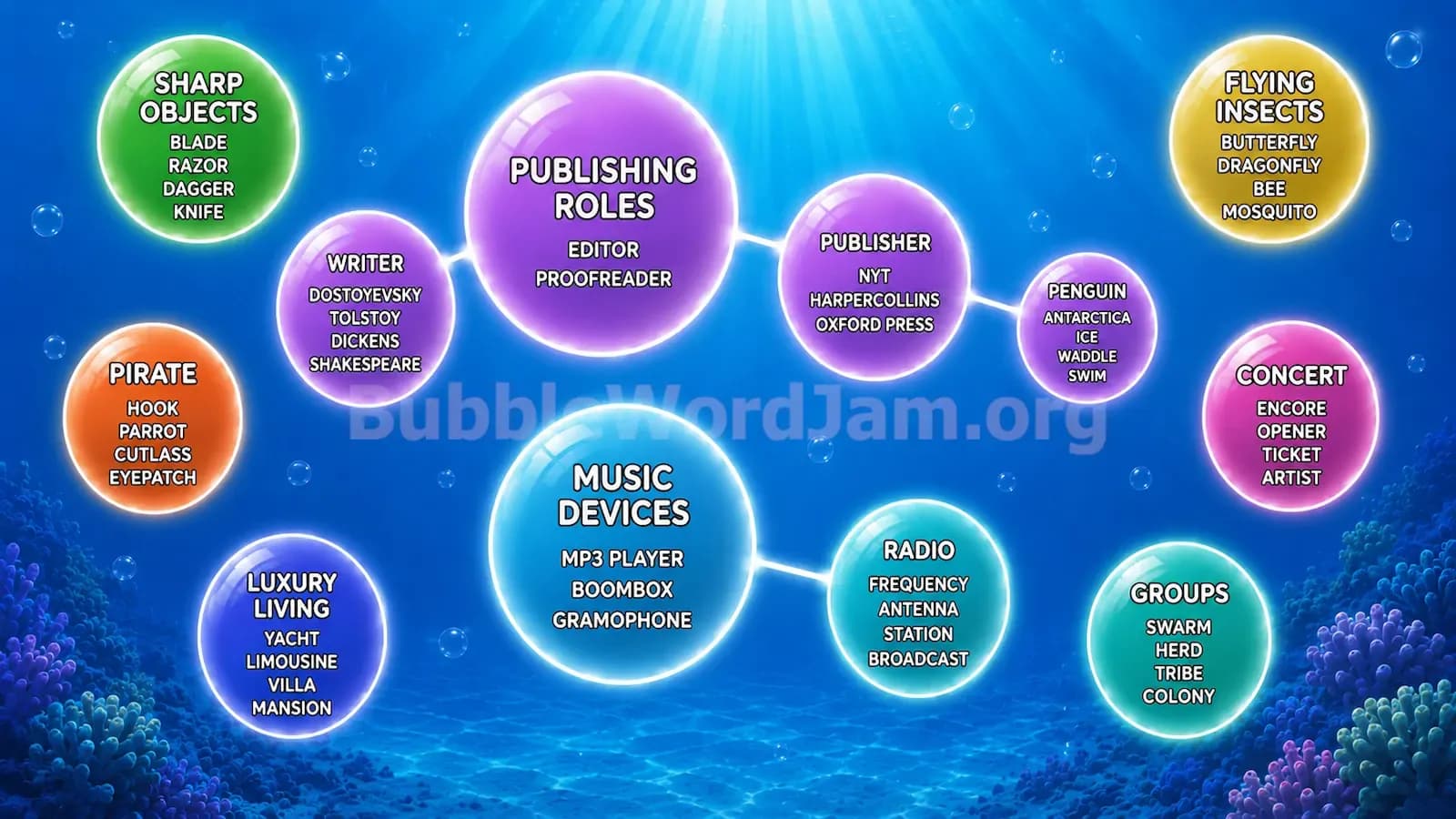
Level 124 goes full publishing-house mode with writer, editor, publisher, and proofreader. This is the “who makes the text happen?” category.
A writer creates the draft. An editor improves structure, clarity, and flow. A proofreader catches errors. A publisher gets the work into the world. That’s the production chain, and it’s a rock-solid way to identify the set.
The same level also includes writer as a category with Dostoyevsky, Tolstoy, Dickens, and Shakespeare, plus publisher with NYT, Penguin, HarperCollins, and Oxford Press. This is where the board gets spicy. Writer can be a role, but it can also point to famous writers. Publisher can be a role, but it can also point to publishing organizations.
So don’t merge by keyword alone. Merge by relationship. Writer, editor, publisher, proofreader are jobs. Dostoyevsky, Tolstoy, Dickens, Shakespeare are people. Penguin, HarperCollins, Oxford Press, and NYT are publishing names.
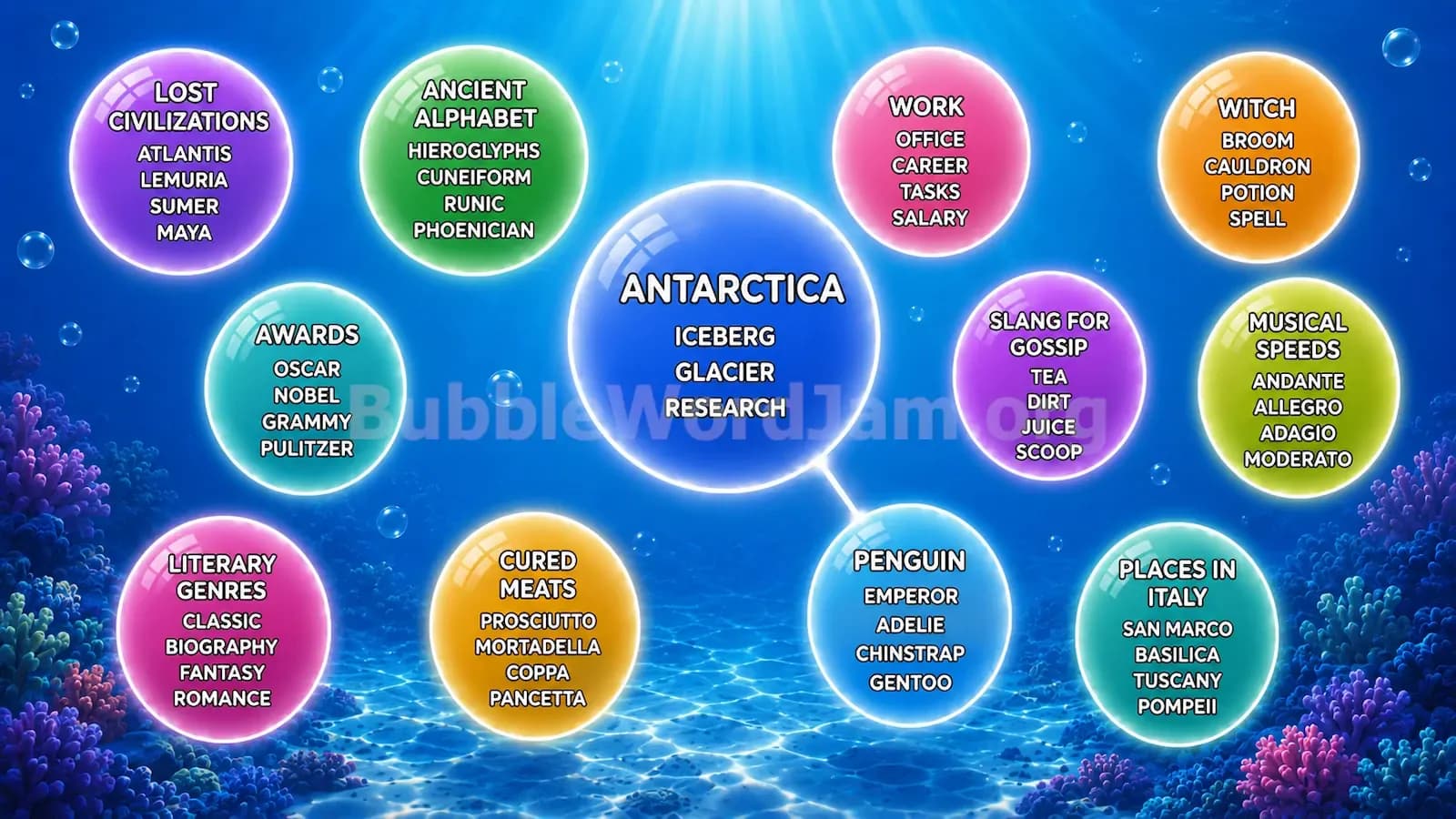
Level 183 stretches the category into older communication systems and broader literary classification. Ancient alphabet includes hieroglyphs, cuneiform, runic, and Phoenician. Literary genres includes classic, biography, fantasy, and romance.
This is a good example of Bubble Word Jam asking for general knowledge beyond modern bookshelves. Hieroglyphs and cuneiform are not “books” in the casual sense, but they belong to writing history. Runic and Phoenician point to scripts and alphabets.
The trick is to notice age and system. If the words sound ancient, carved, symbolic, or civilization-linked, they probably belong in a writing system group. If the words sound like bookstore categories, they belong in literary genres.
Level 699 is where the literature category stops being serviceable and starts demanding real vocabulary. Literary forms includes sonnet, epic, elegy, and villanelle. Sonnet includes turn, meter, sestet, and iambic.
That’s a tougher loop because one category contains a word that becomes its own category. Sonnet is a literary form, but it also has internal parts and technical terms. Turn, meter, sestet, and iambic are not just “poetry vibes.” They point specifically to how a sonnet works.
This is where I slow down. When a word can serve as both a parent and an item, don’t merge it until you’ve checked the surrounding bubbles. If sonnet appears beside epic and elegy, it may belong as a form. If iambic and sestet are nearby, sonnet may be the hub.
Level 826 gives writing systems with calligraphy, hieroglyphics, braille, and cuneiform. It also includes calligraphy with brush, ink, script, and flourish.
This level is a neat late-game test because calligraphy can look like a craft, an art style, or a writing system. The answer depends on its neighbors. With hieroglyphics, braille, and cuneiform, calligraphy belongs to the broader writing systems set. With brush, ink, script, and flourish, calligraphy becomes the center of a tool-and-style group.
That parent-child structure is classic Bubble Word Jam. One word can belong to a larger category while also generating a smaller, more specific one. When that happens, solve the tighter group first.
When I hit a books or writing board, I use a four-pass scan.
First, I look for people: writer, editor, proofreader, publisher, author, librarian, scribe. Roles usually form clean sets.
Second, I look for formats: article, essay, editorial, review, novel, poem, story, drama. These are things someone can read or publish.
Third, I look for genres and literary forms: fantasy, mystery, romance, horror, memoir, biography, sonnet, epic, elegy, villanelle. These describe the type or tradition of writing.
Fourth, I look for systems and tools: pencil, pen, marker, crayon, brush, ink, braille, cuneiform, hieroglyphics, calligraphy. These explain how writing is made or represented.
That method won’t solve every board instantly, but it gives you a stable opening. It also protects your moves from lazy associations.
Books, writing, and publishing categories in Bubble Word Jam reward players who can separate nearby ideas. Poetry and poem are connected, but they don’t always belong in the same merge. Writer and Dickens are connected, but one is a role and the other is a person. Article and persuasive are connected, but one is a format and the other is a writing mode.
That’s the whole vibe of these puzzles: close connections, sharper categories. Once you train yourself to sort by genre, format, role, tool, and writing system, the board feels much less chaotic. You stop guessing and start reading the puzzle like an editor.
And honestly? That’s when Bubble Word Jam is at its best.