Spot board game, card game, chess, casino, dice, and puzzle categories faster in Bubble Word Jam by sorting the game family before individual clues first.
Guide By Liam Stone
Updated on June 29, 2026
Liam Stone has been playing Bubble Word Jam since the mobile app first launched on the Apple App Store. He knew this game would pop, so he enjoys playing every level, collecting the answers, and running this site for other players. He loves mobile puzzle games and sometimes publishes his walkthroughs on his YouTube channel Puzzle Game Answer. Follow his channel if you are a puzzle game lover too.
Game and puzzle categories in Bubble Word Jam are absolute bangers when they click. They feel familiar, playful, and crunchy in the best word-puzzle way. But they can also be sneaky. One second you’re looking at “rook,” “pawn,” “chips,” “dealer,” “sudoku,” and “maze,” and the next second your board feels like a shambling corpse of half-solved guesses.
The trick is simple: don’t start with the individual word. Start with the game family.
That means asking, “What type of game world does this word belong to?” before asking, “What exact category is this?” In Bubble Word Jam, game-related puzzles often mix board games, card games, casino games, puzzles, chess, sports-style games, and strategy games in the same level. If you chase each clue one by one, you’ll burn moves. If you identify the family first, the whole board starts to loosen up.
Game words are dangerous because many of them overlap. “Hearts” can be a card suit, a card game, or just a symbol. “Castle” can belong to chess, medieval life, buildings, or fantasy. “Go” can be a strategy game, a verb, or part of a phrase. That overlap is exactly why these levels work. They test whether you can recognize context, not just vocabulary.
I like these puzzles because they reward a clean mental loop: spot the broad family, separate the obvious members, then handle the weird leftovers. It feels less like memorizing trivia and more like sorting a messy game shelf.
The best mindset is: “What box would I put this in?” A chess set goes in one box. Playing cards go in another. Casino terms go in another. Pencil-and-paper puzzles go somewhere else. Once you think this way, Bubble Word Jam becomes much more manageable.
Before you merge anything, scan for families:
Board games: chess, checkers, monopoly, backgammon, go Card games: bridge, hearts, rummy, war, poker Card components: spades, hearts, clubs, diamonds, cards, dealer, chips Puzzle types: sudoku, maze, jigsaw, cipher, crossword, tangram, Rubik’s cube Casino games: roulette, blackjack, slots, poker Dice games: craps, bunco, farkle, Yahtzee Strategy games: chess, checkers, backgammon, go
This is the core technique. Don’t treat “bishop” as a random word. Ask whether it belongs to religion, chess, or a title. Don’t treat “clubs” as nightlife or sports gear immediately. In a game-heavy level, “clubs” may sit right beside spades, hearts, and diamonds.
That first family pass gives you control. It turns a chaotic board into a few smaller boards.
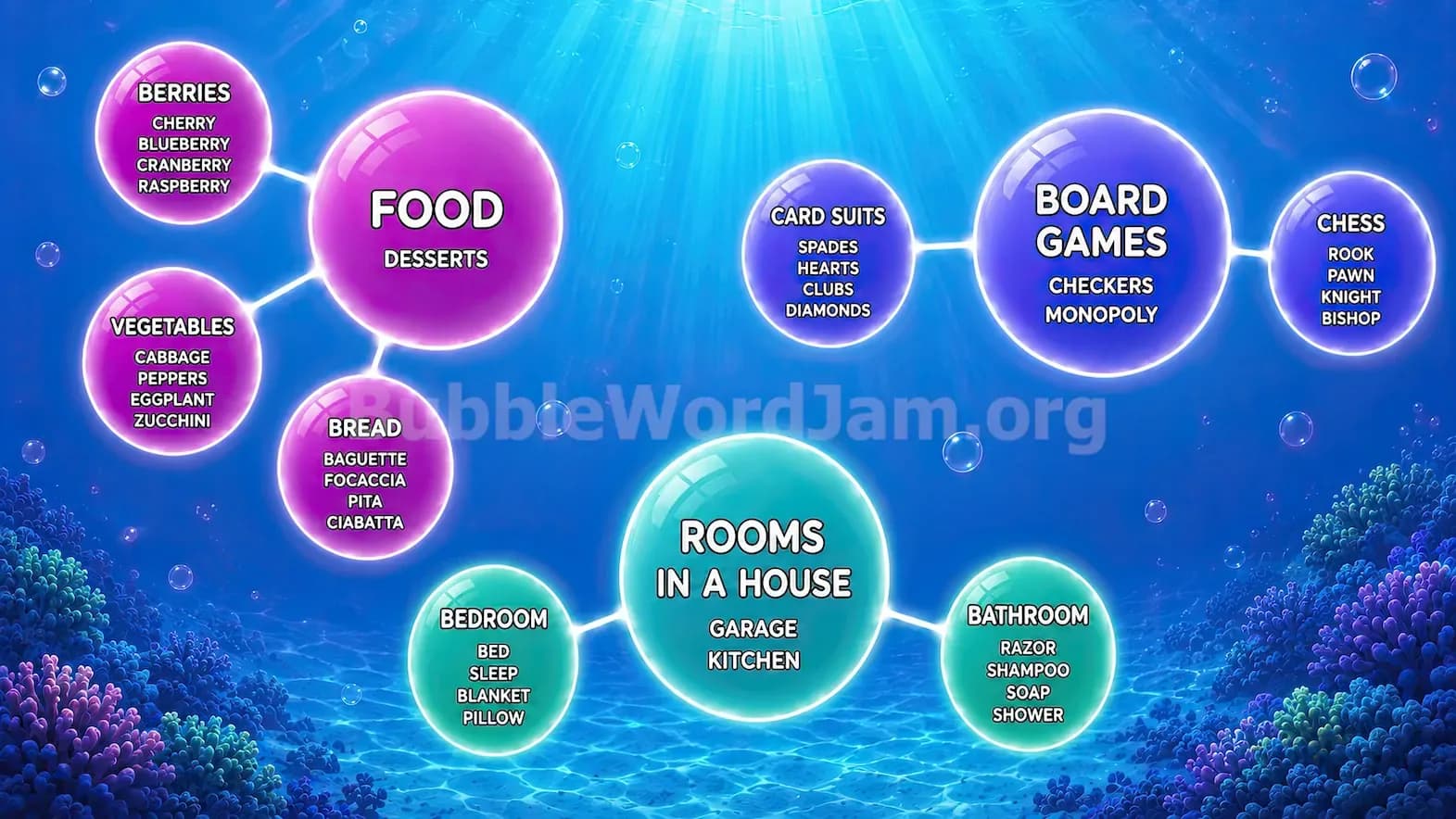
Level 14 is a great early example because it teaches the main pattern fast. You get card suits with spades, hearts, clubs, and diamonds. You also get chess with rook, pawn, knight, and bishop. Then the level zooms out into board games, where suits, chess, checkers, and monopoly sit together.
That structure matters. Bubble Word Jam isn’t only asking for single categories; it often builds a hierarchy. Card suits are a group. Chess pieces are a group. Then those groups can feed into the broader idea of board games.
This is where players often overthink. They see “suits” and try to pair it with clothing. They see “clubs” and think of nightlife. But the level’s vibe is games, not fashion. Once you spot that, the puzzle stops fighting you.
My advice: when you see both chess pieces and card symbols in the same puzzle, pause. There’s probably a bigger board-game or game-component structure waiting underneath.
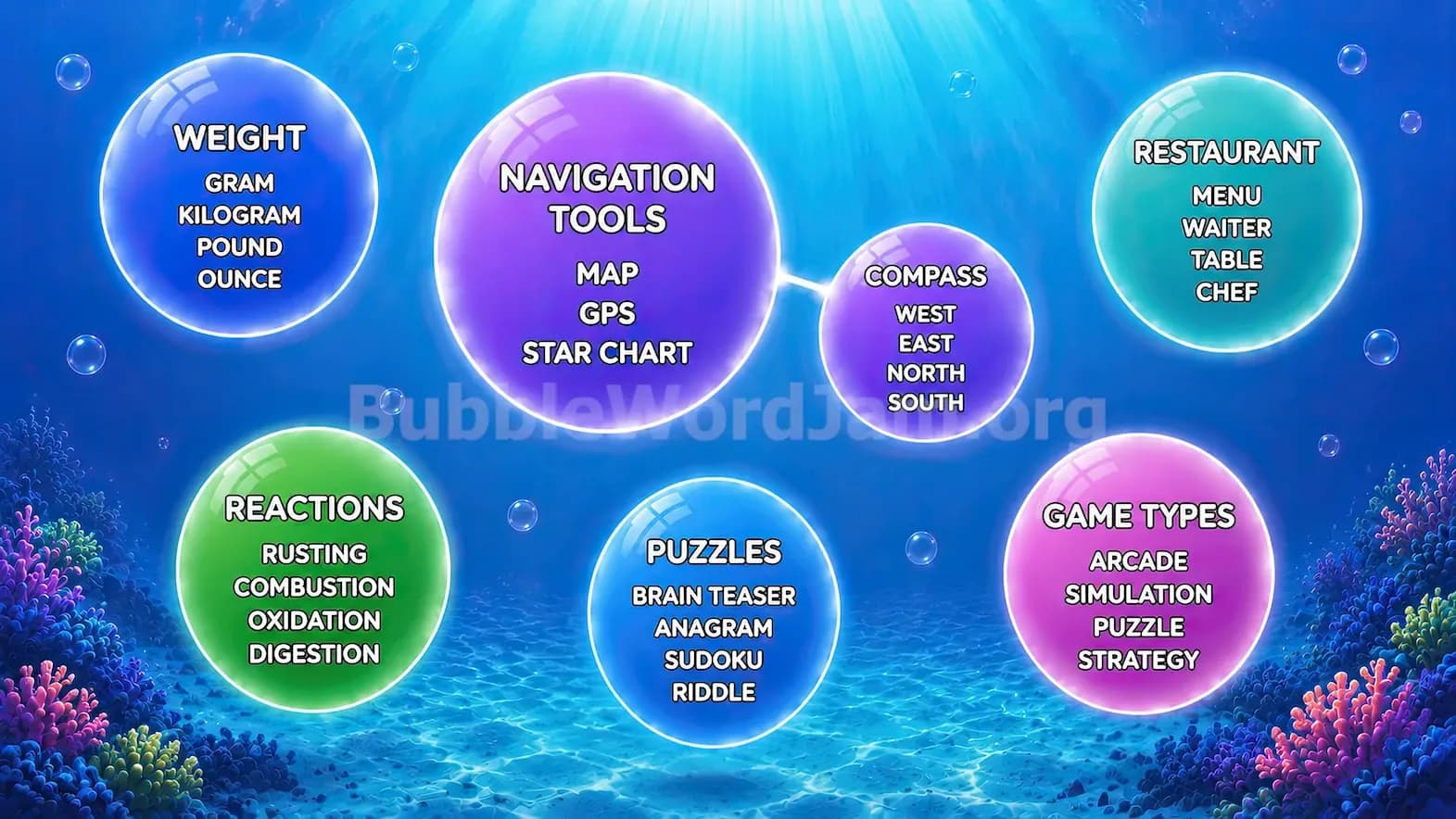
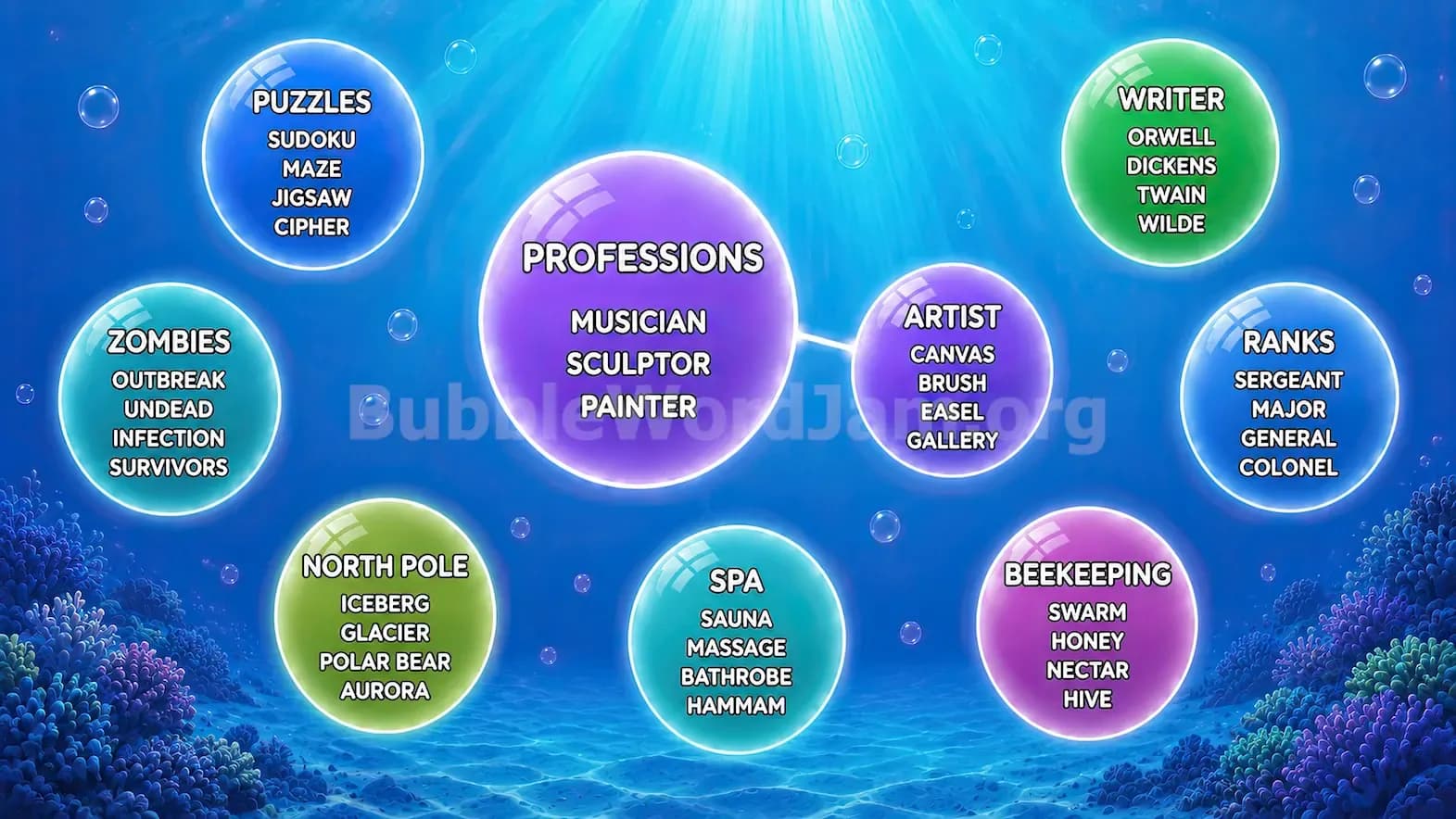
Levels 24 and 26 lean hard into puzzle identity. Level 24 groups puzzles like brain teaser, anagram, sudoku, and riddle, while also using game types such as arcade, simulation, puzzle, and strategy. Level 26 gives a more classic puzzle spread: sudoku, maze, jigsaw, and cipher.
These are serviceable words on their own, but together they become a clean category. The trap is that “puzzle” can appear as both a specific genre and a broader label. That can make the board feel floaty if you don’t decide what role the word is playing.
Here’s the move: separate “puzzle as a type of game” from “puzzle as an item or format.” Sudoku, maze, jigsaw, and cipher are puzzle formats. Arcade, simulation, puzzle, and strategy are game types. Same word, different level of the category tree.
That distinction is huge in Bubble Word Jam. The game loves making you sort between a parent category and its children.
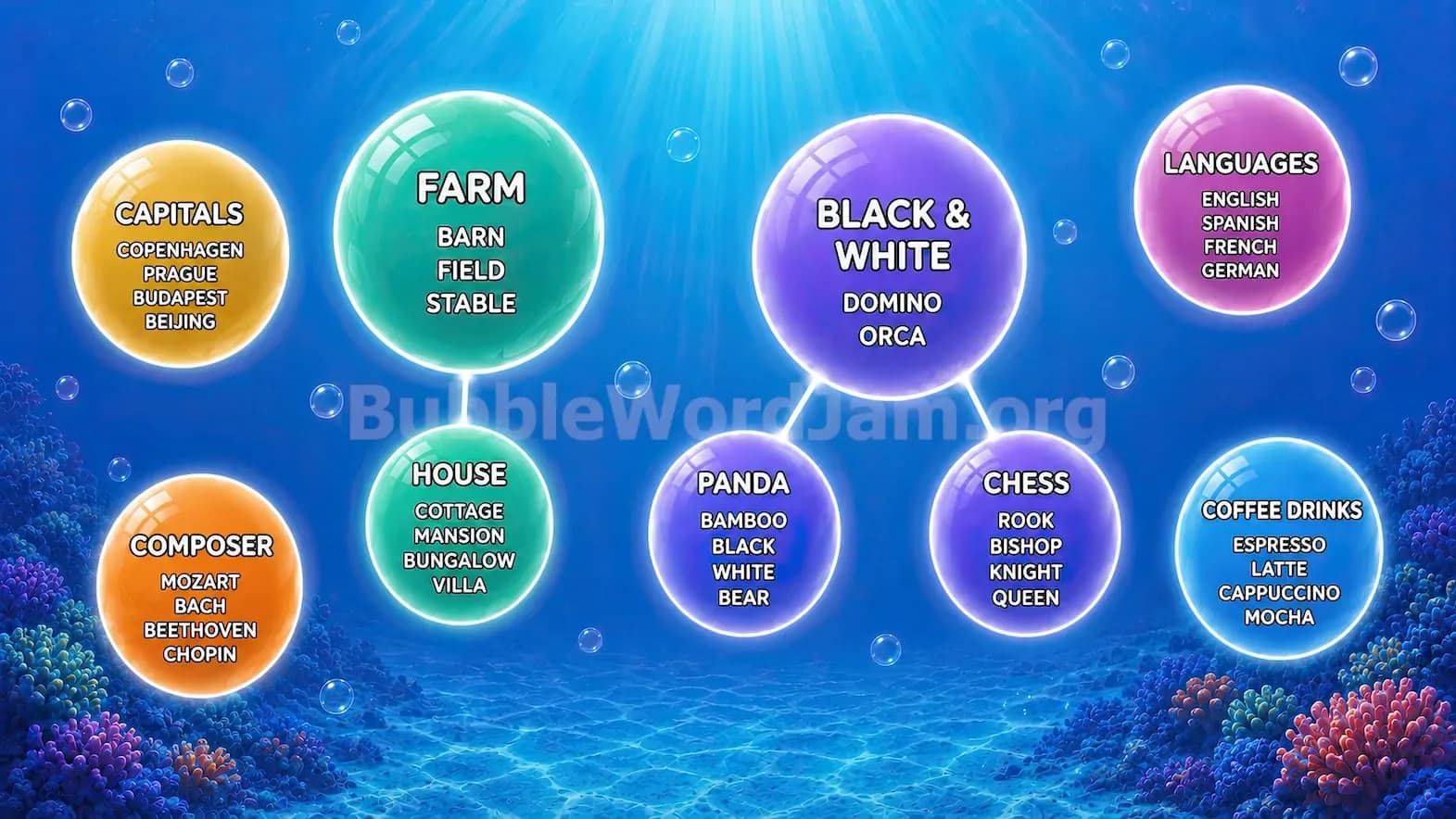
Level 31 is a sneaky one because it mixes black & white with chess. Domino, panda, orca, and chess all belong to the black-and-white visual idea. But rook, bishop, knight, and queen form the chess category.
This is the kind of level where I rolled my eyes the first time, then respected the design. It’s not unfair; it’s just asking you to notice that one word can serve as a bridge.
When “chess” appears next to chess pieces, it might be a parent clue. When it appears beside panda, orca, and domino, it might be a visual clue. The strongest play is to avoid locking a word too early. Hold flexible words until you know which family needs them most.
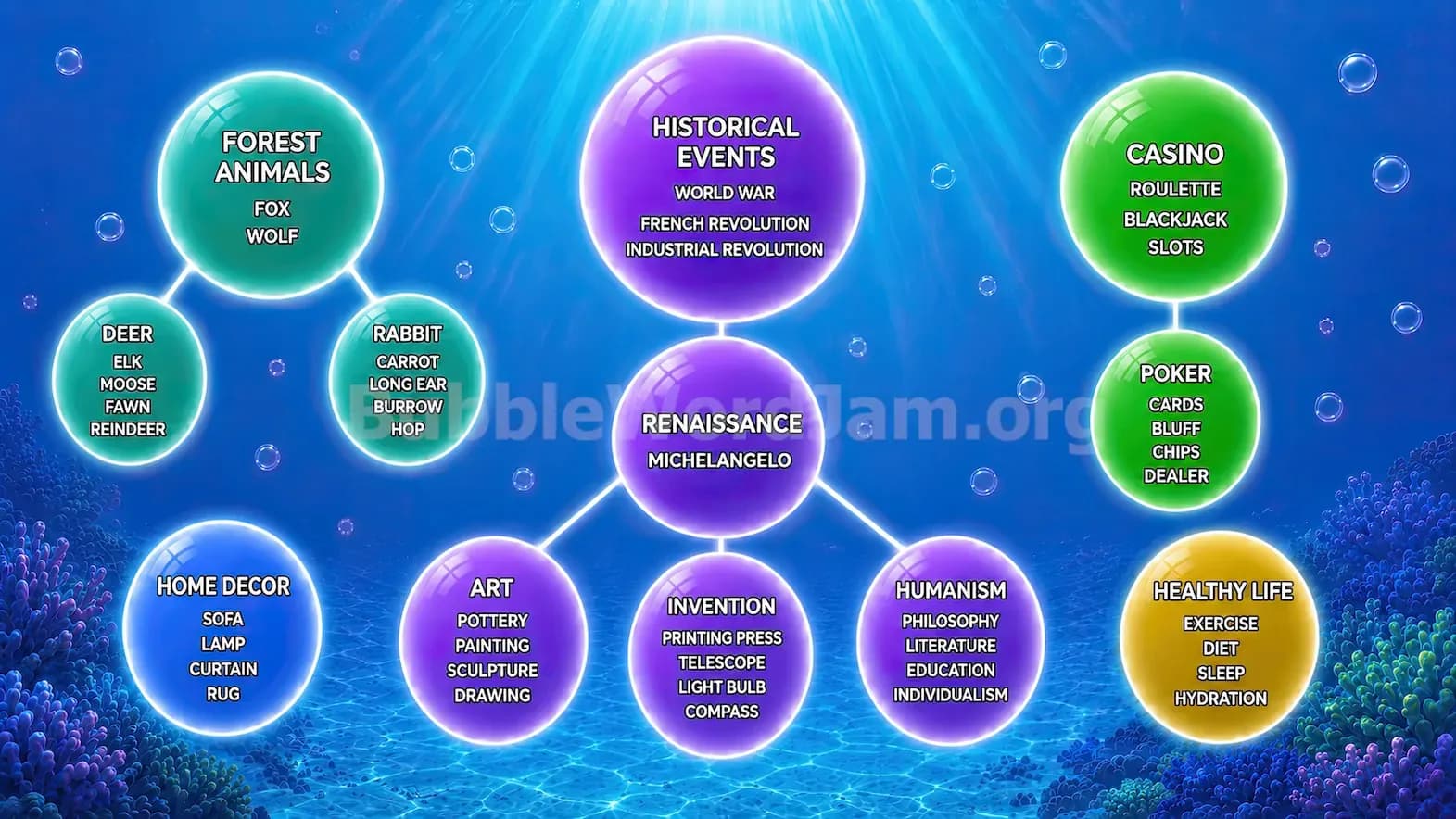
Casino and card-game levels bring a different kind of crunch. Level 75 includes casino with poker, roulette, blackjack, and slots, plus poker with cards, bluff, chips, and dealer. Level 504 adds card games with bridge, hearts, rummy, and war, then follows with poker hands like flush, full house, straight, and two pair. Level 587 combines poker, casino, and dice games, with bunco, craps, farkle, and Yahtzee forming the dice-game group.
This is where the “game family first” method really pays off. Poker can be a casino game, a card game, or its own category. “Hearts” can be a suit or a card game. “Dealer” belongs naturally to poker and casino settings. “Chips” might look like food in another level, but here it screams poker table.
To solve these faster, split terms into three piles:
Casino venue games: slots, roulette, blackjack, poker Poker table terms: chips, bluff, fold, dealer Poker hand rankings: flush, full house, straight, two pair
Once those piles are clear, the leftovers usually stop looking random.
Level 102 is a clean puzzle lesson. Crossword uses letters, cells, clues, and questions. Puzzles uses crossword, jigsaw, tangram, and Rubik’s cube.
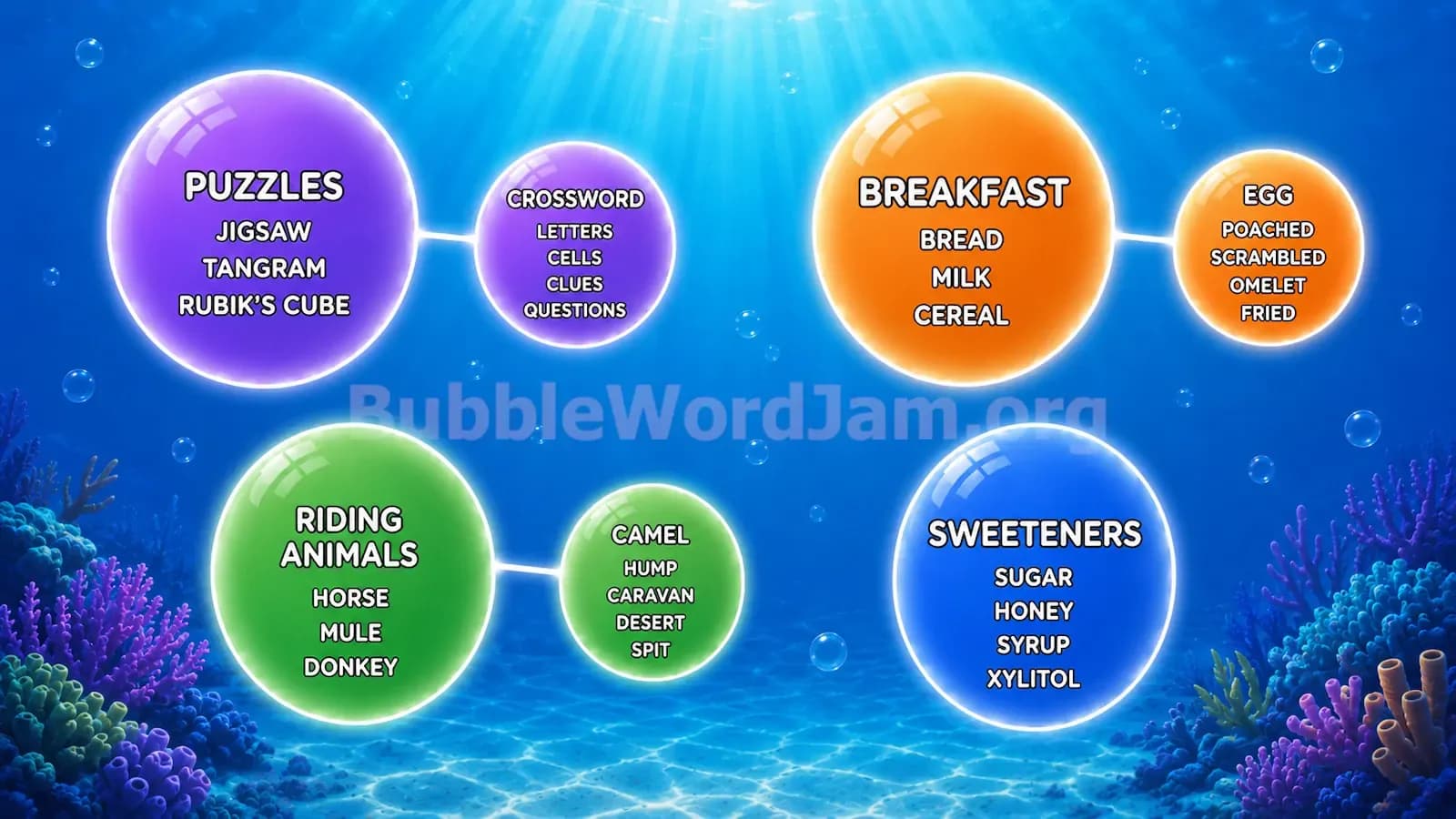
This is another parent-child setup. Crossword is both a standalone category and a member of the larger puzzle family. That can feel like a cheap trick, but it’s actually one of the most important patterns in Bubble Word Jam.
When you see a word that could name a whole category, don’t merge it too fast. Ask whether it belongs with its parts or with its peers. “Crossword” belongs with jigsaw, tangram, and Rubik’s cube when the category is puzzle types. But letters, cells, clues, and questions belong inside crossword.
Level 142 brings in chess terms: castle, mate, gambit, and draw. It also includes bowling and fencing, which can distract you because they feel like sports rather than puzzles. Level 611 goes broader with strategy games: chess, checkers, backgammon, and go, while also using chess with bishop, castle, knight, and pawn.
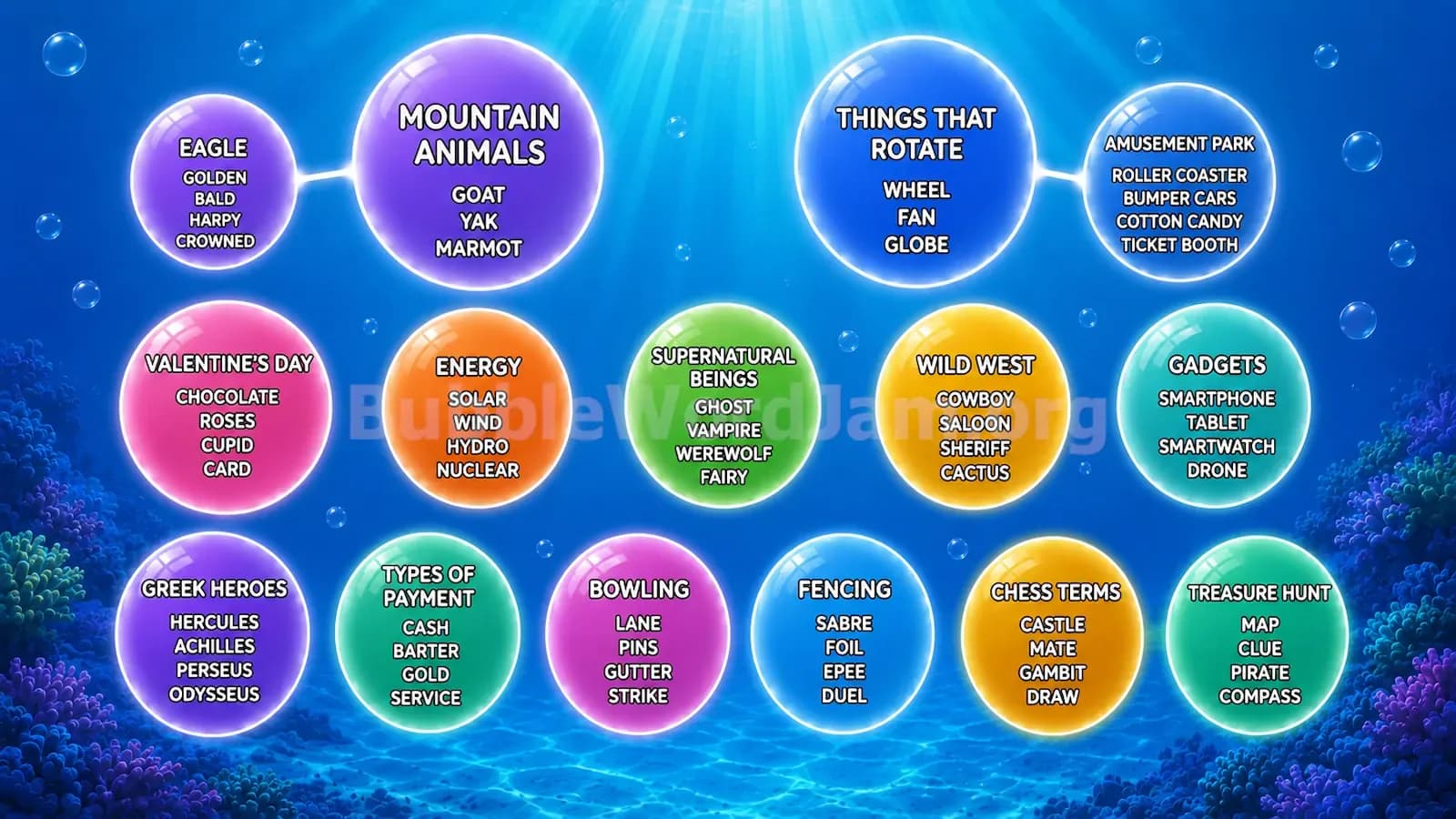
This is a great example of why individual terms can mislead you. “Castle” might look medieval. “Draw” might look like art. “Go” might look like a verb. But in a strategy-game context, they snap into place.
For these levels, I recommend solving from the most technical words first. Gambit and mate are strong chess signals. Backgammon and checkers point toward strategy games. Once you anchor those, flexible words like castle and go become much easier to place.
Because each merge matters, don’t start by testing guesses. Start by labeling families in your head. I use this order:
First, grab obvious clusters like spades, hearts, clubs, and diamonds. Next, identify named games such as chess, poker, sudoku, and backgammon. Then separate components from game titles. Finally, handle words with multiple meanings.
That loop keeps your board clean. It also helps you avoid wasting moves on tempting but mediocre pairings.
Game and puzzle categories in Bubble Word Jam work because they remix familiar words into layered category trees. Board games can contain chess. Chess can contain pieces or terms. Poker can sit inside casino, card games, or hand rankings. Puzzle can mean a genre, a specific object, or a larger family.
That’s the whole win condition: spot the family before the term.
Once you train that habit, levels like 14, 24, 26, 31, 75, 102, 142, 504, 587, and 611 stop feeling like traps. They become some of the most satisfying puzzles in the game—the kind where one good connection makes the whole board collapse in a perfect little chain.