Master art, craft, and museum categories in Bubble Word Jam with creator-tool-material-result logic, from artists and pottery to famous museums today.
Guide By Liam Stone
Updated on June 17, 2026
Liam Stone has been playing Bubble Word Jam since the mobile app first launched on the Apple App Store. He knew this game would pop, so he enjoys playing every level, collecting the answers, and running this site for other players. He loves mobile puzzle games and sometimes publishes his walkthroughs on his YouTube channel Puzzle Game Answer. Follow his channel if you are a puzzle game lover too.
Art puzzles in Bubble Word Jam have a sneaky little edge. At first, they look easy because the words feel familiar: brush, canvas, painting, sculpture, gallery. No weird science terms. No obscure geography. Just art-class vocabulary, right?
Then the game starts mixing artists, tools, materials, results, craft techniques, museums, and broad culture categories into the same board. That’s where the vibe changes. Suddenly, “sculpture” might be an art form, a craft result, or part of a Renaissance clue chain. “Gallery” might belong with artist tools, visual arts, or museums. “Canvas” feels obvious until the board also throws in “painting,” “artists,” and “Louvre.”
That’s the crunchy part of Bubble Word Jam: it’s not asking whether you know the word. It’s asking whether you know its role.
The cleanest technique for art and craft categories is what I call the “creator/tool/material/result” test. When a word appears, ask: who makes it, what do they use, what is it made from, and what is the finished thing? That simple loop can save a ton of moves.
Most visual art and craft puzzles follow a chain:
Creator → Tool → Material → Result → Place
For example:
Artist → brush → canvas → painting → gallery
That chain is the whole game plan. When I see “brush” and “canvas,” I don’t instantly merge them with every art-looking word on the board. I first check whether the category wants the maker, the tools, the medium, the object, or the location.
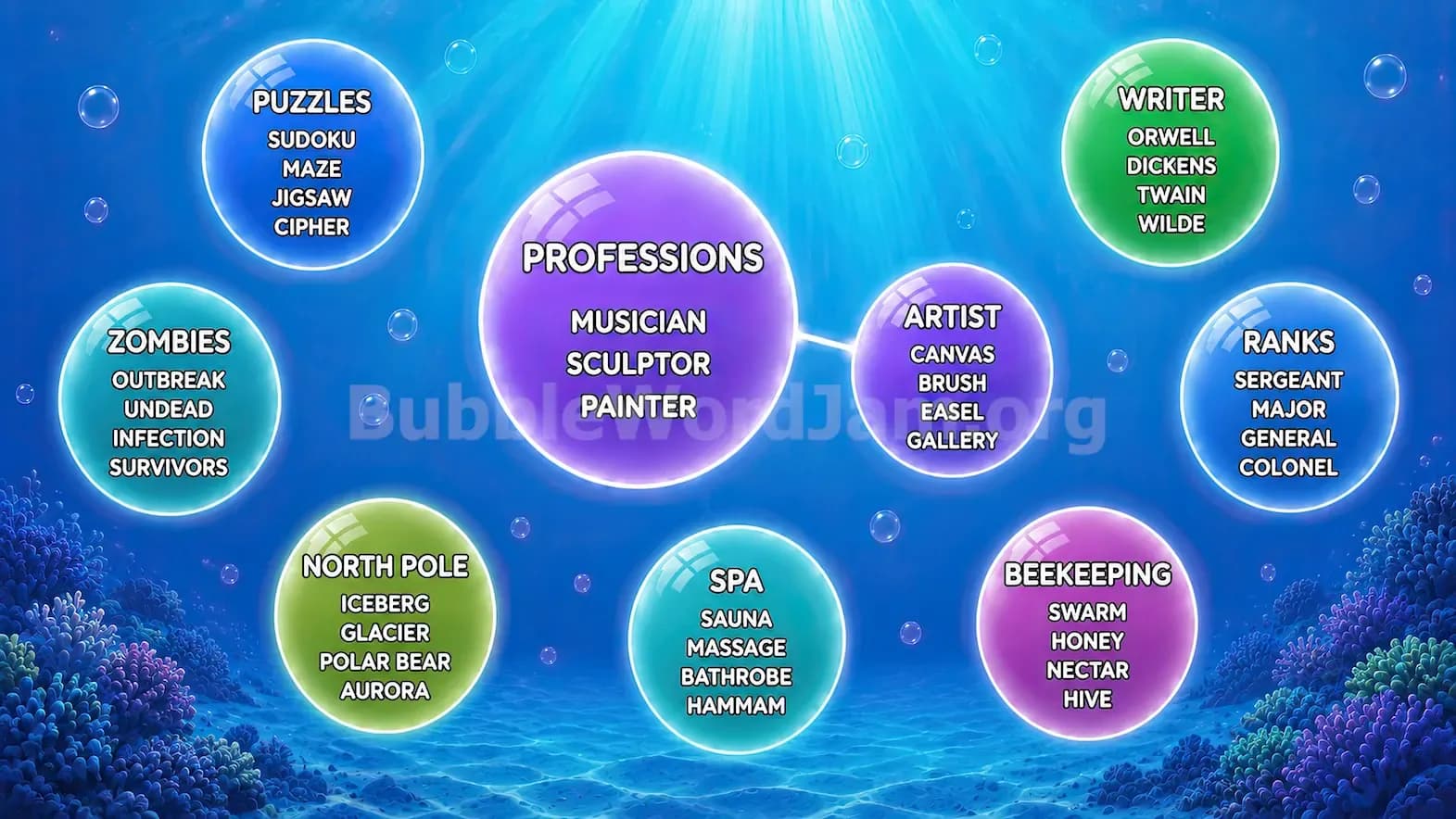
In Bubble Word Jam Level 26, the artist category uses canvas, brush, easel, and gallery. That’s a beautiful starter set because it teaches the studio ecosystem. These are not finished artworks. They are the things around an artist. But the same level also includes professions: musician, sculptor, painter, artist. See the trap? “Artist” can be a profession, while “canvas” and “brush” belong to the working environment of an artist.
That’s why role recognition matters. If you treat every creative word as one pile, you’ll burn moves and tank the board. If you sort by function, the puzzle opens up.
Level 26 is one of the best early examples for art logic because it separates the creator from the creator’s world.
The artist group includes canvas, brush, easel, and gallery. These are linked by the act of visual creation and display. Meanwhile, professions includes musician, sculptor, painter, and artist. That second group focuses on job titles or creative identities.
The trick is to avoid emotional grouping. “Painter” and “brush” feel connected, but Bubble Word Jam usually wants category precision. Painter is a person. Brush is a tool. Canvas is a surface. Gallery is a place. Easel is equipment.
When you hit a board like this, use this order:
Words like artist, painter, sculptor, musician, architect, designer, and photographer usually point toward a profession or creator category.
Brush, easel, chisel, needle, saw, wheel, and mandrel usually belong to a tool-based or craft-process category.
Painting, sculpture, statue, carving, drawing, collage, and pottery usually describe results.
This may sound basic, but in Bubble Word Jam it’s a banger habit. It stops you from making those “it looked right” mistakes that feel awful two merges later.
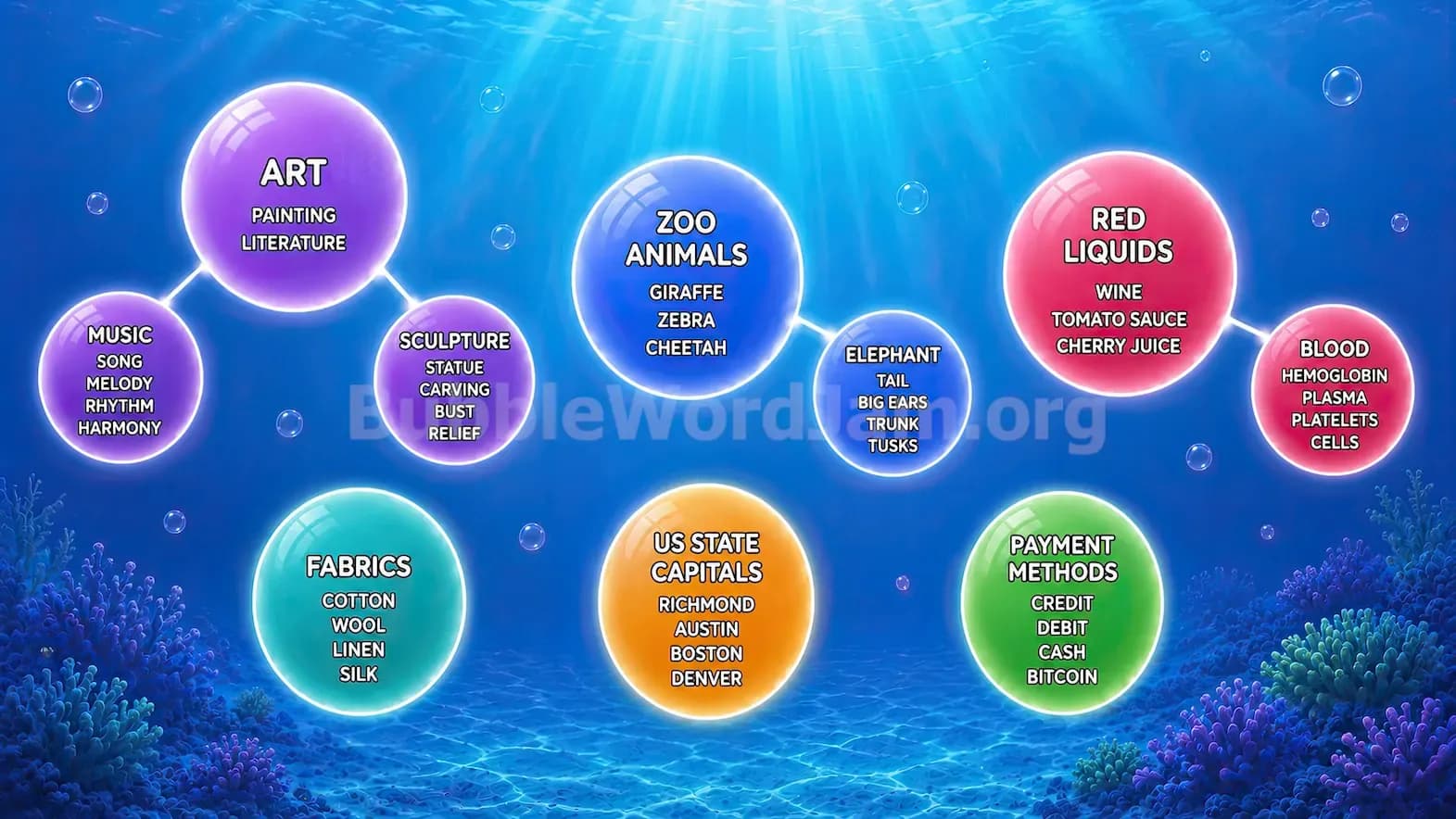
Level 28 gets more interesting because it separates broad art from a specific art form.
The art category includes music, sculpture, painting, and literature. That’s a high-level category. It’s asking for branches of art, not tools or famous artists.
The sculpture category includes statue, carving, bust, and relief. That’s much narrower. These are types or results of sculptural work.
This is one of the most important art-puzzle lessons in Bubble Word Jam: broad categories often contain words that can become categories later. “Sculpture” belongs under art as a form. But statue, bust, carving, and relief belong under sculpture as examples.
Think of it like a category tree:
Art → Sculpture → Statue / Bust / Relief / Carving
When the game gives you both a root category and a branch category, don’t panic. Build the deepest, most specific group first. If statue, bust, relief, and carving are all available, lock sculpture. Then use sculpture itself as a member of the broader art group if the board asks for it.
That’s the difference between clean play and a shambling corpse of random merges.
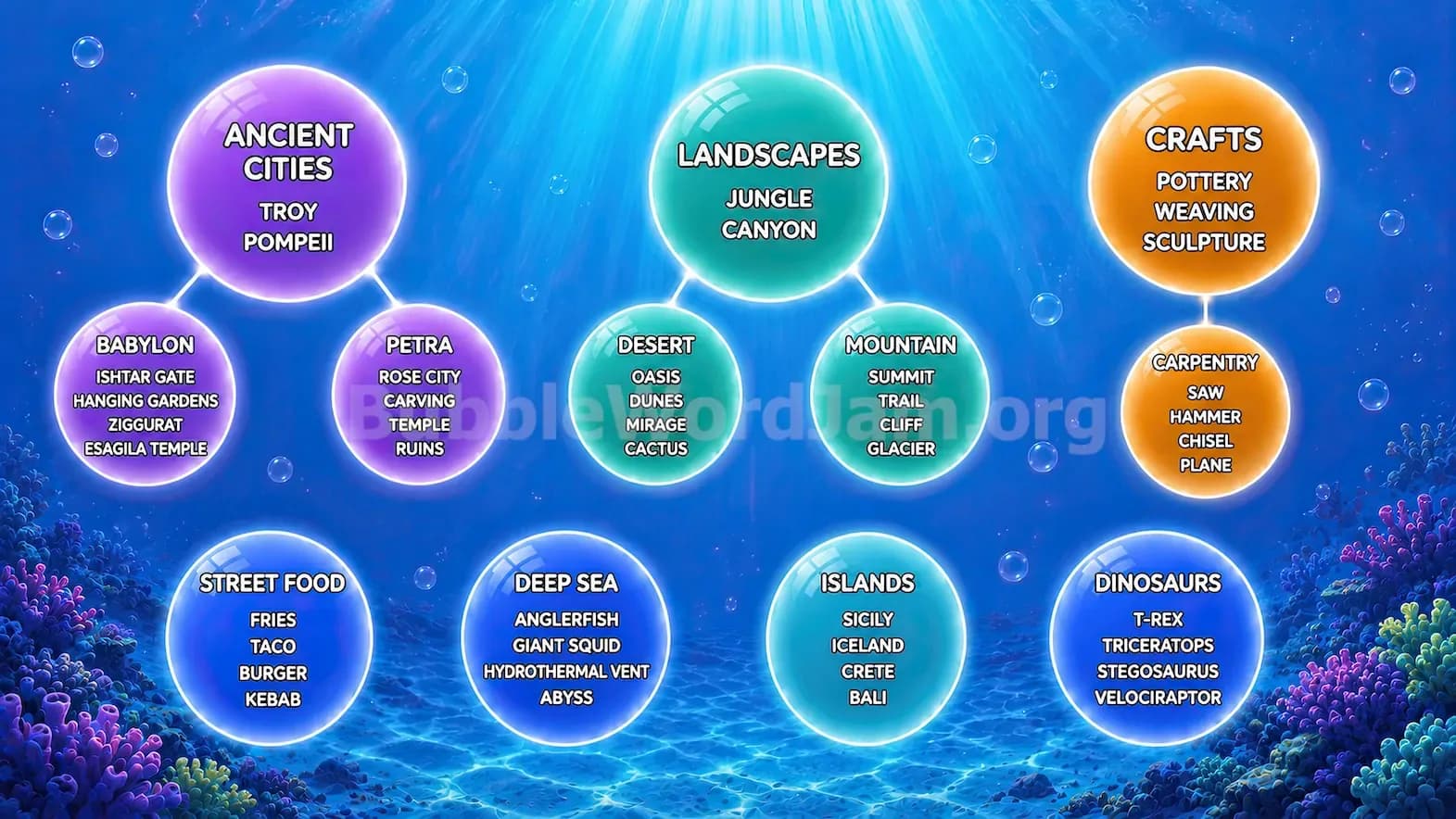
Level 45 is where the art-and-craft theme gets hands-on. The crafts category includes carpentry, pottery, weaving, and sculpture. That’s a family of making practices. Then carpentry breaks down into saw, hammer, chisel, and plane.
This is the same hierarchy again, but with a workshop vibe:
Crafts → Carpentry → Saw / Hammer / Chisel / Plane
Here, the word “sculpture” can sit beside pottery and weaving because the category is not “fine art.” It’s “crafts,” meaning made objects and maker traditions. That shift matters.
The move-saving trick is to spot tool density. If you see several tool words clustered together, don’t merge them with the broad craft category too early. Saw, hammer, chisel, and plane are too specific to be random. They almost always want a tool category or a craft process.
This is also where materials start to matter. Wood points toward carpentry. Clay points toward pottery. Paper points toward origami. Yarn points toward knitting. Metal can point toward jewelry making. Bubble Word Jam loves these material breadcrumbs.
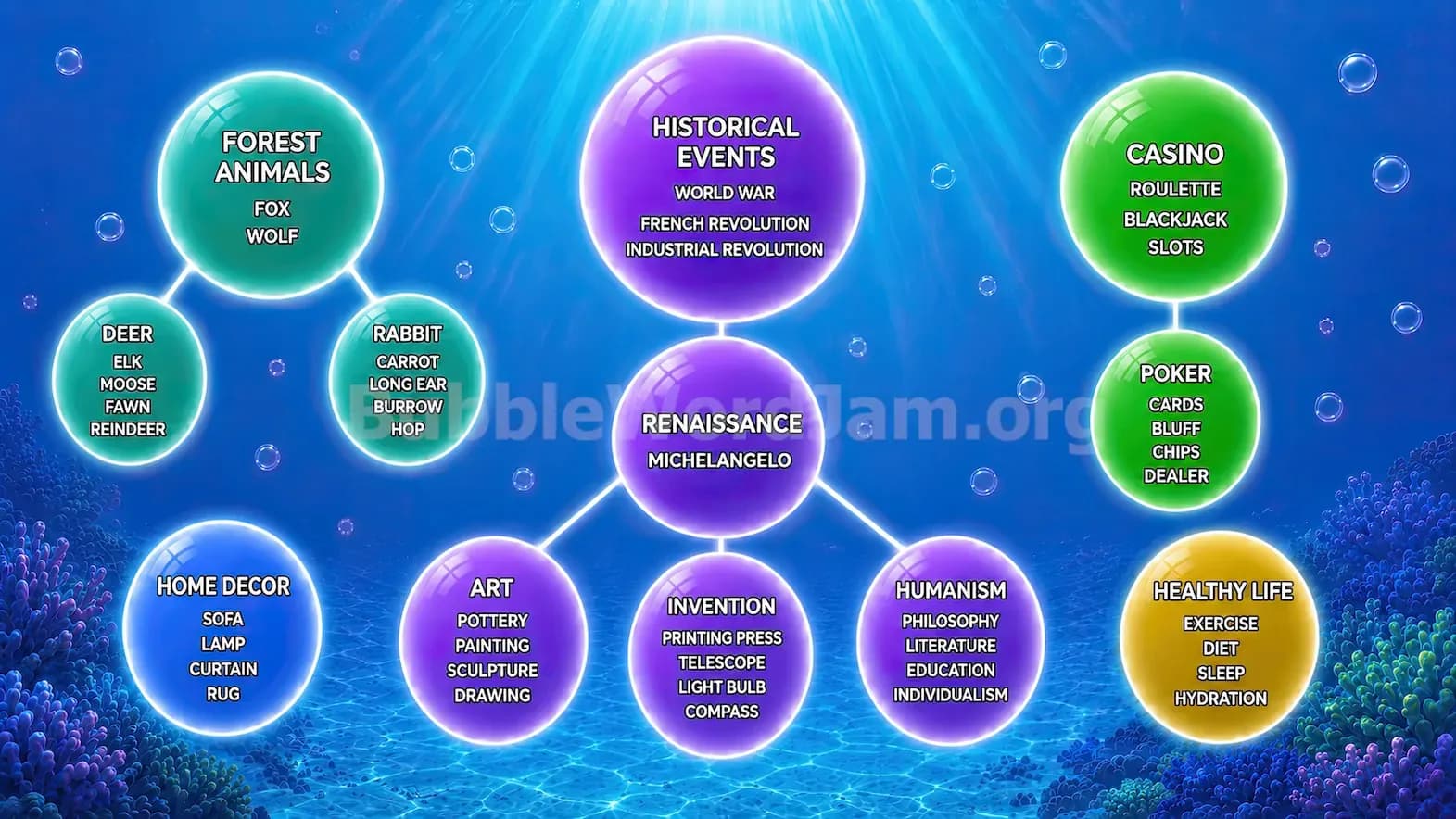
Level 75 brings in a more historical angle. The art category includes pottery, painting, sculpture, and drawing, while the Renaissance category connects art, Michelangelo, invention, and humanism.
This one has a cool loop because “art” is not just an answer category; it becomes part of a larger historical movement. If you only think in object groups, Level 75 can feel floaty. But if you think in cultural systems, it snaps into place.
Renaissance is not a tool or material category. It’s a period and movement. So the connected words are big concepts: art, Michelangelo, invention, humanism.
When you see a famous name like Michelangelo, don’t immediately chase “artists.” Look for the historical frame. Is the board asking for painters? Sculptors? Renaissance? Museums? Famous works? A proper noun can be a huge clue, but it needs the right container.
My rule: if a name appears with concepts like invention, humanism, education, philosophy, or literature, expect a movement or era category. If the name appears with other names like Picasso, Rembrandt, Vermeer, and Rubens, expect an artists category.
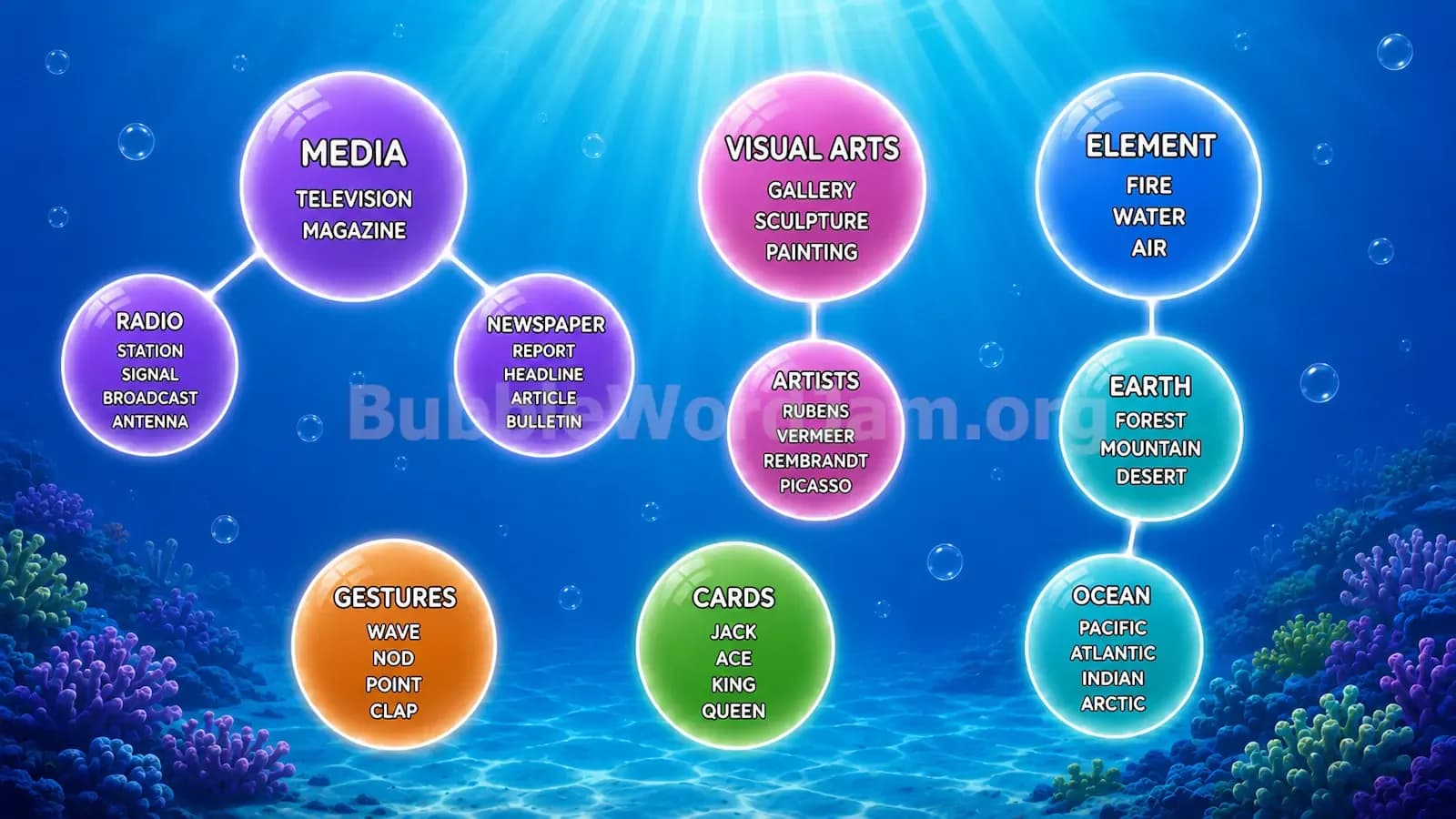
Level 201 is a rock-solid training level for museum-minded players. Visual arts includes gallery, artists, sculpture, and painting. Artists includes Rubens, Vermeer, Rembrandt, and Picasso.
Again, Bubble Word Jam separates the field from the people inside it. Visual arts is the broad ecosystem. Artists is the name-list category.
This is where capitalization would help in another game, but Bubble Word Jam often pushes you to read meaning rather than rely on presentation. Rubens, Vermeer, Rembrandt, and Picasso are unmistakably names once you slow down. Group them before touching broader words like gallery or painting.
The tactical lesson: famous names usually form a set faster than abstract nouns do. If you recognize even two artist names, scan for the remaining two. A name-based category is often less ambiguous than a concept category, so it gives you a clean early win.
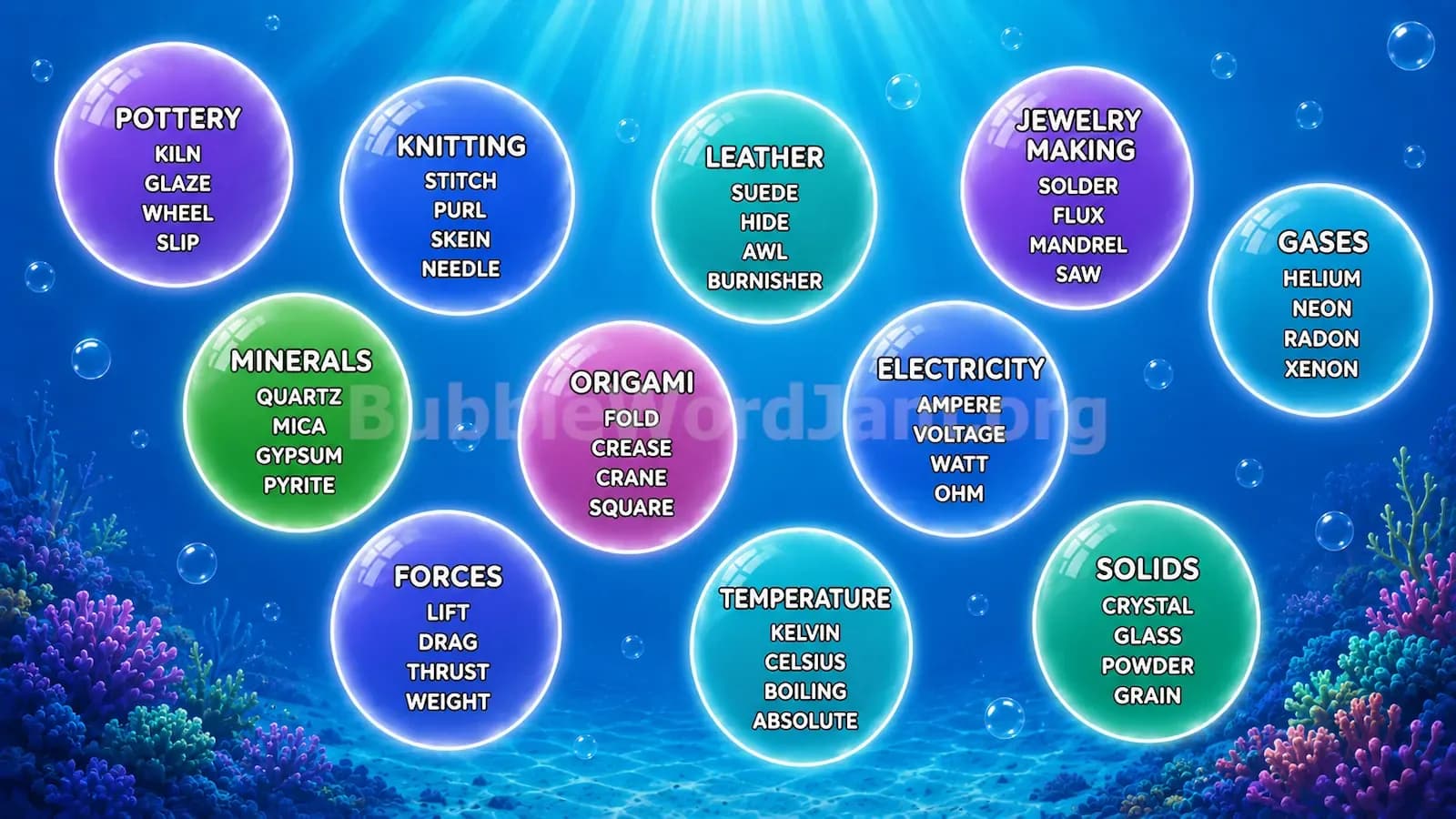
Level 265 is a craft lover’s dream and a move-management test. It includes pottery, knitting, leather, jewelry making, and origami. This is where the creator/tool/material/result method really earns its keep.
Pottery includes kiln, glaze, wheel, and slip. These words revolve around ceramic process and equipment.
Knitting includes stitch, purl, skein, and needle. That’s technique plus material plus tool.
Origami includes fold, crease, crane, and square. That’s action plus shape plus finished model.
Jewelry making includes solder, flux, mandrel, and saw. That’s a specialist bench setup.
The danger is that several words sound generally “crafty.” Needle could feel like sewing. Saw could feel like carpentry. Wheel could feel like vehicles. Crane could be a bird, machine, or origami model. Bubble Word Jam loves this kind of ambiguity.
So don’t ask, “Is this word crafty?” Ask, “What craft process does this word serve?”
Needle plus purl plus skein? Knitting. Kiln plus glaze plus slip? Pottery. Fold plus crease plus crane? Origami. Solder plus flux plus mandrel? Jewelry making.
That’s the loop. Once you find the process, the rest becomes serviceable and clean.
Level 663 turns up the specificity. Origami includes crane, dragon, lotus, and swan. Paper crafts includes origami, scrapbook, collage, and decoupage. Pottery tools includes banding wheel, wire tool, needle tool, and wedge.
This is one of those Bubble Word Jam boards where the same concept can exist at two levels. Origami is a category with its own finished models. But origami is also a member of paper crafts. That means you should solve origami’s children first, then treat origami as a parent-level word elsewhere.
Pottery tools is also more specific than general pottery. Banding wheel, wire tool, needle tool, and wedge are not finished ceramics. They are workshop items. If you’ve trained yourself to separate tool from result, this group becomes much easier.
The paper crafts group also teaches a nice category texture: origami, scrapbook, collage, and decoupage are techniques or craft forms, not individual supplies. So if you see “paper,” “glue,” “scissors,” and “cardstock,” that would be a material/tool cluster. But scrapbook, collage, and decoupage point to craft types.
Level 845 is the museum payoff. Famous museums includes Gala Dali Castle, Hermitage, Louvre, and Met. That’s not about making art anymore. It’s about where art lives, gets preserved, and becomes part of cultural memory.
The level also includes “can be 3D” with animation, art, games, and glasses, plus kaleidoscope with fragments, mirrors, patterns, and symmetry. These aren’t traditional art-history groups, but they live in the same visual-thinking neighborhood.
This is a good reminder that Bubble Word Jam art categories aren’t always “painting and sculpture.” Sometimes the game tests visual culture: museums, 3D media, optical objects, patterns, and symmetry.
For museum categories, proper nouns are your best friends. Louvre, Hermitage, and Met are strong anchors. Once you identify two famous institutions, don’t drag in “gallery” or “art” unless the set clearly needs generic words. Museum groups usually prefer named places.
When an art-heavy Bubble Word Jam board starts to feel messy, use this order:
Artist names and museum names are often the least ambiguous. Picasso, Rembrandt, Louvre, and Hermitage usually give you a clean category foundation.
Brush, chisel, needle, mandrel, kiln, and saw are tools or equipment. Painting, statue, bust, collage, and pottery are results or forms.
Art can contain sculpture. Paper crafts can contain origami. Renaissance can contain art. Solve the child group first, then use the parent word later.
Canvas, clay, yarn, leather, paper, metal, and glaze all point toward specific creative processes.
This is the big one. Bubble Word Jam punishes “close enough” thinking. The game wants the exact category relationship, not just a shared artsy mood.
The best way to beat visual art, crafts, and museum puzzles in Bubble Word Jam is to think like a curator organizing a collection. Don’t just ask whether words feel creative. Ask what role each word plays.
Is it the maker? The tool? The material? The technique? The finished work? The museum?
That creator/tool/material/result framework turns messy boards into readable category trees. It helps with early artist puzzles like Level 26, broad art-form puzzles like Level 28, craft-heavy boards like Levels 45 and 265, layered paper craft puzzles like Level 663, and museum-focused challenges like Level 845.
And honestly, that’s why these categories are fun. They don’t just test vocabulary. They test structure. Once you see the hierarchy behind the bubbles, the whole board stops feeling like a rehash of random art words and starts feeling like a smart little gallery tour with a timer attached.