Learn how to solve Bubble Word Jam ancient history levels using time-period anchors for Egypt, Rome, Babylon, Renaissance, and empires.

Guide By Liam Stone
Updated on June 12, 2026
Liam Stone has been playing Bubble Word Jam since the mobile app first launched on the Apple App Store. He knew this game would pop, so he enjoys playing every level, collecting the answers, and running this site for other players. He loves mobile puzzle games and sometimes publishes his walkthroughs on his YouTube channel Puzzle Game Answer. Follow his channel if you are a puzzle game lover too.
Some Bubble Word Jam puzzles feel breezy. You see “apple,” “banana,” “grape,” and “plum,” and your brain basically auto-merges the category before your finger finishes moving. Then the game throws in pharaohs, ziggurats, Roman numerals, Renaissance inventions, medieval knights, and historical empires, and suddenly the vibe changes.
That’s where I think Bubble Word Jam becomes properly interesting.
Ancient history and civilization levels aren’t just vocabulary checks. They’re knowledge checks with a crunchy little twist: you need to know what belongs to Egypt, what belongs to Rome, what belongs to a broader landmark group, and what belongs to a time period like medieval, Renaissance, or industrial. The trap is that these words often feel related without belonging to the same category. “Pyramid,” “Colosseum,” “Petra,” and “Great Wall” all scream “old world,” but they may not always merge under the same logic.
The best technique is simple: use time-period anchors. Before you start merging bubbles, ask yourself: is this ancient, medieval, Renaissance, industrial, or empire-based?
When a Bubble Word Jam level leans into history, I stop looking for isolated word meanings and start building a loose timeline. It doesn’t have to be a perfect textbook timeline. You just need enough structure to avoid wasting moves.
Here’s the mental map I use:
Ancient usually points to Egypt, Rome, Babylon, Petra, pyramids, pharaohs, mummies, forums, legions, and early civilizations.
Medieval usually brings knights, squires, moats, feudal systems, castles, and old European war imagery.
Renaissance often connects to art, humanism, inventions, Michelangelo, literature, and education.
Industrial usually means factories, steam, engines, looms, machines, and production.
Empire categories often go broader, using names like Ottoman, Mongol, Byzantine, Mughal, or Roman.
That timeline does a lot of work. It keeps you from making those floaty “well, they’re all old things” guesses that tank your move count.
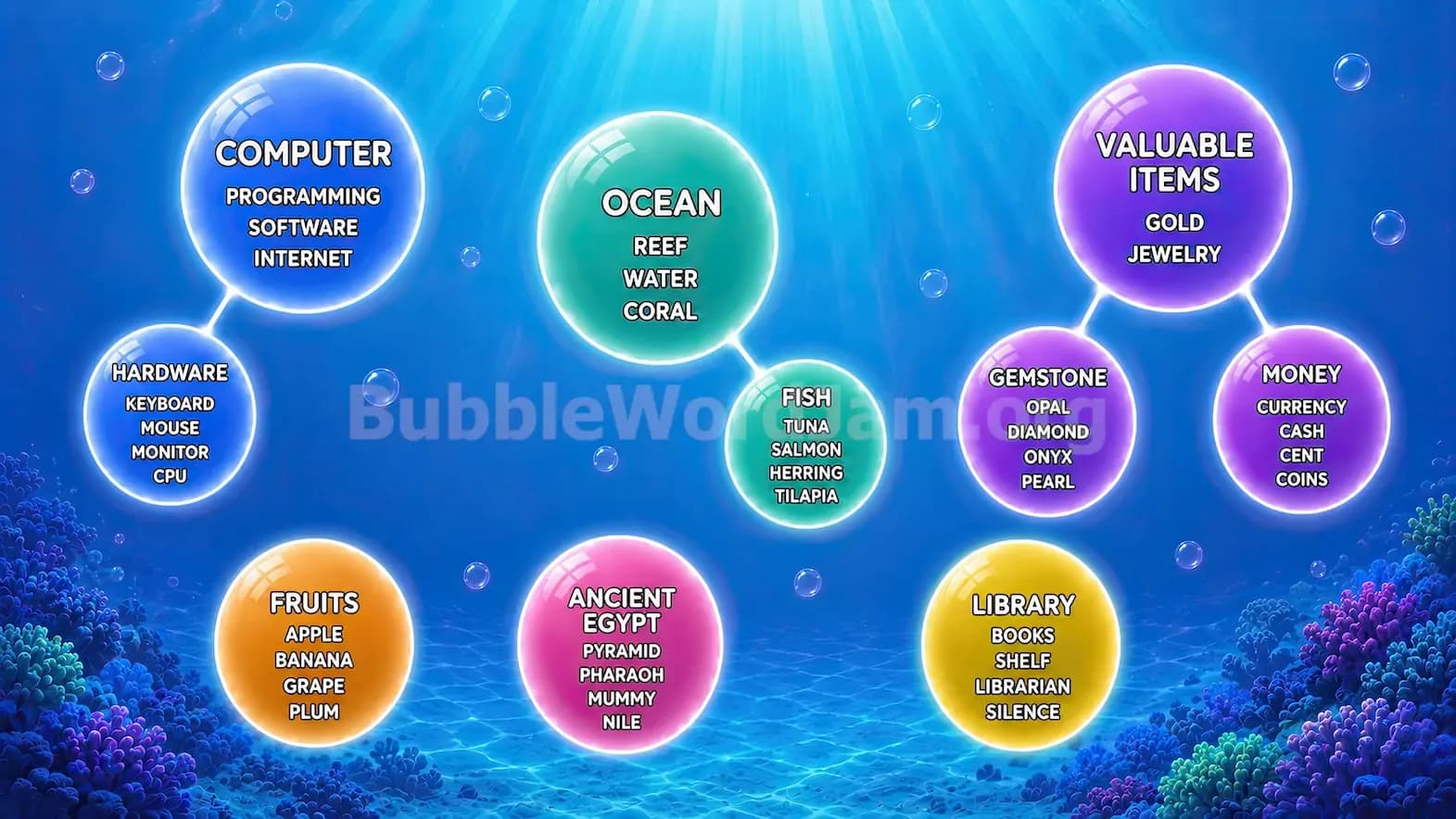
Level 30 is a clean entry point because “ancient Egypt” has one of the most recognizable sets in the whole game: pyramid, pharaoh, mummy, and Nile.
This is the kind of category you should lock in quickly. It has a rock-solid identity. Every word points to the same civilization, and none of the items feel like they need a second category unless the board is trying to bait you with a wider “landmarks” or “valuable items” group nearby.
The useful habit here is to spot civilization-specific nouns. “Pharaoh” is not just a ruler. In Bubble Word Jam logic, it is basically a neon sign flashing Egypt. “Nile” does the same thing. “Mummy” can feel like horror, burial, or museum vocabulary, but when it appears with pyramid and pharaoh, it belongs to the Egypt cluster.
My rule: when two or more words are civilization-specific, treat them as your safest merge path.
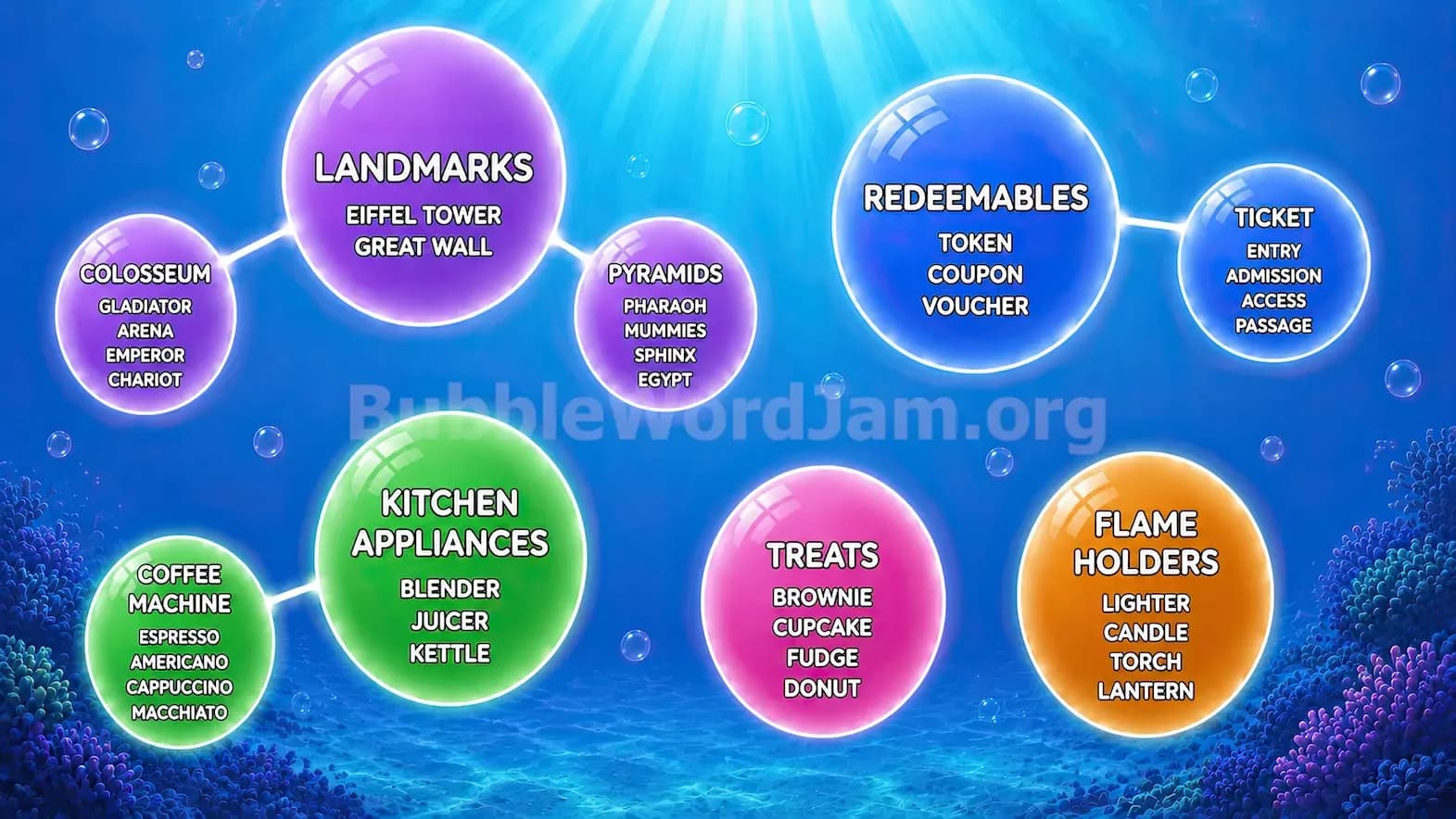
Level 38 gets sneakier because it uses overlapping history categories. “Landmarks” includes Eiffel Tower, Great Wall, Colosseum, and pyramids. But the same level also breaks out “Colosseum” with gladiator, arena, emperor, and chariot, plus “pyramids” with pharaoh, mummies, sphinx, and Egypt.
That’s a banger teaching moment. The game is testing whether you can tell the difference between a landmark category and a subcategory attached to one landmark.
If you merge Colosseum too early with Great Wall and pyramids, you might be right for one category, but you could also blind yourself to the Roman mini-cluster. This is where Bubble Word Jam feels less like a simple word game and more like a sorting puzzle with hierarchy.
Think of it as hub-and-spoke logic:
Landmarks is the hub.
Colosseum and pyramids can become spokes.
Gladiator, arena, emperor, and chariot belong under the Colosseum idea.
Pharaoh, mummies, sphinx, and Egypt belong under the pyramids idea.
When a level gives you both a broad object and details about that object, don’t panic. Separate “place names” from “things associated with the place.”
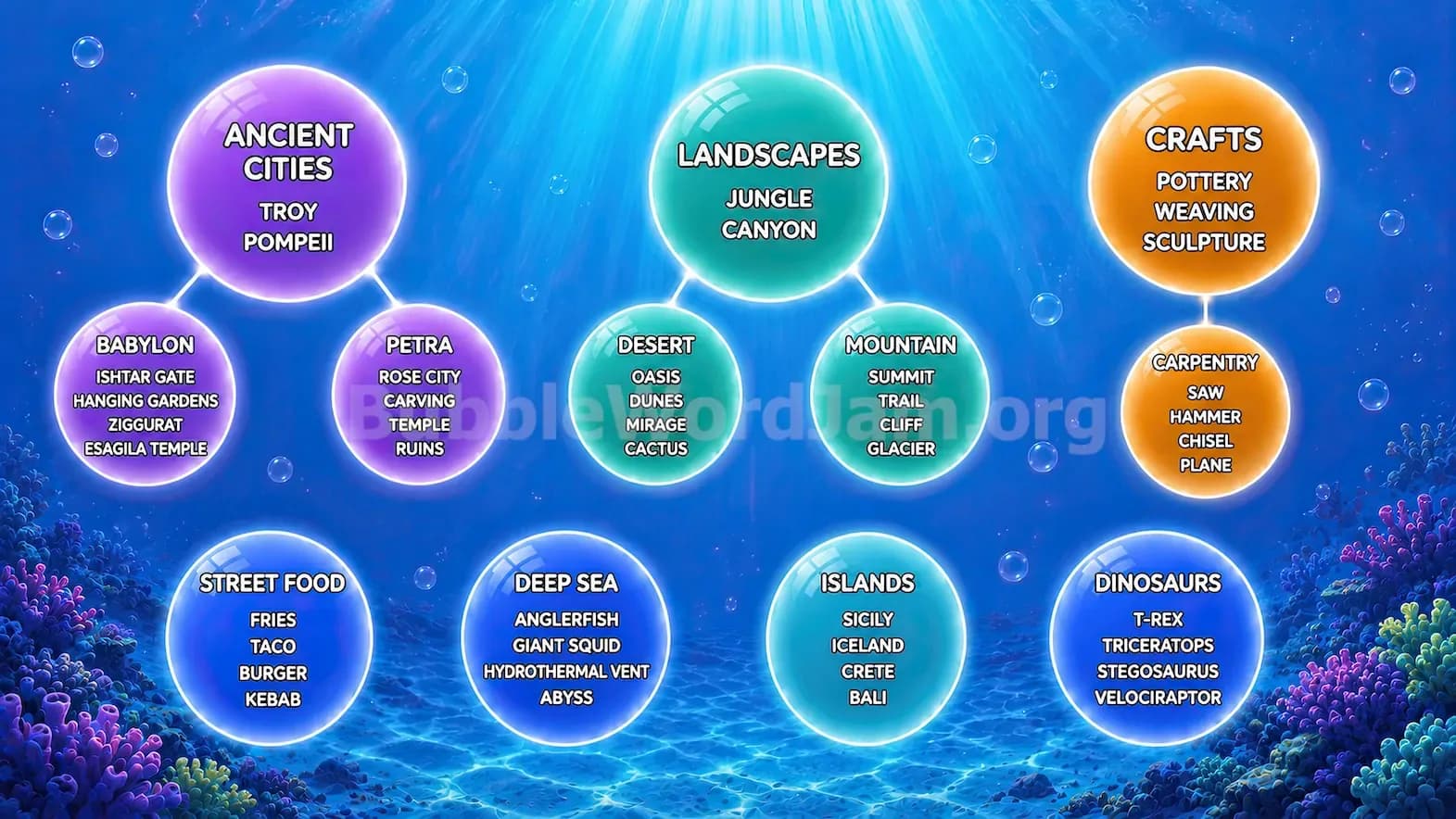
Level 45 is one of those history sets that can make players roll their eyes if they don’t recognize the references. “Ancient cities” includes Troy, Babylon, Petra, and Pompeii. Then the puzzle dives deeper: Petra connects with rose city, carving, temple, and ruins, while Babylon connects with Ishtar Gate, Hanging Gardens, ziggurat, and Esagila Temple.
This is a step up from Level 30. Egypt gives you pop-culture history. Babylon and Petra ask for more specific ancient-world memory.
The technique here is to separate city names from city features. Troy, Babylon, Petra, and Pompeii are the actual ancient cities. “Ishtar Gate” and “ziggurat” are not city names; they’re clues pointing toward Babylon. “Rose City” and “carving” point toward Petra.
When I see a capitalized place-like word, I pause before merging it. Bubble Word Jam often uses the proper noun as the category object, then surrounds it with clues. That means “Babylon” might belong with Troy and Pompeii in one group, while “Ishtar Gate” belongs with Babylon’s own detail group.
It’s a neat little hierarchy check, and it punishes sloppy merging.
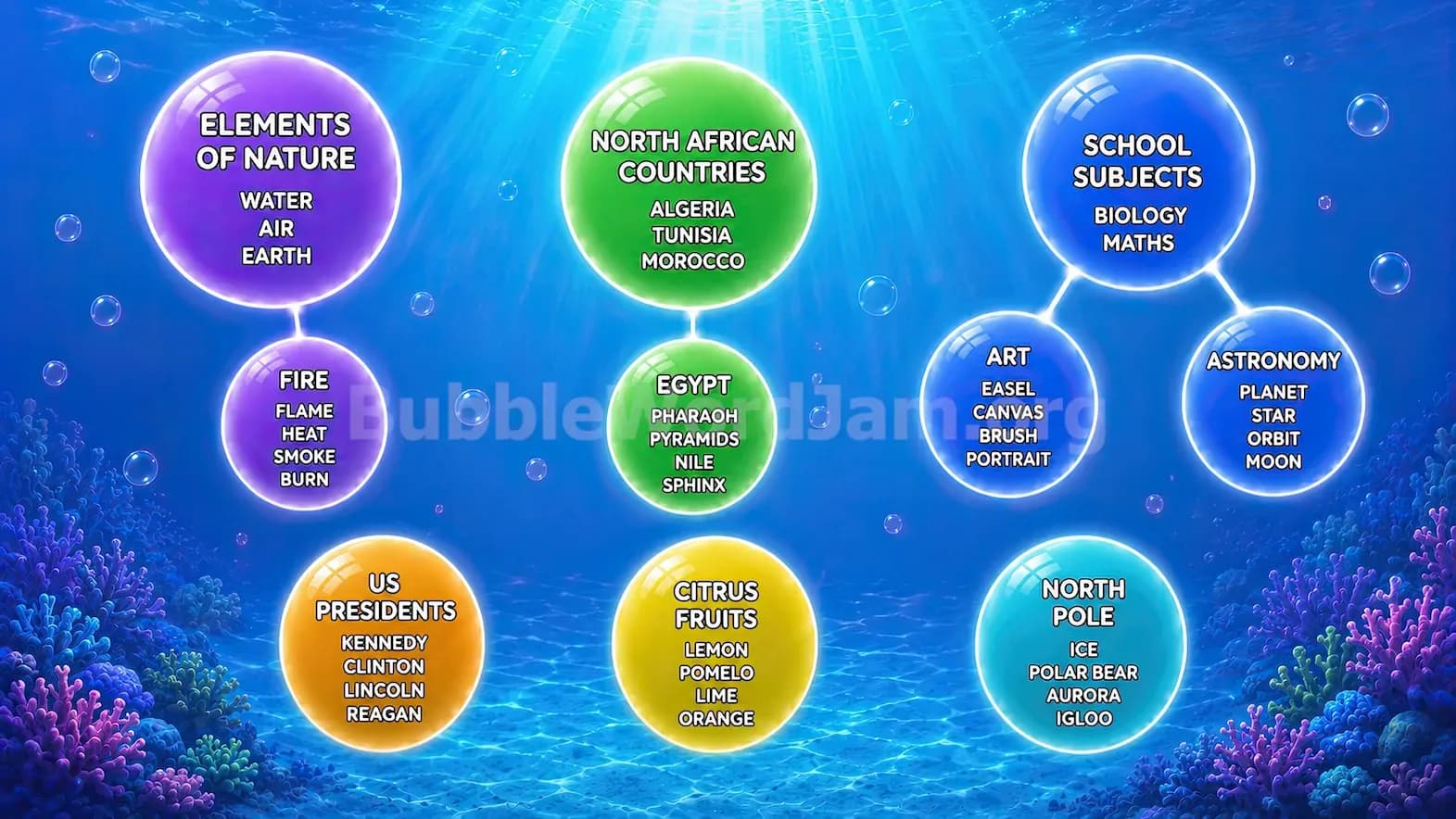
Level 49 uses another classic trick: Egypt appears in two different historical-geographic ways.
One category is “Egypt,” with pharaoh, pyramids, Nile, and sphinx. Another is “North African countries,” with Egypt, Algeria, Tunisia, and Morocco.
This is where you need to read the word’s role, not just its topic. Egypt can be the subject of a category or one member inside a bigger geography category. That distinction matters.
I like to ask: is the word acting as a place, or is it acting as a clue?
If Egypt appears beside Algeria, Tunisia, and Morocco, it’s acting as a country. If pharaoh, Nile, sphinx, and pyramids are nearby, Egypt is the historical civilization anchor. This same logic helps across many Bubble Word Jam levels, not just history ones. A word can be a category title in one puzzle and a member of another category in the next.
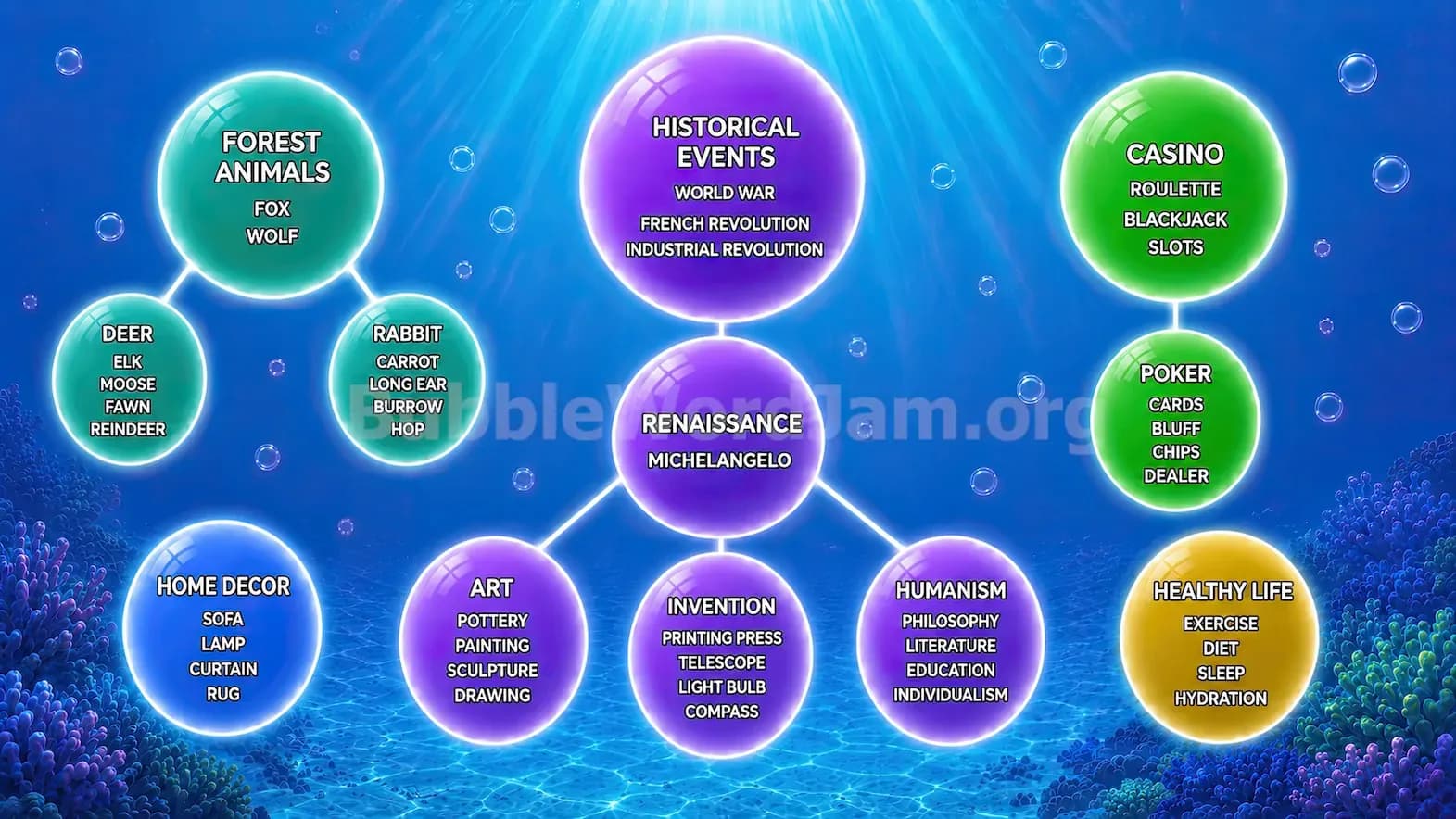
Level 75 shifts from ancient civilization to historical eras and cultural movements. “Renaissance” connects with art, Michelangelo, invention, and humanism. Then the level also includes “historical events,” with Renaissance, world war, French Revolution, and Industrial Revolution.
This is a different kind of challenge. You’re no longer just sorting objects. You’re sorting movements, events, and ideas.
The Renaissance anchor is culture. Art, Michelangelo, invention, and humanism all point toward a period defined by creativity, learning, and renewed interest in classical thought. If you see those terms together, don’t scatter them into generic art or school categories too quickly.
But the word “Renaissance” can also sit beside other major historical events or periods. That means you should watch for two layers:
Renaissance as a detailed category.
Renaissance as one entry in a bigger historical-events group.
This is one of my favorite Bubble Word Jam history patterns because it feels fair. The clues are clear, but only if you respect the category scale.
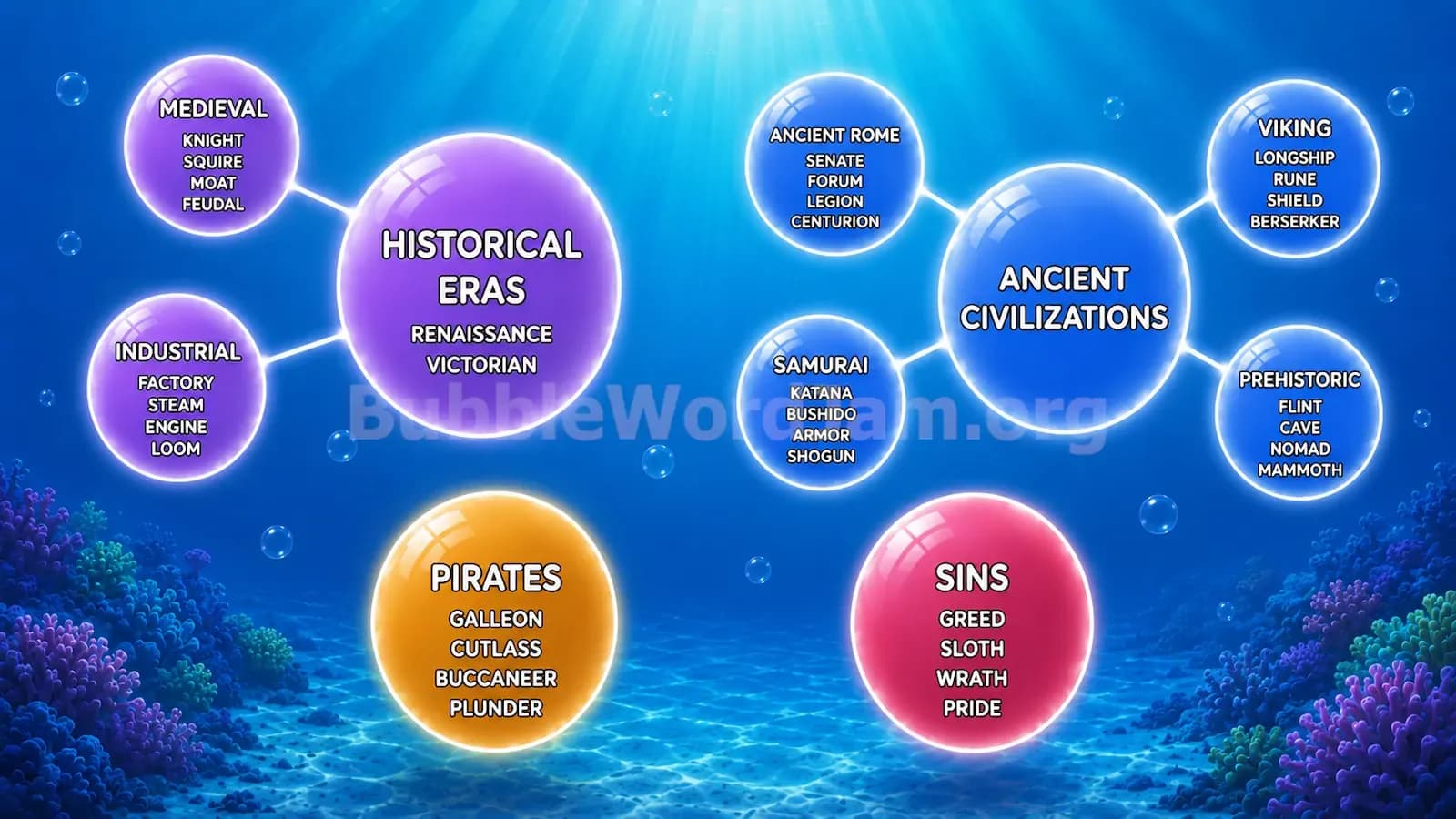
Level 266 is basically the history anchor technique in one packed board. It includes historical eras like medieval, Renaissance, Victorian, and industrial. Then it gives separate clusters for medieval, ancient civilizations, ancient Rome, Viking, samurai, industrial, and prehistoric.
This is the level where a timeline in your head becomes your best booster.
Medieval points to knight, squire, moat, and feudal.
Ancient Rome points to senate, forum, legion, and centurion.
Industrial points to factory, steam, engine, and loom.
Prehistoric points to flint, cave, nomad, and mammoth.
The danger is that “ancient civilizations” includes ancient Rome, Viking, samurai, and prehistoric, even though those don’t all sit neatly in the same classroom definition of “ancient.” Bubble Word Jam sometimes uses a broad “old-world warrior/culture” vibe rather than strict academic labeling. That can feel a little messy, but the solve path still works if you look for the supporting clues.
My advice: solve the most specific clusters first. Ancient Rome is tighter than ancient civilizations. Industrial is tighter than historical eras. Medieval is tighter than the broad timeline group. Once the tight groups are handled, the leftover era labels become much easier to place.
Level 455 brings in landmarks, landscapes, and the 7 world wonders. The key history set is “7 world wonders,” with Colosseum, Petra, Great Wall, and Machu Picchu. Nearby, “landmarks” includes castle, bridge, statue, and pyramids.
This is a great example of why “famous old place” is not enough. Colosseum, Petra, Great Wall, and Machu Picchu form a specific wonders-style category. Castle, bridge, statue, and pyramids are broader landmark objects.
The trick is to check whether the group is naming specific places or generic types of places. “Great Wall” and “Machu Picchu” are specific. “Bridge” and “statue” are generic. That difference often reveals the intended category faster than the historical theme itself.
Level 470 mixes history with symbol knowledge. “Pharaoh” connects to Nile, pyramid, sphinx, and tomb. “Roman numerals” uses VII, XII, XIV, and XIX.
This level reminds me that ancient-history puzzles are not always about civilizations directly. Sometimes they include systems that came from, or are associated with, ancient cultures.
Roman numerals are a perfect example. They don’t need “Rome,” “Caesar,” or “empire” to announce themselves. The letter patterns do the work. If you see V, X, I, L, C, D, or M arranged as numbers, stop treating them like random letters. They’re almost certainly a Roman numeral category.
Level 680 uses “historical empires,” with Ottoman, Mongol, Byzantine, and Mughal. This is a broader, later-game style of history category. It doesn’t give you obvious monuments or objects. It expects you to recognize names of major empires.
The best move is to group political or imperial names before you chase nearby culture words. Level 680 also includes famous explorers, theatrical traditions, opera houses, ancient trade goods, and political philosophies, so the board can feel stuffed with world-history energy. That’s exactly when you need anchors.
Ottoman, Mongol, Byzantine, and Mughal share political-historical identity. Magellan, Vasco da Gama, Cook, and Amundsen are explorers. Silk, spice, amber, and ivory are trade goods. These categories all live in the same historical atmosphere, but they solve through different roles: empire, person, object.
When a Bubble Word Jam level starts leaning historical, I use this order:
First, identify proper nouns. Rome, Babylon, Petra, Egypt, Ottoman, Mongol, and Byzantine usually give the board its skeleton.
Second, separate place names from clue words. Petra is a place; rose city is a clue. Babylon is a place; Ishtar Gate is a clue.
Third, sort by time period. Ancient, medieval, Renaissance, industrial, and empire-based clues usually don’t want to live in the same merge unless the category is deliberately broad.
Fourth, solve the tightest groups before the broadest ones. A specific “ancient Rome” group is safer than a loose “ancient civilizations” group. A “Roman numerals” group is safer than a general “history” guess.
Finally, watch for hierarchy. Bubble Word Jam loves parent-child category design. A broad category like landmarks can sit beside a smaller category like pyramids or Colosseum. That’s not a bug in the logic; that’s the puzzle’s bite.
I like these ancient history and civilization levels because they reward actual recognition without becoming a dry trivia quiz. At their best, they create that clean “aha” loop: pharaoh locks Egypt, gladiator locks Colosseum, ziggurat locks Babylon, steam locks industrial, and suddenly the whole board starts collapsing into place.
They can be frustrating when two categories share the same historical vibe, but that’s also what gives them texture. You’re not just matching words. You’re reading category scale, time period, and cultural context all at once.
For puzzle gamers, that’s the good stuff. It’s crunchy, it’s fair, and when the final merge lands, it feels like you actually outplayed the board instead of just guessing your way through it.