Learn how to solve Bubble Word Jam body and medicine puzzles by sorting organs, systems, symptoms, doctors, and tools with clear examples for tricky boards.


Guide By Liam Stone
Updated on July 1, 2026
Liam Stone has been playing Bubble Word Jam since the mobile app first launched on the Apple App Store. He knew this game would pop, so he enjoys playing every level, collecting the answers, and running this site for other players. He loves mobile puzzle games and sometimes publishes his walkthroughs on his YouTube channel Puzzle Game Answer. Follow his channel if you are a puzzle game lover too.
Anatomy and medicine puzzles in Bubble Word Jam can feel weirdly simple at first. You see heart, lung, doctor, patient, and medicine, and your brain says, “Easy merge, free win.” Then the game throws in brain, digestive, surgeon, vaccine, glucose, and face, and suddenly the board gets crunchy.
That’s the trick with body and health categories. They don’t always sit in one neat box. A word can be a body part, a medical setting, a professional role, a tool, a symptom-adjacent clue, or a whole body system. If you sort too fast, you burn moves on a mediocre guess and tank your flow. If you slow down and ask what type of medical word each bubble is, the whole thing starts to click.
The best technique is simple: sort every clue into four buckets before merging anything big — part, system, person, or tool. Once you learn that loop, Bubble Word Jam’s health puzzles become much less floaty and much more readable.
When a body-related category appears, don’t start by asking, “Is this medical?” That question is too broad. Almost everything in these puzzles can be medical in some way. Instead, ask a sharper question: “What role does this word play?”
A part is a physical piece of the body. Think heart, lung, kidney, liver, skin, brain, face, nose, mouth, artery, vein, or skeleton.
A system is a bigger biological structure or function. Digestive, muscular, immune, circulatory, and respiratory-style clues belong here. Sometimes Bubble Word Jam uses organs inside a systems category, which is where the puzzle gets spicy.
A person is usually a job, specialist, or patient role. Doctor, dentist, surgeon, allergist, dietitian, and patient all point toward people involved in care.
A tool or treatment is something used in health care. Stethoscope, scalpel, gloves, mask, injection, vaccine, insulin, and antibiotic usually aren’t “body” answers. They’re medical objects, procedures, or treatments.
This sounds basic, but it’s a rock-solid sorting habit. It stops you from merging heart with doctor just because both feel “health-related.” Bubble Word Jam rewards precision, not vibes.
The cleanest anatomy puzzles usually begin with organs or visible body parts. Level 8 is a great example because “organs” groups lung, kidney, liver, and heart. That set has almost no noise. They’re all internal body parts, and they all sit at the same category depth.
This is where you should cash in early. If you see four words that are all the same kind of body part, merge them before the board gets crowded. It creates space, preserves moves, and gives you confidence for the messier categories still floating around.
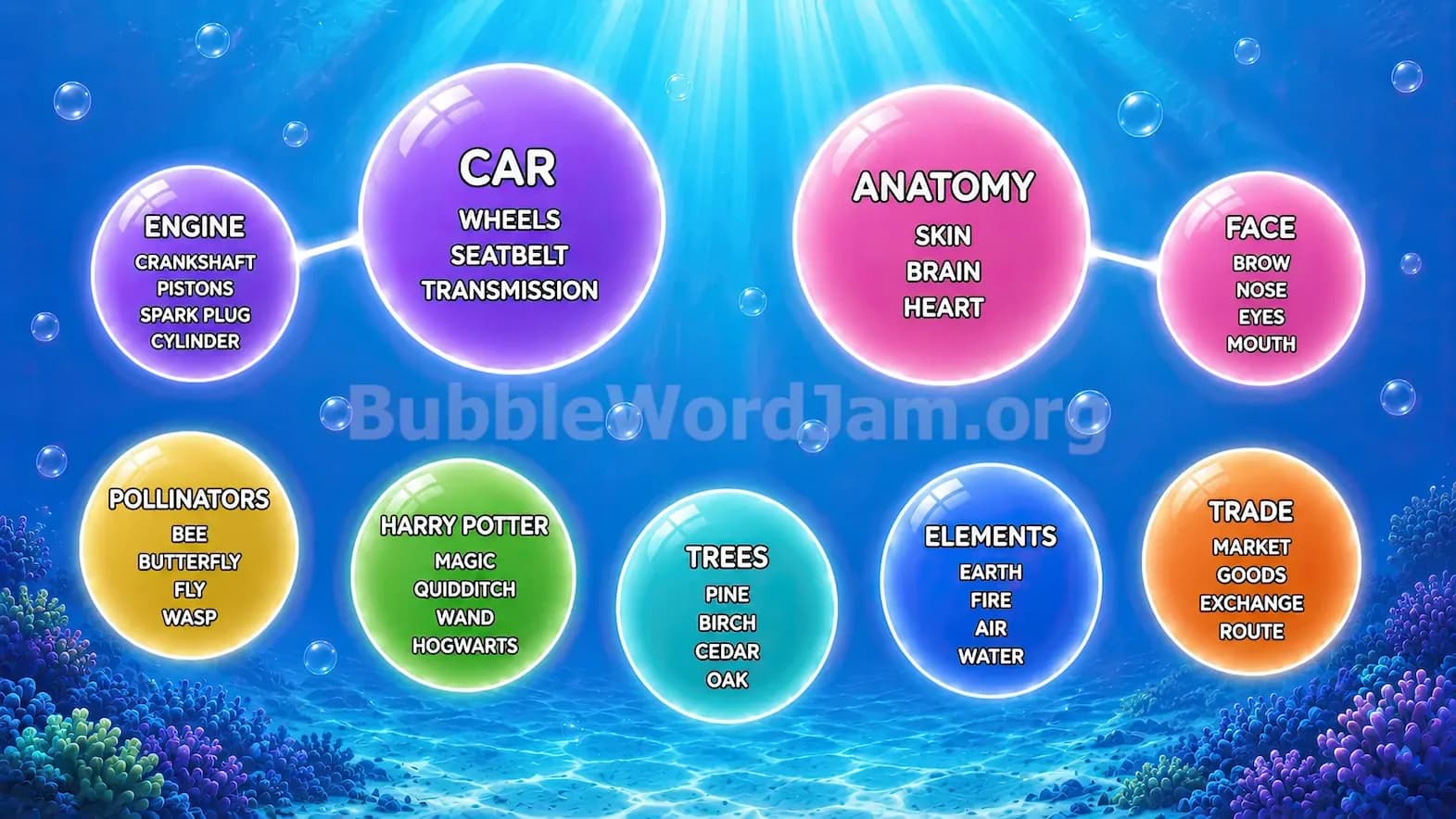
Level 25 uses the same idea but shifts from internal organs to the face. Brow, nose, eyes, and mouth are all visible face parts. The trap is that Bubble Word Jam may also show a broader anatomy category nearby, such as skin, brain, heart, and face. That means “face” can be both a category theme and an item inside a larger category.
That double-use pattern is classic Bubble Word Jam. The game loves hierarchy: face contains eyes and mouth, while anatomy contains face. When you see this, don’t panic. Just sort by scale. Small parts go together. Bigger body-region words belong with other broad anatomy words.
Body system categories are where the game starts asking for real common knowledge instead of simple word matching. Level 19 brings in body systems with digestive, muscular, brain, and lung. That set feels slightly odd because brain and lung are organs, while digestive and muscular are systems. But in puzzle logic, they’re being used as major body-function anchors.
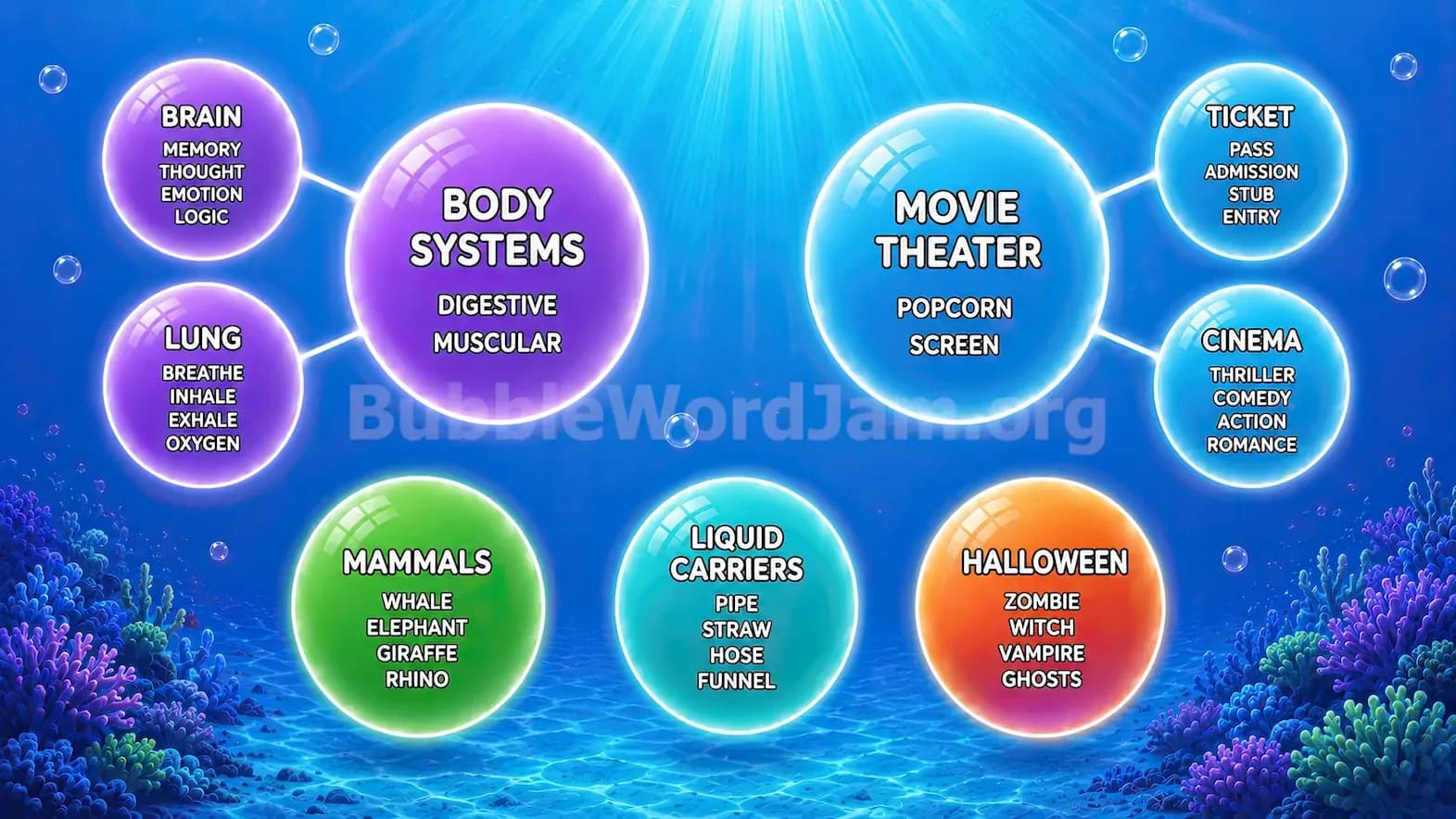
The safer move is to look for the category’s intention. Is Bubble Word Jam trying to group “things inside the body,” or is it building a system map? If digestive and muscular appear together, the answer is probably system-level thinking. Brain and lung then join as major functional centers, not just random organs.
Level 806 pushes this even harder with body systems containing organs, immune, circulatory, and brain. Here, “organs” itself becomes a clue inside a wider body-systems group. That can feel like a rehash until you notice the abstraction jump. Organs is not one organ; it’s a category label acting as a bubble.
This is why I don’t merge health words just because they’re nearby. I first ask whether the puzzle wants a body part, a system, or a category-of-categories. Once you spot that scale, the solution becomes much cleaner.
Doctor categories are deceptively dangerous because they often mix with medicine categories. Level 4 gives an early version: stethoscope, patient, medicine, and hospital. This is a beginner-friendly “doctor” cluster because every clue points to the clinical world.

But by Level 16, the game gets more specific. Dentist, surgeon, allergist, and dietitian are all types of health professionals. That’s a person category, not a medicine category. In the same area, injection, vaccine, insulin, and antibiotic belong to medicine. Patient, clinic, doctor, and medicine then form a broader health group.
That three-layer structure is a banger teaching moment: specialists, treatments, and general health words are different. If you merge surgeon with scalpel too early, you might break the person/tool split.
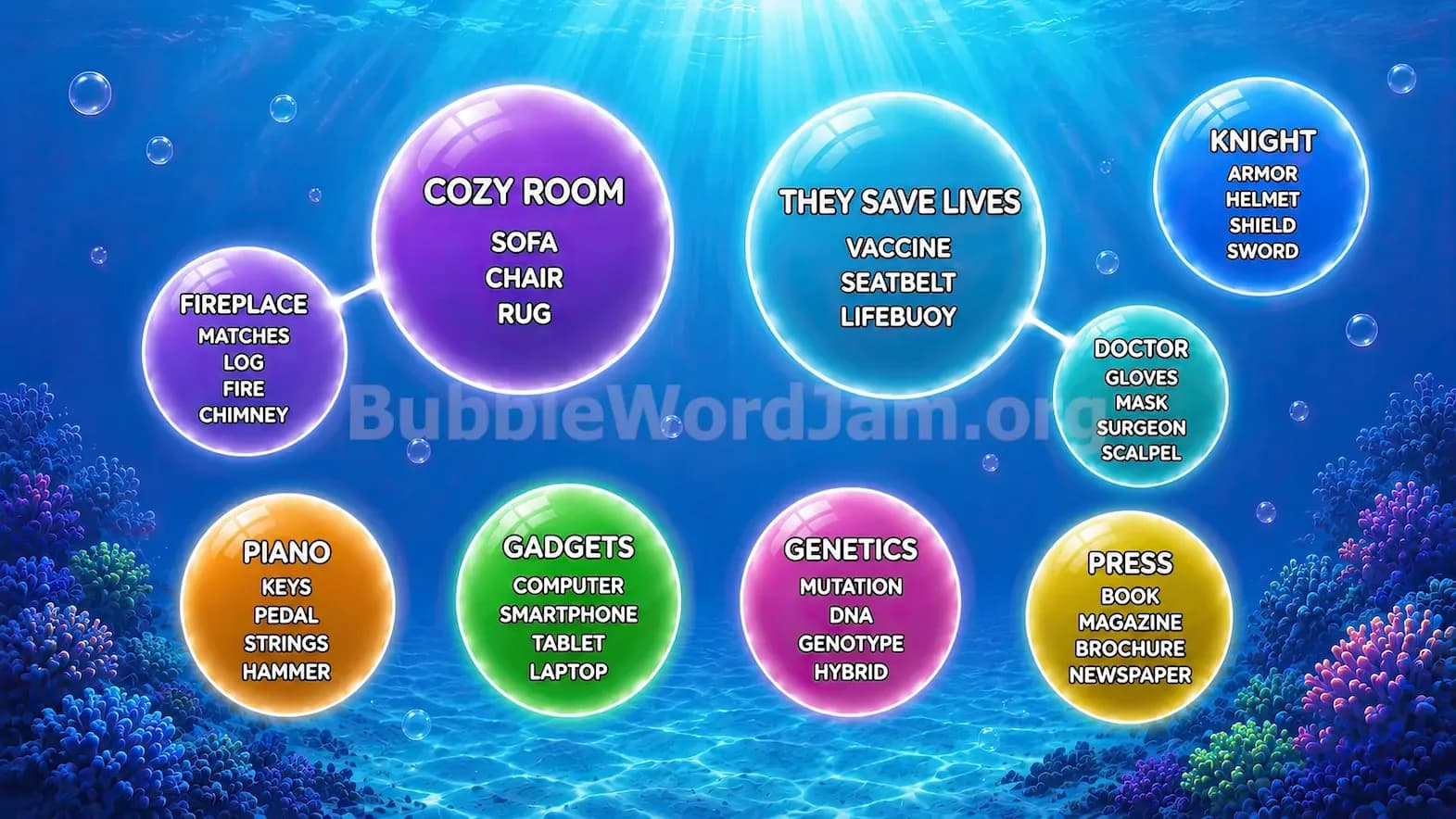
Level 29 adds another version with doctor clues such as gloves, mask, surgeon, and scalpel. This one is a little more hybrid because surgeon is a person, while gloves, mask, and scalpel are medical equipment. The theme is still doctor, but the internal logic leans toward operating-room association.
So the rule is not “people never mix with tools.” The rule is “check the category’s center of gravity.” If all four words are specialists, it’s a doctor-type category. If the set includes gear and a surgeon, it may be a clinical scene category.
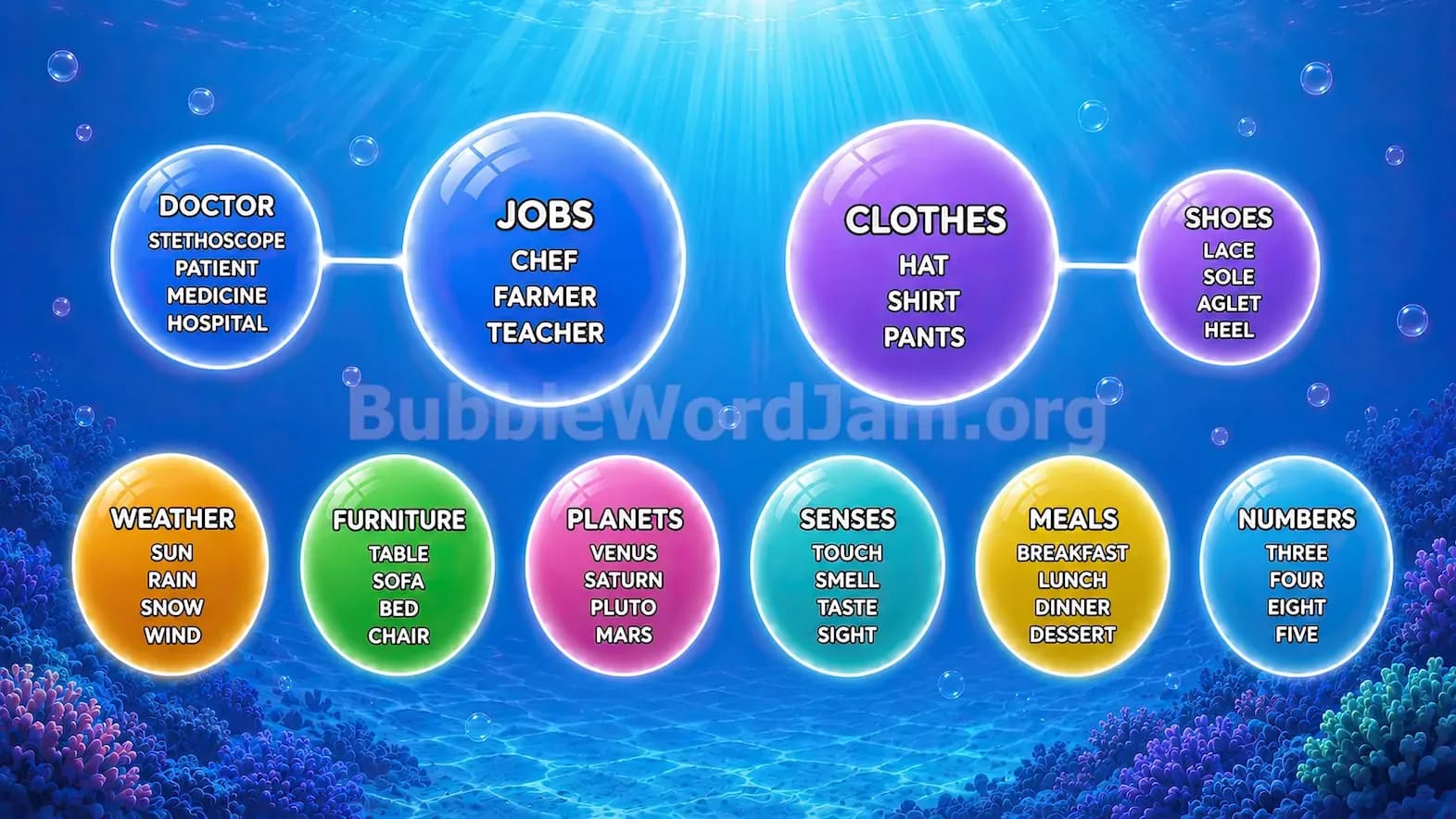
Not every health-adjacent clue is anatomy. Level 4 includes senses: touch, smell, taste, and sight. These words relate to the body, but they are not body parts. They describe how the body gathers information. If hearing appears in a similar puzzle, it probably belongs here too, not with ear or face.
Level 806 introduces health metrics: blood pressure, temperature, glucose, and heart rate. These are measured values, not organs and not symptoms. They live closer to checkup language: what a doctor records, monitors, or tests.
That distinction matters because Bubble Word Jam often puts “temperature” in non-medical places too. It can be weather, measurement, or health depending on the surrounding clues. The board decides the meaning. That’s why I always scan nearby words before committing.
A good move-order trick: save ambiguous terms for last. Merge the unmistakable anatomy first, then return to flexible words like temperature, pulse, pressure, or heart. Once the obvious groups disappear, their intended category usually becomes obvious.
Digestive clues are some of the most readable once you know what scale the puzzle wants. Level 55 has heart with hemoglobin, pulse, chamber, and artery. It also has stomach with acid, food, digestion, and organ. Then it expands into digestive system with stomach, intestine, liver, and esophagus.
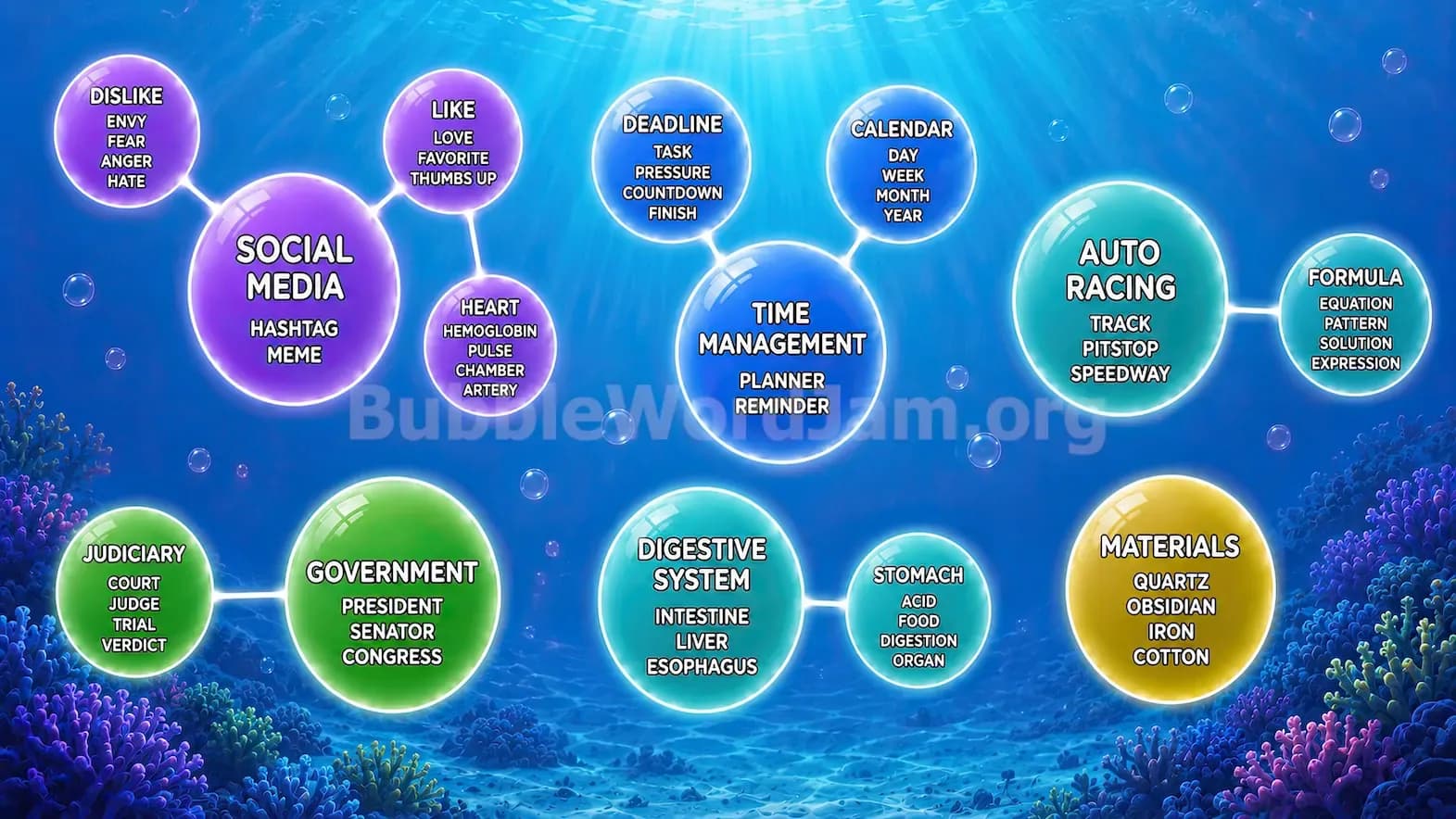
This is Bubble Word Jam at its most satisfying. The game isn’t just asking “what words are medical?” It’s asking whether you can separate an organ, the things associated with that organ, and the larger system that organ belongs to.
Heart clues like pulse and chamber are not the same as digestive system clues. Stomach can be a category with acid and digestion, but stomach can also be an item inside digestive system. Again, scale wins.
When you see digestive, stomach, intestine, liver, and esophagus, don’t overthink it. That’s the system group. When you see acid, food, digestion, and organ, the puzzle is probably zooming into stomach as its own theme. This part/system split is the whole loop.
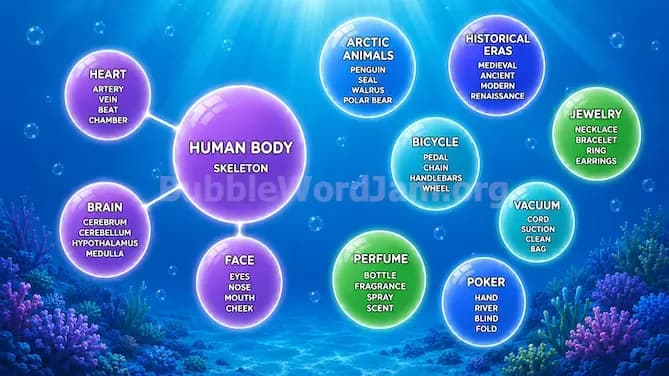
Level 111 is basically a mini anatomy exam, but in a good way. Human body groups heart, brain, face, and skeleton. Then heart expands into artery, vein, beat, and chamber. Face expands into eyes, nose, mouth, and cheek. Brain expands into cerebrum, cerebellum, hypothalamus, and medulla.
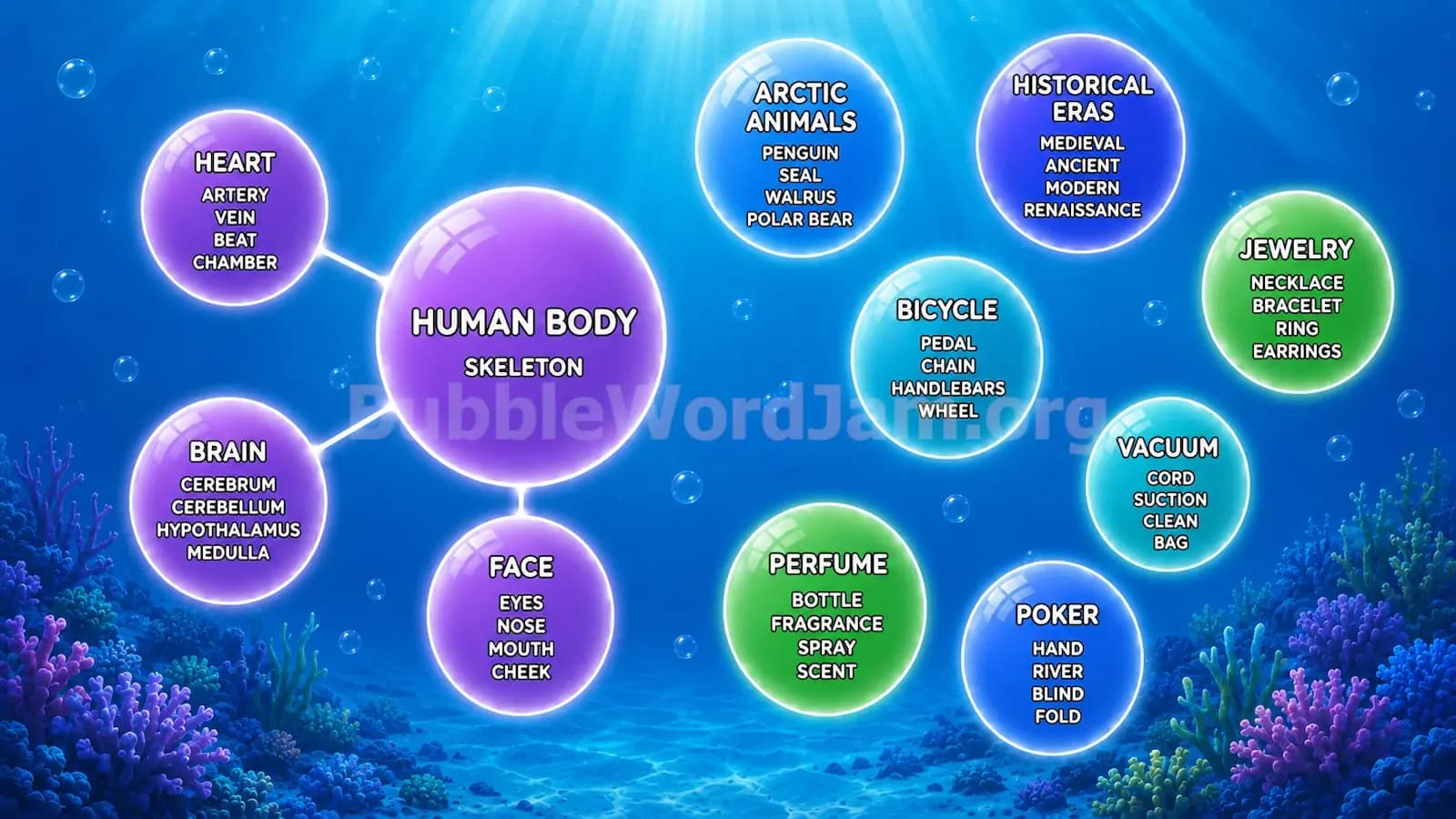
This is one of the cleanest examples of Bubble Word Jam’s anatomy hierarchy. The broad group comes first: human body. Then each major body anchor can become its own smaller category.
The danger is merging too soon. If you see brain and cerebrum, your instinct may be to connect them. But if brain belongs with heart, face, and skeleton in a broader group, cerebrum belongs with the more specific brain-part set.
My rule: when one word looks like a “parent” category, don’t attach it to its children until you check whether other parents are nearby. Brain, heart, face, and skeleton are parent-level words. Cerebrum, artery, cheek, and chamber are child-level words. Keep those layers apart and the puzzle stops fighting you.
Level 29 includes genetics with mutation, DNA, genotype, and hybrid. This is part of the body-and-medicine family, but it plays by a different logic. These are biology concepts, not organs, doctors, or tools.
That matters because DNA can tempt you into a medical merge. Vaccine, doctor, mutation, and DNA all feel science-coded, but they don’t belong together by default. Genetics wants inheritance and biological variation. Medicine wants treatment and care. Anatomy wants body structure.
When Bubble Word Jam uses science-heavy health clues, ask whether the words describe the body’s structure, a medical action, or a biological concept. Mutation and genotype are concept words. Kidney and lung are anatomy words. Vaccine and antibiotic are treatment words. Surgeon and dentist are people.
That one distinction saves a lot of wasted moves.
Here’s the loop I use when a health board starts to look crowded.
First, merge the clean body-part sets: organs, face parts, heart parts, brain parts, or digestive organs. These are usually the least ambiguous.
Second, identify person words: doctor, surgeon, dentist, allergist, dietitian, patient. Decide whether they form a specialist group or a broader clinic group.
Third, sort tools and treatments: stethoscope, scalpel, gloves, mask, injection, vaccine, insulin, antibiotic. Don’t let them sneak into anatomy categories just because they sound medical.
Fourth, handle systems and metrics last. Digestive, immune, circulatory, blood pressure, glucose, and heart rate often depend on context. Once the cleaner sets are gone, these become much easier to place.
That’s the part/system/person/tool strategy in action. It’s not flashy, but it’s a triumph when the board starts collapsing perfectly.
Anatomy and medicine puzzles in Bubble Word Jam are less about memorizing every body term and more about reading the category ladder. Is the word a body part? A system? A doctor or patient? A tool, treatment, or measurement? Once you answer that, the board loses a lot of its chaos.
The best examples — from Level 8’s organs to Level 111’s human body hierarchy and Level 806’s body systems — show why this category is so good. It forces you to sort by meaning, scale, and function. That’s the exact crunchy logic loop that makes Bubble Word Jam work.
So next time heart, brain, doctor, glucose, and scalpel all show up together, don’t rush the merge. Sort the role first. Then make the board behave.