Learn how to solve Bubble Word Jam abstract categories, multi-meaning words, and tricky association traps without wasting moves, hints, coins, or boosters.
Guide By Liam Stone
Updated on August 10, 2026
Liam Stone has been playing Bubble Word Jam since the mobile app first launched on the Apple App Store. He knew this game would pop, so he enjoys playing every level, collecting the answers, and running this site for other players. He loves mobile puzzle games and sometimes publishes his walkthroughs on his YouTube channel Puzzle Game Answer. Follow his channel if you are a puzzle game lover too.
Bubble Word Jam gets downright sneaky when it stops asking, “Do you know this word?” and starts asking, “Do you know which version of this word I mean?” That’s where the game’s best advanced puzzles live. Not the easy food, animal, or color groups. I’m talking about the crunchy word traps: mint, roll, deal, fold, pitch, sharp, core, and all those slippery little words that look obvious until they suddenly aren’t.
The trick is simple to explain and hard to master: don’t merge too early. In Bubble Word Jam, a confident wrong merge can tank a whole run because every move matters. When a word has multiple meanings, treat it like a suspect in a detective game. Keep it on the board, watch who it hangs around, and only commit when the context is rock-solid.
Early Bubble Word Jam levels teach you the basic loop: spot a theme, group the bubbles, clear the category, move on. Advanced word trap levels mess with that comfort. They use association logic instead of simple dictionary logic.
A word like “knife” might belong with sharp objects. Easy, right? But “knife” can also become part of a silent-letter category if the puzzle is playing with spelling. “Mint” might be a plant flavor, a drink ingredient, a place that makes coins, or even a condition meaning “perfect.” “Pitch” can be a baseball throw, an idea you sell, a tent setup, or the tone of a voice.
That’s why literal thinking gets punished. If you see one meaning and instantly merge, the game has already baited you. The better play is to delay the merge until you can identify the category’s full vibe.
My favorite rule for these puzzles is the “third word test.” Two words can lie. Three words usually tell the truth.
For example, if you see “air” and “river,” you might think nature. Add “time,” and suddenly the category shifts toward “it flows.” Add “energy,” and the group becomes even clearer. That’s the kind of association Bubble Word Jam loves: not physical similarity, but shared behavior.
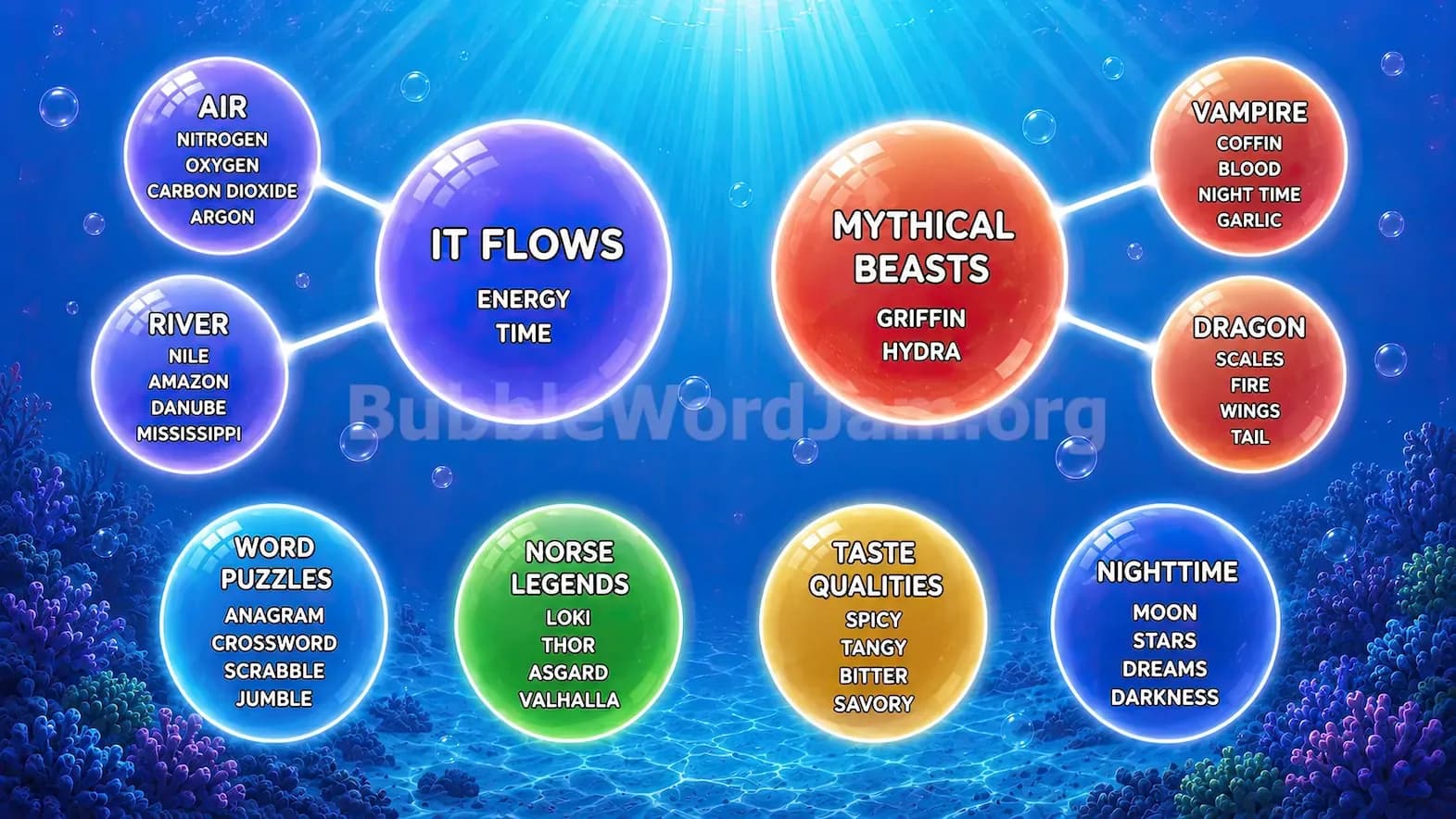
Level 52 is a clean example of this logic. “Air,” “energy,” “time,” and “river” all flow, but they don’t belong to the same object family. One is atmospheric, one is abstract, one is temporal, and one is geographic. The connection is action-based. They do the same thing.
So before merging two tempting words, ask: what would the third and fourth words need to be? If you can’t answer that, hold.
Advanced Bubble Word Jam categories usually hide behind one of four lenses: what something is, what something does, what it sounds like, or how it’s written.
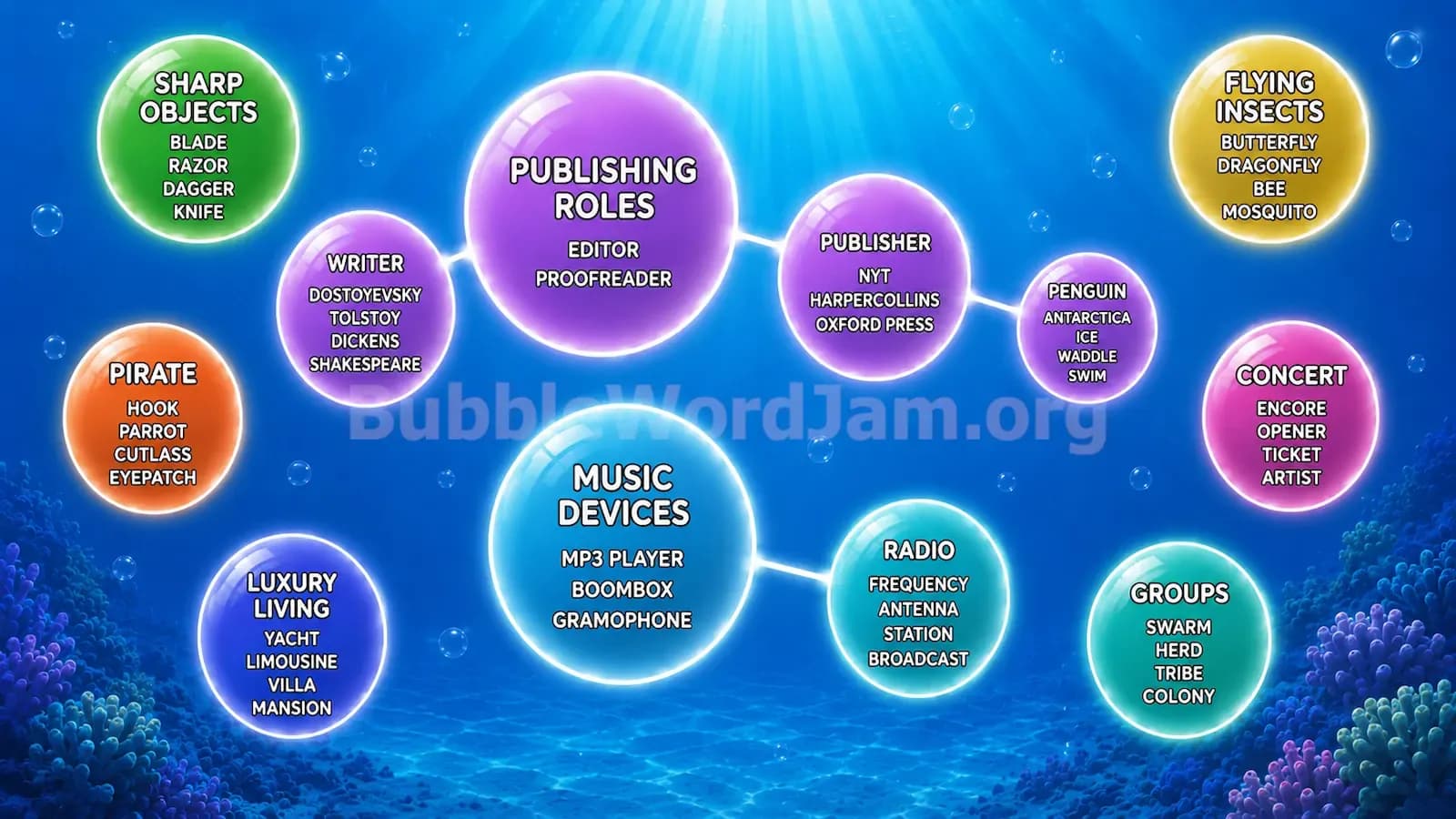
Level 124’s “sharp objects” group uses the object lens: blade, razor, dagger, knife. That’s a straightforward category, but it also trains you to respect the word “sharp.” Sharp could mean dangerous, smart, sudden, stylish, or musical. The board decides the meaning, not your first instinct.
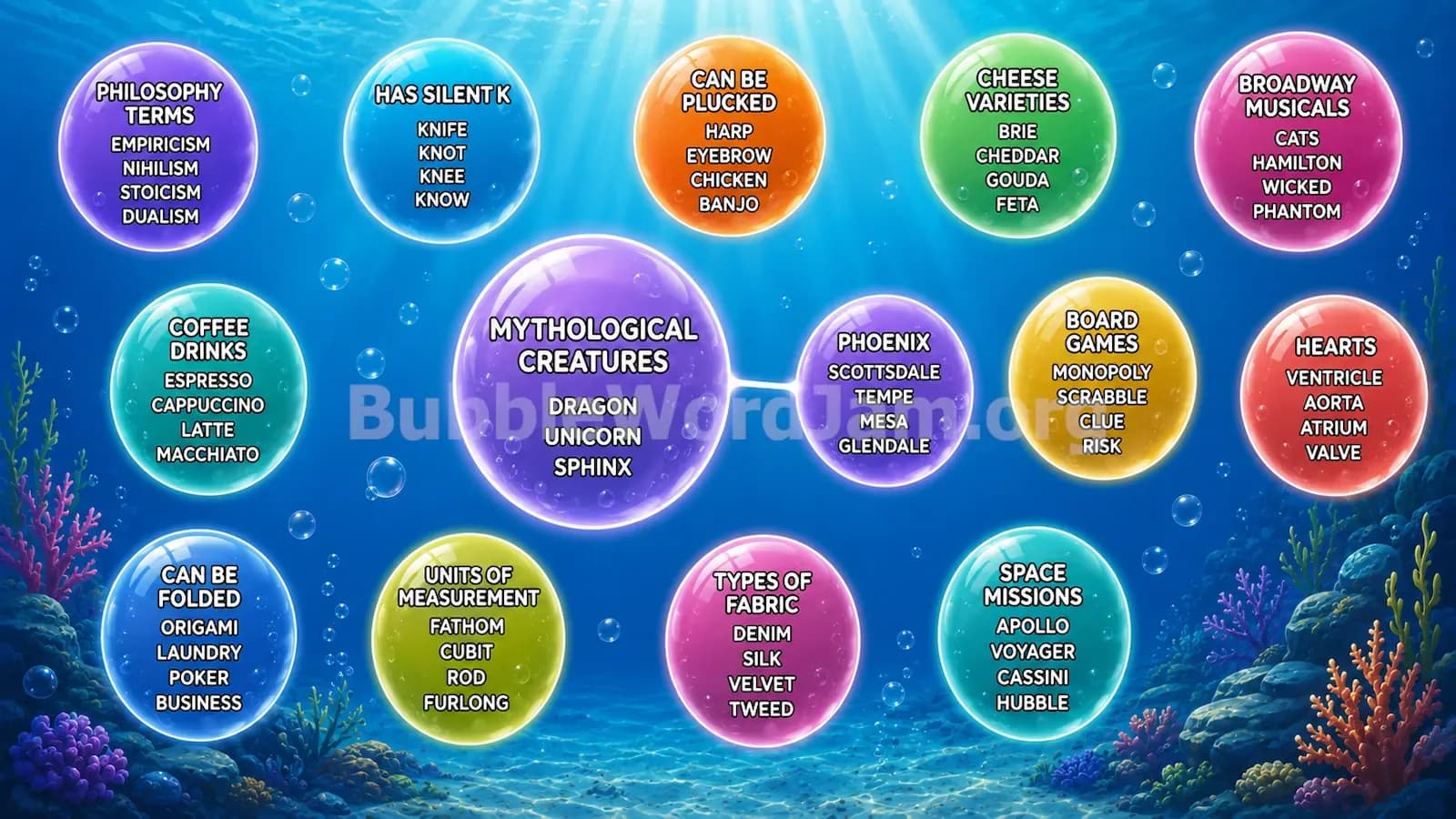
Level 424 goes harder by stacking several lenses at once. “Has silent k” uses spelling: knife, knot, knee, know. “Can be plucked” uses action: harp, eyebrow, chicken, banjo. “Can be folded” is even nastier: origami, laundry, poker, business. That category works because “folded” changes meaning across contexts. You fold paper, fold clothes, fold in poker, and a business can fold when it closes.
That’s a banger puzzle design move because it forces you to stop treating words as labels. You have to treat them as flexible tools.
The words that deserve the most suspicion are short, common, and flexible. Bubble Word Jam loves words like roll, deal, fold, pitch, mint, core, handle, and sharp because they can connect to several categories without looking suspicious.
Level 468 is basically a masterclass in this. “Types of rolls” includes barrel, cinnamon, honor, spring. That category is weird in the best way. A barrel roll is a movement, a cinnamon roll is food, an honor roll is an achievement list, and a spring roll is food again. The word “roll” isn’t one object. It’s a shared phrase pattern.
The same level uses “things that are dealt”: blow, cards, hand, justice. Again, this isn’t a neat object category. You deal cards, deal a hand, deal a blow, and deal justice. If you only look for nouns that physically match, you’ll miss the loop.
Then there’s “handles”: grip, knob, lever, pull. This one plays with function. The words aren’t identical objects, but they share a use case. They are things you hold, move, or use to open something. In a level like this, context beats literal category matching every time.
Some of the dirtiest Bubble Word Jam tricks happen when a word could be both an item and a category clue.
Level 753 does this with “mint.” On one side, “mint” connects to spearmint, peppermint, mojito, and julep. That’s flavor, herb, and drink logic. On another side, “U.S. mints” includes Denver, Philadelphia, San Francisco, and West Point. Same word, totally different lane.
This is where players burn moves. You see “mint,” you see “Denver,” and your brain might not immediately jump to coin production. Or you see “mojito” and assume the entire board is about drinks. Don’t. Let the surrounding words narrow the meaning.
Level 753 also includes “center”: bullseye, core, middle, midpoint. “Core” is another slippery word. It could mean the center of something, a body muscle group, a computing concept, or the heart of an idea. With “middle” and “midpoint,” the category becomes safe. Without them, “core” should stay parked.
Not every trap is abstract. Some categories look physical but still require careful sorting.
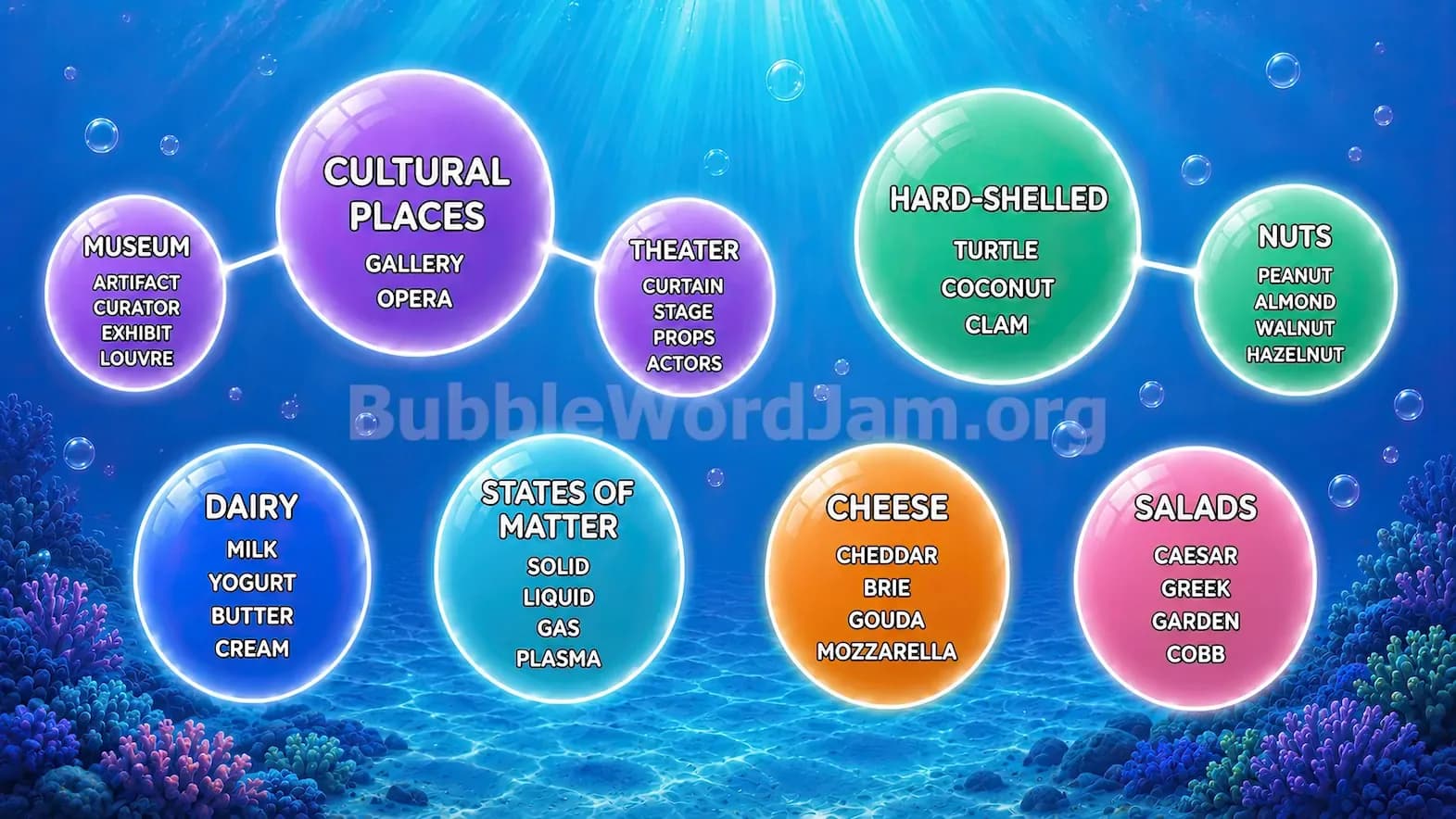
Level 23’s “hard-shelled” group includes turtle, coconut, clam, and nuts. That’s a great reminder that one category can mix animals, foods, and broader object groups if the shared trait is strong enough. You’re not sorting by type. You’re sorting by property.
Level 199’s “spiky things” does something similar with hedgehog, cactus, porcupine, and thistle. Again, the words don’t live in the same category family. One is an animal, one is a plant, another is an animal, and one is a flowering plant. The shared trait is texture or defense. If you’re only searching for “animals” or “plants,” you’ll whiff.
This is why I like asking, “What do these words have in common physically?” before I ask, “What category name would I give them?”
Action categories are some of the most satisfying when they click. They feel floaty at first, then suddenly snap into place.
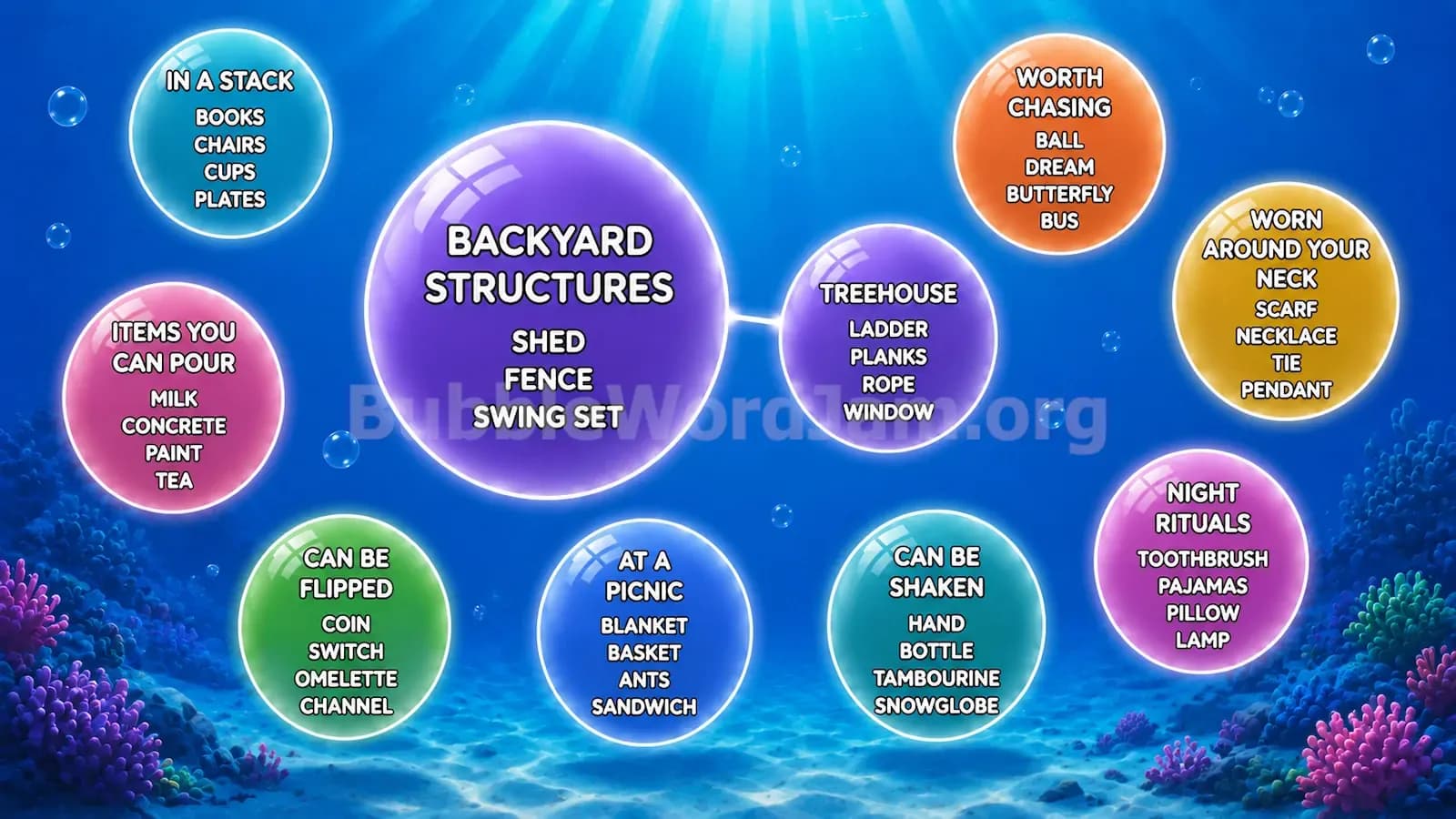
Level 311 uses “can be flipped”: coin, switch, omelette, channel. That’s a perfect multi-context action group. A coin flips, a switch flips, an omelette flips, and a channel flips when you change it. The same level also uses “can be shaken”: hand, bottle, tambourine, snowglobe. Once again, the category is not what the objects are. It’s what you can do to them.
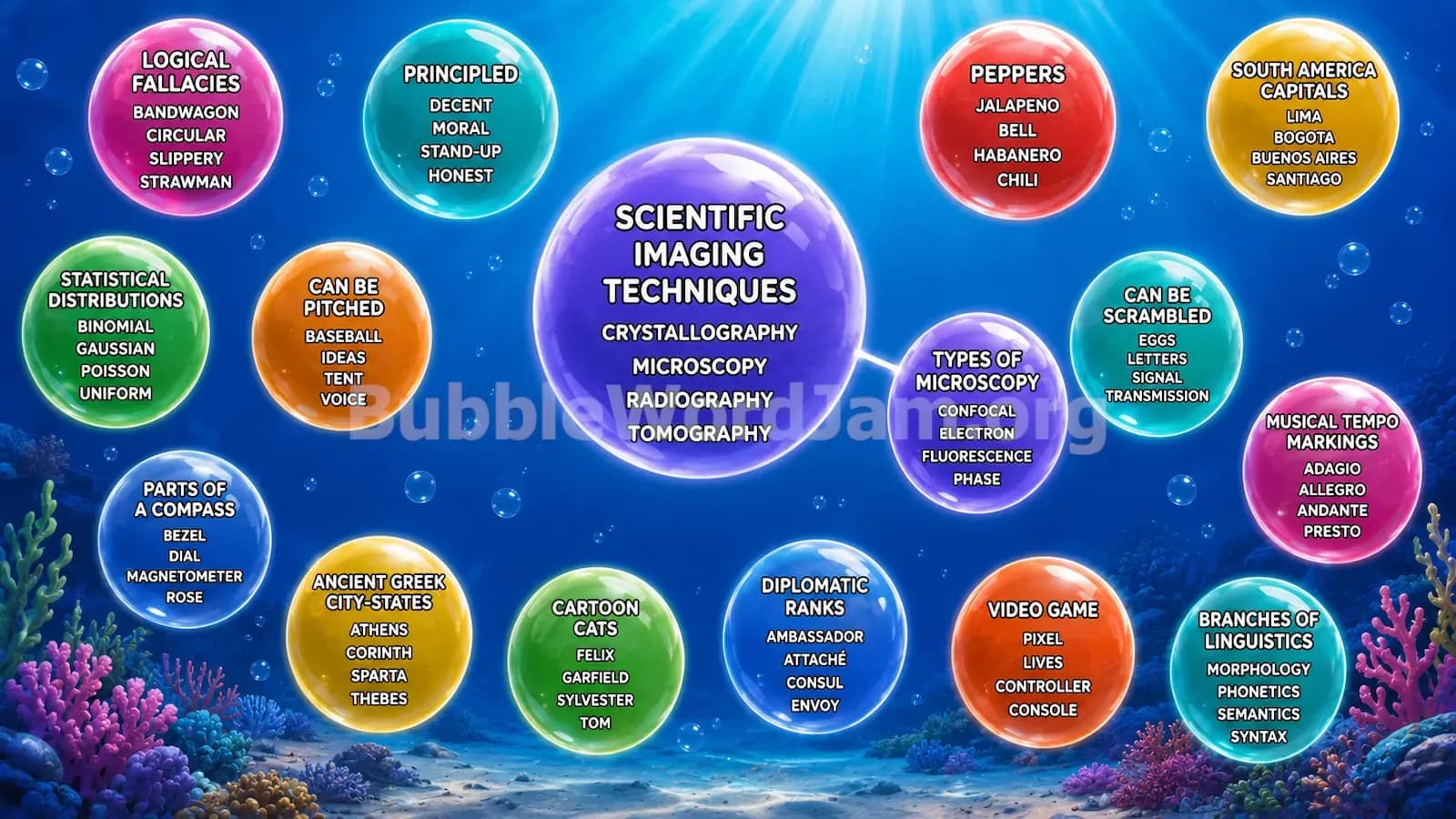
Level 440 pushes this even further. “Can be pitched” includes baseball, ideas, tent, voice. A baseball is pitched, ideas are pitched, a tent is pitched, and voice has pitch. Meanwhile, “can be scrambled” includes eggs, letters, signal, transmission. The category jumps between cooking, word puzzles, and communication. That’s the advanced Bubble Word Jam vibe: the board wants flexible thinking, not fast clicking.
When a Bubble Word Jam level feels messy, slow down and run a three-step scan.
First, identify the obvious fixed groups. Proper nouns, clear object sets, and technical terms usually have less wiggle room. In Level 440, South American capitals and statistical distributions are safer than “pitched” or “scrambled.” Clear those mental anchors first, even if you don’t merge them immediately.
Second, mark the flexible words. Anything common and short gets a warning label in your head: mint, roll, deal, fold, core, pitch, sharp, handle. These words should be the last to merge unless the category around them is unmistakable.
Third, test the category name before the merge. Don’t just ask, “Do these two words match?” Ask, “Could I name a clean category that includes all four?” If the category name sounds awkward, you probably don’t have the full set yet.
There’s no shame in using a hint when the board turns into a semantic swamp. Bubble Word Jam is built around limited moves, and some advanced groups are designed to hide in plain sight. But don’t waste a hint on the first confusing word. Use it after you’ve narrowed the board down to two or three possible interpretations.
The best hint target is a flexible word with multiple meanings. If “mint,” “fold,” “pitch,” or “roll” is blocking your progress, a hint can save the run. If you already know a category is obvious, solve it yourself and save the booster for the nasty stuff.
The biggest lesson from Bubble Word Jam’s abstract category levels is that words don’t have one fixed role. They shift depending on their neighbors. “Mint” can be a flavor or a coin facility. “Roll” can be food, movement, status, or phrase logic. “Fold” can be paper, laundry, poker, or business failure. “Pitch” can live in sports, sales, camping, or sound.
So the winning strategy is patience. Don’t chase the first connection. Don’t let one familiar meaning bully the board. Wait for context, hunt for the third word, and merge only when the whole category has a clean, crunchy logic. That’s how you beat the tricky Bubble Word Jam levels without turning a clever puzzle into a move-wasting mess.